Just before 9 p.m. on March 31, 2023, tiny Crawford County Airport (RSV) stood just like it always had since it was established as an auxiliary military airfield in 1943.
But minutes later, the 432-acre general aviation facility in southeastern Illinois literally ceased to exist.
A powerful tornado, rated EF-3 on the Enhanced Fujita scale of zero to five, barreled through the area and leveled the facilities at RSV. Two rows of airport-owned T hangars, two corporate hangars and a small office building that served as a lounge for pilots were reduced to twisted piles of rubble. In addition, 19 small airplanes and several airport vehicles were demolished.
| facts&figures
Projects: New Terminal & Hangars Location: Crawford County Airport, in Palestine, IL Catalyst: Tornado leveled previous facilities in 2023 Rebuilding Period: March 2023-Oct. 2024 New Terminal/Hangar Cost: $5.6 million Funding: FAA; IL Dept. of Transportation Size: 7,331 sq. ft. terminal, 2,550 sq. ft. hangar Amenities: 2-story, vaulted-roof concourse/atrium; pilot lounge; flight planning room; public lounge; offices; bathrooms; kitchenette; communications room; “hardened” storm shelter room Construction: Engineering Consultant: Hanson Professional Services Inc. Architect: General Contractor: K. Wohltman Construction Inc. Wall & Roof Panels: Dimensional Metals Inc. Key Benefit: Larger, more modern facilities New Hangars Type: 10 T hangars; box hangars for 10 aircraft; 1 corporate/maintenance hangar Cost: About $2.1 million Funding: Pre-engineered Hangars: On-Site Contractor: Construction: Sept. 2023- April 2024 for T & box hangars; April-July 2024 for stand-alone corporate hangar Benefits: Newer, significantly improved facilities; better aircraft traffic flow on apron |
“Everything was gone,” says Vicki May, a member of the Crawford County Airport Authority board of directors. “To see this airport, where we’ve spent so much time with friends, totally destroyed was pretty staggering.”
The Piper Warrior she and her husband had owned for 25 years was among the airplanes that were destroyed. “It was like a death in the family,” May recalls.
Although there was no official estimate, the storm easily caused millions of dollars in damage—a devastating loss for the small, close-knit town of Palestine, near the Indiana border. With about 200 operations per month, RSV provides a vital transportation link for businesses and medical facilities in the area and also serves as a social hub for local aviation enthusiasts, May explains.
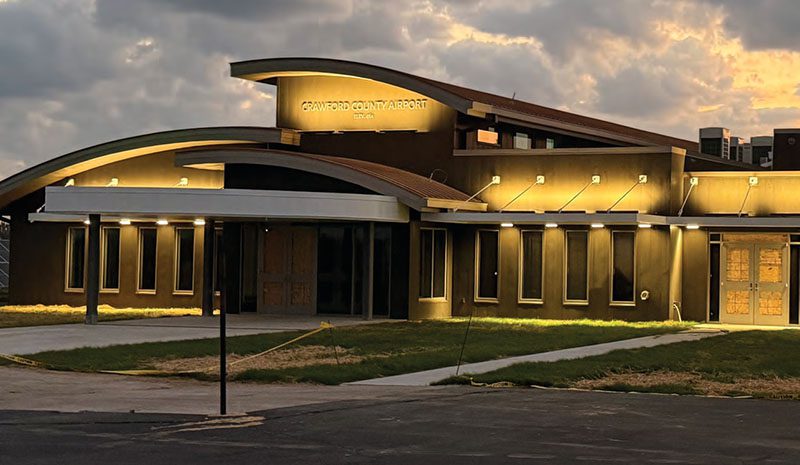
The airport resumed full function by the end of 2024, complete with an eye-catching $5.6 million terminal designed by White & Borgognoni Architects. And to top it all off, the Illinois Department of Transportation named RSV the state’s 2024 Small General Aviation Airport of the Year.
The story of how the small airport went from a debris-strewn airfield with only its two runways left intact to an award-winner just 20 months later is a testament to the power of resiliency, teamwork and community spirit.
Timing is Everything
There’s obviously no good time for a tornado to hit, especially a brute like the one that destroyed RSV and extensively damaged nearby communities. The destructive storm packed winds up to 165 miles per hour, traveled nearly 41 miles in 21 minutes and measured a little more than half a mile wide, according to the National Weather Service.
But the tornado’s timing was fortuitous in one respect: The FAA had recently announced $5 billion of funding available to airports nationwide for terminal improvements.
“While the tornado was devastating to the community, the federal funding opportunity emerged at just the right time and positioned us to rebuild efficiently and create long-term improvements for the airport and the community,” says Jeff Olson, aviation discipline manager at Hanson Professional Services Inc., the airport’s engineering firm for about 25 years. “A new terminal at RSV was a perfect application for those funds.”
Because everything at the airport was levelled, the project team could redesign facilities and improve convenience for pilots, Olson adds
“If there was one silver lining behind those buildings disappearing overnight, it was the opportunity to take a really fresh look at where buildings should go in order to improve on what was there before,” he explains. “We had a clean slate to build off of the existing aprons.”
May and other Airport Authority board members eventually saw the upside, too. “We weren’t in love with how the office, some of the hangars and the fuel tank were positioned,” she relates. “So since we had a blank slate, we decided to reconfigure things to make it easier for planes to get around the apron.”
But there was a catch: To qualify for the federal funding, RSV had to submit a revised Airport Layout Plan reflecting the new facility configurations. Hanson and Airport Authority members developed a new plan, aided by an $80,000 planning grant from the Illinois Department of Transportation.
The new layout included a row of nesting T hangars (10 in all) and a row of box hangars for 10 airplanes where two rows of T hangars once stood. A new corporate/maintenance hangar was added on the north side of the terminal apron. And the terminal, which is attached to another new hangar, was located about 100 feet away from the apron and further north. Moving the terminal from its previous location in the middle of the apron improves the flow of aircraft, Olson explains.
In addition, a fuel tank that was in an awkward location was moved to provide easier access for pilots.
Funding Win
After the new Airport Layout Plan was completed, the team worked feverishly to submit a funding application by October—a process that included obtaining environmental approvals and developing a conceptual terminal design to establish a cost estimate.
“We did it all in four months…approximately three times faster than it normally would take,” Olson recalls. “There were a lot of moving pieces; it was all very fast-paced.
“But we had the FAA district office in Chicago and state of Illinois in our corner,” he continues. “Both were very influential in getting our application prepared and cheerleading for Crawford County. We held weekly coordination meetings with them to make sure all the required reviews got done.”
Even so, the odds of receiving funding were against RSV because the program was primarily aimed at larger airports. But Olson knew the rural Illinois airport had a very compelling storyline.
“It really pulled at people’s heartstrings,” he says.
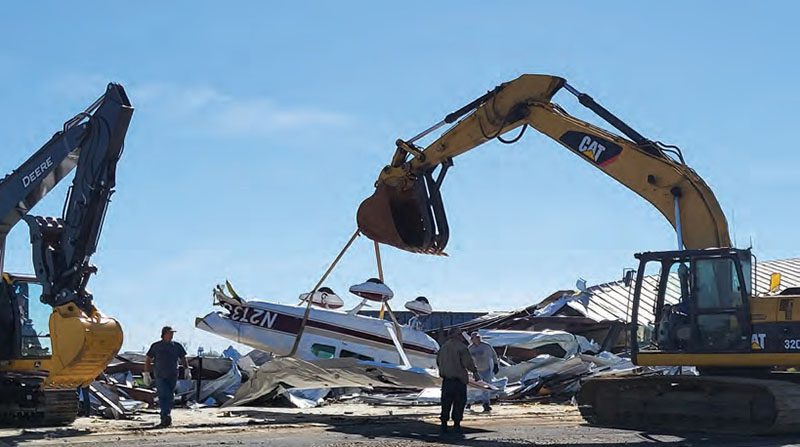
The tornado destroyed 19 airplanes as well as rows of hangars and the small office that previously served as a pilot lounge.
Olson’s instincts were correct, and the funding application was approved in October 2023. The airport received $3.8 million through the FAA’s Terminal Project Fund, with the remaining $1.8 million for the new terminal and an attached 2,550-square-foot hangar coming from the FAA Airport Improvement Program and the state of Illinois.
Step-by-Step Comeback
In the meantime, the Airport Authority, community volunteers and a contractor worked for several months clearing mounds of debris from the airfield. Large metal pieces were cut up and removed, trash was collected and put into dumpsters, and a local township used rubble from destroyed concrete blocks for riprap.
 “A lot of the material was recycled, so we felt pretty good about that,” May remarks.
The runways opened in about one week, but only for daytime operations because the airfield lights were still out. The airport also bought a small temporary building for pilots to use.
Step by step, RSV rebuilt its facilities and returned to business as usual. Electricity was restored after about three months, and airfield lighting was reestablished.
Rows of new T hangars and box hangars were finished in April 2024. The new corporate/maintenance hangar was completed in July 2024, which allowed fixed-base operations to resume. Construction of the terminal and attached hangar began in October 2024 and wrapped up in October 2025.
Every project, from construction of new hangars to the installation of a wind sock and beacon, was a celebrated milestone, May reflects.
Significant Upgrades
The “shining star” of the rebuilt airport, as Olson puts it, is the new terminal. The 7,331-square-foot facility represents a vast improvement over the previous terminal, which was a small concrete block building (also attached to a hangar), with basic offices, a small kitchen, a pilots’ lounge, bathrooms and a conference room.
The new terminal features graceful curved roof sections, including a dramatic vaulted barrel roof towering above a two-story concourse/atrium that runs through the middle of the building. Two rows of 10 clerestory windows—each window 5 feet long and 3 feet tall—are located high above on the north and south sides of the atrium and flood it with natural light.
 “We wanted to maximize natural light as much as we could,” says Nick Williams, the project’s lead architect. “Since it’s an aviation building, we basically wanted to connect it to the sky. All of that natural light creates a welcome and transparent environment that contrasts sharply with the solidity of the building’s metal envelope.”
Williams explains that he was drawn to a distinctive barrel-roof design because the curves introduce a sense of motion and lift, as well as evoke the aerodynamic profile of an aircraft wing.
The building features a structural steel frame covered with coated, rust-proof metal wall and roof panels made by Dimensional Metals Inc. The roof panels are 12 inches wide, 1 inch thick and vary in length from about 26 to 39 feet.
“The panels clip onto the frame and interlock with each other, so there are no exposed fasteners penetrating the protective panels,” Williams says.
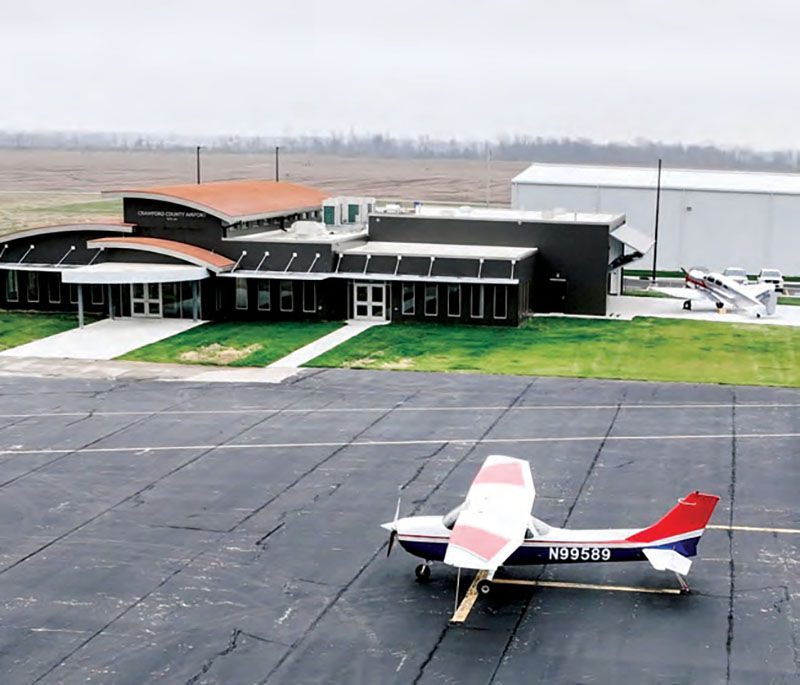
The new terminal has a barrel-roof design and metal panels to complement agricultural buildings in the area.
The vertical wall panels, which are 12 inches wide, 1 inch thick and up to 15 feet long also are secured to the building’s steel frame with concealed fasteners.
“The metal panels evoke a familiar agricultural feeling compatible with structures that dot the surrounding countryside, such as machine sheds and barns,” Williams shares. “They provide extra durability while maintaining a visual dialogue with the rural landscape around the airport.”
Public Access
The terminal offers many amenities, including a pilots’ lounge, a flight planning room, a lounge area for public use, offices, large bathrooms, a kitchenette, showers for pilots and a communications room. It also features a storage room that is “hardened” with a concrete ceiling and walls to provide shelter during severe weather.
 Including as much public access as possible was a chief design consideration, because federal funding only covered the cost of areas that are open 24 hours a day to the public. “So when we got into wants versus needs, we had to maximize eligibility for federal funding,” Olson explains. “We were able to make the building 86% eligible for federal funds, which is a pretty high benchmark. That’s a very good percentage, probably about 10 points higher than normal.”
The building also includes solar panels designed to generate enough electricity to supply all of the power the building will need.
Affordability, ease of maintenance and an aviation-themed aesthetic drove the interior design. For example, the main concourse floor was finished with dyed-and-polished concrete that requires very little maintenance, and the colors and patterns evoke clouds in the sky.
It Takes a Village
For Olson, rebuilding an airport—even a small one—in about 19 months was a notably gratifying, rewarding and unique project.
“It was a feel-good success story for everyone involved it,” he reflects. “It shows what can happen when everyone works together. We had such wonderful coordination and cooperation with all agencies from goal line to goal line.
“It was an incredible project to be a part of,” he continues. “The resiliency of the Airport Authority was amazing. They never blinked. We matched each other’s energy throughout the project, which is a large part of why it was successful.”
May expresses deep gratitude for support from the FAA, Illinois Department of Transportation and local community. “Everyone bent over backward to help us,” she says.
The Airport Authority board of directors, Crawford County Board and other local agencies also deserve a lot of credit, May adds. “I’ve been on a lot of boards and this is one of the best and hardest-working ones. We had a lot of debates, but it was always healthy debate.
“And Hanson did just a super job,” she remarks. “They worked diligently to pull everything together and get everything done in time to submit the grant.”
Nonetheless, while May is thrilled with the improved airport facilities, she still has mixed emotions when remembering what transpired that grim day in March 2023.
“We do have a wonderful new airport, but I think it’s up for debate whether it was worth what everyone had to go through,” she says. “People suffered tremendous losses.
“We all love the new airport,” May continues. “But it all took a tremendous personal toll on a lot of people—there was a lot of heartbreak. But at least in the end, something good came out of it.”