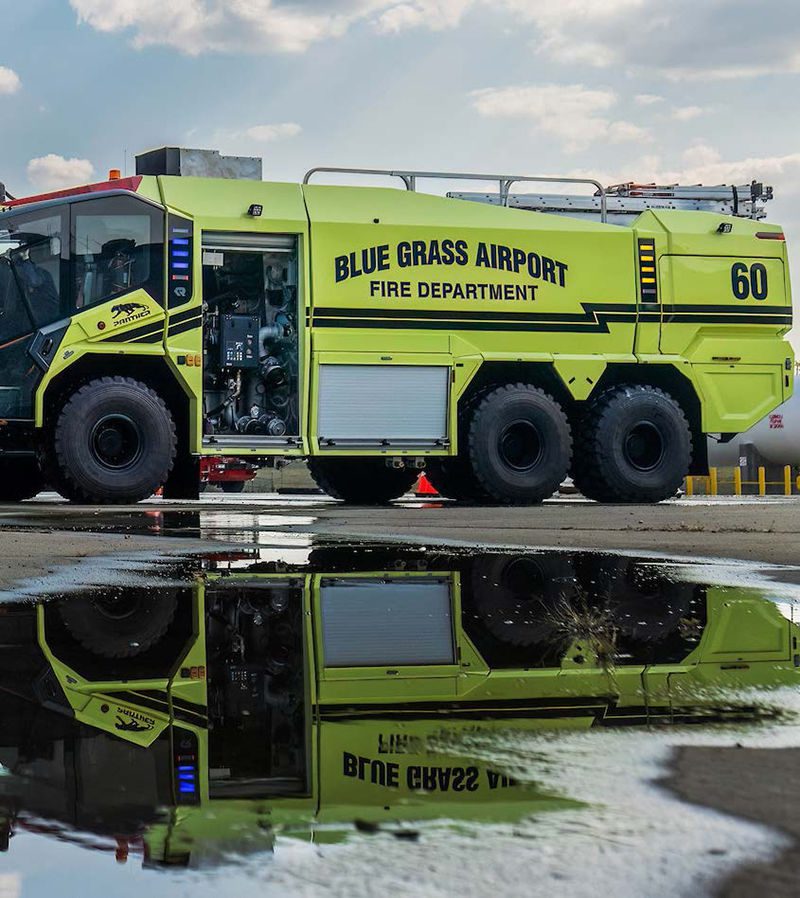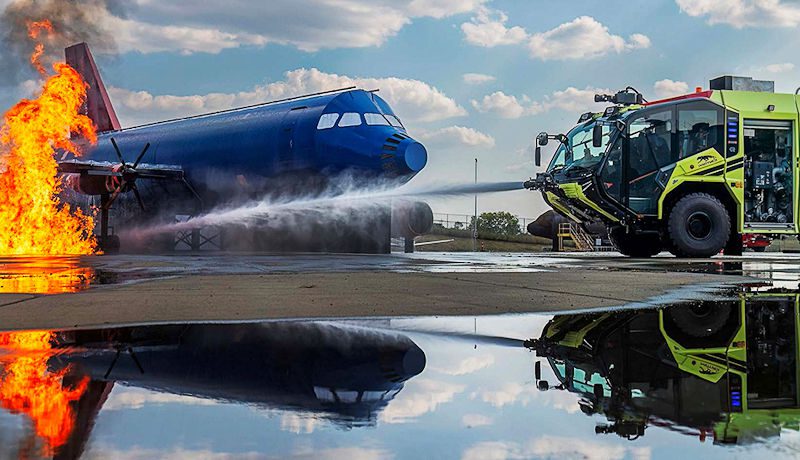
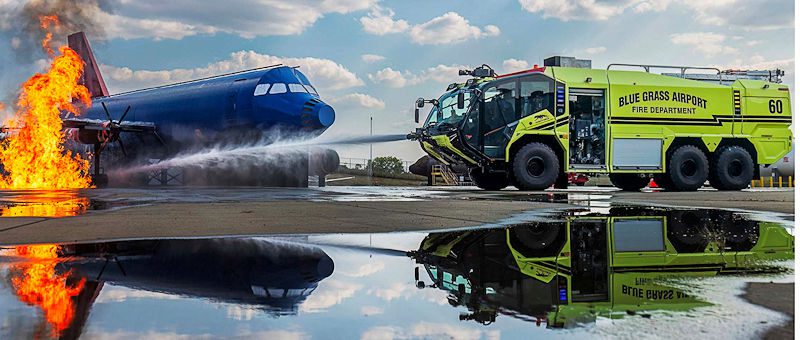
Last August, Blue Grass Airport (LEX) in Lexington, KY, unveiled its newly expanded and significantly upgraded Regional Aircraft Rescue and Firefighting (ARFF) Training Center. For many, the stars of the show were advanced simulators of a Blackhawk helicopter, Boeing 737 and Airbus A320.
One of only 12 airport-operated training facilities in the United States, the center at LEX began offering basic and advanced ARFF training in 1997. “Since then, we’ve been serving airports all over the country and even internationally,” says Tyler Miller, the center’s chief operating officer. “We’ve become known for offering that consistent training, and our attendance has steadily increased. Because of that growth, we needed to expand our footprint.”
The airport partners with FAA to refine and deliver training curriculums that meet the federal agency’s requirements. Each year, the Blue Grass Regional ARFF Training Center hosts more than 1,000 firefighters representing more than 125 public safety departments from more than 30 states and several Canadian provinces, as well as LEX’s own fire department.
Growing Prominence
The recent $4.8 million update and expansion helps the center at LEX meet a growing demand for training, including basic certifications, recertifications and custom-designed courses.
 facts&figures facts&figures
Project: Expansion & Upgrade of Regional Aircraft Rescue & Firefighting (ARFF) Training Center Owner: Blue Grass Airport, in Lexington, KY Key Benefits: More advanced, realistic training for ARFF crews Project Budget: $4.8 million for facility construction/expansion; $9 million for new simulators Funding: Airport Improvement Program grant; FAA discretionary funding Timeline: Planning began in 2022; new simulators came online in 2024; facility construction began 2023; grand opening Aug. 2025 New Training Technology: B737/A320 Live Fire Training Simulator; UH-60 Blackhawk Simulator, both from Alpine Metal Tech Facility Expansion: 4,200 sq. ft. Prime Contractor: Construction: Electrical: Elliot Electric Earthwork: LagCo HVAC & Plumbing: |
“The need has been apparent for quite some time as we’ve continued to grow and received feedback from our students that we are one of the preferred training centers,” Miller says. As aviation has advanced, so have best practices and technology for ARFF training. And, as the center’s training catalog grew, so did the need for more classrooms, support areas, equipment and lockers.
Planning for the comprehensive renovation and expansion began in 2022, with Alpine Metal Tech North America and Whiting-Turner Contracting Company selected to lead the design/build project. “It did take a couple of funding cycles for us to be able to fit into the overall Airport Improvement Program,” Miller notes. But the facility received federal funding, which he sees as a nod to the importance and industry impact of the project.
The 4,200-square-foot expansion doubled the size of the previous facility. A new classroom can accommodate double the number of trainees—up to 30—and features advanced technology in an updated, more comfortable space. Existing classrooms and training areas were also upgraded and modernized.
Key features include dedicated areas for equipment and fire gear storage, an apparatus bay (that will soon house a Rosenbauer training fire truck), an area for training with personal protective equipment, and a gear cleaning/washroom.
The size, layout and amenities allow for the introduction of best practices and new technologies that weren’t available when the facility was originally constructed.
Now, the center is better equipped to provide a practical approach to learning with the latest technology, resources and knowledgeable instructors, says Miller. “It’s really bringing the classroom from 1995 to 2025,” he remarks. “It’s what you would see in a typical college classroom and what students have come to expect in a classroom today.” Miller says the new environment is less of a firehouse atmosphere and more conducive to focus and learning.
Courses are led by dedicated staff, including Fire Chief Brian Wainscott and ARFF Training Instructor Scott May, who both joined the faculty in 2020.
Advanced Simulators
To further enhance and expand its capabilities, the center added two new training simulators—one of a Blackhawk helicopter and another that can portray two different popular narrow-body airliners. After LEX determined its requirements for the simulators, manufacturing took about 12 months, followed by four months for installation and commissioning.
Alpine Metal Tech North America manufactured and oversaw construction and installation of the AMT Simulation B737/A320 Live Fire Training Simulator, which is designed to enhance the realism and depth of training and provide students more comprehensive experience handling emergency situations with Boeing 737s and Airbus A320s.
 Older simulators are not as sophisticated and lack the training possibilities that this model provides, explains Mitch Joseph, technical director for Alpine Metal Tech. “Essentially, they were a shell of an aircraft inside a big burn pit that simulated fuel spills,” he explains. In contrast, the company’s current unit is a multipurpose simulator that not only simulates fuel spills, but can also create more than two dozen different fire scenarios for training ARFF crews.
“Obviously, over the past 20 years, simulator technology has changed and it has become much safer,” Joseph says. “That is our utmost concern—that we provide a training facility that is, first of all, as safe as possible, but also provides realistic training scenarios.”
Miller calls the B737/A320 simulator his “pride and joy,” adding that LEX can now provide training for crews from Index E airports, which handle large aircraft and require greater ARFF resources. The new simulator at LEX is 98.4 feet long with a wingspan of 63.6 feet. The cockpit area includes a flight control console and pilot and co-pilot seats. There are also passenger compartments and interchangeable wings to replicate a Boeing 737 or Airbus A320. Perhaps most notably, the simulator provides 28 different live fire training scenarios inside and outside the aircraft model, and also includes advanced environmental and flame monitoring systems and evacuation systems.

A new, larger classroom features upgraded technology.
The center’s other new unit is a 30-foot UH-60 Blackhawk simulator, also from Alpine Metal Tech. It helps trainers prepare ARFF crews for the specialized rescues that helicopter accidents can require due to the unique aircraft design and construction.
Facility Upgrades
Renovations to accommodate the advanced simulators began in 2023, with construction scheduled to reduce impact on day-to-day operations. That was a tricky feat because crews had to demobilize the existing simulator before replacing it. “We had to go dark as a training center for a while,” says Miller of the roughly six-month hiatus.
Demolition of the previous simulator proved more challenging than anticipated due to unforeseen underground conditions that required additional site prep. “There was quite a bit of rock that the contractor had to deal with, which led to unusable soil and the need to backfill,” Joseph explains.
After the new simulators were online in 2024, contractors accelerated their work renovating and expanding the building. During this six-month period, classroom instruction was conducted in a conference room at the airport fire station.
 For Miller, the project’s unexpected challenges and extra adjustments were worth it. “The updates and expansion have really solidified our role and made us even more relevant and valuable to the industry,” he remarks.
Serving the Industry
The Blue Grass Regional ARFF Training Center is a separate business entity that operates independently from the airport’s fire department. “From an executive mindset, I think this is a very good example of our airport identifying one of our differentiators and then investing in it and maximizing our opportunities,” says Miller.
Although the newly expanded and upgraded training center is expected to attract more non-aeronautical revenue, Miller stresses that isn’t the primary focus for LEX. “If we don’t make a lot of money off of the training center itself, we recognize the value that it has in the airport industry and how our role is to serve aviation as a whole,” he explains.
“I’m really proud of the facility that we’ve introduced, and we’re proud that the training center is self-sustaining,” Miller elaborates. “I think it’s a great example of our airport team prioritizing a project that a lot of the Lexington public will not see on an everyday basis. This truly is a project of service to the industry.”