In September 2025, Charlotte Douglas International Airport (CLT) celebrated the completion of its Terminal Lobby Expansion, a $608 million project designed to accommodate growing passenger demand and, at the same time, improve security, circulation and the overall customer experience.
“The Terminal Lobby Expansion is a transformational milestone for CLT,” says Chief Executive Haley Gentry. “This monumental effort represents years of planning, construction and commitment to improving the passenger experience…The result is a modern, spacious lobby that reflects the dynamic growth of our region and positions us for the future.”
The Terminal Lobby Expansion is one piece of the North Carolina airport’s $4 billion capital investment program, Destination CLT. It also includes concourse renovations, the expansion of concourses A and E, The Plaza Concessions Hub and a new fourth parallel runway.
| facts&figures
Project: Terminal Lobby Expansion & Renovation Location: Charlotte Douglas Int’l Airport, in NC Scope: 175,000 sq. ft. of new space, 191,000 sq. ft. of renovated space Key Components: 3 larger, more efficient TSA checkpoints; overhead & underground walkways between terminal & parking; 146,000 sq. ft. curbside glass canopy; 8 high-capacity baggage claim carousels; new escalators & elevators; central courtyard with seating, concessions and 11 major art installations, including Queen Charlotte statue; new central utility plant Budget: $608 million Funding: Passenger facility charges; customer facility charges; general airport revenue bonds; airport cash Construction: Dec. 2019-Sept. 2025 Architects: Gresham Smith; K2M Design Construction Manager at Risk: Holder-Edison Foard-Leeper, a joint venture Program Manager: TY Lin Int’l Civil Engineering: Talbert, Bright & Ellington Structural Engineering: Laurene, Rickher & Sorrell, A division of Britt, Peters & Associates Mechanical, Electrical & Plumbing Engineering: NV5; AME Consulting Engineers Special Systems Design & Engineering: Arora Engineers LLC Baggage Handling System Engineering: BNP Associates |
Planning for the project began in 2008, with construction kicking off in 2019.
The original terminal was built in 1982 and designed to accommodate approximately 2.8 million passengers per year. Passenger growth and changes to processing and security procedures, as well as normal wear and tear, left the facility constricted and outdated. In total, the recently completed expansion project increases the main terminal by 175,000 square feet and renovated another 191,000.
Key components include:
- five security checkpoints consolidated into three larger areas with 21 lanes, including 11 Automated Screening Lanes designed to process 600 more passengers per hour;
- eight new high-capacity baggage claim carousels;
- new escalators and elevators to improve vertical circulation between ticketing and baggage claim levels;
- a central meeter/greeter courtyard with seating, concessions and 11 major art installations, including an iconic Queen Charlotte statue;
- overhead and underground walkways connecting the terminal and parking facilities;
- a new central energy plant designed with future capacity in mind;
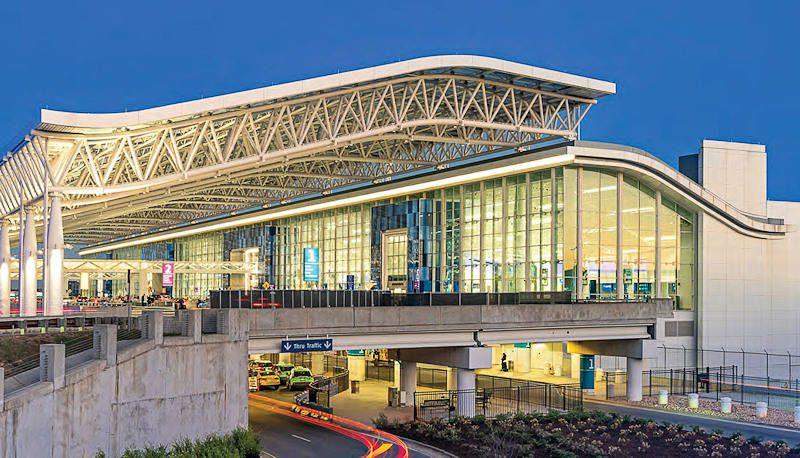
- 146,000-square-foot glass canopy to shield passengers curbside;
- increased circulation space in the main lobby; and
- a basement level primarily for mechanical, electrical and plumbing components.
When Airport Improvement first covered the Terminal Lobby Expansion project in our January/February 2023 edition, CLT was readying for what officials anticipated would be the most invasive portion of the project—renovating existing terminal spaces. In comparison, Chief Infrastructure Officer Jack Christine says the recently completed new construction wasn’t easy, but it was a little more “controlled.” For instance, customers walking through the area were largely unaware of the project thanks to connectors built through the construction zone. The renovation phases, which involved moving ticket counters, relocating security screening checkpoints and rebuilding baggage claim, were more impactful. “Once we got into the renovation phases, we were pretty much in everybody’s business,” jokes Christine.
To further complicate this more invasive portion of project, passenger growth at CLT did not take a pause. Traffic at the North Carolina airport rebounded quickly and “faster than expected” following the COVID-19 pandemic, Christine says, bringing passenger volumes not forecasted until closer to 2030. In fact, American Airlines added 100 flights at CLT in 2024 alone. “That was to support the hub, but actually also added a lot of demand to the local traffic as well,” he explains. “The whole airport facility was heavily burdened in the summer of ’24 with the number of passengers we had moving through the facility.”
American has since rolled back some of that capacity, but CLT is still seeing high passenger numbers—about 3% over 2023. “That’s about where we ought to be,” Christine comments.
Coping Mechanisms
Christine reports that despite the volume-related strains, the entire team for the lobby expansion project—from the contractor and designers to the airport and its tenants—came together and did a really fantastic job trying to manage the chaos. “It was challenging,” he adds.
Especially challenging, was the phase that removed the former B Checkpoint to construct what is now known as Checkpoint 1. “That was the one point in the project where we lost a significant amount of capacity for the checkpoints,” he recalls. On top of that, this phase occurred over the busy summer months. “We worked closely with TSA, airlines and our Terminal Ops team to come up with mitigation strategies to make sure we had an adequate customer experience.”
The effort to manage wait times relied heavily on adding resources, including additional bomb-sniffing dogs for screening. Another key strategy was ensuring that checkpoints were fully staffed during peak times and the airlines had additional staff to assist customers with ticketing. “Our Terminal Ops team did a great job of managing the crowds and keeping everybody moving when it got really busy,” Christine says, noting that CLT never had reportable wait times of more than 40 minutes at the checkpoints. “[That] was really one of the key indicators for us as to whether we were successful or not.”
 Maintaining uninterrupted technology services throughout construction and renovations was critical, and the design team included Arora Engineers to develop the integrated special systems design for the project’s security, operational and telecom elements. Examples include access control, passenger processing systems, security checkpoint design, and Electronic Video Information Display Systems, among others. The firm orchestrated phased, temporary and permanent system solutions to help CLT achieve its modernization goals without compromising day-to-day airport performance, notes Vice President, Special Systems Practice Lead Heath Kolman, P.E., RCDD. Close coordination with Gresham Smith, other design disciplines and stakeholders supported by detailed phasing strategies and ongoing technical coordination was instrumental in ensuring success, he adds.
Phasing was a balancing act between the project schedule and passenger experience, agrees Tim Beecken, senior aviation architect with Gresham Smith. Determining how much space could be taken over for active construction without disrupting flow through the terminal was like trying to thread a needle. “Passenger experience and their ability to comfortably navigate the space was always at the forefront of planning, scheduling and construction,” he adds.
Ben Goebel, a Gresham Smith principal, praises the project team for doing a good job solving problems and delivering on the intent of the design, but also taking a step back and considering how guests were moving through the facility while it was being built.
Naturally, the project team encountered some unexpected challenges. For instance, during demolition phases, there were rain leaders coming down into the center of the space where security equipment would be located. “That just wasn’t going to work,” Beecken quips. “It was a little extra work, but we were able to reroute them.”
Flexibility for the Future
Because of the project’s long horizon—planning/design, enabling work and more than five years of construction—CLT was especially conscious of “future-proofing” the design as much as possible. From how the facility was laid out to changes in ticketing and screening areas, the project is designed to accommodate ongoing developments in passenger processing. “We were trying to be a little generous with the space, knowing that the technology was going to continue to evolve,” Christine says. “And it didn’t necessarily mean that the technology was going to get smaller.”
 In addition to increasing the size of screening checkpoints to match passenger volume, designers made the ticketing area more flexible, with room for staffed check-in stations as well as self-check kiosks and baggage drops. Behind (and under) the scenes, space is roughed-in for when and if CLT airlines shift their passenger processing. “We tried to be forward-thinking as best we could and maintain a budget,” Christine says.
Art and Aesthetics
The crowning design element in the newly expanded and renovated terminal lobby is a 3,000-pound bronze sculpture of the city’s namesake, Queen Charlotte, wife of England’s King George III. Back in 1763, English settlers in the area named their county seat after Queen Charlotte. Today, a 15-foot-tall statue of her likeness mounted on a 30-foot pedestal creates the first and last impression for travelers at CLT.
The overall aesthetic for the recently completed terminal project takes cues from the city of Charlotte and larger mid-Piedmont Carolina region. The lobby blends open, modern design with the history of Charlotte. Architectural details include scalloped ceilings that echo the Piedmont hills, a gold ribbon paying homage to the area’s gold rush history, and an oculus skylight that symbolizes Queen Charlotte’s crown and fills the space with natural light. Doorframe gingham patterns reference the city’s textile industry, while shades of blue honor local sports teams.

The central courtyard includes new seating and a statue of Queen Charlotte that was relocated from elsewhere at the airport.
In partnership with the Arts and Science Council, eight artists were selected to create pieces for locations throughout Terminal 1, including subterranean walkways, arrival areas for international and domestic passengers, on the mezzanine and in select elevator areas.
The wide range of work includes sculptures, murals and terrazzo flooring.
Communicate and Celebrate
Given the length and complexity of the Terminal Lobby Expansion, CLT executed a concerted public information and marketing campaign to help keep guests and local residents engaged and “give them a little bit of hope that we were making progress,” Christine explains. “We were very intentional about celebrating milestones and trying to prepare the customer for what was coming.”
This became easier as the project progressed and new sections of the building opened, particularly Checkpoint 1. “That was a big one for us because that really gave us the footprint for what the checkpoints were going to look like in the main lobby area,” Christine recalls.
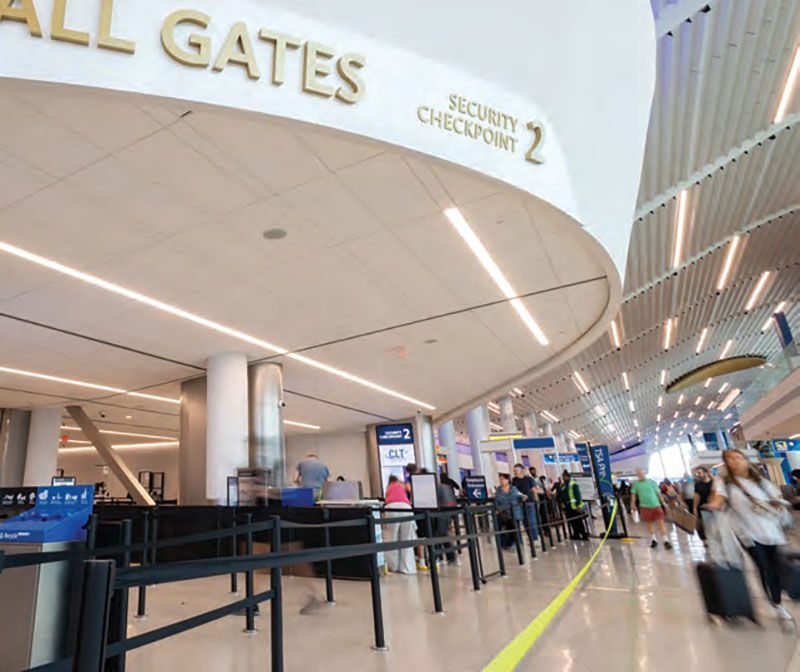
Five security checkpoints were consolidated into three larger areas to improve passenger flow.
“We renovated the airport’s living room—their front door, really,” Beecken remarks. “In doing so, it comes with some pains, but we embraced them.”
For instance, temporary partitions were dressed up with seasonal decorations during the holidays and regional imagery other times of the year. Signage was kept current and clear, he adds.
 Goebel notes that designers dedicated a lot of time providing accurate and appropriate signage to ensure safe pathways and flow—especially during the COVID pandemic. “Having that project team culture of focusing on the passenger first enabled us to weather that storm,” he adds.
Leveraging social media and posting staff in the terminal to direct customers and answer questions were keys to the public information campaign. “It took a lot of effort to be deliberate about our communication and marketing strategies,” Christine notes.
Celebrating the milestones was impactful and inspiring to the project team as well as the general public. “Jack [Christine] and the airport were great about telling the project team that it’s OK to take a step back and appreciate just how transformative this has been,” says Beecken. “That was a big differentiator for the project team to maintain the enthusiasm, the passion.”

One particularly important milestone for CLT and its project team was receiving two Green Globe awards from the Green Building Initiative, which focuses on environmental sustainability, resilience and health and wellness. Beecken attributes the achievement to the efficient building envelope, materials selection, high-efficiency lighting and new central energy plant.
Phased Activation, Continuous Improvement
The airport’s internal activation team was aligned with the project manager from the very beginning of the Terminal Lobby Expansion and used experience from previous projects to develop and execute a successful activation in multiple segments during September 2025.
“Our activation team did a fantastic job minimizing disruption as we made transitions from old into new space,” says Christine. “They worked with the tenants, contractors and Operations team to make sure that as we were opening up segments of the building we had everything aligned as to what the resources needed to be for the tenants to be able to use the space.”
Having a solid execution plan was critical, but so was remaining flexible, nimble and “ready to change the plan at a moment’s notice,” he adds. “Having the plan was indispensable, but we had to know and realize that operational or construction challenges were going to augment that plan.”

A glass canopy and walkways connecting the terminal and parking facilities are major upgrades for guests.
Completing the Terminal Lobby Expansion isn’t the end for CLT. The airport is already in the middle of renovating Concourse D, with completion slated later this year. In addition, Concourse E renovations and airfield work that adds another parallel runway and associated taxiways are currently under construction and slated for completion in 2027. “We don’t take a breath here, we just keep on rolling,” Christine remarks.
“Everything is capacity-driven,” he adds. “Right now, we are on a good, steady growth path for the foreseeable future.”