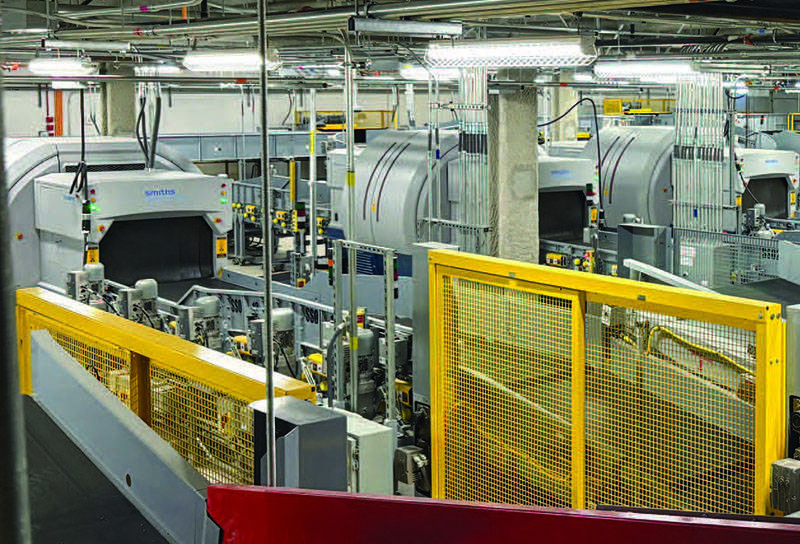
For many industry-watchers, the most impressive aspect of the new $95 million baggage handling system at San Diego International Airport (SAN) isn’t the technology or massive scope of the project. It’s the collaboration, transparency and strategic timing used to get the project to the finish line on time and under budget for the debut of the overall Terminal 1 renovation in September 2025.
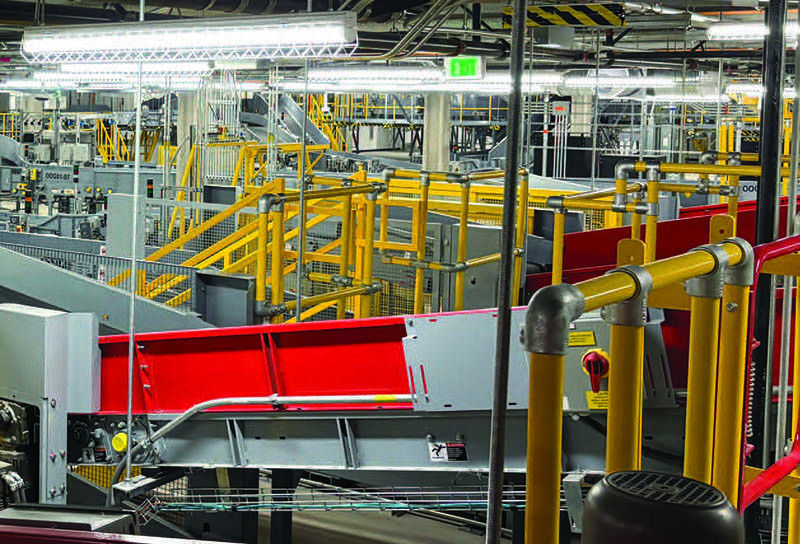
 Engineered by Introba and Vanderlande Industries Inc. in a collaborative Design-Assist arrangement, the new handling system includes conveyance for a Smart Curb check-in facility, main terminal ticketing, a baggage tunnel, six outbound makeup units, two transfer lines, nine inbound claim devices, and a Checked Baggage Inspection System equipped with seven explosives detection machines and a full Checked Baggage Resolution Area. Turner Construction, the construction contractor, and Introba were engaged early to support design-build integration.
Joshua Spoon from AECOM, who served as terminal building systems project manager on SAN’s Airport Design and Construction team, says the goal was to deliver a highly efficient, TSA-compliant system with in-line screening, radio frequency identification bag tracking and built-in redundancy for resilience. But the limited footprint of the terminal required a creative solution. “SAN is a compact airport that maximizes its space, and this project introduced a completely new design approach,” he says. Building a below-grade level for the system enabled efficient curb-to-plane operations and long-term flexibility.
| facts&figures
Project: Baggage Handling System Upgrades Location: San Diego Int’l Airport Terminal: 1 Project Scope: Install new TSA-compliant Approx. Cost: $95 million Funding: Airport Authority bonds; passenger facility charges; TSA reimbursement through an Other Transaction Agreement Completion Schedule: Phase 1, June 2025; Construction: Turner Construction System Design: Introba System Mechanicals: Vanderlande Industries System Controls: Brock Solutions Architecture: Gensler Program Management: AECOM; ABMC Key Components: In-line screening; RFID bag tracking; built-in redundancy for resilience; connects to Smart Curb check-in facility & main terminal ticketing; baggage tunnel; 6 outbound makeup units; 2 transfer lines; 9 inbound claim devices; Checked Baggage Inspection System equipped with seven explosives detection machines; full Checked Baggage Resolution Area |
The benefits to passengers and operations are significant, Spoon says. Travelers will see a smoother curb-to-checkpoint experience thanks to faster automated sortation and more advanced screening lanes. The system also ensures fully automated delivery of baggage to and from airlines, minimizing delays and missed flights by rerouting bags around problem areas when issues arise.
Enhanced security compliance and operational efficiency are key benefits, as demonstrated by the 99.7% tracking accuracy the system achieved during its TSA Integrated System Acceptance Test. Built-in adaptability and redundancy further stabilize operations, even during peak demand. Just as importantly, the design anticipates growth. Additional space for future claim devices, X-ray machines and expanded TSA capacity was included from the outset. As Spoon puts it, “This forward-thinking approach ensures the airport can meet increasing passenger volumes with minimal impact.”
But seeing the project through had as many twists and turns as the nearly four miles of conveyor belts within the baggage handling system itself.
Overcoming Sticker Shock
Project Lead Mike Kessler, special systems senior manager for Turner Construction, recalls that members of his team knew early on that the job at SAN would be one of the largest baggage-handling projects they had undertaken in years, and they would need reliable numbers before moving forward.
But getting those numbers the usual way wasn’t going to cut it.
“Traditionally, baggage companies don’t like to give ROMs [rough order of magnitude figures],” Kessler explains. Still, Turner needed an early cost picture. So, in January 2021, as design work was getting underway with Introba, the team reached out to four major companies capable of handling a baggage handling system project of this size, including Vanderlande Industries.
Kessler provided them all with the same stripped-down equipment spreadsheet of specifications: no “special sauce,” no proprietary tweaks—just a price for exactly what was in front of them. The goal was clarity, not competition.
The responses were a shock. Kessler says his “pre-COVID brain” was thinking the project would come in around $105 million. Greg Wheeler, senior project manager with Introba at the time, had warned that supply-chain impacts were pushing costs higher, and he was right. All four companies returned estimates of $140 million.
The team now had a problem—and a decision to make. Turner leadership had asked Kessler whether it was possible to pull 10% out of the cost. But he and Wheeler knew they’d need a fundamentally different approach to find $14 million in reductions.
Instead of waiting to issue a traditional request for proposals, they chose to open up the estimating process, keeping all four industry players engaged as the design evolved and treating them as collaborators rather than future bidders.
What followed was an effort that spanned months and included an on-site Industry Day for each baggage handling system contractor. As the process continued, the project’s collaborative tone deepened. Instead of basic information sessions, the events became a forum for real dialogue, with engineering teams from each candidate working side-by-side with Introba’s designers as the plans matured. Importantly, critical questions about access, sequencing, staging and operational realities surfaced early.
 Jonah Thompson, senior account executive with Vanderlande Industries, put in months of work on initial estimates and the company’s final response to the eventual request for proposals. During the Industry Day for Vanderlande, he remembers asking, “Have you thought about laydown space? Will there be a spot for our team to embed with you? What are the rules of the road for doing work there?” These are not small questions. They influence cost, risk, safety and schedule; and getting answers to them eliminated many potential issues before drawings were even completed.
In retrospect, Kessler says there was significant value in involving the baggage handling system contractors when their expertise could still have the most impact. By the time the official request for proposals went out in September—about nine months after the first conversations—requests for more information were minimal and the scope was aligned. Armed with ample information about the project, one of the original four bidders bowed out, and the others were able to provide realistic, more finely tuned proposals.
 The results spoke for themselves. On the final bid, all three remaining contractors were aligned at $95 million, which was $10 million under budget. “We attribute that to all the discussions and making sure that everybody understood the project scope as best as they possibly could,” Kessler relates.
He says all of the bidders were strong candidates when the final interviews began, and Vanderlande ultimately secured the contract due to the depth, preparation and detailed phasing work in its final presentation. Proposing Brock Solutions for the system controls strengthened its appeal, he adds.
The $95 million bid was $85 million base plus $10 million in add alternates that Turner and Introba identified as potential “need to have” items they wanted to give SAN the option of including.
The Value of Advance Notice
As the winning candidate, Vanderlande benefited from the intelligence it gathered during the longer-than-usual estimating process. “A lot of times, these bids come out of nowhere,” Thompson remarks. That makes it incredibly difficult for firms to assemble the estimating, engineering and operational expertise required to produce a responsible bid—much less assemble the right team to execute it should they win.
“There are a lot of resources required to put a proper bid together, but also to be ready to hand it over to a project execution team,” Thompson explains. “If the request is coming out of nowhere, then even if I can find a way to put a price to it, who am I handing it off to?”
 Knowing the SAN project was on the horizon and what it would entail allowed Vanderlande to prepare more effectively. “Because this was a known entity for so long, it gave us the ability to plan and bring in quite a few of the people from our Operations side,” says Doug Alewelt, Vanderlande’s executive project manager. “We really got a head start on the project before we even knew it was our project to work on.”
That early clarity built trust, reduced redesigns and created an environment where problems could be solved early.
Introba was more than half finished with the design when Vanderlande was brought in. But unlike a traditional handoff, this was an overlapping transition—two organizations working in parallel toward the same finish line.
“We really got involved right after the 60%,” Alewelt says. “That was a good point for us to come in and provide another set of eyes to make sure nothing was overlooked.” Only minor adjustments followed. “For the most part, I think we stayed pretty darn close to the original design.”
That vision—continuity instead of a full handoff—set the tone for the work that followed. When Vanderlande and Brock were fully engaged, the construction and installation phases included the same overlap.
The team members agree that what stood out most was what didn’t happen. No turf battles. No drama. No silos.
 For Wheeler, the significance of the transition was cultural as much as procedural. “With a lot of these contracts, issues are thrown over the wall, ‘Here you go.’ Then it’s back and forth 50 times,” he says. “I don’t think we had any of that. When we had any problems or issues, we worked them out. We didn’t throw things over the wall. This team tore the walls down.”
Noteworthy Teamwork
From the beginning, the project team—Introba, Turner, Vanderlande, Brock and the airport—established and embraced an unusually open, candid approach. Dan Vandevenne, business unit leader at Brock Solutions, describes it as everybody sitting on the same side of the table. That spirit made all the difference on a project of this size and complexity, he adds.
Even when challenges popped up—like a potential delay of drive deliveries—the team solved them quickly and collectively. “There was no showing up at meetings and pointing fingers at each other on this project,” Vandevenne says. “For as big and as complicated as this project was, there were just open, transparent conversations, evaluating different options.”
Integrating the baggage system into a dense structural and electrical environment was one of the project’s biggest challenges, Spoon says. As a result, contractors relied heavily on 3D building information modeling coordination, clash detection and joint field reviews to promptly resolve constraints.
“In-person field walks with the Airport Authority, contractor and designers during installation were critical for spotting potential problems,” Spoon says. “It’s critical to step away from the desk and walk the job site,” he emphasizes, adding that this allowed teams to catch issues early and solve them quickly.
When problems surfaced, teams collaborated in real time to clear baggage-handling zones and keep installation on track—an approach that helped prevent delays and overruns.
Staying on schedule required disciplined coordination and constant transparency, Spoon notes. Bi-weekly team meetings helped keep stakeholders aligned, while commissioning dashboards helped the team track installation in real time and identify conflicts in advance.
To tackle the enormous task of commissioning and testing a system with nearly four miles of conveyor, the team broke the job into manageable pieces by setting detailed daily and weekly production targets. “How do you eat an elephant? One bite at a time,” Spoon quips.
Lofty Goals, Strong Performance
The team’s overall approach eventually coalesced into a simple, shared mantra: Zero punch list. Zero change orders.
The idea wasn’t perfection for its own sake. It was about being so aligned across design, installation and commissioning that no change orders would be required due to scope errors.
 For Jaime Ontiveros, Introba’s manager of field operations who spent long days walking the site, the collaboration was more than a mantra—it was lived reality. Whenever he needed access to a section of the system, the teams responded immediately, whether that was Vanderlande helping with electricians and millwrights, or Brock lending its controls engineers to assist with troubleshooting. Punch list items moved fast. Many were resolved on the spot; others within a mere week.
“I think the only challenge I had was what to eat for lunch that day,” Ontiveros jokes.
But in all seriousness, his most important role was staying ahead of other trades—spotting potential conflicts before they slowed installation. That led to one of the most impressive parts of the project.
In the end, the team came remarkably close to its goals. The few change orders that did appear were driven by outside factors, not the baggage-handling system.
“I’d say probably 85% of the obstructions that I found were actually part of the building mechanical, electrical and plumbing, or just another trade trying to get a shortcut across the conveyor,” Ontiveros reports.
Wheeler emphasizes how extraordinary that figure is. “Eighty-five percent of the issues we had were non-baggage related! On an almost $100 million job, a 15% error rate is exemplary.” He credits the craftsmanship of the Brock and Vanderlande teams, as well as Ontiveros’ vigilance in the field, for the impressive execution of Introba’s design. “That really was a huge team effort.”
The collaborative groundwork and culture paid off in spades during one of the most important project milestones: full-system sortation testing. “We processed 800 bags with near-perfect accuracy—a critical achievement during TSA certification,” Spoon says.
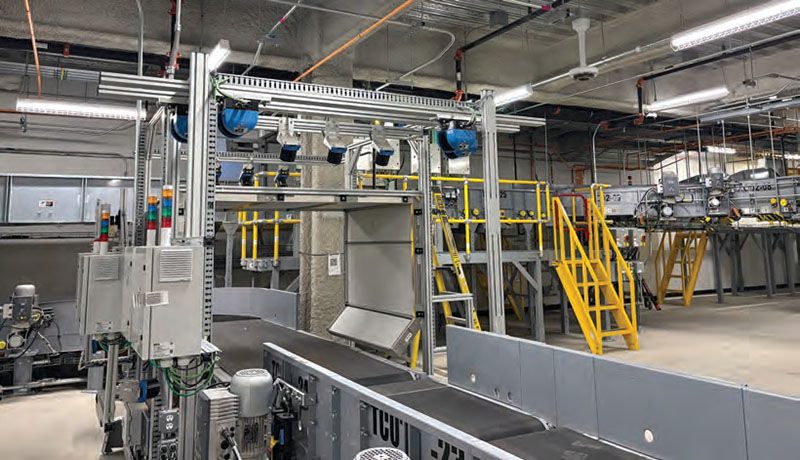
Equipment from SICK reads bar codes and validates the dimensions of each bag for security and sortation.
Preparing for TSA’s Integrated Site Acceptance Testing required a rigorous commissioning plan and third-party oversight. “Every component—conveyors, motors, wiring and hardware—was inspected to confirm compliance with design standards and airport specifications,” Spoon explains.
The meticulous preparation resulted in smooth TSA testing with no major issues, clearing the way for the system to activate in time for the official Terminal 1 opening on Sept. 23, 2025.
Hitting the Sweet Spot
Looking back on the project, team members consistently comment on how unusual—and refreshing—the experience was. Challenges weren’t eliminated, but they were reframed. Problems were shared rather than siloed. What emerged wasn’t just a baggage system—it was also a blueprint for how collaboration could evolve for other airport projects.
Kessler says the lesson learned through this unique approach is simple but profound: “It’s not early engagement; it’s on-time engagement.”
Clearly, the team enjoyed achieving that balance.
“For this project, we hit the sweet spot,” Wheeler reflects.
Weighing in with the airport’s perspective, Spoon says the team’s success came from early stakeholder engagement, strong digital coordination, phased activation planning and a progressive design-build approach that kept everyone aligned throughout construction and allowed issues to be resolved before they became costly.
“We delivered the baggage handling system on time and on budget, with zero impact on opening day—a critical achievement given the high visibility of launching a new terminal,” Spoon emphasizes.
He notes that the system has exceeded expectations for airlines, the Airport Authority and SAN’s Operations and Maintenance teams, but ultimately brings it back to the passenger experience. “We are most proud of delivering a robust, efficient system that provides a world-class experience for travelers.”