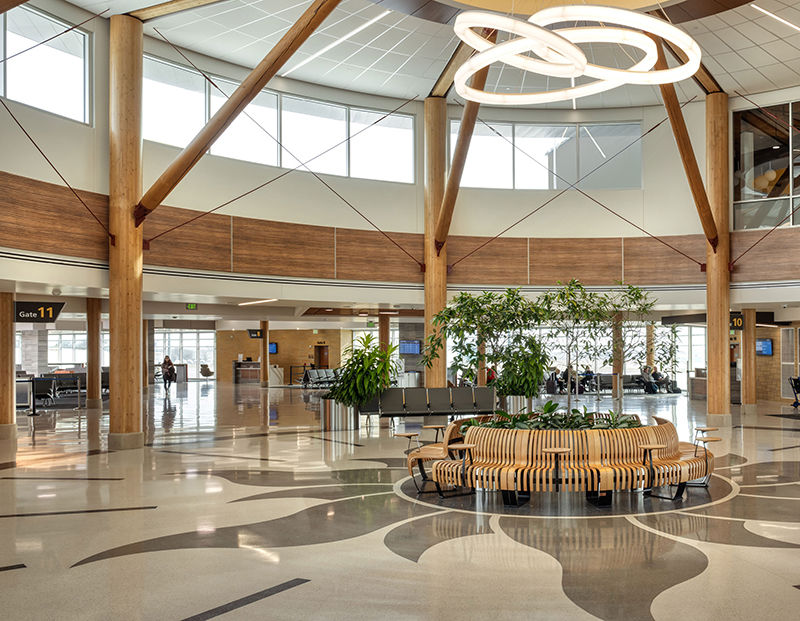
After more than 10 years of phased planning and construction, Eastern Iowa Airport (CID) in Cedar Rapids/Iowa City, IA, has completed a comprehensive modernization and expansion program. The result is an updated, light-filled terminal designed to accommodate larger aircraft and remain flexible for changing passenger needs.
“This has been a decade of work,” reflects Airport Director Marty Lenss. “But it’s really rewarding to see the finish line and know we’ve delivered a facility that meets the needs of our region now and well into the future.”
The nearly $121 million project significantly expanded the terminal footprint from 94,000 square feet to approximately 240,000. The airport also modernized its aging infrastructure, expanded gate and holdroom capacity to accommodate larger aircraft and redefined the passenger experience with common-use processing systems, improved circulation, natural daylight and improved post-security amenities.
The modernization and expansion effort was driven by shortcomings in critical systems that could no longer be addressed with incremental improvements. Originally built in 1986, CID’s terminal had reached the end of its useful life, from HVAC and electrical infrastructure to baggage handling and passenger processing areas.
| facts&figures
Project: Terminal Modernization & Expansion Location: Eastern Iowa Airport, in Cedar Rapids, IA Size: Added approx. 146,000 sq. ft. new space; renovated 94,000 sq. ft. Key Components: Expanded TSA checkpoint; common-use ticketing & gates: 4 new passenger boarding bridges; larger holdrooms; post-security concessions; 2 outdoor airside patios; geothermal & solar energy systems; upgraded baggage handling; renovated restrooms & passenger amenities Approx. Cost: $121 million Funding: Airport (43%); federal (32%), including Airport Terminal Program of Bipartisan Infrastructure Law; state (25%) Construction: June 2014–Jan. 2026 Key Benefits: Increased capacity & flexibility; ability to accommodate larger aircraft; enhanced passenger experience and amenities, gate and ticketing flexibility, improved security screening and circulation, improved resilience and future expandability Prime Architect: Mead & Hunt Estimating: Concord Group Civil Engineering, Owner’s Representative: Foth General Contractor (Phase 4): Rinderknecht Associates Inc. Mechanical, Electrical, Plumbing, & Technology Engineering: IMEG Corp. Structural Engineering: MBJ (Meyer Borgman Johnson) Geotechnical Engineering: Terracon Airside Consultant: AERO Systems Engineering Architectural Consultant for Administration-Level Interiors: OPN Architects Architectural Consultant for SSP: O’Kelly Kasprak Signage Consultant: Eidahl Environmental Design Inc. Photovoltaic & Commissioning: HGA (Hammel, Green & Abrahamson Inc.) Photovoltaic System: Acme Electric Co. Project Information Management: Submittal Exchange; Newforma Project Photographic Management: Multivista Furniture: AGATI Inc.; Arconas; Blu Dot Design & Manufacturing; Brown Jordan Co. LLC, Dauphin; Forms + Surfaces Inc.; Fun & Function LLC; Landscape Forms; Steelcase; Triplett Office Solutions; Workspace Inc. Passenger Boarding Bridges: JBT AeroTech Corp. (now Oshkosh AeroTech) Baggage Claim Conveyors: G&S Conveyors Signage: Latitude Signage + Design Tensioned Fabric Structures: Apollo Sunguard Systems Inc. Stone: Vetter Stone Timber Connections: Cast Connex Corp. Structural Steel Erection: Cedar Valley Steel Inc. Carpet & Resilient Flooring: Commercial Flooring Co. Porcelain Wall Tile: Stonepeak Ceramics Tiling: Grazzini Brothers & Co. Acoustical & Wood Ceilings: Hargers Acoustics Inc. Concrete: Jason Smith Concrete Construction Inc. Painting & Wallcoverings: JC Toland Painting LLC Epoxy Terrazzo Flooring: Advanced Terrazzo; Kenneth Janning & Sons Inc. Concrete Ready Mix: King’s Material Inc. Spray Foam Insulation: Kinzler Construction Services Elevators: KONE Inc. Common-Use Technology: AeroCloud Window Treatments & Toilet Accessories: Heartland Finishes Inc. Wall, Floor & Ceiling Expansion Joint Cover Assemblies: Inpro Corp. Fire Sprinkler System: Continental Fire Sprinkler Co. East Cargo Building Demolition: D.W. Zinser Company Inc. Sitework: Metro-Pavers Inc. Aluminum Glass & Glazing: Mid-American Glazing Systems Inc. Metal Wall & Soffit Panel, Sheet Metal Flashing: Modern Builders Inc. Joint Sealants: Mt Vernon Construction Inc. Rebar Installation: Nelson Rebar Inc. Electrical System: Neumiller Electric Inc. Rebar Supply: Nucor Rebar Fabrication Midwest LLC Tubular Skylights: Ogden & Adams Building Solutions Drywall, Metal Studs, Batt Insulation: Pearson Wall Systems Inc. Excavation, Rock, Aggregate Piers: Peterson Contractors Inc. Geothermal: QC Geothermal Inc. Glue-Laminated Construction & Wood Decking: R.E.W. Supply Ltd. Paper Composite Panels: Richlite Co. Masonry: S Moyle Masonry Inc. Membrane Roofing, Metal Roofing, Patio Pavers: T&K Roofing Co. Weather Barrier: Total Seal LLC; Corridor Coatings Structural Steel Supply: TSF Structures Inc. Casework & Countertops: Woodcrafters Inc. Plumbing & HVAC Systems: Day Mechanical Systems Inc. Doors, Frames, & Hardware: Doors Inc. Fire Extinguishers: Epco Ltd Inc. |
To complete the comprehensive project, the airport assembled a core team of long-standing consultants and contractors. Foth Infrastructure & Environment served as its on-call engineering consultant and owner’s representative. Mead & Hunt acted as architect of record and design lead during all four phases. Rinderknecht Associates Inc. served as general contractor for the final phase, delivering an additional concourse expansion within the active terminal.
Planning the Change
Over time, steady passenger growth, changing security requirements and evolving airline fleets had exposed capacity constraints across the facility, especially in restrooms, security screening, concessions and holdrooms that had been designed to accommodate traffic from smaller aircraft. “Passenger growth had been fairly consistent, so some of the restrooms were no longer adequate size-wise,” Lenss notes. “We had a concession program that was reflective of pre-9/11, meaning most of our concessions were pre-security checkpoint.”
Beyond its functional limitations, the terminal no longer met common passenger expectations. Low ceilings, limited natural light and limited post-security concessions created an environment that felt dated and constrained—a “Cold War Eastern European feel” as Lenss used to joke. To create a better first and last impression for the region, airport leadership developed a long-term, holistic strategy.
Rather than planning one large, single project, CID used a phased approach that eventually proved essential to its success. Work was divided into four phases that were bid and constructed independently. This allowed the airport to maintain operational continuity while retaining the flexibility to pause, adjust or accelerate work as needed. “The Cedar Rapids Airport Commission [which operates CID] took that approach with a heavy emphasis on being good physical stewards of the public asset,” Lenss explains. “At the end of each phase, we would have a usable facility and could delay, stop or accelerate construction if we needed.”
That flexibility proved invaluable when the COVID-19 pandemic disrupted air travel worldwide. “We finished Phase 3 right in the middle of the pandemic, and then Phase 4 was delayed approximately two years,” Lenss details. “That allowed us to better understand industry recovery and make informed decisions about whether to scale back or stay the course.”
The pause also aligned with new funding opportunities, including the Airport Terminal Program associated with the Bipartisan Infrastructure Law. “The COVID dollars that came available enabled us to do the full Phase 4 in a way that probably wouldn’t have been possible absent those unique funding streams,” Lenss notes.
Project phases progressed from landside improvements to airside expansion. Phase 1 focused on exterior and curbside upgrades to improve the terminal’s public face and accessibility. Phase 2 upgraded building systems and modernized interior landside spaces, such as ticketing, baggage claim and restrooms. Phase 3 created a larger TSA checkpoint with improved queuing, and improved post-security areas with new concessions, expanded holdrooms and energy-efficient upgrades. Phase 4 added new gates, passenger boarding bridges, additional holdrooms and architectural features that support long-term flexibility and growth. (See sidebar on Page 48 for more details.)
From a financial standpoint, CID took a conservative, pay-as-you-go approach for the nearly $121 million project, with 43% of the cost covered by airport funds, 32% from federal sources and 25% from state funding.
Engineering for Continuity and Operations
Foth served as the airport’s on-call engineering consultant throughout the project, providing continuity across all four phases. Its team worked to maintain airport operations—and associated income—while building in the middle of an active terminal and apron.
One of the primary objectives during Phase 4 was maintaining gate availability. “The goal was to maintain the same number of boarding bridges throughout the duration of construction,” recalls Eric Scott, an engineer with Foth. “That required a lot of coordination—how contractors moved safely across the apron, how we dealt with conflicting paths and how we kept aircraft operations uninterrupted.”
The evolution of aircraft serving CID over recent years added another layer of complexity to the project. As airlines transitioned away from smaller regional jets to larger narrow-bodies, the airport’s original gate spacing and apron circulation areas became insufficient. “When the airlines started upgauging, that was a big problem,” Scott remarks. “The larger aircraft had to sit in the footprint of what two used to.”
To address this, the airport expanded its apron and relocated cargo operations away from areas where passenger aircraft circulate. “These things don’t necessarily get captured in this project,” Scott says. “But that was the vision—we saw this coming and needed to program that in.”
Timeless, Community-Driven Terminal
Mead & Hunt served as architect of record, interior designer, lighting designer and project manager across all four phases of the modernization and expansion. From the outset, the design team faced a unique challenge: creating a cohesive, modern terminal that would be built over many years. “As this was a phased project that likely would take many years to execute, the design driver was to deliver a timeless aesthetic that would seamlessly blend over the phases,” remarks Matt Dubbe, national design and market leader for Architecture with Mead & Hunt.
Rather than following current trends, designers focused on more classic materials—timber, steel, glass and stone—executed in ways that felt both contemporary and familiar to the Cedar Rapids community and wider region. “When we first interviewed for this job, it was a terminal that felt hostile,” Dubbe recalls. “There was no natural daylight, and the airport felt strongly that the first impression did not reflect the community.”
Natural light became the unifying design element across all phases of the project. “The sun plays such an important role in Iowa, both from an agricultural perspective and in intuitively tracking the passage of time,” Dubbe explains.
The updated facility now serves as a physical expression of eastern Iowa’s identity. Natural materials, subtle designs in the terrazzo flooring and expansive views of the airfield and local landscape connect the terminal to its surroundings. Outdoor patios extend that connection beyond the building walls.
One particularly meaningful feature scheduled to be installed soon is a table crafted from trees felled by strong derecho winds in August 2020. “It’s a way to bring a piece of our history into the terminal,” says Lenss, noting that the functional artwork retains the natural outer edges of the trees.
Such sense of place was intentional in the architectural design, says Dubbe. “The most successful airports hold up a mirror to their community,” he comments. “People take pride in seeing themselves reflected in their airport.”
Perhaps the most striking architectural features of the modernized terminal are dramatic light-filled spaces that anchor key transition points for travelers within the concourse. “One oculus is at the recomposure area of the security screening checkpoint and gates 1, 2 and 3, and the other is in the concourse near gates 10, 11, 12 and 14,” Lenss says.
The oculi serve multiple purposes: adding natural daylight, enhancing wayfinding and creating social spaces adjacent to concessions. “People can sit at a table or the bar and have full view of three or four bridges,” Lenss remarks. “That reduces traveler stress because they can keep an eye on their gate while enjoying something to eat or drink.”
The circular openings in the ceiling were designed with both symbolic and practical intent. “The yellow polycarbonate material is symbolic of the sun but also cuts down on direct overhead harsh light,” Dubbe describes. “Frequent flyers can track the time and seasons as light moves across the various floors and walls.”
Passenger-Centered Amenities and Spaces
Across the terminal, customer comfort drove design and engineering decisions. Restrooms were significantly expanded and modernized to accommodate passengers leaving and arriving on larger aircraft. Seating options in holdrooms were diversified to reflect changing traveler demographics and preferences. “Gone are the days of a sea of beam seats being your only option,” Dubbe says. “The integration of beam seats, soft seats and standing tables provides choices.”
Before the recent modernization project, most gate seating at CID was designed around 50-seat aircraft. “Our airline partners have upgauged their aircraft, so expanded gatehold seating throughout the terminal was essential,” Lenss notes.
Other passenger-focused additions include a sensory room for travelers seeking a quieter space, multiple nursing lounges, device charging options throughout the terminal and two post-checkpoint patios, each with a service animal relief area.
The larger patio, located near the west end of the concourse, offers expansive views of the airfield and Iowa sunsets. “It gives people an opportunity to go outside before a long journey,” Lenss says. The airport has a stadium license that allows it to serve food and beverages outdoors.
New and expanded post-security concessions represent a major shift from the terminal’s previous configuration, where most food and retail offerings were located landside. “That was a big gap before the project,” Lenss notes.
Now, full-service dining, coffee kiosks and other grab-and-go options are strategically integrated into the concourse—particularly around the oculi. This encourages passengers to relax and spend time in naturally lit spaces while maintaining sightlines to their gates.
From a design perspective, concessions were placed to reinforce intuitive wayfinding rather than disrupt it. “We let light pull people through the building. Concessions become landmarks rather than obstacles,” Dubbe explains.
Maintaining Security and the Schedule
Rinderknecht Associates Inc. served as the airport’s general contractor for Phase 4, completing the final concourse expansion. “[Our] role was everything construction—bringing the drawings to fruition while accommodating the added complications of working on a site with a lot of moving parts,” explains Bob Gaffney, the company’s president and chief executive officer. “It was still a functioning airport, and we had to keep eight gates open and nine plane parking spots open at all times in case of emergency.”
Construction phasing required continual adjustment as flight schedules, gate assignments and supply chain conditions evolved. The team also implemented rigorous safety and cleanliness protocols. “One person’s entire responsibility on the project was to keep work areas spotless,” Gaffney shares. “We went to great lengths to make sure there were never any foreign materials in the air or on the tarmac.”
Building a major concourse extension inside an active, secure terminal environment demanded a high level of discipline and coordination from the construction team. “Phasing was critical to project success,” Gaffney says. “We had to maintain a separate, secured construction gate and keep passengers, contractors and airport personnel safe at all times.”

The airport issued security badges—approved by TSA—that allowed Rinderknecht Associates to track workers entering and exiting the site and comply with Davis-Bacon requirements while allowing work to proceed efficiently. “Temporary access that we created and manned nine hours a day allowed us to do so much during airport operating hours,” Gaffney reports.
Interior and exterior construction schedules were decoupled to hedge against potential material procurement delays, though supply chain issues delayed delivery of façade panels and patio pavers. “The exterior delays did not affect the interior work,” says Gaffney. “We managed them separately.”
Sustainable Without the Label
Although the airport did not pursue formal LEED certification for the project, sustainability was embedded throughout design and construction. Energy efficiency, durability and operational resilience guided decisions across all four phases, influencing both visible design elements and underlying infrastructure systems.
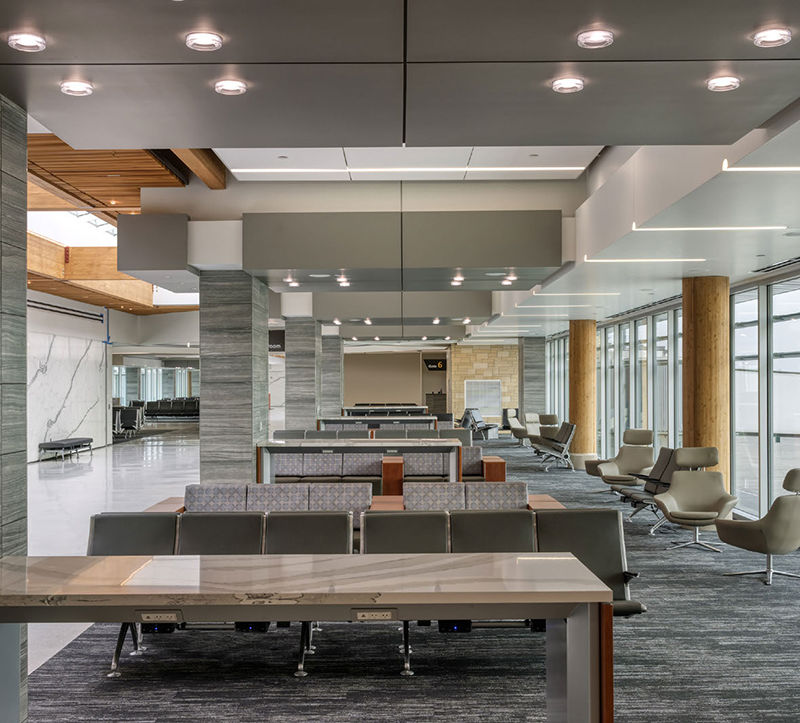
Designers specified different types and brands of seating and furniture to accommodate various guests.
One of the most significant sustainability investments was a geothermal heating and cooling system. A geothermal well field installed during earlier phases reduced reliance on conventional heating systems and was also extended to support heated sidewalks and curbside areas. “All of that was heated through geothermal, which helps us keep salt from coming into the building, and all but eliminated our primary slip and fall scenarios during the winter season,” Lenss notes. As the terminal expanded, the project team supplemented the geothermal system with a central utility plant to ensure adequate capacity and system redundancy as operational demand increased.
 Photovoltaic solar panels installed on the terminal roof supply 10% to 15% of the building’s electrical load. Rather than incorporating a system designed to offset total energy use, the airport chose to reduce its demand on nonrenewable sources and integrate renewable energy incrementally to avoid introducing operational risk.
Daylight harvesting played a central role in sustainability and passenger experience. Large expanses of glazing, increased ceiling heights and the two oculi significantly reduce the need for artificial lighting during daytime hours. Project designers treated daylight as both an environmental and experiential asset.
Durable finishes and long-life architectural elements suited for high-traffic environments further supported the airport’s sustainability goals. Materials were evaluated not only for environmental benefit, but also for long-term operational practicality. “The total cost of ownership over 30 years far outweighs the initial construction cost,” Lenss says. “We wanted systems that were tried, true and maintainable.”
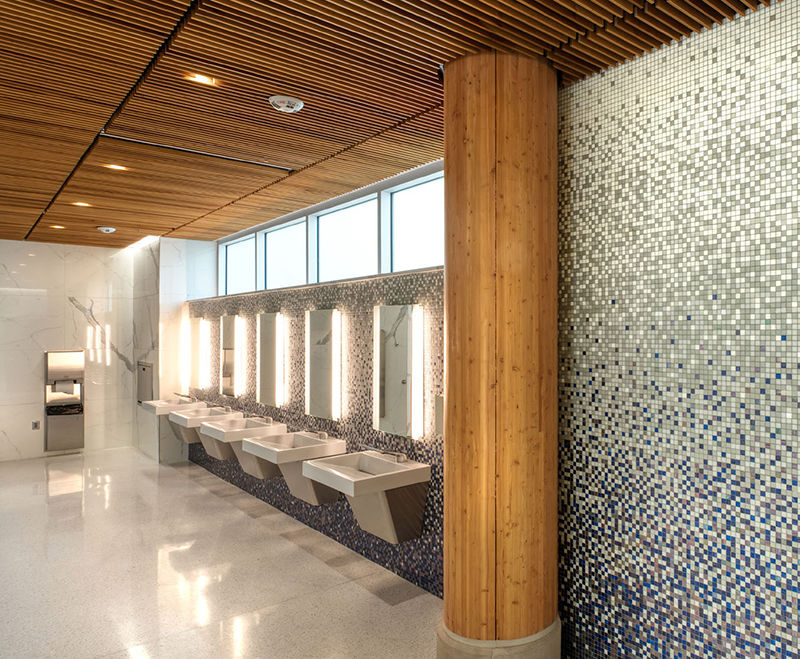
Restrooms were expanded and updated.
Behind-the-Scenes Renewal
While passengers immediately notice features like expanded holdrooms, light-filled spaces and new concessions, much of the project’s value lies in infrastructure upgrades that are largely invisible to the public.
 During all four phases, the airport replaced or upgraded HVAC systems, electrical infrastructure, plumbing, access control systems, paging systems and building automation platforms that had reached (or exceeded) their useful life. “A lot of those back-end systems were being sunset by manufacturers,” Scott says. “This was an opportunity for CID to upgrade and position themselves well for future growth.”
One particularly complex challenge emerged during Phase 4 when plans to expand the terminal’s geothermal system were derailed. “That was a huge curveball,” Scott recalls. “We had planned to add additional geothermal wells, but the permit was denied.”
Rather than compromise system performance, the airport pivoted to a centralized utility plant that supplements the existing geothermal infrastructure with conventional HVAC systems—adding redundancy and long-term resilience. “Now they have multiple layers of heating and cooling capability,” Scott explains. “That redundancy protects them against single points of failure and supports future expansion.”
Lessons for Other Airports
“For us, a phased approach worked really well,” reflects Lenss. “It allowed us to be nimble on financing and operations.”
Dubbe, from Mead & Hunt, agrees that phasing had a significant impact on the project outcome. “While some people hate phasing, the way this airport did it was best-in-class,” he comments. “It allowed them to ramp up or slow down design and construction to meet funding, financial or operational needs.”
Collaboration among the airport, designers, engineers, contractors, airlines and TSA also proved to be a key component. “It’s integral,” notes Gaffney, from Rinderknecht Associates. “We were able to develop a relationship with the architect so that we could call him with an issue and FaceTime solutions, leading to problem-solving on the spot.”
Scott, with Foth, echoes the importance of coordination, particularly during surprise twists such as the permitting denial for more geothermal wells. “We had to pivot—and pivot fast,” he recalls.
Positioning for the Future
In addition to addressing immediate capacity and infrastructure needs, the recently completed terminal modernization was designed to help CID remain adaptable as its airline operations and passenger volume continue to evolve.
Plans accommodate larger aircraft and higher peak passenger loads without major structural rework in the future. “The primary driver was aircraft upgauging,” Dubbe says. “We planned in a growth scenario over many decades.”
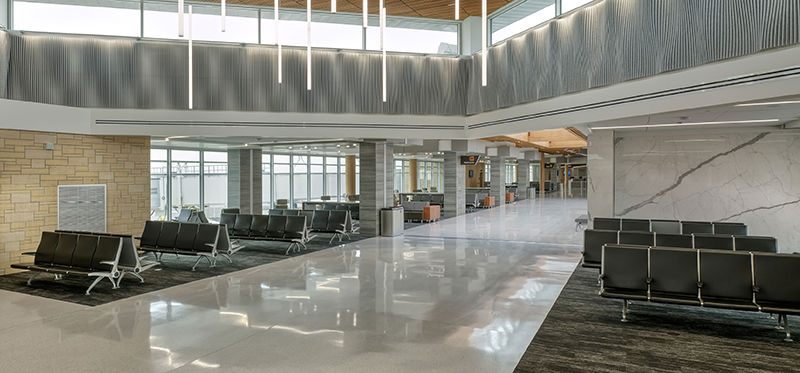
Holdroom capacities were increased to accommodate higher passenger volume from larger aircraft.
That forward-looking approach influenced decisions about gate spacing, holdroom sizing, circulation space and support areas throughout the concourse. Adding common-use technology from AeroCloud at ticket counters and gates further enhances operational flexibility by allowing airlines to accommodate future service additions without costly reconfiguration.
 Land use planning and the preservation of adjacent space around the terminal was also considered to provide clear paths for future expansion should demand warrant it. “We feel that the airport is decades ahead of what is needed for this community,” Dubbe remarks.
With the terminal modernization and expansion program complete, CID is moving into the next phase of capital improvements to further increase operational flexibility and build on infrastructure established over the past decade. One of its first priorities is a new snow removal equipment building, with construction scheduled to begin this spring.
Another proposed improvement is expanding the outbound baggage handling tunnel to increase capacity and improve reliability as enplanements continue to rise. The airport has pursued funding from the Bipartisan Infrastructure Law Airport Terminal Program to help advance this project. Funding sources have been secured for a centralized aircraft deicing facility through a Community Directed Spending grant.
| Four vs. One
When modernizing and expanding its terminal, Eastern Iowa Airport (CID) subdivided the approximately $121 million project into four phases that were bid and constructed independently. This allowed CID to maintain operational continuity throughout construction and pause, adjust or accelerate work as needed—flexibility that proved invaluable when COVID-19 turned the entire industry upside down. Here’s how the project was divided: Phase 1: Exterior transformation including a new façade, windows, lighted curbside canopy and sidewalks, as well as glass panel modules for the existing pedestrian walkway. Other elements included signage, roof repairs and replacing the cooling tower. Phase 2: Complete renovation of pre-security terminal spaces, including rental car and airport shuttle counters, airline counters, baggage claim equipment and TSA checkpoint entry. Skylights were added for natural lighting and energy savings; heating and cooling systems were updated. Phase 3: TSA checkpoint expansion and post-security improvements, including 54,350 more square feet of holdroom space, additional restrooms and two new concessions areas. Energy efficiency measures included new roofing and siding, building system upgrades, geothermal well field and 240 KWh solar array. Phase 4: Renovating final 25,197 square feet of terminal space and adding more than 30,000 square feet. Highlights included four new boarding bridges, additional holdrooms and restrooms, and new concessions. Sustainability elements included continued transition to the geothermal HVAC system and expanding the solar array. |