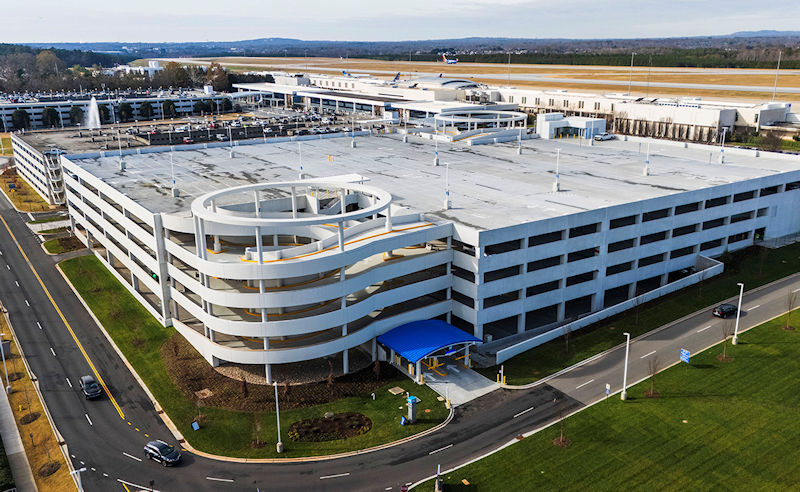
A new five-level garage recently opened at Greenville-Spartanburg International (GSP), adding roughly 1,500 more parking spaces to the South Carolina airport’s inventory. Garage C, located directly adjacent to the terminal, has two levels for public parking, two levels for rental car operations, and one level below ground that houses quick turnaround services for rental vehicles.
The $97 million project was funded by the airport’s capital improvement fund and proceeds from bonds backed by a customer facility charge applied to rental car transactions and ground transportation vehicles.
“We needed to do this project for two main reasons,” states GSP President and Chief Executive Officer Kevin Howell. “First, due to the continued growth of our airport, we had a shortage of garage parking for both the general public and the rental car companies. Second, the airport and the rental car vendors wanted to provide better facilities and a higher service level for their customers, specifically the premium frequent rental clients.”
| facts&figures
Project: Parking Garage/ Consolidated Rental Car Facility Location: Greenville-Spartanburg Int’l Airport—Greer, SC Key Benefits: More parking capacity for customers & rental vehicles; consolidating all rental operations into single location near the terminal Project Scope: 5-level garage with about 750 public parking spaces, 750 rental car spaces, rental agency counters, quick turnaround services Cost: $97 million Funding: Capital improvement funds; bonds backed by customer facility charges from car rental transactions Programing & Design: 2017-2019 Construction: Feb. 2024-Dec. 2025 Architect: LS3P Construction Management: LCK General Contractor: Precast Structure: Metromont Electrical: Walker Whiteside HVAC: Paulson-Cheek Mechanical Plumbing: WN Kirkland Park Assist System: TKH Security |
GSP continues to offer passengers surface parking lots with shuttle service to and from the terminal building.
The new consolidated rental center is a short two-minute walk on a covered sidewalk from the terminal. The facility includes a large customer service lobby, as well as reserved spaces for premium pick-ups and drop-offs. Support services such as fueling, vehicle washing and maintenance are located separately, below ground.
The two levels for public parking are equipped with Park Assist, an automated guidance system from TKH Security that uses smart sensors and high-definition cameras to help customers find open spaces. Green LED indicators guide drivers directly to available spots; red lights indicate spaces that are already occupied. Inix software provides information about system status, parking occupancy, heatmaps and garage trends, plus real-time and historical reports. LAZ Parking Services, the company that manages the garage and surface parking facilities for the airport, monitors all systems from its office in Garage B.
Contractors installed the Park Assist system after Garage C was constructed to prevent damage and to avoid impeding progress as the new structure was being built.
Temporary Holding Pattern
The design process for GSP’s combination rental car facility and public parking garage started back in 2017 and 2018. “At the time, we had two garages,” Howell explains. “One was about 30 years old, and the other 20 years old. During busy periods, it was sometimes a challenge for a traveler to find a garage space.”
The final design for the new facility was completed in 2019, and bids were sent out later that year. Construction was slated to start in 2020, but the COVID-19 pandemic delayed the process several years. “By 2023, passenger traffic had returned to 2019 levels, and the project was restarted.”
LS3P Associates, which provided the design work, was named the project’s architect. LCK was chosen for construction management services, and Brasfield & Gorrie was selected to be the general contractor.
The entire project team had to deal with a tight location, sandwiched among GSP’s two other parking garages, the main terminal and the main entrance road to the terminal. “The project was on a very constrained site with active operations on all four sides,” Howell remarks. “We worked closely with the rental car companies and met with them as both a group and individually. It was important to have their input on how their individual operations worked.”
The design and construction package finished in 2019 basically remained the same when the project was re-bid in 2023. While the project was on hiatus during the pandemic, building codes were updated, and the design team had to incorporate those revisions into the package prior to re-bidding. The LS3P team of design consultants paid particular attention to the consolidated rental car facility, which brought all eight of the airport’s rental car companies together under one roof.
The transaction lobby includes contemporary restrooms, seating and large windows facing the terminal. Finish materials for floors, walls and ceilings echo those used in GSP’s existing facilities to create design continuity throughout the airport campus.
 “Terrazzo and tile floor patterns within the main terminal were incorporated into the flooring of the new garage,” says Brian Bresg, LS3P principal, vice president and aviation section leader. “We utilized the same finish materials, color palette and lighting themes as those in the main terminal. Restroom finish materials and GSP proprietary details match those in the concourse and terminal building.”
The garage was constructed utilizing pre-cast concrete structure and façade for the flat plate parking levels. Hiring a local supplier simplified construction logistics. “All the columns, beams and double tees were cast right here in Greenville, and once they were delivered and placed in position, the garage went up very quickly,” Bresg remarks. “That process went smoothly.”
Two cast-in-place reinforced concrete double-helixes provide vertical circulation access to each level for all vehicles, both public and rental cars.
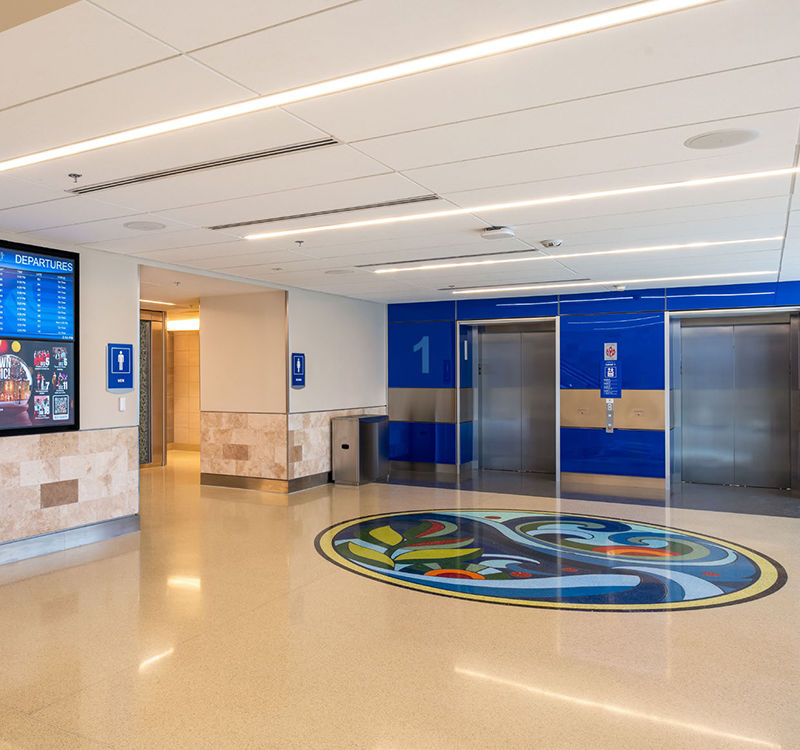
Finish materials and color schemes are consistent with those in the main terminal.
Outside Intermediary
Although GSP has an in-house Design and Construction Department that reports to Howell, its staff was already busy with other projects during the construction of Garage C. “We have a lean team,” Howell says. “That is why we hired LCK to provide project management services and serve as an extension of our staff. They had a project manager on-site who coordinated with our staff.”
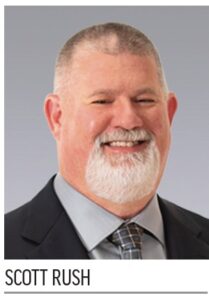 Scott Rush, vice president for LCK, supervised the project. “We were involved in the initial planning in 2017 and 2018,” he relates. “At that time, we compiled a list of potential contractors. After the three-year hold due to COVID, we again sent out a short list of three contractors for bids. The airport reviewed the bids and chose Brasfield & Gorrie as the general contractor.”
During construction from February 2024 to early December 2025, LCK maintained an office at the airport and had a daily presence at the jobsite. Two staff members were involved in pre-construction planning, and then two more supervised construction when it started.
Throughout the project, Rush emphasized the importance of communication. “We had frequent meetings in person with the owner and general contractor. That helped keep all parties on the same page,” he says.
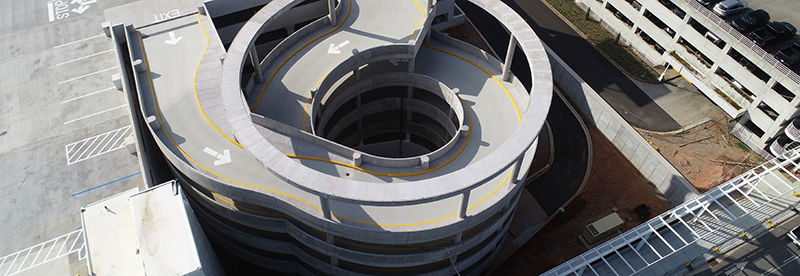
One double-strand helix provides vertical circulation for rental customers; another on the opposite corner serves the general public.

Complex Undertaking
Erecting the large pre-cast garage while GSP continued operating 24/7 was a complicated challenge for the project team. Last year, during the height of construction, approximately 3.1 million passengers streamed through the airport.
Kimberly Bailey, project director for Brasfield & Gorrie, set up shop in a temporary trailer next to the jobsite to keep close tabs on construction.
“Our headquarters was on a vacant lot, which provided easy access for trucks delivering materials,” she says. “Those vehicles were able to use Stevens Road, a local thoroughfare not open to the public. The workers had a separate lot in which to park.”
| facts&figures (cont.)
Civil Engineer & Landscape Design: Seamon Whiteside Associates Structural Engineer: Michael M Simpson & Associates Mechanical, Electrical, Plumbing & Fire Protection Engineers: Newcomb & Boyd IT, Low Voltage & Security: Quick Turnaround Systems Design: Blymyer Engineering Roadway Design: Stantec Lighting Design: Glass Curtainwall: Graham Hodge Park Assist System: TKH Security Parking Management Controls: Carolina Time Low Voltage Systems: Network Controls Drywall & Framing: Spectrum Interiors of SC Fire Sprinkler: VSC Fire & Security Terrazzo Art: David Allen Pedestrian Canopy: UNI-SKY Landscaping: Parrish Lawn Carwash Equipment: Power Clean Systems Fueling & Vacuum Systems: JF Petroleum Group Upfit Contractors: Buildrite Construction; JDK Construction Garage & Parking Facilities Management: LAZ Parking Services Consolidated Rental Car Facility Operator: CONRAC Solutions Car Rental Companies: Alamo, Avis, Budget, Dollar, Enterprise, Hertz, National, Thrifty |
Applying stickers to crew members’ hard hats helped identify who was cleared for access to the jobsite. Security requirements would have been much more stringent if the construction site had been located airside, Bailey adds.
“We had 22 people from our company contribute over the course of the build,” she relates. “At peak construction, we also had a total of 150 workers on-site on a given day. In all, we calculated that it took 346,000 work-hours to get this done.”
Since LCK was the airport’s representative, Bailey reported to it about the progress of work. “Hiring subcontractors was my company’s responsibility, but I often consulted with Scott [Rush] on soliciting bids and drawing up their contracts.
“We used a lot of subcontractors,” she adds. “I estimate that we had between 60 to 65 entities working for us during this project.”
In addition to its three project managers, Brasfield & Gorrie had several superintendents onsite to help manage installation. Typically, the company had at least four staff people there at any given time. “And I was there nearly 100% of the time,” Bailey adds.
Throughout the project, she made it a point to keep LCK and airport management informed about ongoing construction and potential issues that could affect its progress. “I think that helped keep everyone on the same page,” Bailey reasons.
Executing a double-strand helix at two corners of the garage was a particular challenge. The design allows rental car customers to enter and exit in one area, while the general public enters and exits from a different spot. The separate ramps ensure that the two traffic streams do not intersect at any point. The tricky part was that the helixes had to join up with the main parking garage at each level.
“We did a three-dimensional model of this, which we showed to our various workers,” Bailey shares. “Once the project was green-lighted and funded, we then made a virtual model of this helix system, and color-coded it to match the schedule.”
This undoubtedly helped work stay on schedule throughout the two-year project. “We had 178 weather impact days throughout the 22-month construction schedule, which we managed without any impacts to the overall construction scheduled,” Bailey reports. “The one surprise we had involved weather delays due to fog. We had four cranes on-site, all of which were in the flight path of aircraft. Every morning and evening, we were required to notify the air traffic control tower for approval to raise our crane, and then to notify them we had completed work for the day. On particularly foggy mornings, we would not receive approval to raise our booms. In those cases, the aircraft took priority of the available air space until the visible conditions improved. This level of collaboration was necessary to ensure smooth and safe operations for GSP and Brasfield & Gorrie.”
“Overall, we were lucky,” she reflects. “The winter of 2024-2025 was fairly mild. We did not get the snow and ice that hit this region hard in late January and early February 2026.”
Another challenge involved adding a new exit plaza with pay stations very close to the old pay stations, which were later demolished. “We had to install a new pay station of three lanes with a canopy over them, while the old pay stations were still being used. We built a scaffold for the workers to use in that situation,” Bailey explains.
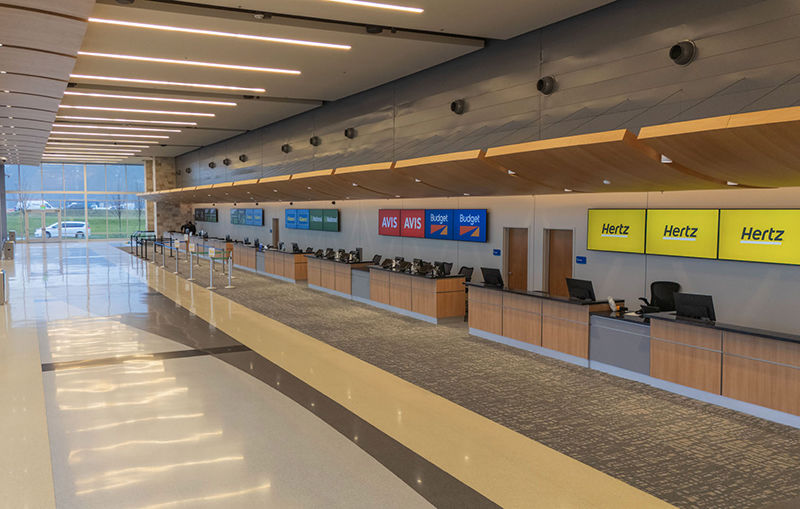
All eight of the airport’s car rental companies are now located in the same facility.
Internal and External Praise
 Howell reports that the new garage has been well received by the general public and the rental car companies that operate at GSP.
“I have received nothing but positive feedback,” he relates. “Until Garage C opened, we were running out of parking spots in our old garages. We don’t have that problem now.
“The rental car companies are very pleased, and customers have a spacious facility,” he concludes.