At first glance, Punta Gorda Airport (PGD) in Florida and San Francisco International Airport (SFO) in California are very different.
The former is a fast-growing regional airport shaped by leisure travel and fluctuating flight schedules that served about 2.3 million passengers last year. The latter is a long-standing global gateway; a Category X airport that moved 54.5 million passengers through its complex, interconnected terminal system last year.
Yet both rely on the same model for passenger and baggage screening: TSA’s Screening Partnership Program (SPP), which allows airports to use private contractors operating under federal oversight to manage security checkpoints.
| facts&figures
Project: Privatizing Passenger & Baggage Screening Format: TSA Screening Partnership Program (SPP) Key Benefits: Ability to flex staffing levels to match passenger traffic; performance-based contracts tied to wait times; operational continuity during government shutdowns Sample Locations
Punta Gorda Airport: Growing regional airport with 2.3 million passengers in 2025 Private Contractor: Aviation Security Management Effect on Checkpoint Throughput: Wait times reduced from up to 45 min. to under 10 Oversight: Daily TSA audits & monthly performance reviews
San Francisco Int’l Airport: Category X int’l hub with 54.5 million passengers in 2025 Checkpoint Throughput: 2 million passengers/month, with peak wait times under 10 min. Private Contractor: Covenant Aviation Security Oversight: Daily TSA audits & monthly performance reviews Workforce Metrics Hiring: 4–6 weeks for contractors vs. about 275 days for TSA Training: Accelerated through local/on-site programs Screener Attrition: Lower |
While the two airports have vastly different operations, each has found that the program provides greater flexibility than the traditional TSA model. Together, they show the wide range of application for privatized screening.
At PGD, the decision to apply for the alternative program was driven by necessity.
Rapid increases in passenger volume, fueled by a contract with Allegiant Airlines that grew traffic by over 40%, pushed the airport’s federally managed screening model beyond its limits.
“It was difficult for the TSA to staff screening lines for sporadic service,” explains PGD Chief Operating Officer Ray Laroche, who previously worked at the federal agency before joining the airport more than 12 years ago.
Laroche and other airport executives were particularly frustrated that TSA would close the checkpoint at a pre-determined time, even if flights were still scheduled to depart.
“Even when departing flights were delayed, the TSA would shut down our security checkpoint on their schedule with little communication with the airport,” he recalls. This meant that travelers who postponed going through security missed their flights, and those who arrived early waited inside the holdroom where concessions were limited.
Exasperated by these negative effects on the passenger experience, Laroche explored the topic of privatized screening at an industry conference and learned that private contractors will leave a skeleton crew in place until all passengers depart. “This drove my interest in SPP, where contractors use a flexible model that allows them to modify schedules quickly to meet demand,” he explains.
The airport subsequently applied to join the program and was officially approved in early 2015 and implemented in 2016.
SFO has operated under the program for even longer. “We have never actually had TSA screeners here,” comments Eva Cheong, managing director of SFO Airport Services.
The large global gateway was one of five airports selected to operate with privatized security when the SPP was launched in 2004, and notably, the only Category X airport in that initial group. Since then, the airport has built its operations around the SPP model, integrating it into discussions and plans about passenger flow, construction projects and long-range strategies.
Same Standards, Different Structure
Currently, 20 U.S. airports are approved for SPP participation (see sidebar on Page 24), and operate under the same regulatory framework as airports with screening performed by federal TSA officers. The private contractors are required to follow TSA procedures, training requirements and operational directives. And oversight remains firmly in federal hands.
The program changes how screening services are delivered, not how they are conducted, is how Laroche puts it.
The private screening vendors work for TSA, not the various airport authorities. Pre-qualified providers are hired through an Indefinite Delivery, Indefinite Quantity (IDIQ) structure and compete for contracts. “Once an airport is approved to be part of the program, the TSA handles the bid process and selects a contractor for airports enrolled in the program,” Laroche explains.
Aviation Security Management provides screening services at PGD. It manages day-to-day staffing and operations, but TSA retains full authority over security standards and performance oversight. Robert Hyde, the company’s chief operating officer, describes the structure as tightly controlled.
Covenant Aviation Security is the contractor that provides screening services at SFO. “I trust that screening is to the same level as TSA screening because the TSA oversees it,” Cheong says. “It’s the TSA’s contractor. But we work closely together to make sure our airport runs well.”
The SPP framework provides contractors with more flexibility in how they staff, manage and support operations than federally operated TSA screening, she adds.
Flexibility, Complexity, Accountability
James Parish, chief executive officer at PGD, considers flexibility the defining advantage of the SPP program.
 Contractors can adjust staffing in real time, keeping screening lanes open longer and aligning schedules with actual demand. This is a boon at PGD, where traffic fluctuates throughout the day and by the season. “They operate like a business,” Parish stresses.
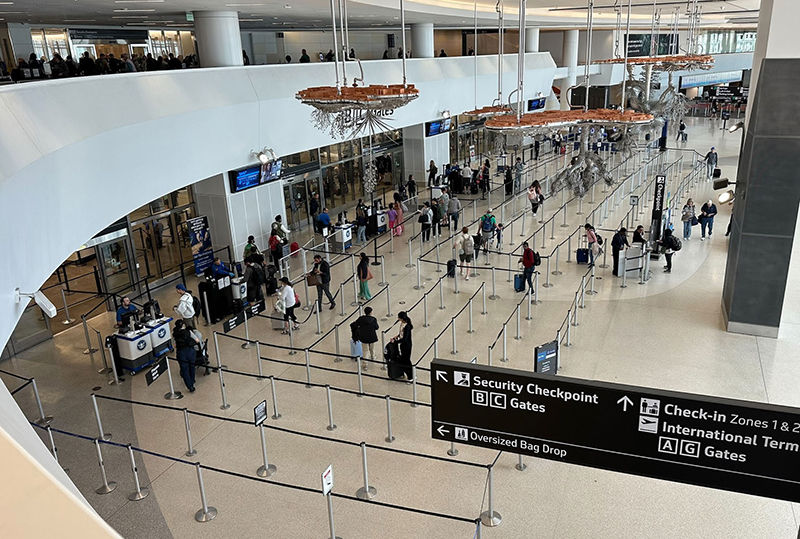
At SFO, the program also addresses complexity by helping the airport coordinate six passenger checkpoints for more than 50 airlines and heavy passenger flows across an interconnected system. “The key to our success is that we have a very collaborative relationship with the TSA,” Cheong shares. “We have a standing bi-weekly meeting with TSA’s assistant Federal Security director, [and] the TSA has three briefings a day with Covenant screening staff. We have even received partnership awards from the TSA. The key is that we all respect each other, work well together and work toward the same goals.”
Regularly scheduled meetings focus on forecasting passenger volumes and identifying potential pressure points. Daily briefings are designed to anticipate peak periods, align staffing to them and address issues before they escalate.
 Covenant and TSA have also helped the airport manage screening traffic as construction projects transformed SFO from isolated individual concourses to connected concourses after security checkpoints. “Having a contractor has given us more flexibility during these construction projects,” Cheong says.
Oversight is a standard element for all SPP contractors. “A TSA employee known as a technical monitor audits the program daily to make sure they’re following Standard Operating Procedures for screening,” Laroche says. “Our contractor holds its screeners to a higher standard than federal TSA screeners, and because of that, we end up with a better screening product.”
Monthly performance calls between TSA and private screening companies add another level of accountability. “If a contractor does not perform at a level equal to or better than the TSA, they lose their contract,” Laroche says. “So, the contractor has a personal stake in providing the highest level of screening possible. They are also rated on their wait times, so if they go above a set wait time, they could lose their contract.”
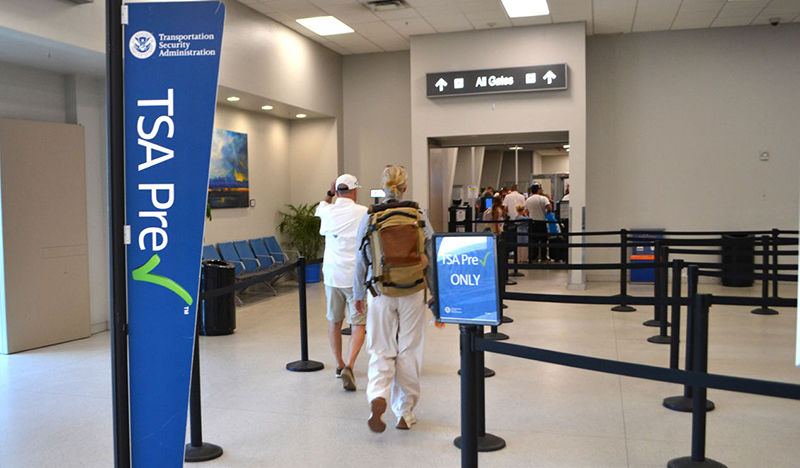
Checkpoint wait times at Punta Gorda Airport dropped after it joined the TSA Screening Partnership Program.
Both PGD and SFO cite significant advantages to using private screeners. Checkpoint wait times at PGD dropped from up to 45 minutes to under 10 minutes on average after it made the change. “Our peak times are 6 to 8 a.m., 10 a.m. to 2 p.m. and 5 to 7 p.m.,” Laroche says. “We don’t see delays during these peak times.”
The numbers at SFO tell a compelling story for large hub operators. “We process over 2 million passengers in 30 days, with an average peak wait time of under 10 minutes,” reports Doug Yakel, the airport’s public information officer.
Workforce Benefits
A significant difference between the SPP and traditional federal model lies in workforce management.
Private contractors face far fewer bureaucratic constraints when hiring and onboarding employees, and also subsequently when addressing performance issues. “We are able to hire much quicker than the government is,” Hyde says. “We can hire somebody within four to six weeks, whereas the TSA average is about 275 days.”
The impact was quickly apparent at PGD, as the private contractor initially hired screeners and underperformers were weeded out either through attrition or termination. “You end up with an all-star team,” Hyde remarks. “After that, there is very little turnover.”
Training timelines also improve under the program. Previously, SPP contractors had to send their screeners to Federal Law Enforcement Training Centers for training. Today, online TSA training and on-the-job training get employees up to speed more quickly.
“The TSA takes six months or more to get screeners certified. We can get them certified in almost half that time,” Hyde reports.
At SFO, low turnover is an important advantage. “We have a pretty stable workforce,” Cheong says. “Covenant prides itself on having employees with 20+ years of tenure. This creates consistency in a high-volume, high-pressure environment.”
She links excellence in training with improved retention. “Screeners understand what the job is before they are thrown into it,” she explains. “It is a very demanding job, so there is a benefit to being well trained.”
Contractors also have flexibility in how they manage screening employees. “They have their own incentives and employee recognition,” Cheong says. “Covenant offers incentives to keep its staff from calling out for the Super Bowl or over the holidays. They also do a lot to recognize their employees for a job well done.”
 At PGD, Aviation Security Management gives employees a pin when they detect banned items during Red Team testing. “Awarding screeners gives them a sense of pride,” says Laroche. “Others see the pins and know that they were rewarded for doing their job well.”
Customer Experience Factors
At both airports, customer service is a defining advantage of SPP participation.
“Our passengers are happier. Our employees are happier,” Parish reports about PGD. “In fact, we went from numerous complaints to almost none. We get compliments almost daily about how great our TSA is because the passengers do not know the difference.”
Cheong says SFO monitors customer satisfaction closely in quarterly surveys and has added employee training to improve checkpoint interactions. Covenant ensures its employees participate in the airport’s supplementary training by paying for their time.
“The workforce is better trained as a result of those efforts,” Cheong says. “We actually have one screener that has gotten internal and external awards because of how many compliments he gets.”
Aviation Security Management puts a similar emphasis on training at PGD. When the airport invited a group of people with disabilities to an orientation session to help make their future air travel more comfortable, the screening contractor paid all of its employees to participate.
Operational changes have translated into measurable gains in throughput for both airports.
Checkpoint wait times at PGD dropped from up to 45 minutes to under 10 minutes on average after the airport privatized screening. “Our peak times are 6 to 8 a.m., 10 a.m. to 2 p.m. and 5 to 7 p.m.,” Laroche says. “We don’t see delays during these peak times.”
SFO has had a similar experience. “We process over 2 million passengers in 30 days, with an average peak wait time of under 10 minutes,” says Doug Yakel, SFO Public Information Officer.
Added Resilience
One of the most visible advantages to privatized screening emerged during the recent federal government shutdowns. Screening operations at SFO, PGD and other SPP locations continued without disruption in stark contrast to the delays experienced at federally staffed airports.
Stable staffing can be maintained during government shutdowns because SPP screening operations are funded by existing federal contracts and screeners continue to get paid. In contrast, federally employed TSA officers do not get paid until the government resumes operations.
“During shutdowns, our employees continue to work because they continue to get paid,” Hyde notes.
Looking Ahead
Not surprisingly, interest in adopting the SPP approach is growing as airports face increasing passenger expectations. Less frequent, but highly disruptive, staffing challenges during government shutdowns also has it top of mind.
In fact, expanding privatized screening is part of the proposed 2027 federal budget. President Trump is calling for increased SPP participation, framing it as a way to reduce disruptions and save money.
This initiative might be the right idea at the right time. Airports that experienced hours-long security lines as unpaid TSA officers called out en masse are now taking a closer look at the alternative approach.
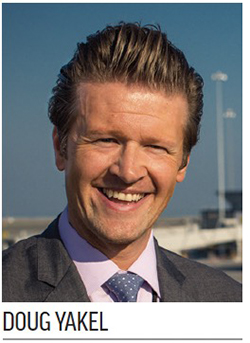 “This is probably the most serious move we’ve seen to alter the composition of who staffs airport checkpoints,” Yakel says. “Part of our rationale back in 2001 to become part of the program is that if privatization is the way the industry is heading, the SPP will position us to be ready for that when it comes. At the time, we never thought being part of the SPP would insulate us from government shutdowns and the disruption they create. But it’s been a wonderful unintended consequence.”
For airports interested in making the change, Yakel describes the path into the program as relatively straightforward.
Participation is open to all federally staffed airports that require passenger screening, and airport operators can apply through their local TSA Federal Security Director. Per standards established in the FAA Reauthorization Act of 2018, TSA will review an airport’s application and issue a determination within 60 days. If approved, TSA will contract a private screening provider, typically within 120 days. After a contract is awarded, it can take another 120 days to transition into the program, depending on airport size.
Yakel and Laroche both encourage any airport interested in the program to submit an application soon. “You don’t want to be the last one to apply,” says Laroche. “It takes a bit of time to get this program into place. You don’t want to be on the backend of a landslide.”
TSA declined to participate in this article but provided the following statement: The airports and contractors interviewed are not speaking for the TSA, nor do they represent the TSA office.
| Pioneers of Privatized Screening
The 20 airports that currently participate in the TSA Screening Partnership Program represent a variety of markets and operational volumes:
Source: TSA.gov |