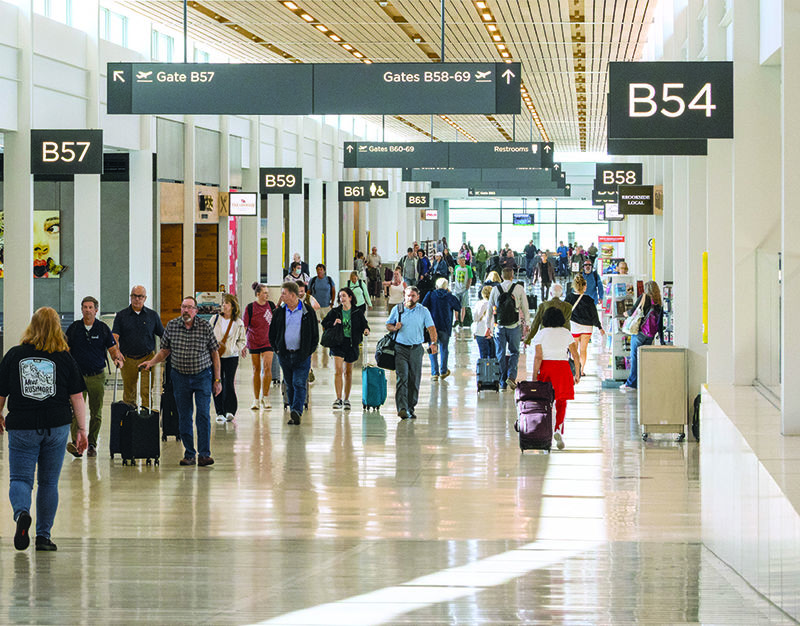
June 26 is a day that staff and officials at Kansas City International Airport (MCI) are likely to remember for a long time. It’s the narrow window between FIFA World Cup 2026™ matches when one team’s wave of fans is leaving the city and another’s is arriving.
“Friday, June 26 is going to be a day like we’ve never experienced,” says Justin Meyer, deputy director of marketing and air service at MCI. That single day is a snapshot of a much larger challenge. Kansas City, MO, is set to play a significant role in FIFA World Cup 2026, hosting six matches and serving as a training base for four national teams: Algeria, England, the Netherlands and Argentina, the defending champions.
The airport is bracing for record-setting crowds, global travelers speaking dozens of languages and a level of operational complexity few U.S. airports has ever experienced.
facts&figures Project: Preparations for FIFA World Cup Travel Surge Location: Kansas City Int’l Airport, in MO Key Components: Increased security; additional customer service staff; modified ground transportation routes; additional language translation services; phone-based support for guests with impaired vision or hearing; tabletop emergency drills; stress-testing baggage systems; contingency planning; theme products & menu items from concessionaires Private Partner for Passenger Screening: VMD/Xcelerate Screening Technology: Rohde & Schwarz Concessions Contractor: Vantage On-Demand Assistance for Guests with Impaired Vison or Hearing: Aira apps Baggage Handling System: Vanderlande |
Planning for the Surge
Preparation didn’t begin with the World Cup lineup announcement in June 2022. “Engagement started about two years before,” Meyer says. “We were already working with the Sports Commission on air service capacity during the bid process.”
After Kansas City was named as one of the 11 U.S. host cities, planning accelerated quickly and MCI began conversations with airline partners to ensure they could accommodate the event’s legendarily large fan base. A total of 5 million to 7 million visitors are expected to arrive in the United States for the World Cup, which features an expanded 48-team format.
The situation evolved in stages for MCI. First came the match schedule. Then, months later, the tournament draw revealed which national teams would play in Kansas City—and when—as well as which teams would make their home base there. That’s when the planning became far more precise at the airport.
“After the draw, we built a matrix of 65 day-specific, route-specific opportunities and shared that with airlines,” Meyer explains. That matrix allowed planners to anticipate when fans from specific countries would travel. If a team plays in Kansas City, then travels to another U.S. city and returns days later, its supporters are likely to follow in a similar pattern.
“We know those fans are going to fly out and fly back on very specific days,” Meyer relates. The June 26 surge is driven by a tight schedule between matches—Tunisia vs. the Netherlands on June 25 and Algeria vs. Austria on June 27—that will create a rapid turnover of departing and arriving fans. In addition, planners expect a lot of Argentina fans to be based in the area that day.
As of late March, American Airlines had added four flights—two round trips between MCI and both Atlanta International and LaGuardia International—specifically tied to World Cup travel demand. The airline is also planning to use larger aircraft on certain routes, with additional adjustments from other carriers expected as the tournament approaches. As a result, the Kansas City Aviation Department expects this June and July to be the two busiest months on record for MCI.
Adding to the airline numbers are passengers not flying commercial. General aviation traffic at several local airports is being managed through a coordinated, region-wide planning effort. Kansas City has partnered with nearby airports—including those in Lee’s Summit, Johnson County and Lawrence—to develop a structured general aviation management plan. The strategy accounts for each airport’s capacity, including FBO resources, runway throughput, parking availability and turnaround capability. The goal is to ensure that reservations and arrivals are distributed efficiently across the system, distinguishing between aircraft that will park for extended stays and those making quick turnarounds to drop off passengers.
The Playbook
At MCI, nearly every aspect of the passenger experience is being refined. “We’re looking at it from an all-hands-on-deck perspective,” says Adam Freeman, deputy director of operations at the airport. That means drafting employees from across the organization.
 “We’re utilizing staff whose normal duties aren’t in the terminal to help with customer service and wayfinding,” Freeman explains. “Maintenance, administrative personnel—everyone is helping.”
The goal is to manage not just volume, but complexity as well. To support travelers who will be arriving for matches, heading to fan events and navigating unfamiliar transportation systems, the airport is redesigning how people move once they land.
“One of our parking lots is being used as a depot for KC Direct charter buses transporting passengers between the airport, the fan experience [events] and the stadium,” Freeman says. “We’ve also created a separate pickup area for passengers going directly to the fan experience [areas].”
Airport shops and restaurants are scaling up, too. “Vantage, our concessions contractor, is holding a hiring fair specifically to add staff,” says Jackson Overstreet, public information officer for the Kansas City Aviation Department. “They’re looking to get people in and trained up ahead of the World Cup.” Vendors are preparing FIFA World Cup merchandise, and food/beverage locations are planning to offer international menu items tied to participating countries.
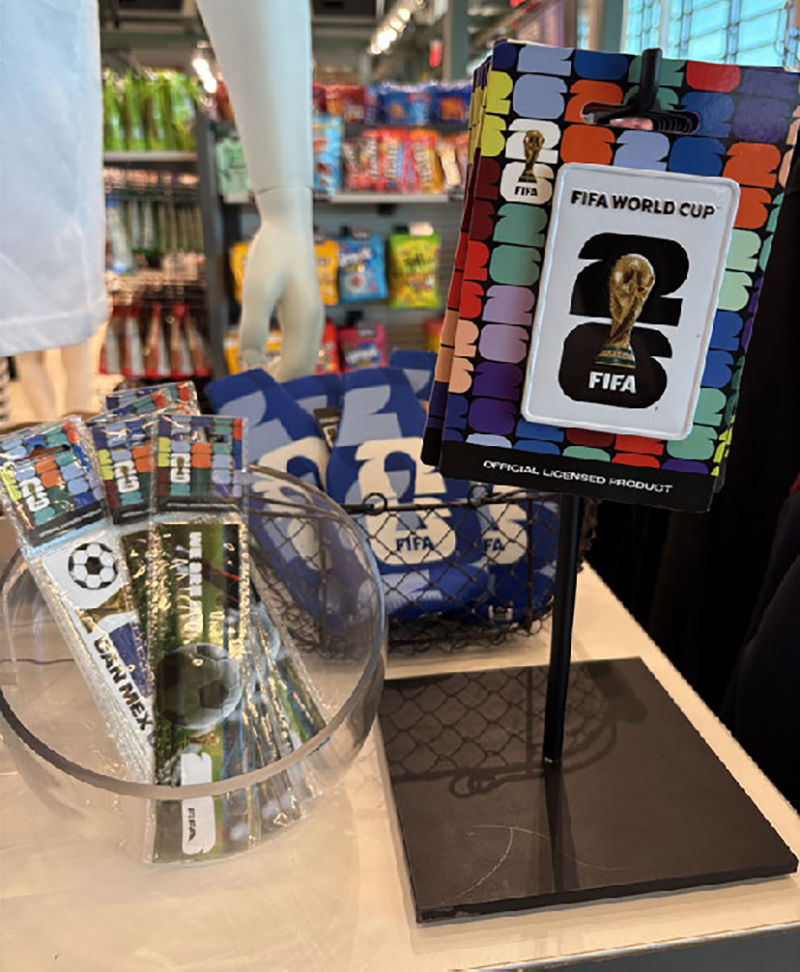
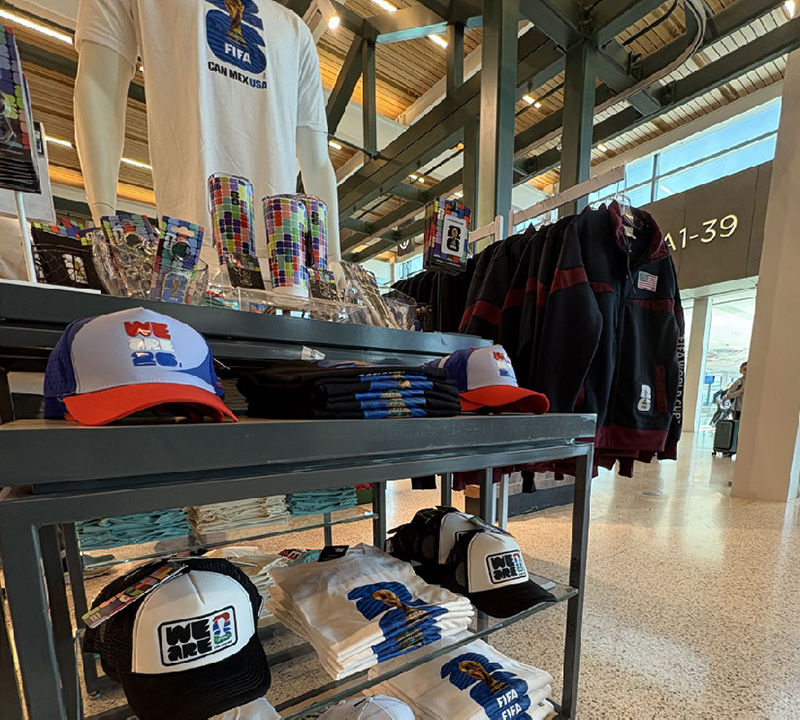 Concessions operators stocked up on World Cup merchandise and added extra staff.
While much of the work is behind the scenes, some changes are meant to be seen. A large countdown clock, located just beyond the security checkpoint in a high-traffic area, ticks down the days to kickoff—a highly visible reminder of what’s coming to the airport and city.
Welcoming the World
With visitors arriving from across the globe, communication is a major focus. “We’ve equipped our team with new technology so they can translate live, on the go, with passengers,” Meyer says. “That’s something we didn’t have before.”
 Existing tools such as landline phones that offer support in languages are being supplemented with real-time translation apps. Service staff will also be equipped with printed language cards that allow travelers to simply point to their preferred language.
To increase accessibility for guests with hearing or vision impairments, MCI is partnering with Aira. The company’s Explorer app connects passengers who are blind or low vision with professionally trained visual interpreters to provide on-demand, real-time visual information and guidance. Passengers who are deaf or hard of hearing can use the Aira ASL app to connect with American Sign Language interpreters via video calls.
“These tools are here to stay,” Meyer notes. “They’ll continue well beyond the World Cup.”
While rolling out the red carpet for international visitors, airport leaders also are being intentional to remember their home team customers. “We want to make sure the flying experience this summer is just as great for our regular travelers,” Overstreet remarks.
Meyer echoes that point, emphasizing that the extra World Cup traffic shouldn’t be problematic because the airport has already demonstrated it can handle heavy traffic without significant delays or long lines. “On a recent Friday during Spring Break—our busiest day since the Sunday after Thanksgiving—more than 21,000 travelers went through security with an average wait time under three minutes,” he reports.
In addition, MCI is one of 22 U.S. airports that uses private security screeners authorized by TSA, a model Meyer and other airport leaders say allows them greater staffing flexibility. “I’m really proud of the work that we’ve done with VMD/Xcelerate to match staffing with known demand,” he says. “Even on our busiest outbound days, we’re not expecting there to be much visible impact to travelers.”
Confidence is high that the system can handle significant surges during the World Cup. “We’re prepared for busy,” Meyer says. “People don’t sit on the wings. [Aircraft] capacity ultimately determines how many travelers we will handle. If we know the flights and the number of passengers, security lines will be staffed appropriately.”
Scaling Up Security
Overall, MCI is taking a layered approach to security. “We’re adding National Guard support, increasing police presence and expanding patrols around the airport perimeter,” Freeman shares. “We’re addressing security from both a physical and operational standpoint.”
 Inside the terminal, extra capacity was built into the checkpoint queue system when the new terminal opened in 2023. “If we’re fully open, we have 16 security lanes,” Overstreet explains. “We may need all 16 during this period, but we’re typically very efficient at processing passengers.”
Much of that efficiency will come from new screening gates developed by Rohde & Schwarz. TSA is rolling out more than 100 of the company’s next-generation scanners in six World Cup host cities, including Kansas City. The agency awarded Rohde & Schwarz a multimillion-dollar contract to deploy its QPS201 advanced imaging technology scanners, which were added to TSA’s Qualified Products List in 2022. Since then, the systems have been deployed at more than 80 U.S. airports, and security officials expect them to increase both speed and accuracy at checkpoints for World Cup fans traveling this summer.
 The scanners use millimeter wave technology to detect concealed threats in milliseconds, allowing passengers to move through checkpoints more quickly and with fewer physical demands. The system’s hands-down pose for passengers is designed to make screening easier and more accessible, while also improving throughput during peak travel periods. “We have the highest level detection offered,” says Darren McCarthy, technical marketing manager of Security for Rohde & Schwarz America. “Level two is kind of the benchmark of what current systems can do, and we’re at level four. Think of it like folding a napkin: Each fold represents a jump in detection capability, and we’re at that fourth level. This high level of detection is always for better resolution of objects and ultimately a lower false alarm rate.”
The improvements offer both technical and practical advantages over the decades-old technology they’re replacing, he continues. “The scan time is five times faster than the blink of an eye,” McCarthy specifies. “There are fewer errors due to movement because the scan is so fast. Passenger privacy is also always preserved because alarm zones are shown as avatars, and no images are saved.
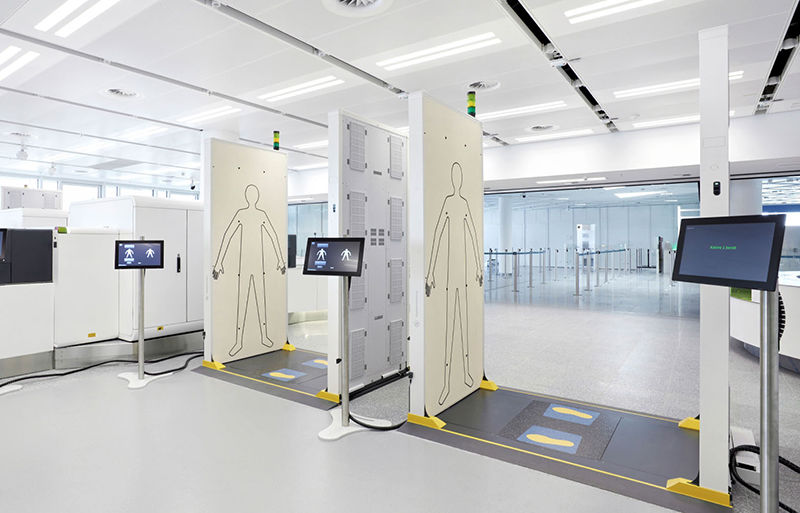
Advanced equipment from Rohde & Schwarz is expected to increase both speed and accuracy of passenger screening.
“The technology is very low power,” he adds. “A one-minute phone call is roughly equivalent to about a million scans, so there’s no [health] impact to the operator or the person being screened.”
Preparing for the Unexpected
Security checkpoints are only one piece of the passenger processing puzzle. The airport is also planning what happens after passengers check their bags. Vanderlande, which handles MCI’s baggage handling system, has been stress-testing capacity with trials that simulate a variety of situations, from increased luggage volume to potential system failures. “They’ve been working to understand what happens if something goes down—and how quickly that information can be communicated,” says Overstreet. The goal is to identify weak points before the first fans arrive, working toward June 1 as a soft deadline.
The airport is also running tabletop exercises that cover a range of scenarios—from road closures to severe weather to transportation disruptions. “We’re not operating in a silo,” Meyer emphasizes. “We’re coordinating closely with other stakeholders.”
That list includes federal agencies like TSA and U.S. Customs and Border Protection, as well as local law enforcement and private partners.
Even with years of preparation and contingency planning, uncertainty remains. The wildcard of international travel demand remains undefined, but airport officials say they are ready to adapt. “Everybody is really focused on making sure Kansas City is ready for whatever comes,” Meyer says.
Game Time
As the giant countdown clock ticks closer to zero, work at MCI continues—refining plans, testing systems and preparing staff for what could be the busiest stretch in the airport’s history.
For Overstreet, the mission is ultimately about people. “We understand that the airport is essentially going to be a lot of people’s first impression of Kansas City, potentially their first impression of the U.S.,” he reflects. “You definitely remember your first and last experiences. So we want to make sure they are as positive as possible.”
On June 26, when thousands of fans converge in the terminal between matches, all of MCI’s preparations will be put to the test.