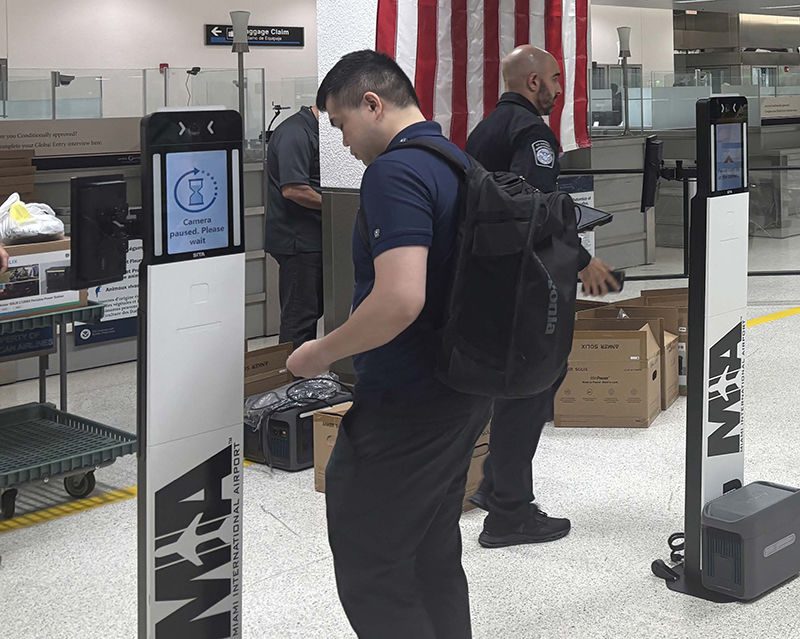
As a major gateway to the United States for overseas flights, Miami International Airport (MIA) must walk a fine line between keeping travelers moving and safeguarding the nation’s borders. This challenge is intensified by sustained growth in international travel, concentrated peak arrival periods and MIA’s role as the primary U.S. gateway to Latin America and the Caribbean.
In 2024, the airport served 55.9 million passengers—7% more than in 2023—ranking it as the 10th busiest airport in the U.S. To keep pace, MIA continually adapts its arrivals operations to balance capacity, security and the passenger experience.
In November 2025, the airport took a major step to modernize by launching the U.S. Customs and Border Protection (CBP) Enhanced Passenger Processing program for eligible arriving U.S. citizens—the largest single deployment of automated passport screening in the country.
| facts&figures
Project: Enhanced Passenger Processing Location: Miami Int’l Airport Site: International Arrivals Facilities in Concourses D, E & J Key Benefits: Improved identity assurance through biometric verification; increased capacity & throughput within existing footprint; improved consistency & predictability of passenger flow; reduced administrative workload for processing staff, allowing greater focus on risk-based assessments Airport Operator: Miami-Dade Aviation Dept. Agency Partner: U.S. Customs & Border Protection Technology Platform: SITA Smart Path Scope: Largest single Enhanced Passenger Processing deployment in U.S. Cost & Funding: Undisclosed Infrastructure: 13 mobile biometric face pods across 3 int’l arrivals facilities Deployment: Nov. 2025 Eligible Users: U.S. citizens (voluntary participation) Biometric Match Time: Approx. 3 seconds/traveler Impact to Facilities: Minimal construction required |
The move reflects a broader strategy at MIA in leveraging automation and biometrics to increase capacity, reduce traveler friction and enhance border security.
“EPP [Enhanced Passenger Processing] supports MIA’s goal of being a global leader in smart airport operations,” says Airport Director and Chief Executive Officer Ralph Cutié. “Biometric processing, leveraging real-time data and automation allow the airport to handle growth without expanding physical space, improve airline on-time performance and deliver a world-class arrival experience.”
Miami-Dade County Mayor Daniella Levine Cava stressed in a press release that Enhanced Passenger Processing is part of a larger commitment to make MIA “one of the most technologically advanced and passenger-friendly airports in the country.”
“It’s all about enhancing the overall experience for the millions of visitors who arrive in Miami-Dade County from around the world every year,” she added.
Modernizing the Border
The airport is using a total of 13 biometric face pods in its international arrivals facilities—seven pods in Concourse D, two in Concourse E, and four in Concourse J.
SITA Smart Path captures biometric photos of passengers during inspection and uses CBP’s biometric facial comparison to verify their identity against government-issued travel documents already in Department of Homeland Security (DHS) holdings. If all goes according to plan, the process takes about three seconds. For an airport like MIA, which processes millions of international arrivals annually, even incremental improvements in transaction time and throughput translate into significant operational benefits.
Using Enhanced Passenger Processing is voluntary for eligible travelers. If preferred, they can opt for verification by a CBP officer instead. However, officials from the airport, city/county and CBP emphasize that using the new biometric technology improves security and creates a smoother, more efficient arrival process for international passengers.
Daniel Alonso, a senior official currently performing director duties at CBP, highlights the operational and strategic aspects. “At one of the nation’s busiest international gateways, the goal was simple and ambitious: move travelers faster, more securely and with less friction while preserving CBP’s law enforcement mission,” he summarizes.
Enhanced Passenger Processing helps CBP and MIA process more passengers within the same footprint, with greater accuracy, fewer touchpoints and improved situational awareness, Alonso explains. In addition, automating identity verification reduces manual document handling, shortens transaction times and allows officers to focus on interacting with travelers and making risk-based assessments.
Because facility expansion is typically costly and disruptive, the ability to increase throughput within MIA’s existing space has been a critical advantage. Shifting identity verification to a biometric-first strategy via Enhanced Passenger Processing helps reduce bottlenecks at primary inspection points while maintaining high confidence in traveler identity, says Alonso.
New Twist
To date, 22 U.S. airports have Enhanced Passenger Processing capabilities. A defining aspect of MIA’s deployment is the use of mobile, wireless-enabled biometric face pods rather than fixed inspection booths. This design gives CBP and the airport operations team greater flexibility in responding to changing passenger flows.
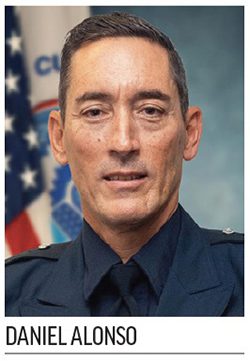 “Pods can be appropriately staffed or repositioned in minutes to respond to fluctuating flight banks, irregular operations or seasonal demand,” Alonso explains. “This allows leadership to dynamically allocate capacity where it is needed most without construction or disruption.”
The system is designed to be passive and intuitive for arriving U.S. citizens. Passengers approach the camera, and the system verifies their identity in mere seconds. A CBP officer then interviews and releases or redirects them. Typically, travelers opting to use Enhanced Passenger Processing do not need to present a passport.
“The benefit is a seamless, contact-reduced experience that is more efficient, intuitive and consistent,” Alonso summarizes.
According to SITA, this streamlined process is possible because the technology creates a unique digital token for each passenger. And the same facial biometric recognition can be used to allow passengers to keep moving when their boarding eligibility needs to be checked.
“Enrollment takes just a few seconds. You can even take it off site with mobile applications,” SITA writes in its brochure titled Your Face is Your Boarding Pass. “There is no need for passengers to carry a paper boarding pass. It is a self-service streamlining process throughout the airport and beyond.”
Reduced Wait Times, Increased Throughput
At MIA, deploying Enhanced Passenger Processing has yielded noteworthy operational benefits.
“EPP has significantly reduced average processing times while increasing throughput,” Alonso reports. “Officers can focus on adjudication and risk-based decision-making rather than on administrative functions, such as swiping a document or conducting manual system checks. During peak arrival periods, the system enables CBP to process more travelers per hour without adding staff or booths, resulting in a 25% decrease in U.S. citizen wait times nationwide, shorter lines and more predictable passenger flows.”
Improving wait times and throughput directly affects passenger satisfaction, connection reliability and overall terminal congestion. Shorter and more predictable wait times also support better coordination with airlines and ground handling operations, particularly during peak international arrival banks.
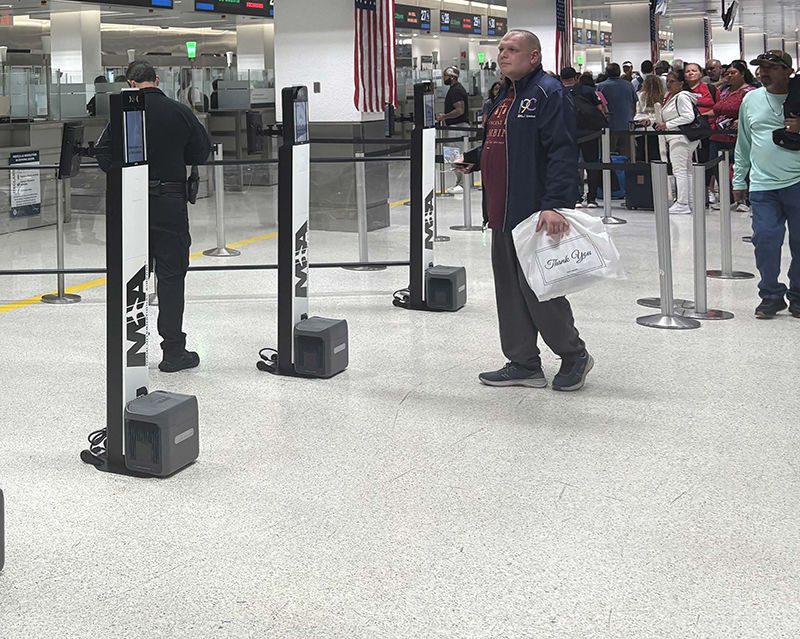
While speed is a major benefit, Alonso emphasizes that Enhanced Passenger Processing is designed to improve security.
“Security is not traded for speed. It enhances it,” he stresses. “Biometric matching provides a higher confidence of identity verification than visual document inspection alone. Officers at EPP pods can fully process biometrically confirmed travelers while redirecting travelers requiring additional screening to an inspection booth, enabling officers to tailor each inspection appropriately. Travelers who require added screening receive it, while low-risk travelers move efficiently. This is risk-based border security at scale.”
Passenger and Staff Response
Early feedback from eligible travelers at MIA has been positive, reinforcing the value of reducing friction at one of the most stressful points in the passenger journey.
“Travelers consistently report the process feels faster, easier and more modern,” Alonso remarks. “Many travelers, particularly those who fly regularly, note that they moved through the inspection process more quickly and with less confusion. For families, older adults and connecting passengers, the simplified flow reduces stress and uncertainty.”
The deployment is also boosting operational monitoring.
“Real-time dashboards give CBP supervisors and airport operations teams visibility into queue length, throughput and system status,” Alonso specifies. “This enables proactive staffing, rapid troubleshooting and continuous optimization of passenger flow. It turns the arrivals experience into a strategic operation rather than a reactive environment.”
He adds that this type of operational intelligence aligns with broader airport trends toward data-driven decision-making, enabling teams to anticipate congestion, adjust staffing and respond to irregular operations more effectively.
Integration with Existing Infrastructure
Much to the delight of MIA and other airports, Enhanced Passenger Processing typically requires minimal physical changes to facilities.
SITA’s Smart Path technology can operate in the cloud, on-premises, in hybrid fashion or as a service. Marketing materials from the company note that open application programming interface architecture enables it to integrate with existing infrastructure. Because the technology is interoperable with third-party biometric services, airports can start small and scale up as their goals and challenges change.
This and other flexibilities simplified MIA’s implementation, notes Alonso.
“CBP developed EPP to augment and automate traveler processing by reconfiguring data flows and leveraging existing systems to automatically capture travelers’ faces, verify identity, conduct standard primary system vetting, confirm the traveler and create a biometric cross-reference record in CBP systems,” he explains. “At MIA, CBP, airport officials and SITA coordinated to ensure a smooth launch by proactively testing, training, [making] queue changes and updating technology.”
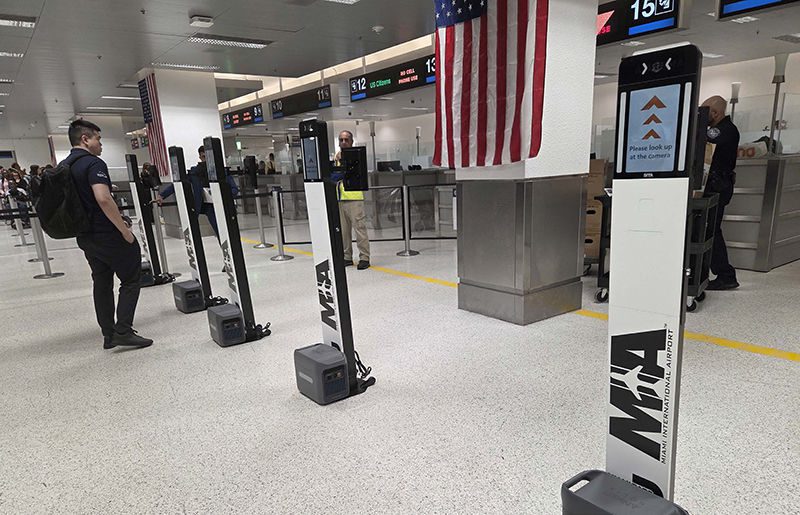
Eligible U.S. citizens arriving on international flights can choose to use biometric facial recognition technology for automated passport screening.
In the end, only limited facility modifications were needed. “Minor changes were made to the queueing to ensure travelers move through the EPP process more quickly,” Alonso notes.
CBP and MIA emphasize that collaboration was critical to the success of the deployment.
“This was a true partnership,” he adds. “CBP and MIA aligned on shared objectives: security, efficiency and passenger experience. From facility design to data integration and staffing models, both organizations worked side by side to ensure the system met operational, regulatory and customer service requirements.”
Broader Digital Transformation
The recently added Enhanced Passenger Processing program is just one part of MIA’s larger strategy focused on smart airport operations and long-term scalability.
 “International travel at MIA is projected to continue its upward trend. EPP allows MIA and CBP to scale capacity digitally rather than physically—and maintain a consistent traveler experience even as volumes increase,” says Cutié. “It represents the future of border processing: secure, data-driven, flexible and traveler-centric. It enables CBP to better protect the border and gives MIA a competitive advantage as a global gateway.”
The deployment at MIA seems to reflect broader trends across the continent. According to SITA’s latest annual benchmark report, 53% of North American airlines are investing in biometric and digital identity management, while nearly 60% have implemented touchless passenger flow technologies.
According to Shawn Gregor, SITA’s president for the Americas, Enhanced Passenger Processing is setting a new standard for efficiency at the border by using biometrics to make arrivals smoother, faster and more secure for everyone. It can also easily scale over time to additional terminals and to handle increased capacity, he adds.