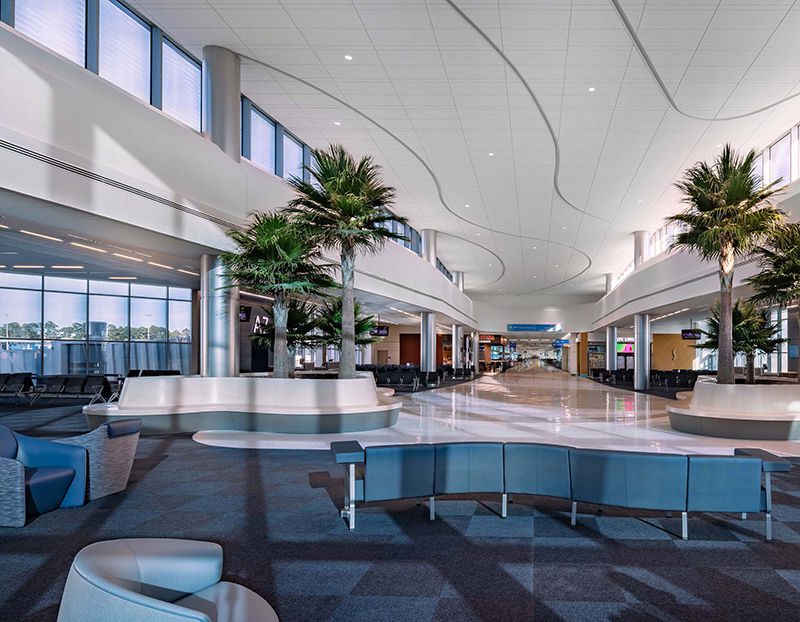
Myrtle Beach International Airport (MYR) recently completed one of its most comprehensive terminal expansion and modernization efforts ever, adding capacity, upgrading infrastructure and reshaping the passenger experience. The $95 million program was specifically designed to create a terminal that is more functional and more welcoming for travelers arriving and departing South Carolina’s Grand Strand region.
The inherent challenges of serving ever-rising passenger volume in facilities originally designed for small regional jets prompted MYR to update the terminal for its new fleet mix. Specifically, the project added 50,000 square feet and six new gates to Concourse A, while also modernizing public areas and renovating 12 existing gates throughout concourses A and B. Key features include larger holdrooms, clearer passenger flows and better amenities for an improved customer experience.
Although planning for the expansion and renovation began before the COVID-19 pandemic, the airport’s notably rapid rebound accelerated the project timeline. When area beaches welcomed tourists back for Memorial Day in 2020, MYR became one of the nation’s fastest-recovering airports “The beach was open for business all day,” remarks Judi Olmstead, director of Airports for Horry County. “A lot of families had their kids on the beach while they were working remotely.”
| facts&figures
Project: Concourse A Expansion & Terminal Modernization Location: Major Components: 6 new gates on Concourse A; renovation of 12 gates on concourses A & B; new flooring; renovated restrooms; new signage & wayfinding; wider passenger circulation corridors; new power infrastructure; upgraded special systems; additional seating with built-in power Key Benefits: Added capacity; improved passenger flow; upgraded amenities; brighter & quieter public spaces; clearer wayfinding; enhanced accessibility; scalable infrastructure to support future growth Project Size: 50,000 sq. ft. expansion; 65,000 sq. ft. renovation Cost: $94 million Funding: Passenger Facility Charges; Airport Improvement Program; SC State Aeronautics Funds Construction/Renovation: Owner’s Authorized Rep/ Program Management: Accenture Architect: Gresham Smith Construction Manager at Risk: JE Dunn Construction + Southside Constructors Joint Venture Special Systems Engineering: Arora Engineers Mechanical, Electrical & Plumbing Engineering: AME Landside Civil Engineering: DRG Airside Civil Engineering: Jet Bridges: Oshkosh AeroTech Terrazzo: David Allen Co. Furniture & Seating: Electrochromic Tinting Windows: SageGlass Restroom Fixtures: Temporary Construction Wall: SwiftWall |
Fortunately, the nimble project team was able to accelerate both design and execution of construction. In fact, work was completed roughly six weeks ahead of schedule and about $4.5 million under budget. Remaining funds were earmarked for similar improvements in other areas of the airport.
Today, MYR serves more than 50 destinations via 10 airlines, and it continues to pursue expanded air service, including the return of its pre-pandemic non-stop flight to Toronto. “We’re always attempting to get Canadian traffic back with the golfers, as well as other international opportunities,” says Olmstead, adding that the West Coast is another focus for service development. “We’re always hoping for L.A. or Vegas.”
The project was delivered by a joint venture of JE Dunn Construction and Southside Constructors, with Gresham Smith serving as prime design consultant and Accenture as program manager. Construction began in June 2024 and reached substantial completion 17 months later, followed by a ribbon-cutting celebration on Dec. 1, 2025.
New Gates and Terminal-Wide Upgrades
“When our existing concourses A and B were constructed, the holdrooms were sized around smaller regional jets,” says Breck Dunne, director of Airport Development for Horry County. As the airport began accommodating a variety of larger aircraft in recent years and overall passenger volume grew, the need for additional gates and associated concourse space became increasingly critical. “It’s important for us to capture a holdroom size appropriate for those larger aircraft,” Dunne comments.
Traveler demographics added yet another challenge. “Being a resort market, we see a high influx of passengers from the hotel checkout window of roughly 10 a.m. to 2 p.m., so our circulation areas get really congested,” he explains. “It was important for us to capture larger circulation corridors in this project as well.”
The design team alleviated these pressures by widening corridors, redistributing seating and improving sightlines so passengers can intuitively move through the terminal even during peak congestion.
Improving the Passenger Experience
In addition to addressing aircraft needs and capacity issues, project designers focused on enhancing the passenger experience. “We targeted noise, outdated finishes and visual clutter,” summarizes Brad Sucher, senior vice president of Gresham Smith.
Olmstead acknowledges that parts of the terminal had fallen well behind current standards. For example, Concourse B was built more than 20 years ago and had received minimal updates. “We needed to just modernize the whole experience,” she says. The airport made terminal upgrades throughout the terminal to help visually connect newly constructed areas with existing facilities.
New finish materials were specified to improve both performance and passenger comfort. Tile flooring in public circulation areas was replaced with terrazzo to dramatically quiet the terminal and amplify natural light. The new flooring is also more durable, notes Sucher.
All public restrooms were rebuilt with additional capacity, enhanced comfort, updated accessibility and more modern fixtures. “Touchless amenities such as soap, water and a hand dryer are all right next to one another, so you never take your hands away from the sink,” Olmstead notes. New features include a family restroom, a mother’s room and an ADA-compliant restroom with an adult changing table.
Seating is another aspect designers changed to meet evolving passenger needs. Legacy beam seating was reduced by roughly 50% and redistributed throughout the terminal. Different types and configurations were also added. “We implemented a blended seating strategy that supports different dwell times and creates visual ‘neighborhoods,’” Sucher explains. “Traditional tandem seating preserves capacity, while lounge clusters, café-height tables, companion/accessible options and work-top counters provide choice and comfort.”
Work-top counters were placed strategically along viewing area and circulation edges to visually break up holdrooms, soften sightlines and offer productive perches, he notes. Now, guests can charge their electronic devices in any seating area.
Designing for Light, Views and Spatial Clarity
Openness, scale and visual connection were key areas of focus throughout the expansion and renovation. From the inception, designers sought to create an environment that feels both expansive and intuitive, while preserving close ties to views of the airfield. “You’ve got all this natural light pouring in, and there’s a clear line of sight all the way back into the existing [structure], including baggage claim and the exit lane,” Sucher describes. The result is a concourse that visually connects passengers not only to their gates but to the terminal as a whole.
Concourse A was extended as close to the runway as allowable, with a floor-to-ceiling curtain wall and clerestory windows to provide abundant daylight and reinforce the visual relationship between passengers and activity outside on the airfield. “As a plane goes by, you almost feel like you can reach out and touch [it],” Sucher says. Electrochromic glazing from SageGlass was incorporated along key façades to mitigate glare while preserving unobstructed views to the apron.
As part of the broader wayfinding effort, Gresham Smith studied sightlines and visual hierarchy across the terminal to optimize intuitive flow. “This reduced visual noise, opened cross-terminal views and reinforced intuitive circulation so passengers can see where they need to go sooner,” Sucher remarks. These improvements will be particularly important when the terminal experiences peak volume during busy tourist seasons.
 Rather than simply adding more signage, the project focused on streamlining and repositioning existing cues at key decision points. “One of the things we felt was important was to modernize our signage, simplify it, so there would be a little less congestion on the signage,” Dunne adds. Floor patterns, ceiling heights and material transitions were also used to subtly reinforce direction and passenger flow.
A Coastal Sense of Place
Designers worked to weave references to Myrtle Beach’s coastal identity into the project in a way that feels modern rather than thematic. Color palettes, materials and finishes throughout the terminal draw inspiration from the surrounding shoreline, allowing the architecture and interiors to quietly reinforce the airport’s role as a gateway to the leisure destination. “The terrazzo incorporates some ‘beachy waves and sand’ type of feel,” Dunne offers as one example.
Coastal sense of place is most visible in the new central hub, where preserved regional palm trees were installed among bench-style seating to introduce a natural focal point while reinforcing the openness and light emphasized throughout the design. Positioned to preserve clear sightlines to the airfield and surrounded by daylight from the curtain wall, the palms help ground the concourse in its geographic context without overwhelming the passenger environment, notes Sucher.
The local references continue into the restrooms, which were rebuilt and modernized. “There’s a pixelated wave graphic that also gives that beach vibe as you walk into the restrooms,” Dunne describes. Blue-toned glass partitions and coordinated finishes reinforces the beachy vacation feel while maintaining a clean, contemporary aesthetic, he adds.

All public restrooms were renovated and modernized.
Aligning Scope, Budget and Stakeholders
The project was delivered using a construction manager at risk model. JE Dunn Construction, in joint venture with Southside Constructors, provided early preconstruction services and then served as construction manager during the build. Early involvement allowed the firm to hone its strategies.
 “We came up with an alternative approach of boring all the electrical over to the expansion, versus tearing roof up and potentially having that risk,” shares Nick Christoffersen, JE Dunn vice president – Aviation Group manager. “That was a time savings and also saved the airport a lot of money by not having to do all that work.”
Accenture served as the Owner’s Authorized Representative, providing comprehensive program management services throughout the project. The firm worked closely with the MYR Finance Department on financial controls and contract compliance services, tracking alignment between the established scope, schedule and funding.
“The project’s success was driven by ensuring a clearly defined scope, which ensured that stakeholders, contractors and decision-makers shared a unified understanding of project requirements, which reduced ambiguity and minimized rework,” says Cassie Krautsack, director of Program Management with Accenture. This clarity helped keep the team focused on delivering the intended improvements without unnecessary changes that could have adversely impacted the cost or schedule, she details.
Communication and risk management played a big role in maintaining momentum as the project moved from planning into construction. “Robust communication enabled the team to anticipate potential changes early and resolve issues before they created delays or financial impacts,” Krautsack notes. Consistent coordination with stakeholders supported transparency and timely decision-making, and proactive contingency planning helped ensure risks were identified early in the process, she elaborates.
“This project stands out as a model of collaborative airport delivery because every stakeholder—from airport leadership to Horry County officials, contractors and program management partners—operated with a unified understanding of goals, constraints and priorities,” Krautsack adds. This alignment helped minimize friction, allowing each partner to focus on its responsibilities while maintaining a shared commitment to delivering a high-quality terminal expansion, she says.
Christoffersen, from the construction side of the team, ranks the collaboration exhibited on the MYR project as some of the best he’s ever experienced.
Business as Usual
Meeting an aggressive construction/renovation schedule while continuing full daily airport operations was perhaps the most complex aspect of the project. “We renovated our entire existing building—the flooring and signage and all the restrooms—all while maintaining 24/7/365 operation,” Dunne reflects. The scope included work in active concourses, holdrooms and passenger corridors, adding complexity to every phase of construction.
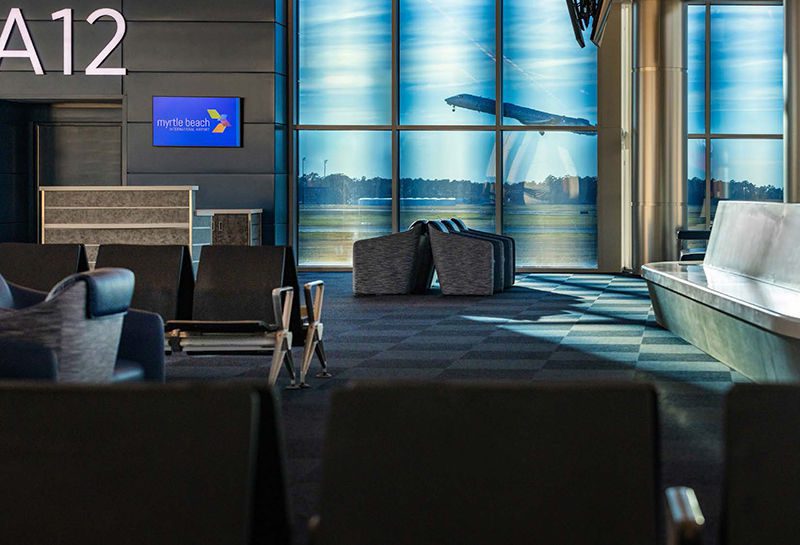
New holdrooms were designed to accommodate the passenger loads of larger aircraft.
To reduce operational impacts, the project team adopted an “island” approach, completing most of the expansion independently from the active terminal and then connecting the areas when new construction was almost complete. Contractors installed a temporary barrier, the SwiftWall Pro, at the end of the concourse to physically separate work zones from ongoing airport operations and create a more controlled construction environment. Beyond limiting disruptions to both passengers and airline partners, the strategy helped manage security requirements and streamline construction sequencing.
 Renovating the existing building, however, was an entirely different matter. Restroom renovations, flooring replacement, signage updates and utility work all had to be carefully phased to avoid interrupting airline schedules and passenger flow. “We had to close gates…we had to move one of our existing gates to make it fit within the new area,” Olmstead recalls. “All that was tough.”
To manage these challenges, the project team relied on detailed phasing plans that accounted for seasonal traffic patterns and daily peak periods. Work was frequently scheduled overnight, on weekends and during off-peak travel windows to minimize impacts. Temporary passenger routes, coordinated gate closures and constant communication with airline partners were critical to maintain operational continuity. Weekly coordination meetings and near-daily field adjustments allowed the team to respond quickly as conditions changed, with a focus on passenger safety and customer experience.
Special Systems and Future Readiness
Integrating telecommunications, audio-visual and security systems into existing infrastructure while the airport maintained full operations required careful sequencing and coordination. Special systems planning was emphasized as a critical project component to ensure that facilities remain resilient and adaptable as passenger volumes, technology and security requirements continue to evolve.
Working as a subconsultant to Gresham Smith, Arora Engineers provided special systems engineering and associated construction-phase services across the new concourse and renovated terminal spaces. Heath Kolman, vice president and special systems practice lead at Arora Engineers, notes that collaboration with TSA, airlines and airport Operations staff guided system cutovers and deployment schedules to ensure uninterrupted security, communications and operational visibility.
 Early coordination was central to the design approach. “System redundancy and future capacity were addressed through early planning of the telecommunications and security systems architecture to support both current operations and future expansion,” Kolman explains. Planning began during schematic design and continued through design development, allowing system layouts, pathways and equipment locations to align with the airport’s long-term goals.
Special systems infrastructure was designed to integrate seamlessly into the existing terminal while preserving reliability. Redundant network pathways, ownership-based cabling separation and carefully planned telecommunications spaces will allow systems at MYR to scale without requiring major reconfiguration, says Kolman. Wireless infrastructure planning was developed to support future growth as well.
Operational reliability was further supported through coordinated power distribution planning.
“While glazing and lighting were outside Arora’s direct scope, power distribution coordination—including UPS [uninterruptible power supply] and emergency generator coordination—was critical to ensuring reliable operation of communications, audio-visual and security systems,” Kolman notes.

Natural light, preserved palm trees and a coastal color palette let visitors know they are in the Grand Strand region.
Ultimately, the company’s work is designed to create a strong foundation for future growth. “The project established a scalable special systems framework that allows future growth within the planned telecommunications and systems infrastructure footprint,” Kolman summarizes. This approach positions MYR to integrate future security and terminal system upgrades efficiently with minimal disruption.
Lessons Learned
As MYR reflects on the completion of its concourse expansion and terminal renovations, project partners point to early alignment, disciplined planning and strong collaboration as key drivers behind its success. From the airport’s perspective, the project delivery method proved critical. Olmstead emphasizes its value in managing complexity and maintaining momentum. “Utilizing a construction manager at risk…was just very successful for us,” she says. Early contractor involvement helped set realistic expectations around cost, phasing and constructability, adds Olmstead.
Christoffersen, from JE Dunn Construction, encourages engaging contractors as soon as possible. “The earlier that we can act as a team and provide input on design and schedule, the more we’re able to influence when projects will open and the total cost of the project,” he remarks, adding that delayed engagement can limit flexibility later in the process.
Accenture’s Krautsack correlates early alignment and scope discipline. “One of the biggest lessons is the value of establishing a clearly defined scope before any major decisions or procurement activities begin,” she says. Alignment across airport leadership, county partners, contractors and program managers helped prevent rework and scope creep, Krautsack explains.
Kolman, from Arora Engineers, also highlights the value of early involvement. “Integration of special systems engineering in the early design process, proactive capacity analysis, planning for redundancy and scalability, and careful coordination within active terminal environments are key takeaways from this project,” he summarizes.
Airports should think holistically about any expansion project—rather than limiting improvements to new construction alone, adds Sucher, from Gresham Smith. “Use expansion as a catalyst to elevate the whole terminal,” Sucher advises, pointing to MYR’s decision to invest in flooring, restrooms, seating and wayfinding for existing spaces.

The recent expansion and modernization project was one of the airport’s most comprehensive initiatives ever.
What’s Next
With the concourse expansion complete, MYR is already moving forward with additional phases of its long-term capital improvement program.
The next project on the horizon is to expand the security screening checkpoint from six lanes to nine and add more queue space. The original terminal design anticipated the need to increase capacity and throughput; continued growth in passenger volume made now the time.
Beyond the terminal, MYR is embarking on a multi-phase runway reconstruction program that will be one of its most significant infrastructure investments ever. Phase One begins early this year and will be a two-year project. Phases Two and Three are each expected to last six to eight months. The phased approach is designed to maintain airfield operations during construction.
These and other efforts are part of MYR’s larger effort to modernize its facilities and accommodate sustained traffic growth while remaining fiscally responsible to the community it serves. As passenger demand continues to evolve, airport leadership says the upcoming projects are essential to maintaining operational resilience, supporting airline partners and delivering a consistent, high-quality passenger experience well into the future.