Traffic jams are not what most people picture when they think about the Hawaiian island of O’ahu. Sitting on a beach watching the waves with a tropical drink in hand? Definitely. Stuck in bump-to-bumper traffic? No thanks! But that has been the frustrating reality for both local residents and passengers at Daniel K. Inouye International Airport (HNL) in Honolulu.
More than 21 million travelers board and deplane at HNL, and the airport and its tenants collectively employ about 35,000 people, with many adding to perennial congestion on Highway H1. In general, traffic is “horrendous” from the west side of O’ahu—where many islanders live—to HNL and downtown, acknowledges Lori Kahikina, executive director and chief executive officer of the Honolulu Authority for Rapid Transportation (HART).
“We’re talking maybe about 15 to 20 miles, and it can take people over two hours to travel that corridor,” Kahikina explains. “We needed some relief.”
| facts&figures
Project: Train Guideway & Stations Location: Daniel K. Inouye Int’l Airport, in Honolulu Scope: 5.2-mile extension of Skyline electric train system; 4 new stations (including airport) Service: High-speed connection between city & airport for travelers & employees Frequency: Every 10 min. 4 a.m.- 8:30 p.m.; every 15 min. 8:30 p.m.-10:30 p.m. Airport Station: ADA-compliant access; closed-circuit video cameras & security; emergency phones & call-boxes; info displays for train departure times; automated voice announcements; ticket vending machines; bicycle parking; TheBus & TheHandi-Van connectivity; direct access to airport parking lot & terminals; wayfinding to/from station & airport Number of Trains: Est. Cost: $10.08 billion (including financing costs) Funding: 83% local taxes; Timeline: State legislature authorized funding in 2005; groundbreaking in 2011; Segment 1 started service in 2023; airport station opened Oct. 2025 as part of Segment 2 Systems Consultant: Lea+Elliott Airport Guideway & Stations: Shimmick/Traylor/Granite (STG) Joint Venture City Center Utility Relocation: Frank V. Coluccio Construction Co. Inc.; HMS Construction; Nan Inc. City Center Guideway & Stations: Tutor Perini Corporation Core Systems (project wide): Hitachi Rail Honolulu Joint Venture On-Call Construction (project wide): Nan Inc. Key Benefits: Traffic relief for employees & passengers traveling to/from airport |
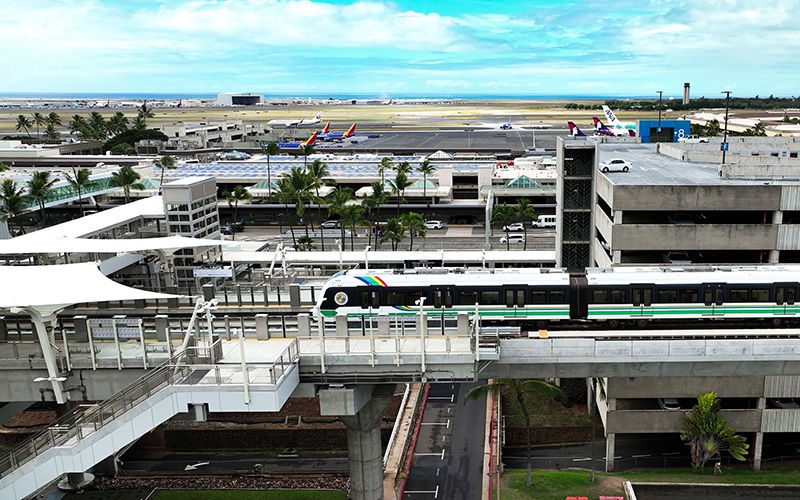
Skyline, Honolulu’s elevated train system, was extended from East Kapolei in the southwest quadrant of O’ahu to HNL in October 2025 to help address the persistent issue. While this doesn’t solve all of the traffic problems, it offers locals and HNL passengers another transit option. And there’s more to come. The train system is scheduled to go all the way to central and downtown Honolulu and neighborhoods on the east side by 2031.
More Efficient Option
While HART is the public transit authority responsible for planning and constructing Skyline, the city Department of Transportation Services manages its operation and maintenance. Roger Morton, Department of Transportation Services director for the city and county, was tasked with helping HART manage the system side of the project.
Morton’s department also focuses on 40- and 60-foot buses that serve visitors and employees at the airport, and the bus system will now connect the new rail end points to popular destinations. With the debut of the train system a few years ago, the Department of Transportation Services and HART have established a pathway to improvement with future segments. It also expands local public transportation from the perspective of security (buses were scrutinized as potential targets after 9/11) and sheer people-moving volume. Kahikina notes that one Skyline train can fit approximately 800 passengers, which is the equivalent of about 10 city buses.
Recent improvements to the train system are designed to work in concert with the bus system to make a difference for tourists in a state where tourism is incredibly important. They are also critical for HNL’s workforce and anyone even tangentially associated with transport in Hawaii.
“We’ve talked about the airport connection being important for visitors, but we should not forget the 15,000 airport workers who rely on the train to get to work,” Morton says. “If you drive to the airport, you have to park and then wait for the shuttle. The train makes it so much better now.”
O’ahu has limited space for infrastructure expansion, as the roadways are fixed between the ocean and mountains. In the event of a major traffic event, there is no place for drivers to go; they are just stuck. From that viewpoint, HART and the Department of Transportation Services see Skyline as a solution that was long overdue.
“O’ahu’s corridor is about 40 miles long and three miles wide,” Morton explains. “The interior of the island is forest and watershed, unsuitable for development, while the amount of developed land is very limited. As a result, we have some of the highest population densities along that primary urban corridor, which causes terrible traffic. A high-speed rail helps us solve our traffic problem.”
Huy Huynh, HART core systems director and principal for systems consultant Lea+Elliott, remembers speaking with Hawaii residents many years ago who would rise before dawn to beat traffic into the city. Sometimes they would arrive at work and go back to sleep in their car. Now, they can take a time-conserving train, complete with Wi-Fi service.
Transit Upgrade
The trains are powered by electricity via a third rail that supplies the current, and are fully driverless. Train manufacturer Hitachi says the benefit of an automated system like this is safety, as the element of human error is removed from the equation. If there is an issue, passengers can call for assistance from the train and at the stations via emergency telephones. More than 2,100 cameras transmit video information to the control center, which enables staff to respond quickly in an emergency.
All trains are air-conditioned and include Wi-Fi, an attractive feature for commuters. Riders can bring large items like bicycles, surfboards, baby strollers and luggage, and the cars have dedicated spaces for wheelchairs and are fully compliant with the Americans with Disabilities Act. These features serve tourists and residents alike, every day of the week. In addition to the train, the Department of Transportation Services for the city and county of Honolulu added buses in congested mixed-flow traffic to serve rapidly developing areas.
The first segment of Skyline opened on June 30, 2023, transporting residents and visitors from East Kapolei to Aloha Stadium, covering 10.75 miles with nine stops. In October 2025, Segment 2 officially started bringing riders to the HNL station, adding 5.2 miles and four stations along the way. Segment 3 will go further east to central and downtown Honolulu. It’s currently under construction and scheduled to begin service in 2031. When that occurs, the system will span nearly 19 miles with 19 stations in all.
Skyline’s elevated guideway is about 30 feet wide to accommodate two sets of tracks and was constructed in precast concrete segments. The guideway is supported by cast-in-place concrete piers on drilled shafts that vary in depth, starting at 30 feet. One shaft is 357 feet, which is considered the deepest cast-in-place shaft in the world, according to the American Society of Civil Engineers.
When traveling east, the train stop for HNL is the stop just after the station at Pearl Harbor, making an efficient line between the two popular destinations.
Pearl Harbor, a military base where 2,400 Americans lost their lives in an aerial assault during World War II, is a major tourist site. In addition, Joint Base Pearl Harbor-Hickam supports both Air Force and Navy missions, hosting about 100,000 people. The Pearl Harbor area alone represents roughly 10% of Oahu’s total population (plus a heavy annual volume of tourists). The new train service makes traveling to the area much easier.

A new train station provides direct access to the terminals and airport parking.
Long Path to Success
According to HART, the seeds of this project were first planted two decades ago. In 2005, the Hawaii State Legislature authorized a General Excise Tax to provide funding for local mass transit. However, the ceremonial project groundbreaking at the Kualaka‘i (East Kapolei) Station didn’t happen until 2011, and Segment 1 wasn’t completed until 2023.
 Along the way, there were several delays, including a State Supreme Court ruling about archaeological studies in 2012. “Native Hawaiians bury their ancestors, and we have utmost respect for their remains,” Kahikina explains. “When we encounter iwi [Hawaiian for the bones of native ancestors], we have to go through a historical preservation process, contact the lineal descendants and ask if they want to intern in place or put them back very respectfully once the construction is completed. It’s a cultural issue we have run into over the years and we are addressing that along the route to downtown Honolulu as well.”
The project also includes the Mauka Shift, a plan to move a section of the rail guideway from the center of Dillingham Boulevard to the inland side of the street to avoid subterranean utility lines. Under Dillingham Boulevard is what Kahikina jokingly calls “a spaghetti noodle nest” of utility infrastructure that has been in place for decades. Not surprisingly, the snarled web of electricity, water, sewer and fiber optics lines are not mapped well, which makes inadvertently cutting into them far too easy.
“When that happens, trying to keep on schedule can be very, very challenging,” Kahikina remarks.
The underground utility lines and electric transmission lines above ground on both sides of Dillingham Boulevard continue to present potential problems and delays that HART is working hard to anticipate.
On the ocean side, aboveground power lines can’t all be moved underground due to space. The design team determined that moving the guideway to the mountain side of the street addresses this problem and avoids the need to move other existing underground utilities. The total savings: a cool $150 million, plus reclaimed project time.
More Smiles, Less Stress
Huynh calls the train extension a mega project that brings a great deal of benefit to the community and city. “It’s not easy to implement such a huge project so far away from the mainland,” he says. “Collaboration and technical integration are so critical to manage different moving parts.”
 Now that trains run to/from the HNL station every 10 to 15 minutes depending on the time of day, Morton is excited that future generations will grow up with fewer memories of being stuck in traffic. So far, feedback is very positive and ridership continues to increase.
“Whether the riders are local or tourists, when they ride the train, they are smiling,” Morton says. “Number one, they have a great view from the train because it’s elevated and you see things you don’t see from the highway.”
Kahikina notes that tourists from Japan and Europe who are already accustomed to multimodal transportation systems find Skyline efficient and familiar. She also reports that train ridership has jumped from an average of about 4,000 people per day to more than 10,000 since Segment 2 opened recently.
“It’s not going to be a cure-all, but at least it will give people a different option,” she remarks.