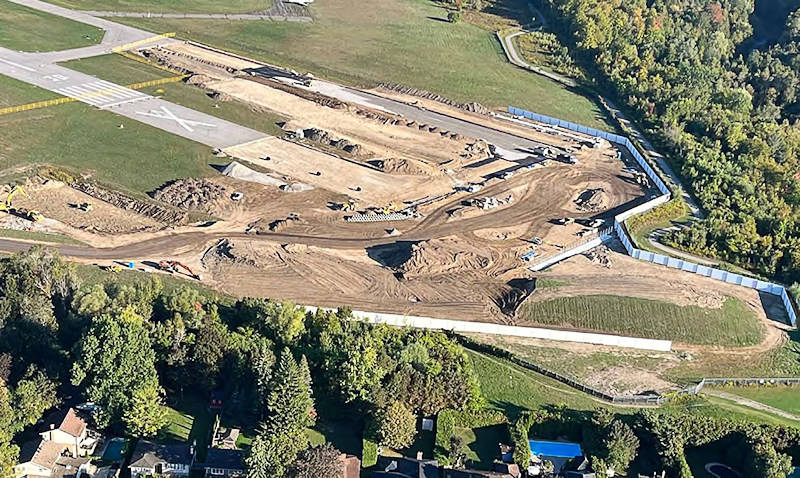
Being one of the busiest general aviation airports in Canada is both a blessing and a curse for Oshawa Executive Airport (YOO) in Ontario. With a healthy customer base and about 100,000 aircraft operations per year, the city-owned facility is considered to be a success. But the active traffic often puts airport officials at odds with nearby residents concerned about the associated noise.
“Oshawa has 14,000 residents who live within 2 kilometers of the airport,” explains Airport Manager Stephen Wilcox. “We are sensitive to their situation, and we want to be a good neighbor. So in the last year, we have really stepped up our efforts to reduce noise levels from aircraft operations.”
The airport’s long-term goals cover several areas:
- Reducing overall noise levels,
- Reducing the frequency of flights,
- Modifying based aircraft, and
- Changing the height and altitude of departing aircraft
| facts&figures
Project: Runway Improvements Location: Oshawa Executive Airport, in Ontario Runway: 12-30 Scope: Lengthening both ends of runway; adding 1 new taxiway & extending another; adding blast deflectors & acoustic fencing Cost: $6.6 million Funding: City of Oshawa Airport Manager: Engineering Consultant: Chief Contractor: Airfield Electrical Engineering: Municipal Engineering Support: civilGO Engineering Geotechnical Engineering: Blast Deflectors: Acoustic Fencing: Groundbreaking Foundations Inc. Noise Wall Panels: Design & Construction: Key Benefits: Improved airfield safety; noise reductions; ability to accommodate larger aircraft |
The last point was the focus of a recently completed construction project that extended the length of YOO’s main runway (12-30) from 4,250 feet to 5,057 feet. The northwest Runway 12 end received the most attention, because many of the homes that directly border the airfield are located under the departure path for that runway. More space was added at the end of Runway 12 so planes taking off from it can get in the air faster.
To obtain the greatest benefit, the airport lengthened the runway at both ends, and used displaced thresholds to allow for appropriate obstacle protection according to Transport Canada standards. “At the Runway 12 end, we added pavement, allowing for a runway starter extension supporting Runway 12—the first of its kind in Canada,” Wilcox details.
This starter extension is unique because typically, there is a large, flat grassy area before the end of a runway. Depending on an airport’s certification, it is either a runway strip or runway end safety area. Either way, the purpose is to provide a flat area in case an airplane lands short before the runway, or lands long and runs off the end of the runway. But when aircraft are taking off, these grassy areas serve no purpose. “We paved the big flat grass area to allow a pilot to use it for takeoff, thus increasing the runway takeoff length,” Wilcox explains. “If an airplane lands short, the pilot is now landing on pavement, not grass. And if an airplane trying to land touches down long, the pilot now may overrun the runway onto pavement instead of grass. The other benefit is that there are fewer birds on the threshold because there is no grass full of bugs for them to eat.”
The change is also designed to have a positive impact on noise. “With this extra space, a G500 jet or even a small plane taking off from Runway 12 will be 50 stories higher as it lifts off, resulting in a significant noise reduction,” Wilcox explains.
In addition to adding a taxiway that connects with the new departure areas at the 12 end, the airport also extended existing Taxiway B by 250 feet at the 12 end. “This helped because planes now do not need to turn around and go backward to get to the end of that runway,” Wilcox explains.
At the Runway 30 end, YOO added 357 feet of pavement and extended the taxiway 607 feet. The normal 200 feet of flat grass threshold was moved back to accommodate these changes.
For initial planning, detailed design, tender preparation, contract administration and eventual construction oversight, the airport hired HM Aero, an engineering consultant based in Ottawa, ON, that has worked with YOO since 2019. But this project was different. The firm started the design process in January 2025, and everything (including construction) had to be completed in just 10 months.
“We employed our detailed knowledge of airport standards and recommended practices in Canada and internationally to optimize the runway as much as possible, so that aircraft could get in the air faster when taking off, resulting in them being at a higher altitude flying over homes,” says HM Aero President Adam Martin.
“We were grateful for the opportunity to bring our niche planning and engineering skills to this assignment,” he adds. “The challenges presented by the site constraints and the requirement to maintain aircraft operations enabled us to think outside of the box, and it was a pleasure to work with a client that was informed and engaged throughout the entire process.”
Preparation Pays Off
Another key element was getting approval from Transport Canada for the runway improvements, and, more immediately, plans to shorten the runway from 4,250 feet to 3,200 during construction. “This was a substantial reduction that required careful planning and analysis,” Martin remarks. “Besides being significantly shortened, the open and closed sections of the shortened runway were changed several times. “Communication was essential for this project,” he adds, “and we worked closely with the airport and the air traffic services provider—NAV Canada.”
 Before construction started, the airport held meetings with tenants and other stakeholders. Although the presentations were informal, they were very important, stresses Wilcox. “In the past, local residents had strongly opposed any sort of runway expansion. They were worried that any new project would just increase aircraft noise,” he explains. “So for this new project, we really had to show how this expanded runway would actually cut down on the noise, especially from aircraft taking off.”
Materials and drawings supplied by HM Aero helped airport management obtain support for the concept, and the project was approved by various government entities. The city of Oshawa finalized a $6.6 million budget, and construction was scheduled from early September to mid-October—a period that traditionally has the most cooperative weather for outdoor work.
Some tenants were temporarily inconvenienced during construction, namely those operating larger corporate jets or military aircraft that need all 4,250 feet of the runway for safe operations. However, the construction period was minimized to the best extent possible, the weather cooperated, and construction was finished on schedule in October 2025.
Noise Barriers and Blast Deflectors
Beyond lengthening the runway to get aircraft and their associated noise in the air faster and higher, YOO also installed noise barriers at the tip of Runway 30 and along its connecting taxiway.
The fencing, from Groundbreaking Foundations Inc., interrupts sound waves generated by aircraft on the ground. Project designers selected the product for its ability to reduce ground noise by 5 to 10 decibels as well as its general aesthetic appeal.
The sound barrier system uses galvanized steel posts and reflective rigid polyvinyl chloride (RPVC) sound wall panels that meet ASTM E90 sound transmission loss requirements.
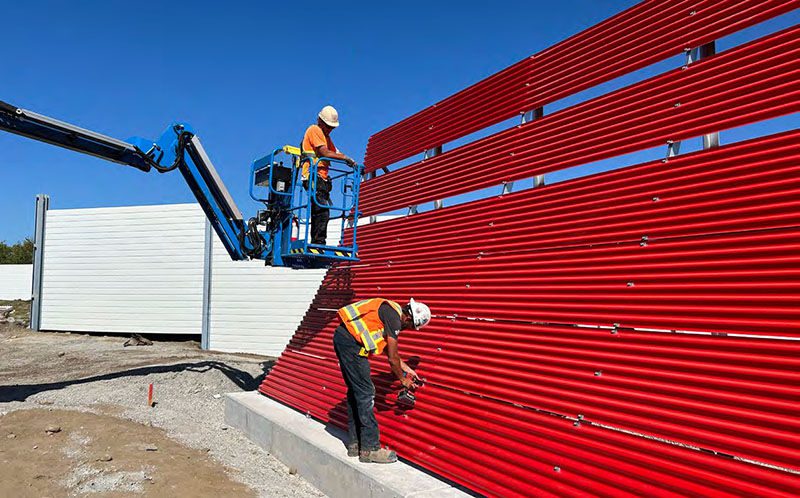
Structures from Blast Deflectors Inc. protect new acoustic fencing from engine exhaust and the debris it stirs up.
The acoustic wall covers 1,290 feet and is constructed from 150-mm-high RPVC panels with integrated steel accessory panels inserted within the PVC section. Because the components are lightweight and modular, installers could hand-stack panels to reach the required wall height of 10.5 feet.
The noise wall panels are a Silentium Noise Barrier product designed to meet all applicable industry codes and standards for noise barriers, including fire testing, physical outdoor weathering, accelerated weather testing, impact resistance and wind load resistance of up to 48 pounds per square foot.
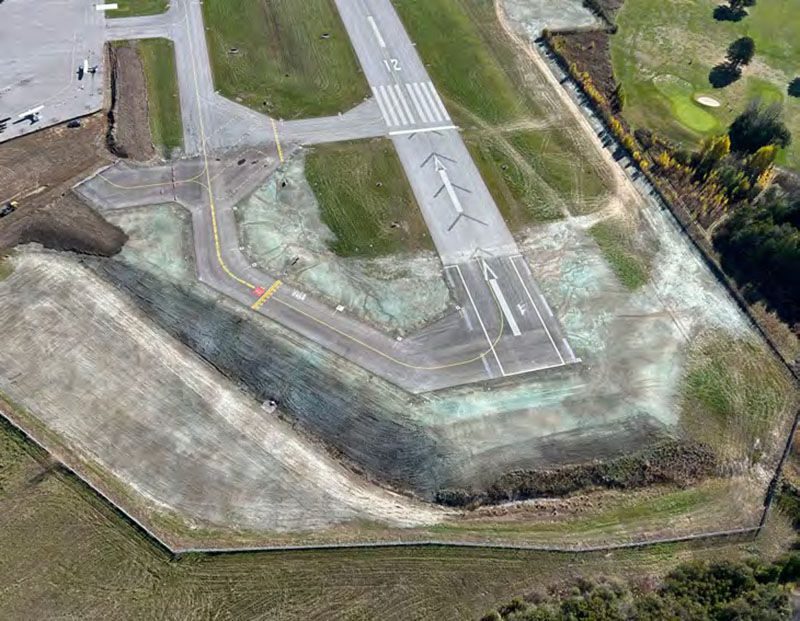
Extending the end of Runway 12 allows departing planes to get in the air faster and helps decrease noise for nearby homes.
Two stands of blast deflectors were installed about 200 feet from the tip of Runway 30 and in the taxiway shoulder area, primarily to protect the acoustic fencing from aircraft exhaust and debris kicked up during taxi, takeoff and landing. The deflectors have a nominal height of 12 feet. One measures about 156 linear feet; the other, 168 linear feet.
 Blast Deflectors Inc. supplied the structures with rush delivery to accommodate the project’s short construction schedule. The company also sent a field representative to support Brennan Paving and Construction during installation.
“We worked closely with the contractor, and the deflectors were installed on one side of a taxiway and at the end of the runway within a week,” reports Blanca Rocha Becerra, international business development coordinator for Blast Deflectors Inc. “We also provided a stamped foundation design that specified the required concrete thickness and reinforcing. This ensured the contractor would pour a foundation that met local code requirements and properly supported the deflector under jet blast loads.”
Positive Impact
The extended and improved runway only has been open for a few months, but Wilcox has already received encouraging feedback from airport tenants and the general public.
“The expanded runway has improved safety,” he adds. “We are only five miles from Lake Ontario, so we are affected by bad weather. In winter, pilots of all aircraft will have more room to land and take off in bad conditions.”
 The recent improvements are especially crucial for pilots on medical missions. “Aircraft specializing in organ transport use our airport frequently,” Wilcox continues. “We have socialized medicine here in Canada, and the government likes to move patients around, if necessary. So in bad weather, our lengthened runway will give such planes more of a safety net.”
The longer runway will also benefit transient traffic and many YOO tenants. “General Motors, for example, has a plant here in Oshawa, and they use Runway 12-30 often to transport just-in-time parts and engineering expertise,” Wilcox explains. “The expanded runway should give them more flexibility in the types of corporate aircraft they can use. And in 2026, we hope our longer runway may attract some new clients as well.”
A watershed moment for YOO occurred this past October, shortly after the improved runway reopened, when Prime Minister Mark Carney flew in for a meeting on a Challenger 600. “That would not been possible before this project was completed,” Wilcox reflects.