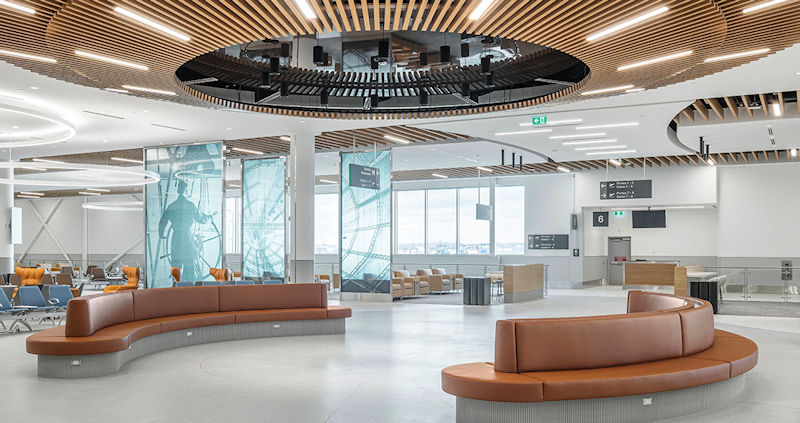
Domestic travel options within Canada from Montreal are set to get a tremendous boost this summer, with service scheduled to begin June 15 out of a recently constructed commercial terminal at Montreal Metropolitan Airport (YHU). In March, officials announced that the new 9-gate terminal will host operations from Canadian operators Porter Airlines and Pascan Aviation in a facility designed to increase passenger connectivity, simplify regional travel and meet a growing need for domestic service. Charles Roberge, president and chief executive officer of YHU Terminal, the private entity that leads facility construction and operation, describes the new 21,0000-square-meter terminal as “more human-scale, faster and more accessible.”
While designed to accommodate 4 million annual passengers, the terminal is expected to start operating at around 25% capacity and increase gradually. “With the current footprint, we have the flexibility to expand,” says Roberge. “The enthusiasm from other domestic carriers is there.”
Fueled financially by Porter Airlines and Macquarie Asset Management, the $450 million terminal development project was first announced in February 2023. The partners’ goal is to offer travelers from Quebec access to more regional cities without having to connect through major airports. Porter currently serves more than 40 destinations with a fleet of 78-seat De Havilland Dash 8-400s and 132-seat Embraer E195-E2s.
| facts&figures
Project: New Terminal Location: Montreal Metropolitan Airport Size: 21,000 sq. m; 9 gates Expected Passenger Capacity: 4 million/yr Cost: $450 million Terminal Operator: YHU Infrastructure Partners Funding: Macquarie Asset Management (part of Macquarie Group); Porter Airlines Key Components: 28 check-in counters & 10 self-service check-in kiosks (2 with self-serve bag drop); 3-lane passenger screening checkpoint; new food & beverage concessions; jet bridges; customer parking Construction: Aug. 2023-June 2026 Architect: SCOTT Associates Architects Inc. Contractor: PCL Construction Baggage Handling System: Alstef Group Main Runway: 7,801 ft. Secondary Runway: 3,922 ft. Airfield Improvements: $30 million Pavement Work: Converted Runway 10-28 into a taxiway; modifications to lighting, signage & markings; rehabilitated Taxiway T; widened Taxiway R; corrected deficiencies on Taxiway C; apron work is pending New Airfield Equipment: 5 plow-brooms; deicing truck; snow blower; loader with 25-ft. snowplow blade; 2 new Oshkosh Striker 3000 trucks Added Infrastructure: Jet A1 fuel farm; ground support equipment buildings; centralized closed-loop deicing facility; new fire station |
Roberge explains that Quebec, which has a population close to 10 million, has experienced a boom in passenger demand. And, while nearby Montreal-Trudeau International Airport (YUL) is working to increase its capacity through a capital improvement program, the addition of commercial service at YHU will relieve some domestic strain in the region. “The timing could not be more perfect in terms of economic growth and what we bring to the table,” he says, noting that IATA predicts passenger demand will double in the next 20 years.
“Montreal strongly needs more airport capacity,” agrees Simon-Pierre Diamond, vice president of Corporate Affairs, Communications and Marketing for Montreal Metropolitan Airport. “The time was right in Montreal for a secondary airport.”
Located in Longueuil, across the St. Lawrence River and just 15 kilometers from downtown Montreal, YHU was inaugurated as one of Canada’s first civilian airfields in 1927 under the name Saint-Hubert Airport. With both commercial and postal flights, it was long the main airport for Montreal. During World War II, it became a key training base for the Royal Canadian Air Force and played a key military role for the following decades. In the 1960s, military use declined at Saint-Hubert, while general aviation, corporate use and specialized training increased.
In 2023, the facility was renamed Montreal Metropolitan Airport, reaffirming its role in civil aviation; and its status was elevated to a commercial airport serving destinations across Canada. The airport is managed and developed by DASH-L (Développement Aéroport Saint-Hubert de Longueuil), a non-profit organization assembled to foster the airport’s growth while balancing operational excellence, sustainability and community interests.
For branding purposes, Montreal Metropolitan Airport uses MET for short.
Convenience Mindset
The layout, design and feel of the new terminal all revolve around the “convenience mindset” and “expediting passengers in a very safe, secure environment,” explains Roberge.
Designed with ease-of-use at the forefront, all passenger services are located on one level, and the closest parking lot is only 25 meters from the terminal. Roberge estimates that travelers will be able to arrive about 30 minutes before their boarding times.
“It’s like flying out of a private FBO in one sense,” he says, mentioning high-end furnishings and food/beverage offerings that are full of local flavor. “When you fly into our terminal, you will see that it’s different.”
Convenient connectivity is important to airport leadership, and YHU consequently includes access to public transportation with shuttle service to/from the Metro system every 35 minutes. It also has 2,600 on-airport parking spaces just 25 meters from the main entrance and a dedicated three-lane area for passenger drop-off that is 500 meters long.
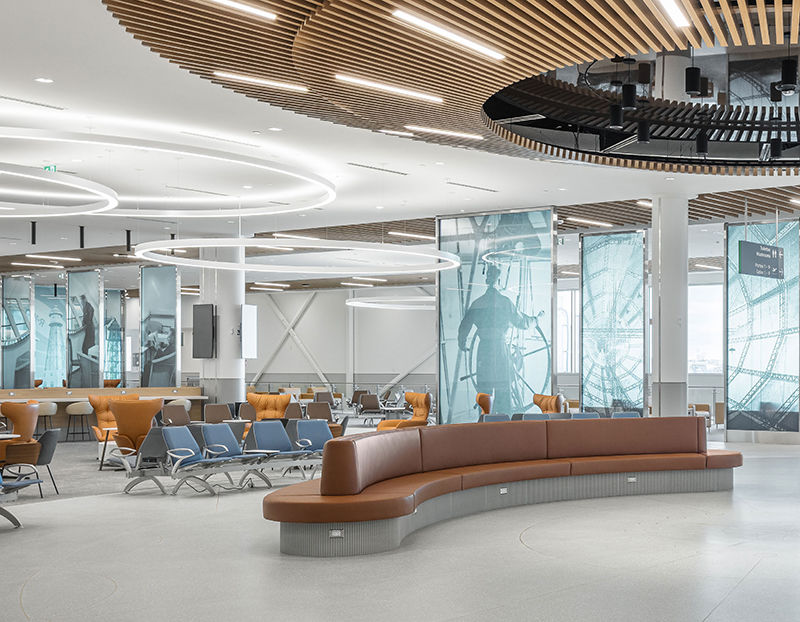
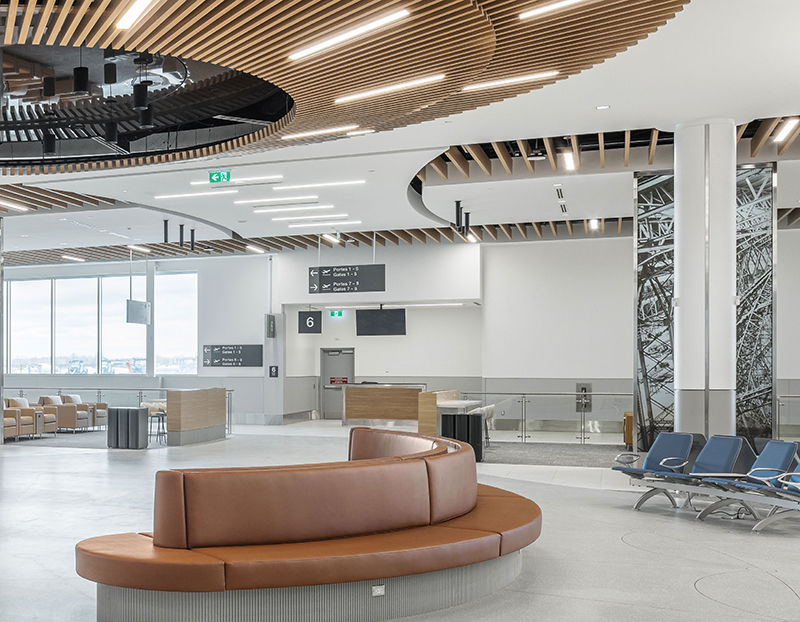
The design of the modern terminal, led by SCOTT Associates Architects Inc., recalls the historic British R-100 airship that crossed the Atlantic Ocean in 1930. After a three-day trip, it anchored with 44 passengers at the Saint-Hubert Aerodrome, attracting more than 800,000 people in just one week.
“The terminal is one level in order to have fluidity and make it easier for the passenger,” Roberge says. The open-concept departure lounge can accommodate 900 guests, with soft seating and other details designed to “rival some of the best airport lounges internationally.” Food and beverage options feature Quebec-based operators, including the grab-and-go Café Depot, and Baton Rouge, a sit-down rib and steak house.
In the lobby, passengers will find 28 check-in counters and 10 self-service check-in kiosks, including two with baggage drops. The passenger screening checkpoint has three lanes, with space for three more in the future.
The baggage handling system, designed by Alstef Group, includes 28 check-in conveyors, a collector conveyor and an out-of-gauge line.
From General Aviation to Commercial
Planners determined that YHU’s two existing runways (7,801 feet and 3,922 feet) were sufficient to handle the forecasted airline traffic, but developers added a large Jet A1 fuel farm, ground support equipment buildings, a centralized deicing facility, jet bridges and passenger amenities such as catering, concessions and parking.
“Basically, we were starting from scratch,” Roberge comments.
 Projects to optimize the airfield for commercial operations included converting Runway 10-28 into a taxiway; modifications to lighting, signage and markings; rehabilitating Taxiway T, widening Taxiway R from 15 meters to 23, and correcting deficiencies on Taxiway C to ensure the safety and durability of infrastructure. Apron work is scheduled to continue into this summer.
The airport also acquired $10 million worth of equipment to support airfield maintenance and operations, fortifying its aging fleet with five more plow-brooms, a deicing truck, a snow blower, a loader equipped with a 25-foot snowplow blade and two new Oshkosh Striker 3000 trucks. An existing aircraft hangar was converted into a fire station, with garage space for vehicles, a decontamination room, rest areas, four dormitories, an office, a meeting room and a control room.
Airfield improvements totaled approximately $30 million.
Green Components
Although YHU was already operating as an airport, Roberge categorizes the new commercial terminal as a greenfield project—full of opportunities to create a culture and operating environment built especially for passengers.
Long-term environmental responsibility remained at the forefront of design and construction, he emphasizes. In addition to being a fully electric building with energy-saving technology, the terminal is constructed with sustainable materials and designed for improved operational efficiency to help lower the airport’s carbon footprint. YHU is also Airport Carbon Accreditation certified, and 95% of its vehicles are electric, with electric vehicle charging stations for public and airport use.
Airside, the new closed-loop deicing system is designed to capture 100% of deicing fluid sprayed onto aircraft for recycling and reuse.
Quieter, modern aircraft are expected to help reduce noise at YHU by 20%, despite a modest increase in flight activity. Currently, the airport logs about 350 daily operations. When the new terminal opens, that number is expected to increase by only 30 to 40.
Planning and Construction
After assessing existing infrastructure and completing a transparent development process that involved stakeholders and the community, the project team developed a business model to establish goals that would meet operational and community needs, including flight volume, passenger capacity and aircraft gauge.
 “There was a key decision made about what kind of airport we wanted,” Diamond explains. “We don’t have the ambition to be a major hub of connection for large carriers. It’s point-to-point travel.”
Stakeholder and community support were critical to shaping development goals of the airport and moving the project forward, he adds. Airport officials consulted with elected officials, airport tenants, public transportation representatives, tourism agencies, community members and even those originally opposed to developing the airport. Each forum explored concerns and included information from specialists to cover traffic, access, noise management, air quality and other potentially thorny issues. Diamond describes the planning process as a collaborative effort. “Participants asked for items to put on the agenda,” he says. “It was really their forum.”
Developing the airport as an economic asset was of interest to the community, but with conditions, Diamond emphasizes. Items
at the top of that list included a ban on night operations, service by narrow-body aircraft and a focus on aerospace innovation. Even though the airport’s main runway is long enough to accommodate widebody aircraft, it was clear that was not what the community wanted.
Thus, the new terminal is designed for narrow-body aircraft and connecting people from point to point. “We believe this is the future of aviation,” Diamond asserts. Based on passenger projections, YHU established a phased development plan to allow for flexibility as demand grows.
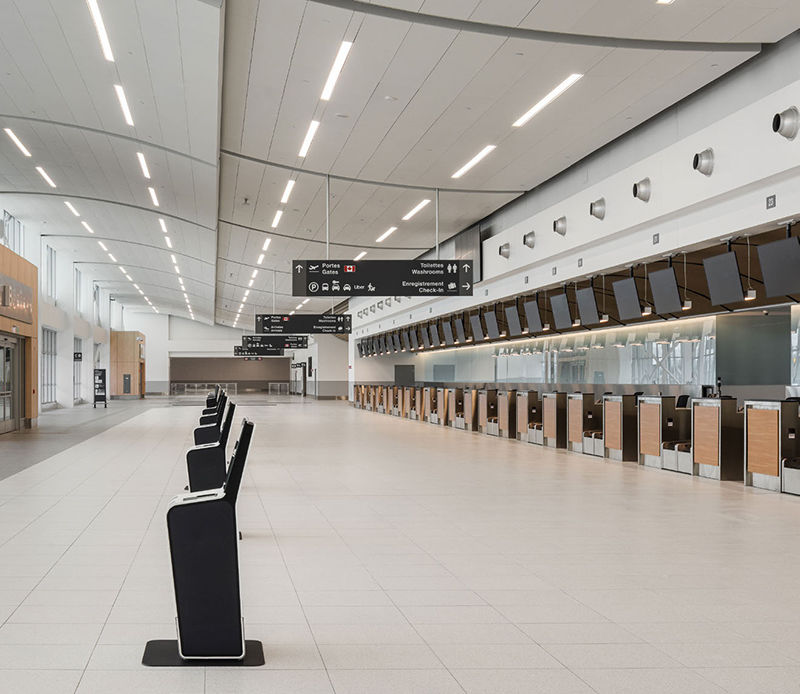
The check-in lobby includes both counters and self-service kiosks.
Construction of the new terminal began in August 2023 and moved at a “very high pace,” he reports. Because the entire footprint of construction occurred landside, security constraints were less demanding than if crews had to work within the operating airport. “That is a huge advantage cost-wise and in terms of expediting the project,” Roberge notes.
Internal and External Outreach
Community engagement was and continues to be critical for ensuring that development at YHU is consistent with regional wants and needs. “We’ve put a lot of time, emphasis and effort to make sure that the population and elected officials are behind us,” Diamond says. “We’ve always been very transparent with them.”
Building those relationships took years of attention, phone calls and meetings. “We’re not able to count the number of meetings that we’ve done in the last three years,” Diamond reflects. Having community representatives and stakeholders around the table wasn’t just a way to make sure the “pill would be swallowed,” he stresses. “Far from that. We built a huge asset of people to help [the airport] evolve, be better and synch with the population.”
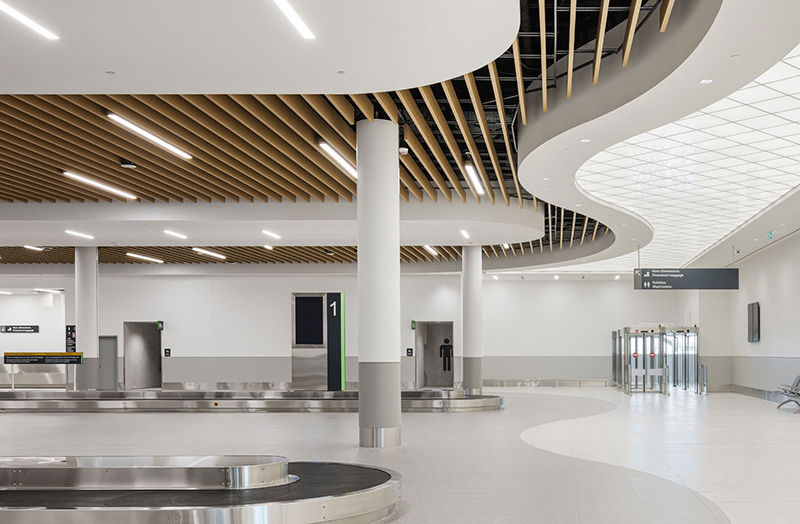
The baggage handling system was designed by Alstef Group. PHOTO: NORDET & CO. FOR YHU TERMINAL
In fact, YHU launched a working group with citizens and elected officials to help leverage the airport as an asset for tourism. This group was involved in things like the branding of the airport shuttle. “We are proud of the initiative with community organizations,” says Diamond.
It’s estimated that 200 people will work in direct positions at the new terminal when operations begin, plus another 300 total. “In terms of economic growth, it’s very significant,” Roberge remarks. Per the airport’s unique business model, 100% of workers are YHU Terminal employees—from ground handlers, fuelers and deicing crews to parking attendants, curbside staff and catering workers. Having employees directly on the YHU Terminal payroll provides more control over operations and the passenger experience than using contracted workers, and ensures a “superior staff,” says Roberge. “They feel that they’re part of a family.”
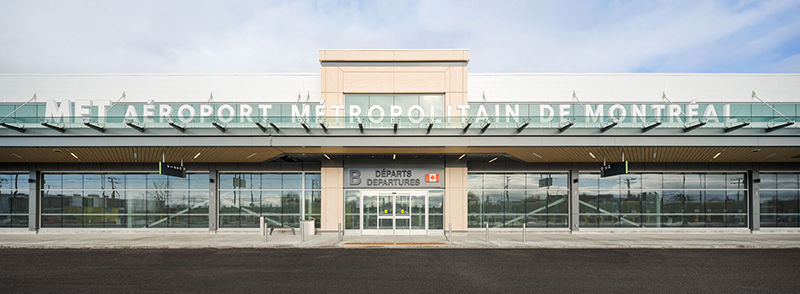
Commercial service in the new terminal is scheduled to begin June 15. PHOTO: NORDET & CO. FOR YHU TERMINAL
Leaders at YHU Terminal believe this structure will decrease employee turnover, increase employee engagement and produce a higher level of customer service. Employees will be cross-trained for efficiency and to keep the focus on passengers. “Our employee culture is about customer service,” Roberge says.
As a private business, YHU Terminal will be attractive to airlines because leaders can act and react nimbly, he adds.
“We have a different way of operating and we can be more competitive,” Roberge concludes. “We have the space, and we have a beautiful terminal that will raise the level of quality flights and create a lot of economic development in Quebec.”