To improve control over economic development and increase revenue at Reading Regional Airport (RDG), the local airport authority took the unusual step of buying out two longtime fixed base operators (FBOs), then creating its own at the Pennsylvania airfield.
After the amicable buy-outs of Reading Jet Center and Millennium Aviation for a combined $13.8 million in January 2024, the Reading Regional Airport Authority established its own FBO called Reading Aviation. The move reflects an operational mindset that could be dubbed FOB: Focus on Business.
“Our strategic plan, which was completed in 2022, laid out our vision for the airport, which included running the airport like a business,” says Zackary Tempesco, director of the general aviation airport. “By owning the FBO, we can keep improving the airport by attracting new businesses or working on expanding existing services.”
 facts&figures facts&figures
Project: Purchasing 2 FBOs, Establishing Airport-Owned FBO Location: Reading Regional Airport in PA Cost: $13.8 million, plus $2 million for subsequent infrastructure upgrades Funding: $15.8 million bond issue backed by Berks County Key Benefits: New revenue streams from fuel sales & related services; control over quality & consistency of services, infrastructure & pricing; enhanced control of development efforts; lease extension from largest tenant & additional ground lease from new tenant Avg. Daily Operations: 125 Analysis Consultant: BBP Solutions Price-Evaluation Consultant: JLL Valuation & Advisory Services Planning/Evaluation Period: Feb. 2023-Aug. 2023 Acquisition Date: Jan. 2024 Subsequent FBO Revenue: $5 million/year Infrastructure Improvements: Consolidating fuel tanks; upgrading or replacing fuel facilities & equipment; upgrading 3 hangars Future Plans: Building 3 box hangars in 2027 (one 20,000 sq. ft.; two 12,000 sq. ft.) |
Previously, that wasn’t easy because projects the airport favored weren’t always in the best business interests of the former FBOs. Since development proposals required buy-in from the FBOs, reaching a consensus was difficult, Tempesco explains.
“The airport authority would get stuck in the middle without a lot of leverage to complete developments,” he relates. “Development proposals then would stall, which eventually drove away customers.”
Running the sole FBO also allows the airport to provide more consistent levels of service and pricing, compared to multiple FBOs charging different prices for various levels of service. The airport once had five FBOs; later, there were just three and then only two after one closed in 2020 during the COVID-19 pandemic.
Moreover, the recent acquisitions enabled the 660-acre airport to consolidate all primary FBO services onto one ramp instead of three. This spurred operational efficiencies and reduced costs. The move also produced another important revenue stream from fuel sales, not to mention improved control over the airport’s image and future, Tempesco says.
The previous FBO leases signed long ago included monthly rates well below the current market, and both leases had 20 years remaining, he adds.
Enhanced Infrastructure
The airport authority paid $9.3 million for Reading Jet and $4.5 million for Millennium. Per the purchase agreements, the authority bought out the FBOs’ remaining leases and acquired their physical assets.
The authority also paid JLL Valuation & Advisory Services $30,000 to help establish fair market value for the two businesses.
The purchase was funded with a $15.8 million bond issue backed by Berks County. The additional $2 million borrowed above the purchase price is primarily funding infrastructure improvements for hangars and fuel facilities, Tempesco notes.
For instance, from January 2024 to March 2025, crews turned a primary 14,400-square-foot box hangar on the airport’s east apron into the home of Reading Aviation. Improvements included a fresh floor coating, new sprinkler system, recoated steel and updates to the attached lobby. Elsewhere, a new roof was installed on a 10,000-square-foot box hangar, and minor improvements were made at another 10,000-square-foot box hangar.
Each of the three ramps where FBOs used to operate included a fuel farm. The condition of these facilities and their associated seven fuel tanks were evaluated. Pumps were upgraded or replaced as needed, and two underground tanks were removed from the west apron to eliminate the risk of contamination liabilities. They will be replaced with two 12,000-gallon above-ground tanks installed on the east apron by early 2027, giving that ramp four 12,000-gallon tanks.
In addition, the interiors and/or exteriors of various fuel tanks will be recoated as needed for enhanced integrity, Tempesco says.
The airport also plans to build three new box hangars on the west apron. One will have 20,000 square feet of hangar space and 4,000 square feet of office space; the other two will include 12,000 square feet of hangar space and 3,000 square feet of office space. All are expected to be completed in 2027.
Thorough Deliberations
The seeds for the acquisitions were planted in early 2023 when both FBOs—which had considered merging and also had sought purchase offers from other entities—asked the airport authority if it wanted to buy out their leases. That sparked about six months of due diligence to determine if this made sense, Tempesco recalls.
For guidance, the authority hired BBP Solutions, a business management consulting firm that had helped RDG develop a new strategic plan in 2022.
Many factors were considered during the evaluation process, including what services to provide, pricing for those services to ensure profitability, staffing requirements and revenue projections. Another consideration was how to consolidate operations/infrastructure for maximum efficiency—and how everything would mesh with the airport’s strategic plan, says David Heath, a principal at BBP.
 “We focused on the capacity needed to properly service customers,” Heath says. “We determined that there was a significant strategic advantage to having a single, airport-operated FBO at an airport the size of Reading.”
An FAA policy generally prohibits exclusive FBO rights. However, if an airport elects to provide services itself as the sponsor, it may do so under what is commonly referred to as a proprietary exclusive right, rather than relying on multiple private operators, he explains.
“This is very unique because there aren’t many situations where an airport can exercise that level of control,” Heath comments. “Operating its own FBO allows the airport to implement its priorities for economic development and offer the best services it can provide.
“If a new business opportunity arises, the airport no longer has to rely on a third-party FBO to agree to it.”
Clearing All Hurdles
The due diligence process also included consulting with officials at Lancaster Airport (LNS), located about 30 miles southwest of RDG.
“A big part of our analysis came from how Lancaster operates,” Heath says. “Seeing that success reinforced the idea that airport ownership of an FBO was a proven model worthy of serious evaluation.”
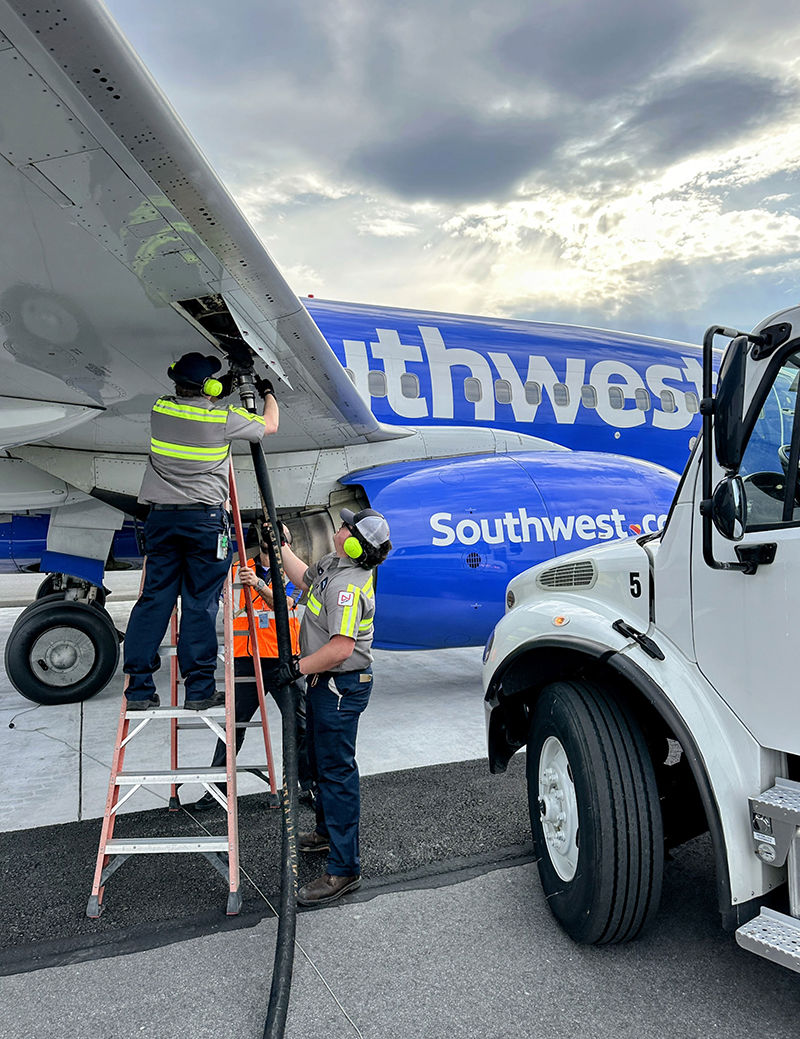
Ultimately, about 13 of the 20 people employed by the two former FBOs ended up working at Reading Aviation. The airport also hired nine more employees to ensure adequate staffing at the new FBO, which is open three hours a day longer than the two prior facilities and primarily focuses on fueling, hangar rentals and ground services.
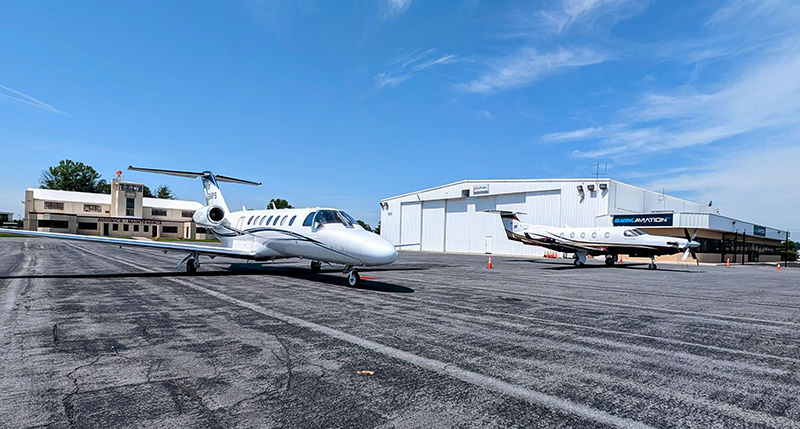
A box hangar was transformed into the new airport-owned FBO.
“It’s always challenging to merge businesses, but we worked through a lot of concerns the employees had,” Tempesco says. “We kept presenting them with the strategic plan and explaining what we need from them to make the FBO successful.”
Some customers also were apprehensive about the change, but Tempesco says the airport alleviated their concerns by following through on its stated goals, particularly regarding services as well as consistent and transparent pricing for those services.
Positive Results
Tempesco reports that the airport’s move to operate its own FBO has been a success. After about two years, Reading Aviation is generating around $5 million of annual revenue, compared to about $470,000 per year from the previous two FBOs combined, primarily from lease payments. Plus, there’s been enough profit to pay the debt service—about $1.2 million a year—while still continuing to grow airport operations, as demonstrated by the plans to build more hangars.

Furthermore, the airport’s biggest tenant—Quest Diagnostics, a medical testing business that operates a fleet of 24 aircraft to transport medical specimens—signed a 15-year extension of its hangar lease in late 2024. And this May, NetJets—a large, high-profile private charter company—signed a 29-year, 11-month ground lease for a parcel of land that includes a 35,000-square-foot hangar.
“In my opinion, buying the FBOs was a major factor in obtaining these leases because we’re able to provide the consistent services that these customers need in order to keep their operations here,” Tempesco says.
“The turnaround at RDG from 2022 to today has been remarkable,” Heath adds. “You can see that progress in new business coming on board and in existing tenants expanding their operations.
“There was a lot of doubt before (about economic development), but now there’s a lot of confidence about the direction the airport is heading and the consistency of its operations.”
That confidence was bolstered in 2022 when Berks County reorganized the airport authority to bring it more directly under county administration, effectively making the decision makers for the county the decision makers for the authority. As a result, the airport authority could align the overall business interests of RDG with what was best for the county and its residents, Tempesco says.
Positioned for Further Growth
The success of RDG’s Reading Aviation underscores the importance of running an airport with a retail mindset, Tempesco says.
“Running an airport from a governmental perspective is much different than running an airport like a business,” he explains. “The former requires things like making sure the airport is open and operating safely and meeting certain standards.
“But when you get into a retail mindset, you also have to look at things through the lens of value—how you provide value to customers.”
Heath agrees, noting that most airports are very good at the fundamentals, such as fueling aircraft and making sure operations are safe. But not many are good at providing great customer service and maximizing revenue so the airport can sustain itself. “As such, it’s really great to see the things that Reading is doing,” he says.
“Purchasing the FBOs allows us to execute our vision by controlling our services, our assets and how customers perceive the airport when they visit us,” Tempesco concludes. “And financially, it adds another revenue stream we can continue to improve on. Before, there were limited revenue buckets we could pull from. We now have the flexibility to operate the way we want to operate.”