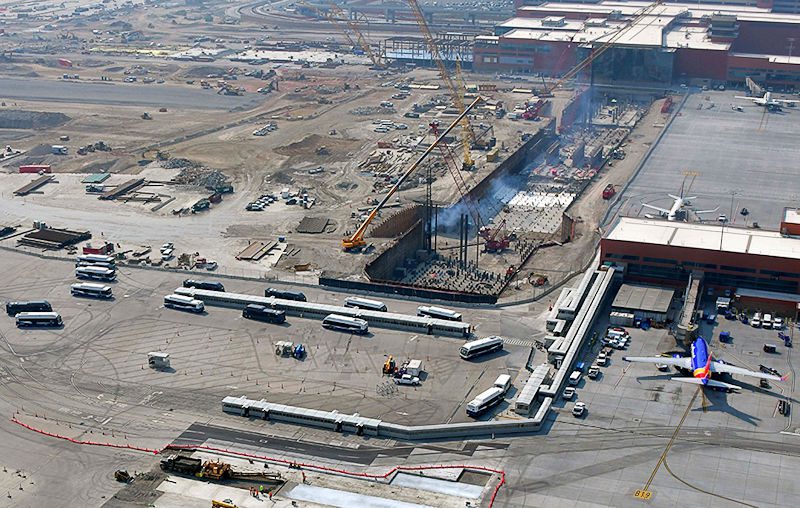
The average passenger may not know the term “hardstand,” but they certainly know when they use one. The big giveaway is the walk or bus ride from the terminal to the ramp when they board, and vice versa after arriving at their destination. Hardstands are common in Europe but less so in America, where most airports prefer to avoid them altogether and use enclosed boarding bridges instead.
However, sometimes they’re necessary. Salt Lake City International Airport (SLC), for instance, leveraged them during the multi-phase construction of its new terminal. When transitioning operations from the adjacent previous facility, SLC used hardstands on a limited basis to help maintain flight schedules. Once they were no longer needed, the airport promptly decommissioned them.
The airport deployed its first hardstand in October 2020 and eventually had 20 in use. By October 2023, the airport only needed five, and the remaining stands were sporadically used until March 2024. When all was said and done, SLC management deemed the strategy effective and efficient—and even included built-in hardstand options for future expansion.
| facts&figures
Project: Hardstand Operations During Terminal Construction Location: Hardstands Deployed: 20 Cost: Part of $5.1 billion budget for all 3 phases of terminal construction Funding: Airport cash; federal grants; passenger facility charges; rental car user fees; revenue bonds Timeline: 1st hardstands built in 2017; deployment began in 2020; at peak, 20 stands were used; by fall 2023, only 5 remained, with sporadic use into early 2024 Boarding Ramps & Staircases: Financial Services for Project: Program Management: Construction Joint Venture: Holder Construction, with Big-D Construction for local management Airside Buses: ElDorado Logistic Support for Bus Operations: Signage: M.C. Dean Key Benefit: Gate access during construction of new terminal |
Tough Decisions About Passenger Flow
When the airport’s previous terminal opened 65 years ago, it was built to accommodate 10 million passengers. By 2014, more than 21 million passengers were enplaning and deplaning at SLC. That year, the airport broke ground on a new facility to address capacity issues, including new gates to handle a variety of regional and large jets. Construction on the $5.1 billion program began in July 2014 with a timeline continuing through 2026.
Even under ideal circumstances, building an airport is a long and complex process that requires project teams to juggle the needs of airlines, passengers, concessionaires and other stakeholders. But 2020 ushered in an unforeseen wrinkle that shook up the entire industry: the COVID-19 pandemic. As air traffic slowed dramatically, the team at SLC faced tough decisions about its construction timeline.
“We went from having 30,000 people a day at our front door to 1,500,” recalls Executive Director Bill Wyatt.
By May 2020, there was little optimism about when air traffic would return to normal, and Wyatt and his project team considered options for transitioning to the new terminal. It seemed like an optimal time to close the old gates and continue construction on the new terminal.
“We figured we would save ourselves and everybody else a tremendous amount of stress and headache by avoiding running operations at the older airport and the new airport simultaneously,” Wyatt recalls.
Delta Air Lines, which operates a major hub at SLC, agreed.
So did the airport’s project management consultant, Making Projects Work. Brian Stetson, a program manager with the firm, notes that expanding SLC was a no-brainer because skiing, national parks and outdoor tourism are driving more and more visitors to the area. Scheduling construction, however, was the more difficult part.
“One of the biggest challenges was time,” Stetson says. “You know how aviation is: We needed gates, and we needed them immediately.”
When the pandemic hit, SLC’s airlines agreed that shutting down wasn’t an option. The project team had to come up with something else, and that “something else” was hardstand parking.
“It seemed reasonable that the best—or maybe we call it the ‘least-worst’—option was to demo the existing facilities and then build all the new facilities and see where everything would shake out,” Stetson remembers.
It was a bit of a gamble, though, since no one knew what the future held post-pandemic. While the SLC team didn’t have a Magic 8 ball, it felt sure that passengers would start streaming through the door again at some point. The big question
was when.
Staffing and Equipment
In fall 2020 (during Phase I of construction), Delta Connection flights at 11 gates on Concourse A were switched to remote hardstands. Passengers departing on regional jets had to venture halfway down the west side of concourse A, connect to Concourse B via a tunnel, then backtrack to the gate counters for the hardstands.
Wyatt acknowledges that the circuitous route wasn’t as easy as passengers would have liked, but he considers the temporary measure a success from an operations perspective. And passenger flow improved dramatically in 2024, when the 1,000-foot River Tunnel that connects concourses A and B opened.
“Airports of our size are small cities, and we have a lot of stakeholders here,” Wyatt remarks. “You’ve got the airport, the concessionaires, the rental car companies, the ground transportation and the airlines. You really have to pay attention to communication and coordination.”
Communication was a key tenet of the hardstand plan, even outside of the SLC network. As the team put together an operations sequence, it knew that buses would be needed to shuttle passengers to and from the remote hardstands. Buying a fleet of new buses was not SLC’s first choice; however, renting or buying used school buses or charter buses wouldn’t meet its needs.
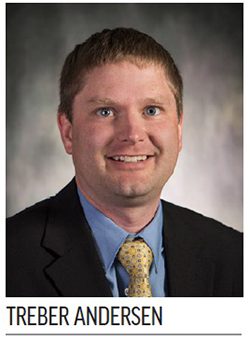
“The minute we found out we were going forward with the hardstand operation, our parking manager started making calls,” says Director of Airport Operations Treber Andersen. “We discovered that Denver Airport had closed a remote lot, and those buses were not being used anymore.”
SLC purchased 17 40-foot ElDorado buses for $3.3 million, and in-house crews removed rows of seats from the middle to make room for more passengers and luggage. Mechanics were comfortable making the modifications because the airport already owned the same brand of buses.
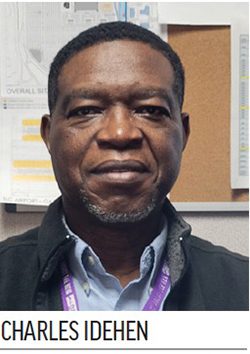
Hill International, which provides financial services for the overall construction project, credits the airport for finding a way to mitigate the high expense. “In terms of managing costs, finding these buses was very helpful,” says Charles Idehen, program controls manager at Hill.
In keeping with the airport’s environmental policies, the newly acquired vehicles run on compress natural gas.
Next up was finding people to drive the buses; and candidates with a Commercial Driver’s License (CDL) were a hot commodity during the pandemic.
“Before 2020, I’d pass a big billboard on my way home advertising wages for bus drivers at $19 per hour,” Wyatt recalls. “By the time we were finished with the hardstands, we were paying $24 or $25 an hour for CDL bus drivers.”
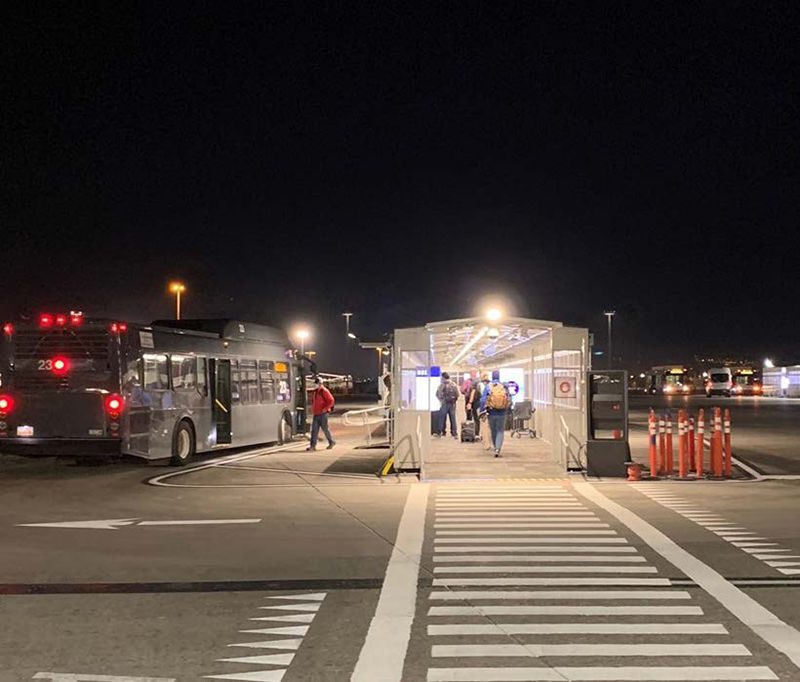
Busing passengers to and from remote hardstands helped maintain operations during terminal construction.
The airport consulted its parking provider to help establish shuttle service for hardstand operations. SP+ (now Metropolis) supplemented its existing parking lot operation at SLC and brought in additional managers to launch the new airside bus service. One key move was recruiting an employee with hardstand experience at other airports to work with dispatchers, hire drivers and provide associated training.
 “Driving those large buses all over the airfield is not an optimal thing for an airport,” Wyatt says. “We had someone in the control tower just to be sure the movement on that part of the airport was properly coordinated.”
Security was another challenge. Because passengers on multiple flights descended the same ramp and then veered off toward different areas for their flights, SLC stationed security staff at each portal to make sure travelers had the proper ticket to enter that area.
Preparing for More Expansion
In October 2025, Wyatt cut the ribbon to celebrate the grand opening of 10 new gates, six additional concessions, two members-only lounges and other new passenger amenities. With all of the hardstands decommissioned and most of the multibillion-dollar construction complete, post-project analysis is already underway.
 Jordan Cammack, construction manager from the joint venture of Holder Construction and Big-D Construction, is officially a “big fan” of the flexibility that hardstands offer. So is Stetson, from the project management side of the project team.
“Airports often think of hardstands as a temporary ‘this is kind of what we have to suffer through’ project; and then out they go,” Stetson says. But hardstands can help airports explore expansion and allow airlines to try out new route service, he adds.
Wyatt calls their use at SLC a “family operation” because the entire airport had to pitch in to achieve success. While using hardstands wasn’t ideal for anyone, he says the team did its best to mitigate issues and make conditions as comfortable as possible for passengers.

“We talked with Delta and all the airlines about the hardstand operation, and we listened very carefully to what we heard,” he relates. “Even though it had its challenges, it wasn’t a hard decision to decide to go forward with. In the beginning, we may not have fully appreciated the challenges to our passenger base, but there wasn’t much that we could have done differently.”
Ultimately, the strategy was so successful that the new airport includes hardstands for future expansion. If they are needed for a short-term event, such as the 2034 Olympics, SLC will be ready with a quick solution.
Meanwhile, Concourse B is slated for completion this fall.