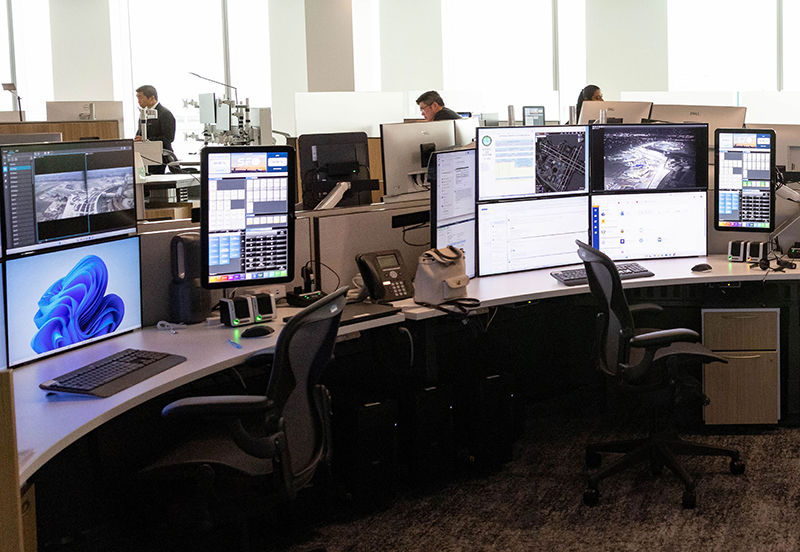
The operations center is the beating heart of an airport, vibrating with insights into what is happening on site at any given moment. However, sometimes different departments and functions are scattered throughout the airport. That used to be true for San Francisco International Airport (SFO), but no longer: It celebrated the official opening of a centralized Airport Integrated Operations Center (AIOC) earlier this year.
Housed in a new administration office building between terminals 2 and 3, the AIOC is a centralized hub that operates 24/7, pulling together the management of security, 911 dispatch, facilities, airlines, operations and planning. The center plays an important role at SFO, which currently accommodates about 55 million annual passengers. AIOC Director Nancy Byun Riedel anticipates growth up to 78.5 million passengers per year with the airport’s current runway configuration.
“We think about that level of growth and how can we offer an extraordinary experience for our customers, because how our customers feel about our airport when they come through is very important to us,” Byun Riedel says. “Our vision is to inspire the extraordinary, and our AIOC vision is to empower the extraordinary with this 24/7 group of professionals.”

facts&figures Project: Integrated Operations Center Location: San Francisco Int’l Airport Key Benefit: Locating various functions, including security, communications & operations management into a single 24/7 operation for increased efficiency & collaboration Facility Size: 22,000 sq. ft. Workstations: 67 911 Operators: 15 Cost: $22.75 million Funding: Capital Plan, funded by airport general revenue bonds Timeline: Concept developed in 2018; construction began 2023; facility opened Jan. 21, 2026 Design: HOK; MEI Construction & Project Management: PGH Wong Construction: Hensel Phelps Electrical Contractor: Rosendin Technology Hardware: NetXperts Digital Twin & Related Technology: Esri Customer Journey Map & Process Development: CityID Process Development: M2P Dashboard Technology: Aerology |
From Separate to Intertwined
Airports around the world call their operations centers by different names. SFO was deliberate in including the “I” in AIOC to emphasize the importance integrating previously disparate departments. The centralized hub was designed to enhance the coordination and management of the airport as a single entity and to integrate the various airport functions that previously operated somewhat in separate silos.
It wasn’t always envisioned in this way, though. Chris Gardini, the project manager and project architect for HOK who coordinated with Hensel Phelps Construction and the rest of the AIOC design-build team, has been working with SFO for almost two decades and knows the history of this phase very well.
“When the project started in 2018, integration was less of a project priority,” Gardini recalls.
Initially, each department was protective about its own space, wanting to operate in a discrete section with walls separating it from other functions. Then, the airport had to move the Security Operations Center and the 911 Center into a new shared location during terminal construction. The groups discovered they enjoyed working together in the same room, and that paved the way for the new AIOC, Gardini explains. The space-saving strategy made particular sense at SFO, where land is at a premium; and working together in the same physical space enhanced efficiency. It was nothing short of a revelation.
“After they ‘lived with each other’ and saw the benefits of collaboration, it became more about working together, and everybody really latched onto it,” Gardini relates.
Before the AIOC was built, the airport primarily handled questions from onsite customers through white courtesy phones. Typically, the operator answered basic questions or transferred callers to their respective airlines. As technology changes, customers want more immediate and specific assistance, and SFO is determined to provide it.
“What we’re doing now with the customer solutions team is pushing for resolution at first contact,” Byun Riedel says. “Within the next several months, we’re going be monitoring social media so that we can offer in-the-moment assistance to customers who reach out to us via social media, and we want to be available in any way that would be convenient for the customer to contact us, whether that be a text message, WhatsApp or an email. We’re going to open up those avenues so that they can be in touch with us 24/7 if they need any assistance.”
High-Tech Backbone
As the idea of the AIOC took shape, technology played a key role. California company Esri built a digital twin of the airport that provides valuable guidance to Byun Riedel and her entire team. The dynamic, virtual replica of SFO funnels data from various sources, offering a real-time view of critical operations including aircraft movement, pedestrian traffic in the terminal, ground transport and maintenance. As a result, SFO can allocate resources more effectively and respond more quickly, says Byun Riedel.
Concurrently, NetXperts (DBA HarborIT) helped design and implement the network infrastructure for all the systems integrated within the new space. Sachin Kattepura Rajegowda, the company’s principal engineer and aviation technical lead, says NetXperts played a key role in designing the next-generation system by enforcing secure data segmentation using a Zero Trust framework combined with role-based access control policies. That means the system is highly restricted, using advanced cybersecurity to protect SFO from potential vulnerabilities.
“We recommended implementing a hyperscale secure network backbone for the AIOC infrastructure to support all three operational domains while enabling seamless integration of next-generation capabilities,” Rajegowda explains. “The design delivers secure, yet flexible, access for all users and systems. To meet compliance requirements, NetXperts and SFO-ITT [the airport’s information technology department] enforced strict segmentation between secure law enforcement environments and general-purpose networks using virtual routing and forwarding isolation, micro-segmentation and controlled inter-domain policy enforcement.”
Another unique aspect of the AIOC is its fully ad hoc workstation design. Any authorized user can operate from any position without loss of access to required applications or operational data, allowing for secure continuity of operations. At the same time, strict controls are enforced through identity-based access and policy-driven segmentation, ensuring users can only access the data and applications they are explicitly authorized to use, notes Rajegowda.
Gathering Around the Hearth
At the heart of the AIOC is the “Hearth Wall,” a central gathering place with comfortable couches and several screens displaying real-time information about airside operations, roadway conditions, customer needs, security checkpoint wait times, weather advisories, an airfield overview showing the position of every airplane on the ground, and more. Additionally, any integrated system within the environment can share its display to the dashboard to facilitate collaborative decision-making, incident response and triage. A live audio feed of SFO’s control tower is broadcast in the background to keep everyone up to date about air traffic.
“This focus on collaboration from the team helped resolve some of the differences in working environments that we were going through,” Gardini says. “All the different groups have different ways of working, but we wanted to have one spot where they could freely collaborate and not worry about bothering their neighbors.”
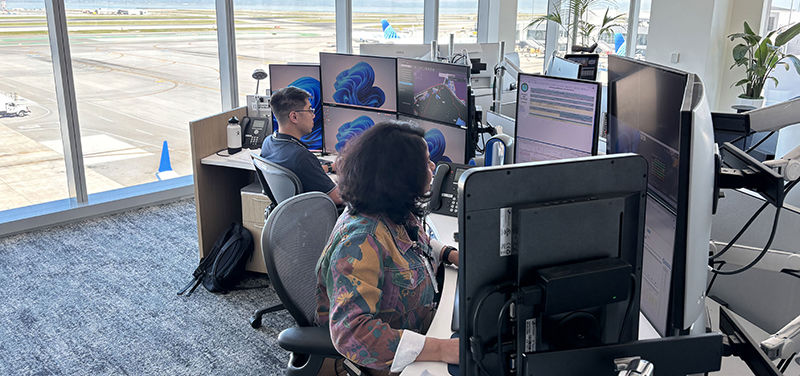
There are 67 work stations inside the Integrated Operations Center.
At least one liaison from each major group at the airport—airlines, the custodial team, facilities management, asset coordination, impact coordination, logistics, customer care, etc.—gather inside the AIOC. When a call is routed in, everyone helps decide how to deal with it. Often, the call is something as simple as a restroom needing attention, and customer care can connect to the custodial coordinator for a quick fix.
 “We recently added happy/sad face buttons at security checkpoints and restrooms,” Byun Riedel says. “As visitors provide feedback, the data feeds into the AIOC so the custodial team or TSA can see very quickly if a problem is developing and dispatch assistance right away.”
In the event of a bigger issue, such as passengers delayed on the tarmac, asset coordinators and facilities maintenance can coordinate to arrange for a team to redirect. Before the AIOC, this sequence would have required a series of phone calls.
Challenges to Resolve
Designing and implementing the improved operations center came with a unique set of challenges, primarily due to the scale and complexity of SFO, which has more than 50 airlines and 121 gates for its high-volume domestic and international operations. Tunneling down further, the AIOC had to meet a variety of needs while bringing multiple departments and functions together.
 “Every group in an operations center works differently,” Gardini says. “There are groups that are highly collaborative and thrive on that day-to-day interaction with each other. And there are other groups that need to be solitary for either security concerns or for audio and visual privacy, or they might be taking calls with the public and can’t have a noisy background. Others need to be heads down, focusing on a long-term task.”
A critical step in overcoming these challenges was performing in-depth audits of existing systems, including their operational sequences, applications and interdependencies. From there, NetXperts mapped how the systems functioned individually and identified gaps in data visibility and integration. Through collaborative input from various teams, Rajegowda and his team were able to pinpoint missing data elements and design an architecture that consolidated disparate systems into a cohesive, integrated operational framework.
 “There are various factors which make the project so unique—all the way from the physical design of the space to the logical architecture that brings together diverse data sources into a unified operational framework,” explains Rajegowda. “This convergence empowers analysts, dispatchers, specialists and planning teams with predictive insights, enabling them to anticipate and prepare for future scenarios while simultaneously addressing unforeseen events. The ability to rapidly identify root causes, coordinate triage and respond in real time significantly enhances operational efficiency and elevates overall safety for passengers and airport personnel.”
Looking Ahead
The AIOC was designed with three phases in mind. The first is descriptive: telling airport operations teams what they need to know now; what’s happening in real time. Phase 2 is predictive: preparing them to best use the massive amounts of data at their disposal. The third phase will be prescriptive: helping the teams make decisions for the best possible outcome for customers based on historical data.
Currently, the airport is in Phase 1.
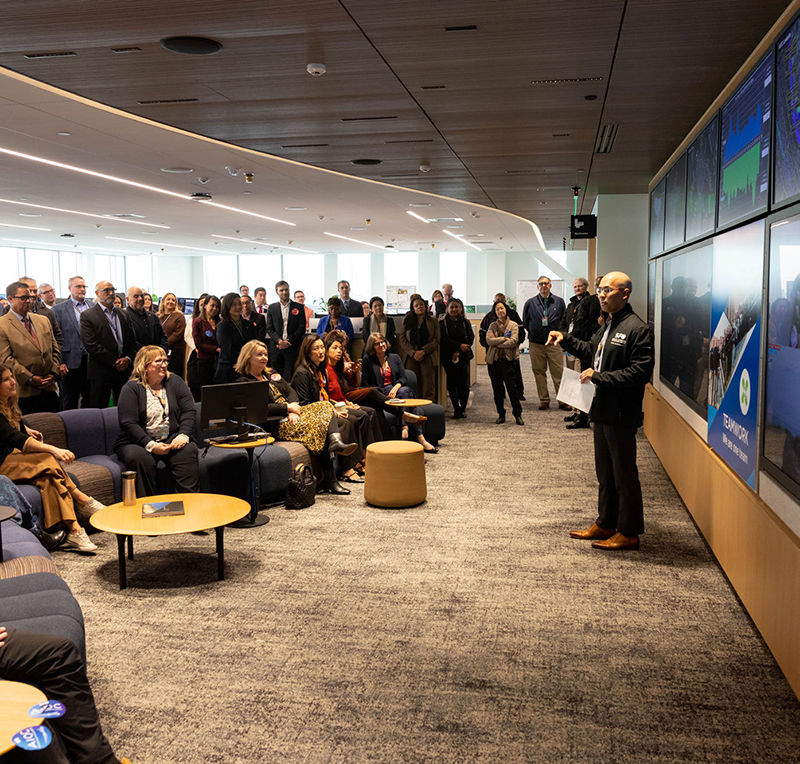
Airport Director Mike Nakornkhet unveiled the new nerve center at a grand opening earlier this year.
“This is telling me right now that my domestic garage is at 96 percent capacity,” Byun Riedel explains, pointing at a monitor in the AIOC. “My team will start looking at that, reaching out to parking and taking some proactive measures. But there are many, many more dashboards.”
Airport management is excited about the predictive phase because it is designed to guide decisions before problems develop, enabling a smoother experience all around. For those capabilities, SFO tapped Aerology, a company that builds AI tools and deep learning algorithms to predict air travel disruptions and interpret weather forecasts, flight schedules and airport capacity to derive rough disruption probabilities. Aerology founder and Chief Executive Officer Tim Donohue spent several years in the Operations Department of United Airlines, gaining perspective about the technological possibilities. SFO already had massive amounts of data coming in; Aerology is helping the airport parse it and use it more effectively.

“This project has been an excellent impetus for the airport to start working with all these data sets that they’ve been collecting and storing and generating,” says Donohue.
Inside the AIOC, at least one monitor details the statistical probabilities of runway movement based on weather forecasts and traffic. If SFO must switch to a southeast runway configuration, that can be very disruptive. Understanding if and when a switch is imminent allows the airport to reduce transition time by moving cranes and construction equipment out of the way in advance.
And that’s just one example of the facility’s many capabilities. “The new AIOC is not just another operations center. It represents a fundamental shift in how large-scale critical infrastructure is operated,” Rajegowda summarizes. “All the technologies converge. It’s the true single pane of glass for an entire airport ecosystem.”