Between half-finished coffee cups and containers with uneaten food inside, airport customers generate a steady stream of trash. And the hurried pace of travel leaves little time for proper sorting and disposal.
This presented a significant operational and sustainability challenge for Seattle-Tacoma International Airport (SEA). Food service waste is the largest and most complex waste stream inside its terminal, driving up hauling costs, complicating diversion efforts and putting increased pressure on the airport’s industry-leading sustainability goals.
But in every challenge lies opportunity.
| facts&figures
Project: Reducing Food-Related Trash Location: Seattle-Tacoma Int’l Airport Airport Operator: Port of Seattle Program Name: Sip, Savor, Sustain Affected Facilities: Food & beverage concessionaires; lounges; back-of-house kitchens; public terminal areas Airport-Supplied Infrastructure: 450+ waste collection stations with separate bins for compost material, recyclables & trash; access-controlled waste compactors for tenant use Tenant Requirements: Reusable serviceware for sit-down restaurants; compostable packaging for takeout items Customer Component: Color-coded bins to sort compost material, recyclables & trash for landfill Composting Partners: Cedar Grove Composting; Compost Manufacturing Alliance Recycling Partner: Recology Bin Supplier: Architectural Brass Trash Compactor Access & Management System: Smarttrash Project Timeline: Planning & tenant engagement began in 2021; program launched in 2024 Goal: Diverting 60% of all terminal waste from landfills Challenge: 50% of total waste stream is food-related Key Benefits: Reducing landfill waste & single-use plastics; supporting sustainability goals of airport & tenants |
For SEA, that challenge became the foundation of Sip, Savor, Sustain, an initiative that reduces landfill waste by redirecting tons of food waste and packaging into composting and recycling streams.
Jeremy Webb, environmental manager for the airport’s sustainability team, explains how the program fits into SEA’s overall sustainability goals. “We have an established goal at the airport to achieve 60% waste diversion from our terminal, and Sip, Savor, Sustain helps us move in that direction,” says the 22-year veteran of the environmental services team. “We quickly realized that in order to reach this goal, we needed to focus on the biggest source of our waste stream, which is predominantly disposable takeout food serviceware and food scraps. This program captures some of the largest sources of airport waste and makes it more recoverable through composting and recycling.”
Data indicates the program is working. Since its launch in 2024, Sip, Savor, Sustain has increased composting tonnage from the airport by 14%.
“Our year-end metrics show we sent nearly 1,600 tons of organic material to the composting facility in 2025,” he says. “Before the program, we sent around 1,400 tons.”
Organic materials from all compost waste are sent to Cedar Grove Composting, located just 14 miles from the airport, for contaminant removal and composting with leaves and vegetation. Once the food waste and packaging are fully composted, SEA buys the compost in bulk or packaged quantities for ground maintenance.
“We joke that it’s our latte-to-landscape cycle,” Webb quips.
Following the Trail
Waste audits conducted by SEA contractors after the COVID-19 pandemic made it clear where the airport needed to focus its sustainability efforts, says Webb.
The audits indicate that food and beverage operations generate 50% of the waste in SEA’s terminal, with packaging and food waste from concessions and lounges being the chief contributors. “That includes the products that they generate and provide to consumers, and waste materials coming out of back-of-house areas in tenant kitchens,” Webb specifies.
To address this difficult challenge, the sustainability team developed a two-pronged strategy: requiring reusable dishware in restaurants with dishwashing capacity, and compostable packaging for all takeout orders.
“This allowed us to shift the waste material being captured to composting and reduce single-use plastics and the overall waste we generate,” Webb explains. “It also allowed us to simplify sorting for passengers to capture more food scraps, which supports our overall climate action plans.”
The program applies only to food prepared and packaged on site, not to items prepackaged elsewhere and distributed at the airport.
Years in the Making
The Sip, Savor, Sustain initiative launched in July 2024, but development began years earlier. Webb and his team began discussing the concept with concessionaires and Khalia Moore, SEA assistant director of Airport Dining and Retail, in 2021.
“We started communicating with our concessions and lounges through routine meetings and presentations,” Webb adds. “We listened to their feedback and tried to tailor the program to address our needs, while meeting theirs as well.”
During planning, the airport discovered that many tenants used mainline distributors for packaging and often experienced intermittent product shortages. This required the airport to be flexible and incorporate waivers and exemptions into the program, Moore notes. For instance, a lack of available compostable wide straws for boba teas required a permanent waiver.
Ultimately, SEA revised its rules and regulations governing all tenant operations at the airport.
The new document includes a section outlining food serviceware requirements. It now specifies that sit-down dining locations with dishwashing facilities must use reusable dishes, and that all takeout packaging must be third-party certified as compostable by the Compost Manufacturing Alliance.
Webb notes that certification is also available through the Biodegradable Products Institute, but SEA’s composting partner only accepts materials certified by the Compost Manufacturing Alliance, which includes additional field testing; so the airport structured its requirements for tenants accordingly.
The updated tenant document also outlines guidelines for temporary substitutions.
 “We allow some flexibility for short-term outages under 30 days, as well as longer-term unavailability of certain products,” he explains. “It also describes how tenants can remain compliant using alternative products during these periods and provides detailed instructions on the notifications and updates they are required to submit.”
To obtain a waiver, tenants must supply the Airport Dining and Retail Department with a detailed letter explaining why one is needed.
“The number of waiver requests we receive is very slim,” Moore shares. “We typically only get one or two annually, and 99% of the time they are because of inventory delays.”
Securing Sustainable Products
Before launching the program, SEA gave tenants more than two years to prepare. This provided time to identify items that were easy to phase out and locate sources for approved alternatives. It also helped them determine which regularly used items could not be phased out. “We helped them fine-tune their processes so they could lean into more reusable and compostable processes,” Moore explains.
The preparation period also gave ample time for tenants to test new supplies, Webb adds.
“Compostable products don’t always behave exactly as your traditional plastic or non-compostable options,” he acknowledges. “Vendors had to test products and identify supply sourcing. Giving them more time to do both helped them comply with the new regulations.”
The airport then implemented a phased rollout, which affected about 75 concessionaires and lounges.
“We gave tenants time to acclimate to the program,” Moore says. “It’s really hard to jump in all at once. These products can come with a higher price tag, so we helped them partner with each other to get better prices on larger bulk items.”
When finding sustainable packaging options emerged as the most challenging aspect for tenants, the airport held vendor fairs and supplier meetings to connect concessionaires with small and large manufacturers that produce compostable products.
“We want to keep a wide breadth of vendor contacts for our tenants,” Moore explains. “We never promote any one vendor. We just do a huge outreach with as many vendors as possible.”
These events, held onsite in the airport conference center, help tenants balance SEA’s sustainability requirements with their own brand presentation and operational needs. For instance, SEA found smaller, minority-run companies willing to create relatively small batches of custom products, such as compostable straws to match one tenant’s very specific brand colors.
Looking into the future, the airport is also working toward more sustainable beverage packaging.
“We met with the Coca-Colas and the Pepsis of the world and their regional bottlers to trial aluminum can options for waters and things like that,” Moore shares. “Then we trialed these products within shops to see how passengers would respond to the new packaging and price.”
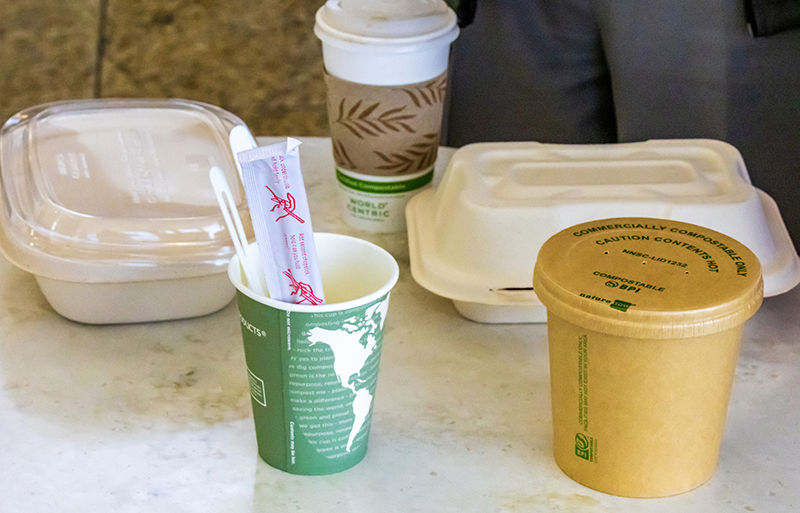
The airport gave concessions tenants two years to source and test new compostable packaging.
Despite challenges presented by tariffs and limited availability, she proudly reports that 96% or more of the products SEA tenants use for food and beverage service are reusable or compostable, and the rest are recyclable.
To receive approval, vendors must provide product specifications and samples for the airport and its composter to test.
The Customer Component
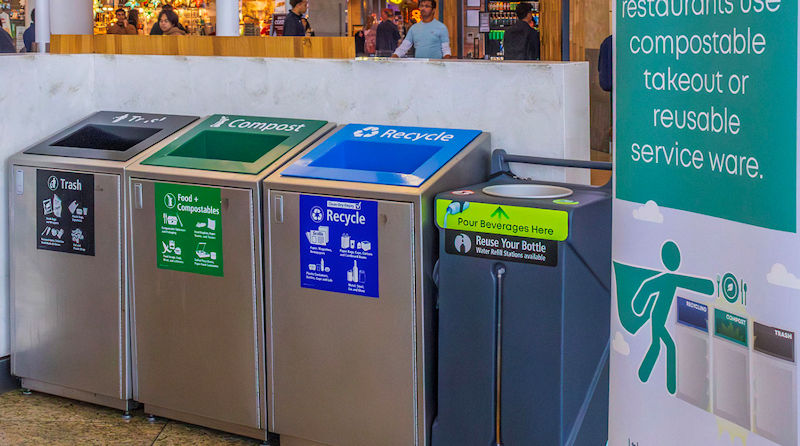
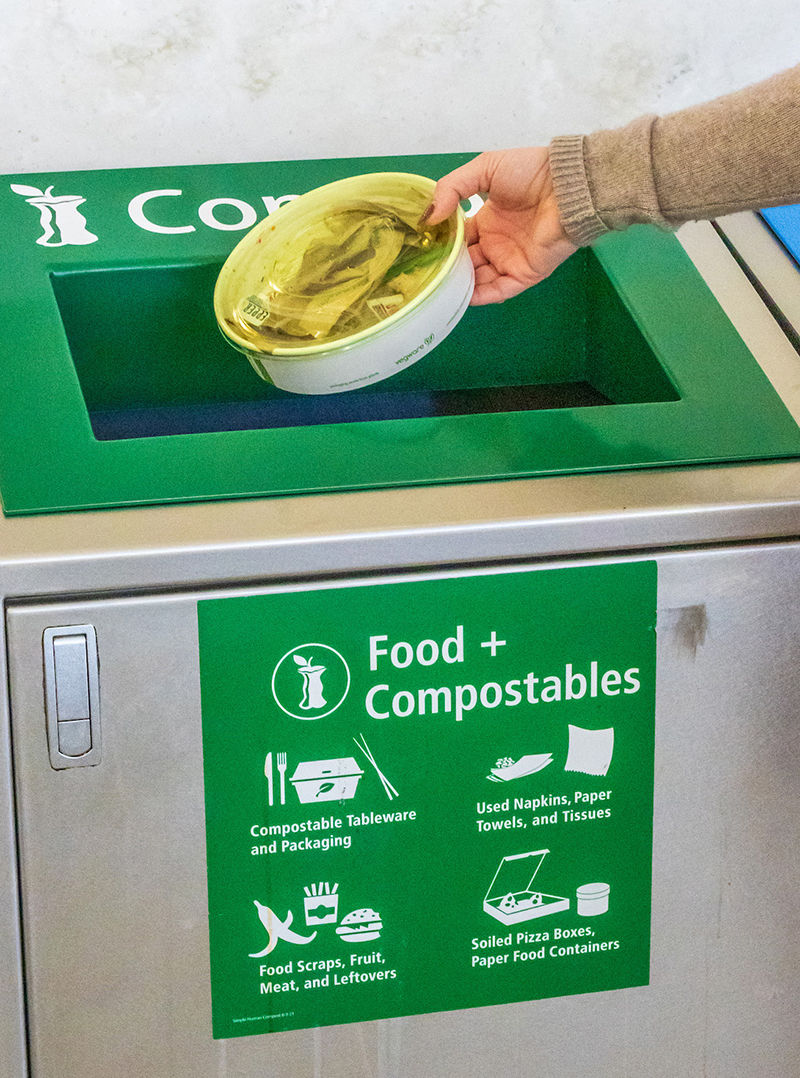
The airport provides more than 450 color-coded collection bins throughout its six concourses to help passengers discard items in a manner that supports composting and recycling. Green bins are for compost material, blue bins are for recyclables, and black are for trash.
“We make sorting as easy as possible by using color coding and symbols for each waste stream and keeping the text describing what goes in each bin brief,” Webb says. “We only have about two to three seconds to guide a passenger to sort correctly.”
New waste collection stations have separate bins for compost material, recycling and trash.
Bin placement was planned carefully, with compost bins concentrated near food courts and shared seating areas where passengers are most likely to dispose of meal packaging and food waste.
Tabletop materials, banners in food courts and television messages about the Sip, Savor, Sustain program help further increase awareness and understanding.
Behind the scenes, collected items are sorted and stored in high-capacity, access-controlled compactors. “Each tenant has a key fob that they swipe on a reader at the compactor, which unlocks it for them and records their usage,” Webb explains. “At SEA, we charge tenants for trash, but not for composting or recycling. This creates a financial incentive: The more they compost and recycle, the less they pay. We call it a pay-as-you-throw system.”
All compost is sent to Cedar Grove Compositing, and recycling goes to Recology, a recyclables recovery facility 17 miles north of the airport.
Monitoring Compliance
Maintaining the new program requires ongoing oversight and training. Moore’s team conducts quarterly environmental audits and bi-monthly operational audits; and each fall, Webb’s team conducts an annual compliance audit to make sure tenants properly sort waste and use approved packaging.
“Last year we saw 90% compliance in the overall use of compostable packaging,” Webb reports.
Tenants are given 30 days to fix issues uncovered during the audit.
“Most of the time tenants can correct the problem with a substitution or a clarification,” he says. “We have a series of escalating fines we can issue if they do not comply. But to date, we have not had to issue a penalty for anything.”
While penalties haven’t been necessary, some tenants need more guidance than others. New companies that haven’t worked in an airport before are paired with experienced tenants to help them navigate the process.
 “Good inventory management is key to keeping products on hand,” Moore specifies. “We need to get them to the point where they can order ahead—because delays can happen.”
Keeping Teams Trained
Webb highlights training as key to the program’s success. “We provide tons of tenant education on our recycling and compost programs at their quarterly management meetings,” he says. “We also have information available on our website that we push to our tenants.”
In addition, SEA provides one-page flyers that outline important do’s and don’ts, along with back-of-the-house materials in several languages. Tenants can use as little or as much of these resources as they need.
“Most of our tenant contracts are for 10 years or more, so we are invested in seeing them succeed,” Webb says. “We work with them as much as we can to help them understand the intent of our rules and how they can comply.”
Webb and his team also provide on-site training sessions and meet with tenant management to answer questions or clarify points of confusion. “We’re here to support them every step of the way,” he says.
Like employee training, waste audits are also ongoing. “This will give us a clearer picture of how much we compost and identify areas where we can improve,” Webb notes.
One Step Further?
Currently, SEA only requires reusable serviceware at sit-down restaurants that have dishwashing infrastructure. But the airport has explored the option of adding a central dishwashing system to support reusable serviceware for takeout providers as well.
“We’ve had conversations with vendors who provide this service, but there are logistical challenges,” Webb shares. “Our concessions are spread across a large area, so we’d need a system to collect the items, a dedicated dishwashing facility on site, and a process for restocking and storing inventory. There are also point-of-sale system integration and deposit system issues to work through. It’s a pretty significant logistical puzzle to work out.”
Sustainability Leaders
Moore sees Sip, Savor, Sustain as an important part of a larger strategy to advance airport sustainability nationwide and across the continent.
“SEA loves being in the forefront of things,” she says. “We want to be the most sustainable airport in North America. We want what we do to help other airports become more sustainable, too.”
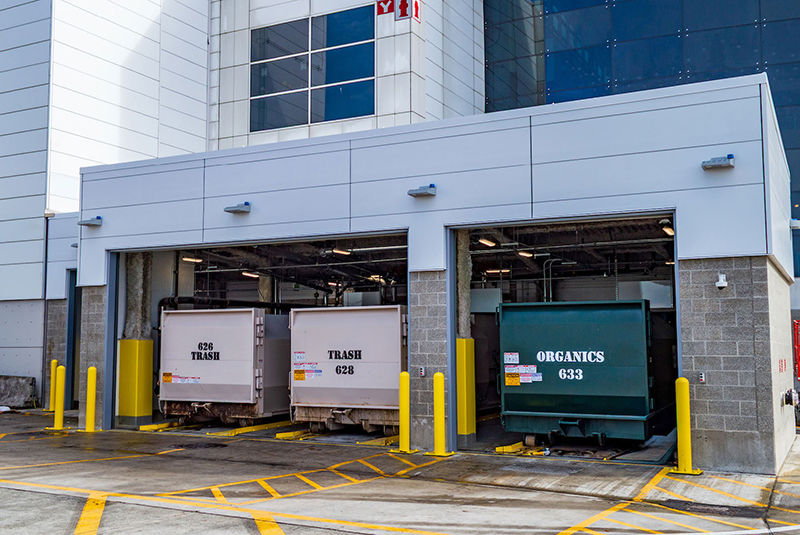
Tons of food-related waste is being redirected away from the trash.
Her advice to other airports that are considering similar programs? Plan ahead and give tenants time to acclimate to the change.
Webb recommends verifying there is a composter nearby that can accept compostable packaging. “If you don’t have that, there’s not much you can do,” he laments. “The next step is to start conversations with concessionaires and lounges to learn what kind of access they have to compostables currently and what they may need.”
Finally, Webb emphasizes the need for follow-up and support: “You can’t just set rules and turn them loose. You need to be with them every step, answering their questions, supporting their needs, and responding to their waiver requests. If you do those things, you will have a successful program.”
For travelers passing through SEA, the impact of changes to waste disposal may seem small. But every compostable cup, reusable plate and carefully sorted waste bin is another step toward a more sustainable future.