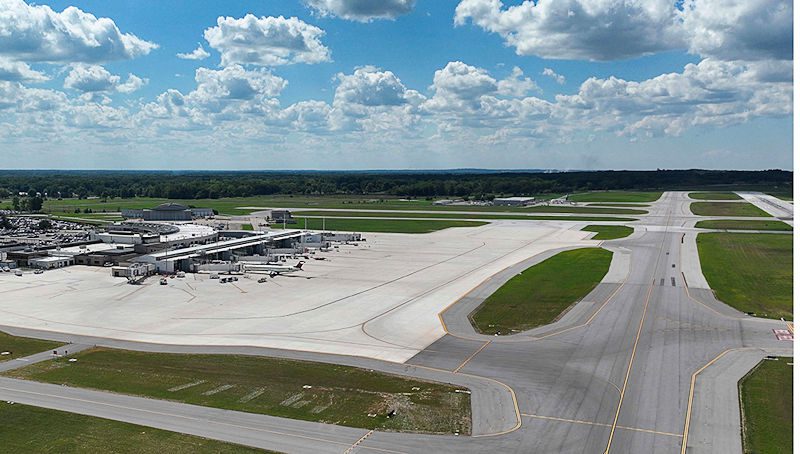
Despite challenges such as seasonal limitation and uncertain funding, South Bend International Airport (SBN) celebrated the completion of a $105 million airfield project in September. The five-year, multi-phase project corrected the geometry of a key taxiway to improve pilot wayfinding and separated the taxiway from the terminal ramp to enhance airfield safety, security and efficiency. And it was all completed amid rising traffic volume.
“We strive constantly for safety and security, and we knew we needed to make some improvements,” acknowledges Mike Daigle, chief executive officer and executive director of the northern Indiana airport.
Owned and operated by the St. Joseph County Airport Authority, SBN has seen steady increases over recent years from more frequent flights and up-gauging from smaller regional jets to larger, mainline Group III aircraft.
| facts&figures
Projects: Taxiway Realignment; Location: Budget: $105 million Funding: $96 million federal; $9 million state & local Timeline: Oct. 2020-Sept. 2025 Civil & Electrical Engineering: Mead & Hunt Inc. Construction Administration & Inspection: Butler, Fairman & Seufert Construction: Rieth-Riley Construction Co. (Phases A, C, D & E) Construction: Milestone Contractors North Inc. (Phase B) Soil Excavated: Asphalt Laid: New Terminal Ramp: Electrical & Communication Cables Installed: Airfield Light Fixtures Changed from Incandescent to LED: 475 Stormwater Pipe Installed: Stormwater Structures Added: 84 Paint for New Airfield Markings: 1,239 gal. |
“We are continuously growing,” Daigle comments, noting that passenger volume and the number of aircraft coming and going are both increasing.
In 2024, the airport recorded 450,000 enplanements, with five carriers and nonstop flights to 17 destinations. In the first nine months of 2025, SBN passenger volume was up almost 28% from 2024, the airport’s second-best year.
“We’re growing dramatically,” Daigle emphasizes.
Prioritizing Safety and Security
The need to decouple Taxiway B from the terminal apron was a priority when planning began. Because this taxiway was located at the north edge of the terminal apron, aircraft pushing back from the gates would enter a controlled area, which hampered general maneuverability and caused serious safety concerns. As operations have increased, mainline aircraft could only be accommodated on two gates at the end of the building, limiting the airport’s growth.
As if that wasn’t enough of a challenge, pavement that sloped toward the terminal caused traction issues for aircraft, tugs and ground handlers when water and ice accumulated on the apron.
Thanks to the recently completed project, mainline aircraft and larger regional jets can now use any gate. Additionally, a new centralized deicing pad allows for more efficient operations and glycol collection.
In 2016, Mead & Hunt worked hand-in-hand with the airport and FAA on a feasibility study to identify and evaluate potential alternatives for SBN. “We did review a couple possibilities and set on the one that made [the airfield] better operationally and safer for everybody,” Daigle says. “It became apparent fairly quickly that with our primary east-west runway and the parallel taxiway, there really were very few options.”
As a result, the team outlined the following project scope:
- Geometry changes to decouple the apron and taxiway for improved safety
- Stormwater network/drainage improvements
- Aircraft deicing improvements: centralized location, glycol collection
- Aircraft gate parking improvements: increased fleet mix, slope improvements
- Pavement condition improvements
Originally proposed as a three-year construction project, cost and the availability of federal funding extended the schedule over five construction seasons. Phases were carefully planned to minimize the impact on operations.
One Phase Per Year
The five-year project was divided into five phases, labeled A through E. Work began on the west end of Taxiway B and moved east toward the terminal, temporarily closing the crosswind runway. “We just repeated that for the next two years so we could get all the commercial ramp completed,” explains Patrick Mac Carthaigh, vice president of Operations at SBN. “Then we went eastbound from there and completed the project this summer.”
 Scheduling and phasing the project to reduce operational impacts as airlines added more flights and capacity required careful planning. “That was a challenge as we got into construction,” Mac Carthaigh recalls. During the transition, SBN adopted a gate management system, AeroCloud, to provide maximum scheduling flexibility for the Ops teams, Daigle notes.
There was a learning curve as SBN airlines transitioned to common-use gates, but the airport has continued to realize operational benefits. “We’ve upgraded it since our initial rollout, and it’s working very well,” Mac Carthaigh reports. “[AeroCloud] gives them flexibility that they otherwise never had.”
Leveling the Field
One of the biggest challenges on SBN’s airfield was sloping pavement on the commercial ramp. At some points, the elevation varied by several feet.
“The slopes were pretty steep, sloping back toward the building,” explains Paul Shaffer, PE, executive vice president with Butler, Fairman & Seufert. This not only caused drainage problems, it also allowed ice to form around the gates during winter, making it difficult for tugs to push back airplanes and dangerous for baggage handling and ground crews. “Those people had a very slippery, icy environment to work in,” Shaffer notes.
To correct this, the apron was lowered as much as 7 feet in some areas and sloped away from the building. “That was a pretty dramatic cut,” Shaffer emphasizes. The entire ramp was rebuilt in sections to ensure proper grade and structural integrity. Now, the surface drains readily and ice does not accumulate around the gates.
 Butler, Fairman & Seufert oversaw materials testing during Phases A and B, including soil density analysis to ensure a suitable platform. Unanticipated soil issues required the material to be undercut as deep as 20 to 30 feet in some sections, notes Shaffer. Crews removed and relocated the problematic material, and then brought in more suitable fill, which also underwent density and compaction tests as it was built up to produce a more even surface.
Fortunately, subcontractor R&R Excavating, led by Reith Reilly, had experience in mitigating soils similar to those encountered. “It was a good collaborative team approach to ensure it all got taken care of,” Shaffer remarks.
Throughout the process, ensuring that slope changes were well-marked and clearly delineated was crucial for safety.
With work areas so close to airline operations, disruption was unavoidable. “We had to take those gates out of service to cut that much dirt out and lower the pavement,” Shaffer explains. Temporarily relocating boarding bridges and then transitioning them to the new, different elevation significantly complicated matters. To accommodate the work, SBN shut down four gates at a time, coordinating closely with airlines to rearrange schedules. Fixing the apron slope in the least amount of time possible was a key priority.
“It was difficult accepting the same volume of operations through the construction process,” notes Mac Carthaigh.
 “It was challenging at times,” Daigle agrees. “But I think our Ops team did such a great job in communicating with the airlines.”
Other Airfield Improvements
During Phase B in 2022, the airport added a centralized deicing pad. Previously, aircraft were deiced at the gates.
When choosing the new location, project planners had to avoid the existing geothermal field west of the terminal, and initially proposed placing pads west or east of the airfield. Airport leadership, however, prioritized a more central location to provide convenient access for both passenger and cargo aircraft. Tying the operation into the sanitary system was also a factor, making the ideal location just northwest of the terminal building.
The new system allows drainage from deicing operations and stormwater to be captured and stored in a 100,000-gallon underground tank. The glycol system is designed to allow for variable discharge rates, as required by local wastewater treatment facilities, but currently discharges up to 10,000 gallons per day for quicker, more efficient winter operations.
Phase E, recently completed in 2025, reworked pavement grading in critical areas of the instrument landing system. This required shutting down the system for close to 60 days and closing the primary runway for 45 days, under close coordination with FAA. During that period, aircraft used the crosswind runway instead, which especially presented challenges in poor weather conditions. Scheduling the bulk of this work during summer helped matters, and SBN experienced just six diversions in that time. “When you consider how many flights they have per day, that’s not too bad,” notes Shaffer.
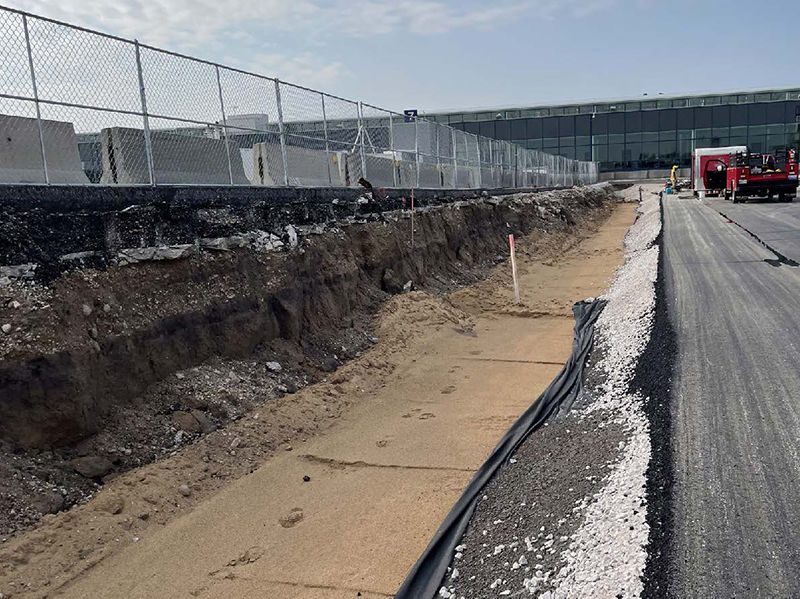
A significant amount of cut excavation was required to lower the grade of the new terminal apron.
Airfield safety and security is now improved without direct taxiway connection from the runway to the commercial ramp, Daigle notes. In addition, Security Identification Display Area access points were upgraded with new cameras and gates to better control the periphery, while new LED lighting on the apron improves safety and security for ground support operations.
Funding and Forecasts
Jeff Thoman, senior project manager with Mead & Hunt, says the uncertainty of FAA funding levels from year to year created a puzzle that required the team to be adaptable, flexible and creative. For each phase of the project, the team developed multiple bid options to allow quick reaction and decision-making if funding levels changed. “[The airport] wanted us to have something ready to go in case late-year money was provided to them,” Thoman explains. “It became really challenging to figure out.”
Weather and the need to leave the airfield in operating condition between phases also played a significant role during project planning. “We couldn’t have taxiways or connectors closed through the winter, and certainly not runways closed through the winter,” Thoman explains.
This required a lot of iterations of project phases to maximize both funding and favorable weather conditions.
 “We worked through it with constant communication with the airport and the ability to remain flexible,” Thoman recalls. “The FAA was also a great partner.”
The team was closely integrated to ensure all stakeholders had a voice at the table when it came to decision making, he adds.
Communication both ways was critical, Daigle emphasizes. “Sharing more than less is better, and you need to provide a way for people to come back with questions.”
Despite a proactive spring construction start, the project faced Indiana’s unpredictable spring weather. And much of the work relied on ground being accessible. That meant some years’ work pushed into October, competing with busier-than-usual operations during college football weekends. “We might have private aircraft landing every four minutes—seemingly non-stop,” Mac Carthaigh recalls. “And we were eliminating taxiway entrances to the terminal apron to avoid that direct access issue.” Clear and consistent communication, including pre-season planning meetings, helped facilitate safe and efficient operations even when Notre Dame (just minutes away from SBN) had home games.
“We believe in solid communication and working with our partners,” Mac Carthaigh says, noting the importance for Air Traffic Control, airlines, fixed-base operators, and other stakeholders to have a clear understanding of processes throughout the ever-evolving project.
Beyond delivering the safety and efficiency gains, the taxiway realignment is opening up new revenue opportunities for SBN. A space on the east side of the airfield, adjacent to Taxiway B, is now being considered for future aeronautical development. “It’s not finalized what we’re going to do, but it could be multiple aviation uses, which it was not before,” Mac Carthaigh says.
“Our airfield construction is continuously ongoing as we continue to modernize and update,” Daigle adds.