Within a massive $19 billion redevelopment program across John F. Kennedy International Airport (JFK), Terminal 4 (T4) stands out as one of the airport’s busiest terminals and one of its most ambitious modernization efforts. The $1.5 billion T4 project also highlights how technology and infrastructure can align to reshape the passenger experience.
Operated by the private entity JFK International Air Terminal LLC (JFKIAT), T4 has grown into a major global gateway since opening in 2001, when it served just 4 million passengers. The most recent redevelopment and transformation of T4, which commenced in late 2021, was well timed to accommodate the rebound in travel and surge in passenger volume that followed the COVID-19 pandemic. As passenger traffic climbed, reaching nearly 28 million travelers in 2024, T4 needed to do more than add space and increase efficiency. The situation called for a comprehensive operational overhaul powered by data, automation and next-generation technology.
Beyond boosting capacity, the comprehensive redevelopment project reengineered operations to emphasize seamless, efficient and personalized travel in T4. The initiative was part of a roadmap the Port Authority of New York and New Jersey established to make all of its airports, including JFK, “world-class.” JFKIAT Chief Executive Officer Roel Huinink notes that the T4 redevelopment was shaped by two primary drivers: meeting the airport’s expectations to comply with Port Authority plans, and accommodating Delta Air Lines’ evolving footprint at JFK. Both required repurposing space, updating processes and refining operations.
| facts&figures
Project: Terminal Updates Location: John F. Kennedy Int’l Airport, in NY Terminal: 4 Terminal Operator: JFK Int’l Air Terminal LLC (JFKIAT) Anchor Tenant: Delta Air Lines Facility Expansion: 150,000 sq. ft. Cost: $1.5 billion Funding: JFKIAT municipality bonds Project Management: Delta; JFKIAT Construction & Implementation: Key Technology Components: Gate efficiency & real-time visibility program; advanced passenger flow management system; tracking system for mobility carts; interactive waste-sorting assistant; cloud-based passenger processing technology, including self-service kiosks, common-use workstations, biometric integrations & shared-use auto bag drop units Key Facility Upgrades: New lounges; 10 new aircraft parking positions; additional domestic baggage claim carousel; digital signage; modernized restrooms Passenger Processing Technology: Amadeus Advanced Passenger Flow Management System: Copenhagen Optimization Mobility Cart Tracking System: Volan Technology Interactive Waste-Sorting Assistant: Intuitive AI Turnaround Gate Control Solution: Assaia General Contractor: Delta Air Lines Engineering: ARUP Architect: Gensler General Contractor for Wayfinding Upgrades; Project Management: Turner Construction General Contractor for Restroom Renovations & Capital One Lounge; Project Management for Delta One Lounge: Holt Construction General Contractor for Self-Service Bag Drops & Departures Kiosks; Holdroom Upgrades; LED Lighting in Retail & Concourses: VRH Construction Electrical: GMA Electrical Corp. Electrical: Unity Electric Signage Fabrication: Key Benefits: Enhanced passenger experience; improved traffic flow; improved operating efficiency; increased capacity |
The T4 redevelopment was originally scoped as a $3.8 billion program in 2019, and it centered on an expansion of capacity beyond Delta’s consolidation at T4. However, the impacts of the COVID pandemic prompted Delta and the Port Authority to renegotiate the project scope, resulting in a $1.5 billion program that began in late 2021. Given the required timelines, this was an extraordinary undertaking.
The physical expansion was significant, driven largely by the consolidation of all domestic operations by Delta Air Lines into the terminal following the retirement of Terminal 2. Accommodating this shift required more gates, more capacity and more efficient operations. The first phase of redevelopment added 10 new narrowbody gates that opened in January 2023. “Basically, 14 months after we broke ground, we opened 10 new gates, which is pretty remarkable,” Huinink comments. Reduced construction work during the pandemic and close coordination between JFKIAT and Delta’s construction teams proved to be major advantages.
Beyond these gates, the project included an additional domestic baggage claim carousel and transformed regional jet areas to support mainline aircraft. The terminal grew by roughly 150,000 square feet, with improvements including an updated check-in hall, refreshed holdrooms, expanded curbside drop-off space, new digital signage and comprehensive restroom updates. These enhancements substantially increased capacity and improved flow for millions of Delta customers in T4. While the physical upgrades laid essential groundwork, technology investments were instrumental to reshaping how passengers move through the terminal and improving behind-the-scenes operations.
The Delta Factor
For Delta Air Lines, moving exclusively to T4 was not simply an infrastructure project but a strategic operational realignment. As the terminal’s anchor tenant, Delta led design and construction of the recent expansion/redevelopment (just as it did the previous two), while JFKIAT managed $1.3 billion of the $1.5 billion invested. “The primary factor driving this expansion within Terminal 4 was to streamline our operation and improve the customer experience via the efficiencies gained from operating within a single terminal,” explains Ryan Marzullo, Delta’s managing director of NY Design and Construction.
Engineering work focused heavily on increasing the number of gates, supporting larger aircraft, optimizing connections and improving the baggage handling system. Delta’s operations required both speed and precision, particularly during construction of the new narrowbody gates. Following an accelerated schedule, the project team constructed 10 new boarding gates in less than 14 months— a job Marzullo estimates would typically take nearly two years to complete. “Delta’s management team worked closely with [our] operational teams as well as with JFKIAT to develop, refine and ultimately finalize the complex phasing plans that allowed us to complete this program in record time,” he remarks.

The physical consolidation at T4 also laid the groundwork for Delta to expand its biometric and digital tools, including a system that dramatically reduces processing time for incoming checked baggage. “Touchless ID speeds up bag drop by 75%, reducing transactions to just 30 seconds on average (compared to two minutes for customers without Touchless ID),” explains Greg Forbes, Delta’s managing director of Airport Experience. “At security, enrolled customers clear checkpoints three times faster than standard TSA PreCheck, with automated ID verification cutting processing times to just 7 seconds (versus 25 seconds for PreCheck).” This new system reflects Delta’s broader goal to shift routine tasks away from agents so they can focus on hospitality and meaningful passenger engagement, Forbes notes.

Across the terminal, the carrier reinforced its commitment to elevated hospitality and delivering a premium, differentiated travel experience by adding a new Delta One Lounge between concourses A and B, and a second Sky Club in Concourse A. “These enhancements are not just physical upgrades. They’re a direct extension of our strategy to elevate every touchpoint of the customer journey,” comments Claude Roussel, vice president of Sky Clubs and Lounge Experience with Delta.
Tech-Driven Passenger Journey
The redevelopment did not stop with physical expansion. JFKIAT’s strategy placed equal emphasis on digital transformation, operational intelligence and a new standard of interconnected airport systems. Huinink emphasizes that technology was not an optional component of the redevelopment; it was essential to it. “We invested a lot…predominantly in quality and technology to make the passenger experience better,” he says.
From new self-service systems to dynamic forecasting and mobility tools, nearly every process a passenger touches was evaluated and reimagined. The result is an airport experience more aligned with current customer expectations. “Good technology is technology that you don’t even perceive is there,” asserts Augusto Santos, senior vice president – Americas – AirOps with Amadeus, one of the key technology providers for the project. “It’s just transparent; it’s just natural, and that’s the type of experience that we want to give to our passengers through our technology.”
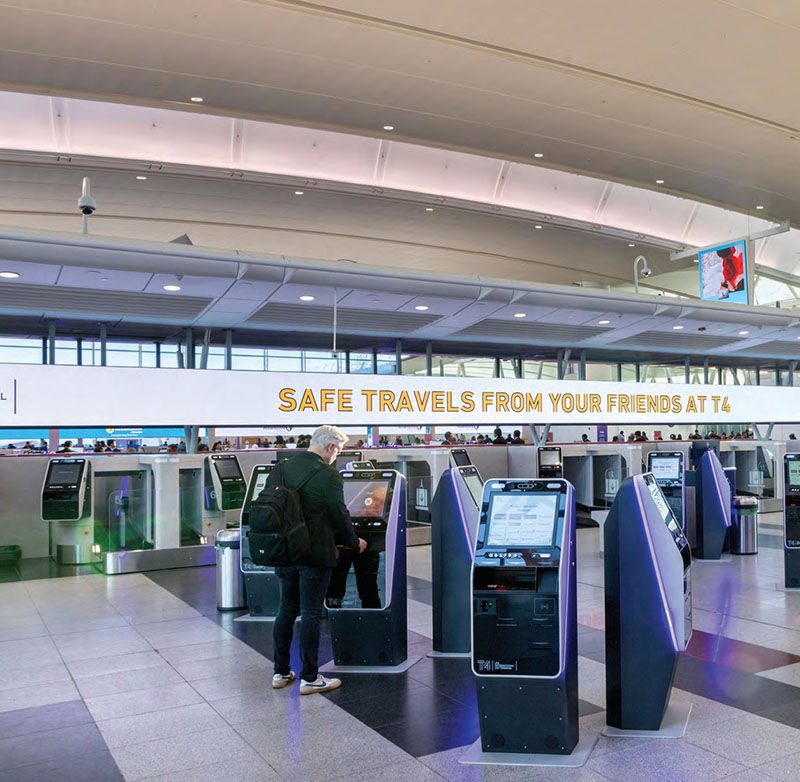
Recognizing that confidence and clarity shape passenger perception, JFKIAT invested heavily in new digital signage, wayfinding and information systems throughout the terminal. LED displays along check-in rows help passengers understand where to go next and provide expected checkpoint wait times.
Additional digital totems developed with TSA provide information to help passengers prepare for screening, such as reminders about restrictions on liquids, removing shoes, taking laptops and other large electronics out of bags, what documents to present to security agents and estimated wait times. JFKIAT is also in the midst of adding kiosks throughout the terminal where passengers can find real-time flight information, ask questions or get assistance from a remote customer service representative. Huinink explains that improving wayfinding and reducing ambiguity or confusion will enhance the predictability of passenger movement and avoid congestion in the terminal.
A major component of the T4 modernization is the deployment of cloud-based passenger processing technology from Amadeus, including self-service kiosks for passengers, common-use workstations for airline personnel, biometric integrations and shared auto bag drop units. The goal was to make passenger processing faster, easier and more efficient for all 20+ airlines that operate in the terminal.
“On average, a passenger can do their checking and self-tagging at a kiosk in under a minute and the self-bag-drop under 43 seconds,” Santos reports. For a terminal that processes tens of thousands of travelers per day, even minor reductions in transaction time translate to major operational savings.
Because the Amadeus platform is fully cloud-based, it gives T4 the flexibility to scale and update systems without major hardware changes, ensuring consistency across multiple carriers while allowing airlines to tailor select elements. “Our goal is to work with our customers, their airlines and listen to the passengers to deliver a frictionless and personalized passenger experience,” Santos remarks.
The deployment of new auto bag-drop units has reshaped how passengers move through the terminal. Because each unit supports multiple airlines, T4 can maximize throughput without dedicating physical space to individual carriers. As passengers become more aware of this self-service option, these units will occupy more check-in space, allowing employees to focus on higher-value hospitality touchpoints rather than routine transactions like checking bags. For JFKIAT, this shift not only reduces congestion in the check-in hall but also aligns with its broader strategy of blending technology with human engagement to improve overall service.
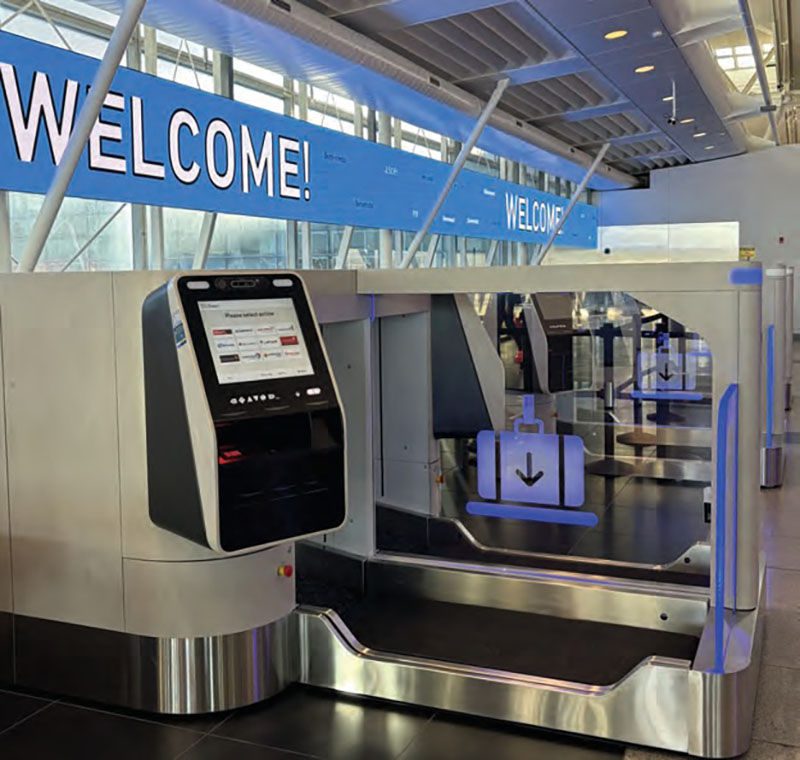
Automated self-service bag drop units from Amadeus support multiple airlines.
The system was designed with accessibility in mind, offering multilingual support, intuitive interfaces and ADA-compliant layouts, with optional biometrics for airlines adopting face-match technology.
The Amadeus platform also improves operational visibility, notes Santos. Shared workstations and kiosks provide real-time data on equipment usage and transaction volumes, allowing managers to identify bottlenecks and reallocate resources before queues build. Integrated connections with airline Departure Control System hosts, TSA, border control and T4’s passenger-flow forecasting tools further support a smooth, predictable journey from curb to gate, he adds.
 To better predict and manage surges, JFKIAT partnered with Copenhagen Optimization and Beonic on the deployment of an advanced passenger flow management system. The partnership began in 2018 with early deployments of Beonic’s computer-vision sensors paired with the Better Airport software to measure queue lengths and movement patterns. As the redevelopment progressed, JFKIAT expanded the platform into a comprehensive operational backbone for the terminal, explains Copenhagen Optimization Chief Executive Officer Kasper Hounsgaard.
Better Airport ingests flight schedules, sensor data, airport operational database feeds, baggage information and real-time operational metrics to create what Hounsgaard describes as a real-time “digital twin” of the terminal. The system predicts how passengers will move through every major process—check-in, security, border control and baggage claim—and enables JFKIAT to anticipate needs and coordinate resources long before issues become visible to passengers.
According to Hounsgaard, terminals using Better Airport typically see a 30% to 50% reduction in peak wait times, a 10% to 15% reduction in unplanned staffing needs and a 15% to 25% increase in the ability to absorb growth within existing infrastructure. “Just as important, they gain a shared, data-driven view of ‘what will happen next,’ which leads to faster decisions and fewer surprises across stakeholders,” he comments.
During the COVID-19 pandemic recovery period, the platform proved particularly useful in managing social distancing, establishing predictable traffic flows and coordinating reopening processes, Hounsgaard adds. Today, it continues to support decision-making among airlines, TSA, Customs and Border Protection and terminal operations, allowing key partners to access the same underlying data to guide staffing and resource deployment.
Real-Time Cart Tracking
For passengers with reduced mobility, not knowing when an assistive cart will arrive can add unnecessary stress. JFKIAT is addressing that issue with a tech-driven tracking system from Volan Technology that integrates with Beonic’s analytics.
 Volan Chief Executive Officer Michael Bettua explains that the company’s indoor micro-location technology uses a mesh network of wireless beacons to achieve continuous indoor tracking with 1- to 2-meter accuracy, and it doesn’t require GPS, Wi-Fi or cell signals. “The setup is incredibly simple,” Bettua notes. “Our team installed the entire system across Terminal 4 in about four hours, with zero impact on IT infrastructure.” The beacons plug into existing monitors, and the mesh network forms itself automatically. “Attaching tags to carts is about as easy as putting an E-ZPass transponder [for roadway tolls] on the windshield of your car,” he remarks.
Passengers now receive real-time information about availability, cart locations and estimated arrival times through digital displays at designated pickup points. “During high-congestion times, we’ve seen a 30% to 40% reduction in wait times,” Bettua reports. The system also provides T4 staff with analytics to optimize fleet distribution and staffing based on predicted patterns up to one month in advance. “That lets JFKIAT proactively manage its cart fleet and deliver a smoother, more dependable passenger experience,” Bettua comments.
Certifiably Green
On the sustainability front, T4 became the first pre-existing airport terminal in the United States to achieve LEED Platinum certification—a milestone that requires long-term commitment, operational discipline and continuous investment, says Huinink.
 While some organizations achieve certification once, JFKIAT is actively pursuing recertification, which he says is more demanding because it requires meeting new goals and making ongoing improvements. “We keep investing in innovative initiatives,” Huinink says. “We’re pretty proud of having a holistic approach.” The terminal operator achieved LEED Platinum by working with its partners to meet ambitious targets for energy efficiency, greenhouse emission reduction, water conservation, waste management, indoor air quality and sustainable transportation.
Other recent sustainability efforts include purchasing Green-e® Renewable Energy Certificates as part of an immediate carbon reduction strategy and commitment to reaching net-zero carbon by 2050. Thanks to this investment and facility changes such as upgraded lighting, HVAC systems and building controls, T4 has reduced its carbon footprint by 16%. The terminal has also procured sustainable aviation fuel to help offset business travel emissions.
One of the most visible new sustainability features in the terminal is Oscar Sort, an interactive waste-sorting assistant from Intuitive AI. “By using computer vision, Oscar can recognize what a person is holding and instantly guide them to the correct bin—lifting recycling accuracy to as high as 96%,” says Hassan Murad, the company’s chief executive officer. “What’s happening at JFK Terminal 4 is a clear demonstration that visual, at-the-source guidance fundamentally changes how people sort waste; those small moments of clarity add up to meaningful environmental impact.” The equipment also serves as a communication tool, displaying sustainability messages and retail promotions when not being used for sorting.
 The new system has already delivered notable improvements at T4, including 71% contamination-free disposal (compared to about 30% across New York), a 95% accuracy rate for bottle recycling and a 65% improvement in overall recycling purity, Murad reports.
In particular, the Oscar unit improves sorting accuracy for items that often cause confusion, like food containers and food scraps. Correct disposal of food boxes now occurs at rates roughly twice the regional average, and accuracy for food-scrap sorting exceeds 90%, resulting in far cleaner waste streams, Murad notes.
JFKIAT’s sorting machine is installed in a particularly active area and recorded more than 2 million interactions in 2025. “That includes over 40 hours of active engagement time—moments where travelers stop, look, learn and make an informed sorting decision,” he explains. “Without Oscar, every one of those moments would have been a missed opportunity for education and behavior change.”
AI-Optimized Apron Operations
With tens of millions of passengers moving through T4 annually, even minor delays can compound into operational challenges. To address this, JFKIAT partnered with Assaia to deploy ApronAI, a computer-vision system that analyzes video footage of the ramp to automatically detect and timestamp key events like fueling, catering, cleaning, boarding and baggage handling.
 JFKIAT was among the first terminal operators in the United States to proactively invest in real-time turnaround oversight/management. A one-year pilot at select gates demonstrated measurable results, justifying expansion of the platform to all connected and remote gates. The subsequent results have been substantial for the terminal and its airline partners. “ApronAI has helped reduce ground delays by an average of five minutes per flight, with the improvement in gate efficiency translating to an estimated $40 million in annual savings potential,” explains Assaia Chief Executive Officer Christiaan Hen.
Beyond T4, Assaia’s 2025 Turnaround Report found that AI-enabled operations delivered an average 25% reduction in departure delays and a 5% increase in gate efficiency, which allows one additional flight per day for every 20 gates, Hen says. With reliable, real-time visibility, operations can become more resilient, allowing airports to accommodate rising passenger demand and capacity constraints without necessarily requiring infrastructure expansion, he adds.
Assaia’s Predicted Off-Block Time algorithm forecasts when an aircraft will be ready to depart based on real-time and historical turnaround data. “It accounts for multiple variables including aircraft type, weather, landing runway, ramp conditions and even passenger load to accurately predict when the gate will be free,” Hen explains. “This enables more efficient gate assignment and helps reduce arrival holding times caused by unavailable stands.”
Making Tech Work for You
For many, the recent T4 project illustrates how real-time location intelligence can reshape airport operations when built into redevelopment plans from the outset. Bettua, from Volan Technology, emphasizes that visibility of people and assets transforms both efficiency and decision-making. “The real win is that this technology enables you to do more with the same resources—or even to increase service, safety and security levels with fewer people. It gives your operations team superpowers,” he explains.

The recent transformation of Terminal 4 is a key component of the $19 billion redevelopment program at JFK Int’l.
Hounsgaard, from Copenhagen Optimization, says that success depends on far more than software. “The main lesson is that technology alone is not enough—you need good data, clear governance and buy-in from all the key players,” he shares.
Murad, of Intuitive AI, encourages airports to see the commercial potential of interactive waste-sorting technologies like Oscar. “It’s far more than a sustainability upgrade; it’s a new revenue-generating consumer engagement channel inside the terminal,” he remarks. By engaging passengers when they naturally pause, airports can leverage a previously overlooked location for messaging and promotions.
Out on the ramp, deployment of Assaia technology demonstrates that sharing real-time data across all stakeholders leads to faster communication and improved turnaround performance. “The airports that see the strongest results are those that treat digital tools as part of their daily operation, not as an add-on,” Hen advises.
The strength of cloud-native technology lies in its ability to connect the entire airport ecosystem and support the passenger journey from start to finish, adds Santos, of Amadeus. He stresses the importance of securely integrating airlines, government agencies/authorities and airport teams on one scalable platform.
For Huinink, collaboration was a central principle to success of the T4 redevelopment. “In aviation and in airports, you shouldn’t think that you can do things alone,” he reflects. “Collaboration amongst all parties, airlines, business partners, stakeholders and the community is crucial.”
Design Updates for a New Experience
In addition to improving operational systems and technology, JFKIAT refreshed customer-facing spaces. Upgrades include new art installations, additional lounges, more modern restrooms, and additional concessions—all crafted to showcase the culture of New York City.
Huinink was personally touched to see that some of the local artists selected to provide installations in the redeveloped spaces were immigrants just like himself, as T4 was likely their first entry point to the United States. “They really can take so much pride in seeing their work exposed here and having that connection,” he comments.
Although the terminal already had several credit card and other premium passenger lounges, the new Capital One Lounge is making its mark as the card network’s largest lounge in the United States and the first in any New York City airport. Developed with Capital One and TAV Operation Services, the 13,500-square-foot lounge combines signature New York food brands, modern design, local artwork and a wide array of traveler conveniences. Its opening in June 2025 marked the beginning of an updated concessions program that includes more than a dozen new dining and retail concepts. The food and beverage additions feature iconic New York brands such as Ess-a-Bagel, Murray’s Cheese and TALEA Beer Co. New retail options include the introduction of Hudson Nonstop’s checkout-free technology.
Throughout the terminal, JFKIAT modernized restrooms with LED lighting upgrades and increased attendant staffing according to new Port Authority standards. “Clean restrooms are a massive driver for customer experience, so that has been a major focus,” Huinink stresses.
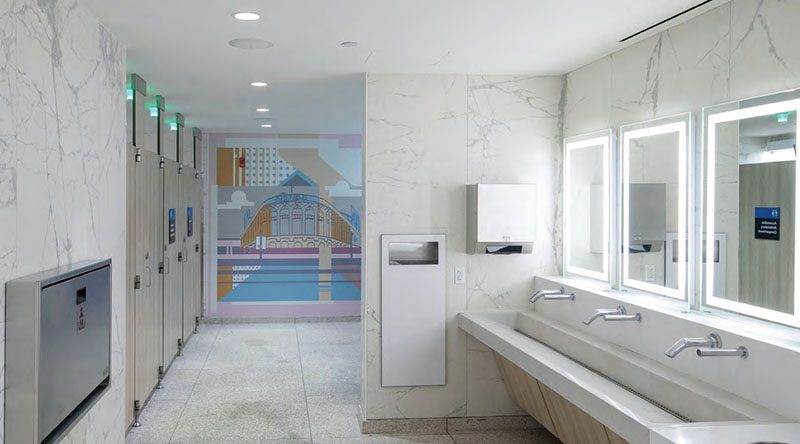
Restrooms throughout the terminal were modernized, and attendant staffing was increased.
During the entire project, JFKIAT worked to ensure that local communities benefited directly from the redevelopment. For example, it worked closely with HMSHost to build joint ventures with local and diverse concession companies that include equity stakes in the terminal’s commercial offerings. “We are super proud that we found quite a lot of good partners in the community to bring into the terminal and not only with [Airport Concessions Disadvantaged Business Enterprises] but also on the construction side to really give us the opportunity to work with the small businesses and give them true access to the airport community,” Huinink remarks.
With the project closing out at $1.5 billion, that purposeful outreach translated into approximately 40%. It also dovetails with the ongoing $19 billion airport-wide modernization that includes an overhaul of roadways and the construction of two new terminals—1 and 6. Huinink sees T4 as an essential contributor supporting the broader vision to make JFK a world-class airport. He notes that the JFKIAT team has more than 25 years of history managing the terminal and takes pride in playing a significant role in helping position JFK for its next era of growth.
| Hospitality Training to Enhance the Art of Travel
The facility and technology components of the recent $1.5 billion redevelopment program at Terminal 4 in John F. Kennedy International Airport (JFK) are complete, but a focus on elevating the passenger experience continues. Roel Huinink, chief executive officer of the private terminal operator JFKIAT, emphasizes that employee engagement and service culture can shape the airport experience as much as the physical infrastructure. Combining “hardware” with “heartware” is how he puts it. The strategy to do so, known as the T4 North Star initiative, addresses five fundamental components: employees, passengers, airlines, commercial offerings and terminal ambiance. Through this initiative, JFKIAT plans to bring the physical transformation of T4 to life by redefining its concessions options, elevating facility design elements and honing the customer service culture across the entire terminal.
JFKIAT is addressing the customer service aspect with a training program called the T4 State of Mind, which focuses on service excellence, innovation and community engagement. The curriculum aims to create a consistent hospitality standard across all partners operating within the terminal—airlines, government agencies, concessionaires, retailers and contractors. The program works to build a unified culture that supports positive passenger interactions through customer service training, shared expectations and visual identity elements. “We’re building customer experiences powered by the T4 State of Mind, where pride, community and innovation unite—and that really aims to enhance the art of travel at T4,” Huinink remarks. Thousands of employees wear T4-branded apparel and participate enthusiastically in community-building programs, |