Winter isn’t just a season at Frederick Douglass Greater Rochester International Airport (ROC) in upstate New York; it’s an operational priority. With average annual snowfalls hovering near 90 inches, snow and ice removal is a core function.
Sean Cleary, airport operations manager at ROC, bases procedures on a zero-tolerance policy for runway ice, leaving little room for error. Aircraft schedules, braking action and safety margins all depend on how quickly and efficiently snow and ice are managed.
The airfield is divided into zones to help ensure the most critical surfaces stay clear, safe and operational during snow events. The 3.3 million square feet of Priority 1 areas include the 8,001-foot primary commercial runway, which runs north/south, as well as all connecting taxiways and the ramp apron for commercial traffic.
| facts&figures
Project: Snow Removal Strategies & Equipment Location: Frederick Douglass Greater Rochester Int’l Airport, in NY Annual Snow Removal Budget: $2 million– Funding Sources: Monroe County Airport Authority Capital Budget; local funds; passenger freight charges Equipment Fleet Snowblower/Brooms: 9 Oshkosh H-Series Snow Brooms & Blowers Plows: 3 HV-Series International 10-wheel dump trucks with 16-ft. Wausau plows with Kuper cutting edges; HV-Series International 6-wheeler dump truck with 16-ft. TENCO plow with steel cutting edge; 2 Western Star 4700 Plow trucks with dedicated rear sander bodies Loaders: 4 Case 1121G wheel loaders with 30-ft. Pro-Tech blades Potassium Acetate Sprayer Truck: 1 International HV-Series chassis with custom rear liquid deicer system made by Batts Inc. including 2,000-gal. tank & 50-ft. spray boom with 35 nozzles, each able to deliver 8.5 gal/ minute at 90 psi Sand Trucks: 2 dedicated sand trucks with Bucher sanders & 2 300-gal. potassium acetate tanks with a spraying system Sand Supplier & Supporting Dealer: Equipment Repair & Maintenance: Monroe County Fleet Maintenance Key Strategies: Zero tolerance for ice on runways; quick & sustained response to prevent snow from building up; preparedness for crews & equipment; retaining experienced employees; cross-department support; continual improvement through post-storm debriefs; local dealers & service providers for equipment repair & maintenance |
The goal is to never let snow build up enough on Runway 4-22 to become a problem. “We strive for nothing worse than wet conditions,” Cleary says. It’s a philosophy that requires immediate action, so as soon as the first snow starts falling, his crew is out there. “If we’re on the runway with our brooms from the start of the storm, not allowing any accumulation, we’re able to maintain a clearer surface with that almost-perfect braking action report the pilots are looking for,” he explains.
Focus on the commercial runway doesn’t mean other areas are forgotten. The airport has a robust general aviation community, and snow removal plans account for movement on Runway 10-28, the 6,700-foot crosswind runway favored by general aviation aircraft. As snow or sleet tapers off, attention shifts from 4-22 to 10-28, the secondary runway.
The target clearing time for Priority 1 areas is about 30 minutes, balancing snow removal with active air traffic. The key is staying ahead of demand, Cleary emphasizes. “Even if there is a window where we may not have any arrivals or departures, we’re still out there clearing the runway,” he says. “That way, when the arrivals and the departures start to pick up, we’re not having to chase our tails.”
While Cleary’s crews are busy clearing the airfield pavement, fixed base operators USAirports and AVFLIGHT handle aircraft deicing. Airlines contract with the two companies for deicing services, and ROC is responsible for glycol collection and treatment.
A Fleet to Fight Snow and Sleet
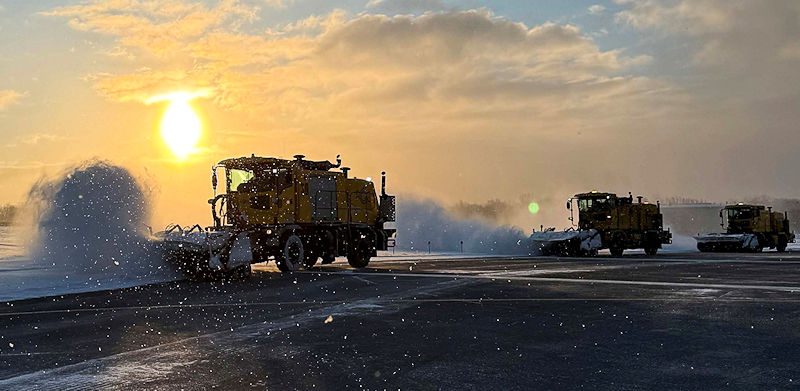
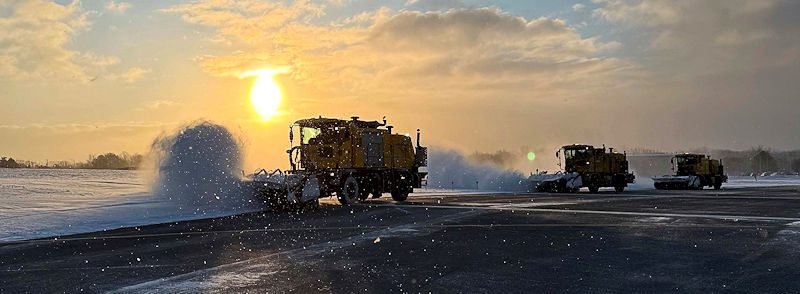
The proactive approach used at ROC depends on a fleet designed for endurance and versatility. At the heart of its operation are nine Oshkosh H-Series dual-engine machines that can switch between broom heads and commercial snow blowers. Cleary keeps seven configured with broom units, and two with blowers. He considers the Oshkosh machines workhorses for runway clearing, and crews often operate four to five brooms in tandem.
“Our brooms, which use a mix of poly and steel bristles, are definitely our bread and butter,” Cleary says. The steel bristles are especially effective at breaking up ice and compact snow, he notes.
The airport doesn’t simply plow snow off its runways and taxiways. “We have to windrow it, and then blow it off into the field to avoid damaging or burying lights or signage,” Cleary explains.
The airport’s fleet of plows includes three HV-Series International 10-wheel dump trucks equipped with 16-foot Wausau plows, which have a steel cutting edge to scrape the hardpack snow and ice buildup. These plows have Kuper cutting edges—a mix of rubber and ceramic pucks designed to ride over inground airfield lights. Also in the arsenal is an HV-Series International 6-wheeler dump truck with a 16-foot TENCO plow and same steel cutting edge. Rounding out the plow lineup are two Western Star 4700 Plow trucks with dedicated sander bodies in the back. “These trucks allow for a one-man operation of plowing and sanding,” Cleary says. “This is essential to our operations because after the plows are operating on the taxiways, they become slippery causing poor braking for the aircrafts. With these plows, after the taxiways are cleared, they can lay down sand all in one operation.”
For clearing apron areas and major intersections, ROC relies on four Case 1121G wheel loaders with large 30-foot blades for efficiency. “If we were to clear those with a plow truck, we’d be making 100 different turns,” Cleary explains. “Those loaders will come through with a 30-foot blade and be able to push a much larger path much more quickly.”
For melting ice, ROC uses a 2,000-gallon potassium acetate truck with a 50-foot spray boom. This vehicle has an International HV-Series chassis with a custom liquid deicer unit made by Batts Inc. on the back. Each of the 35 nozzles across the width of the boom can deliver 8.5 gallons per minute at 90 psi.
Rounding out the fleet are two 300-gallon potassium acetate tanks with spraying systems, and two sand trucks with rear Bucher sanders.
The entire fleet of vehicles, from plows to sanders and everything in between, is housed in a 25,700-square-foot snow removal equipment building added in 2022. Designed by Passero and built by DiPasquale Construction Inc., the $6.1 million facility allowed ROC to consolidate all of its snow removal equipment under one roof and dramatically improve response times. Previously, some snow removal equipment was stored at the airport’s Fleet Center on the far south end of the airfield. “One of the biggest benefits of the new building is that it’s right next door to our Operations Center,” Cleary says. “Now, the equipment can drive right onto the field within minutes, rather than anywhere up to 30 or 45 minutes.”
Takeoffs and Sandings
Like most airports, ROC relies on potassium acetate and FAA-approved runway sand to respond quickly to icing events. “It typically takes anywhere from 300 to 500 gallons of potassium acetate per pass to treat the [primary] runway,” Cleary notes. “But within a pass or two and almost less than 30 seconds, that ice is already starting to melt.”
Dedicated sand trucks allow crews to deploy wet sand, which significantly improves performance, particularly in high-wind conditions, he adds. The on-board spraying systems saturate the sand in liquid potassium acetate to penetrate ice on the taxiways and runways. “This is really effective in windy ice storms,” Cleary explains. “The wet sand has some weight to it, and it more easily embeds in the ice so the wind’s just not blowing it off.”
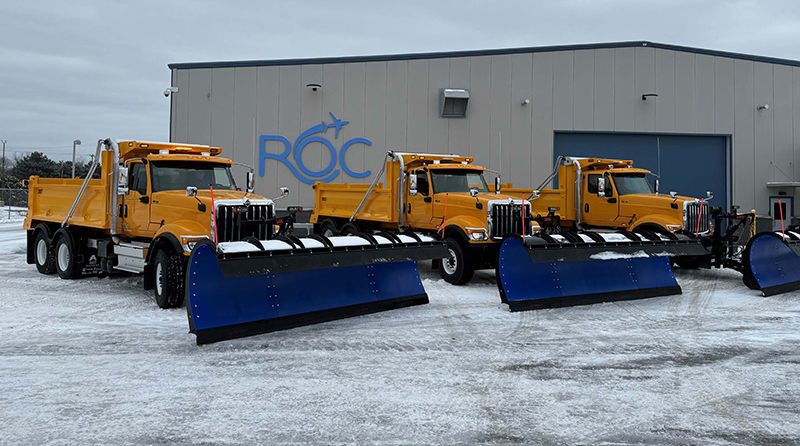
The fleet includes three 10-wheel dump trucks with 16-foot Wausau plows and Kuper cutting edges.
The airport’s FAA-certified airfield sand is supplied by nearby Valley Sand and Gravel. The material is sifted, washed and tested to ensure it is not a danger if ingested into an aircraft engine, Cleary explains. The airport has capacity to store 10,000 tons of sand on site and has a ready reserve of about 10,000 additional tons at the mine that can be delivered on request.

Although some municipalities pre-treat airport pavement when snow or ice is predicted, ROC takes a more cautious approach. “Pre-treating is kind of a touchy subject here,” Cleary shares. “Typically, after a freezing rain event, we get snow. And if you pre-treat a runway and then it snows, it creates what we call a ‘mashed potato’ effect.” The result is snow that is harder—not easier—to remove.
Best Practices
For Cleary, successful winter operations depend on much more than specialized equipment. His method is built on three foundational best practices: preparedness, experience and support—each reinforcing the other during snow and ice events.
At ROC, preparedness starts long before the first snowfall is forecast. It begins with scheduling preventive maintenance in the off season to ensure all equipment is fully operational when winter weather arrives. The airport contracts Monroe County Fleet Maintenance for equipment repairs and maintenance, and partners with local dealerships for warranty work and help resolving issues with manufacturers. “Having local support on our specialized equipment is helpful because of their quick response time,” Cleary emphasizes. “When a piece of equipment goes down, it’s essential that we get it back up and running as soon as possible. Every minute that we have a piece down is critical to the safety of the airfield.”
For Cleary, being prepared also means ensuring operators are current on procedures and machinery training. Staffing is planned with intention, so the right number of trained operators are available when storms hit. To build in flexibility, all operators are cross-trained on each piece of equipment, which allows the team to adapt quickly if one piece of equipment becomes unavailable during a storm.
Experience is the second pillar. Cleary himself started at ROC as a seasonal employee 16 years ago. He was promoted to a full-time operator, then a supervisor before being named airport operations manager in 2022. His current staff includes 18 operators and six supervisors, providing 24/7 coverage year-round. Crew members are seasoned—the least-tenured supervisor has been at the airport more than a decade—and bring deep institutional knowledge to every snow event, Cleary says proudly. Experience allows supervisors to make fast, confident decisions while juggling constant communication with airlines, air traffic control and field crews. “They’re taking phone calls all the time trying to put out fires, and their experience and familiarity with the airfield definitely helps them mitigate some of those situations,” he explains.
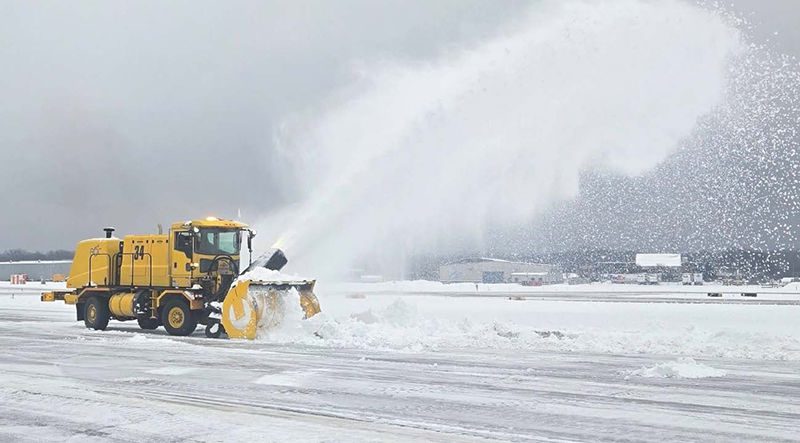
To build To protect airfield lighting and signage, crews first plow and then use snowblowers to remove windrows close to the fixtures.
The third key component is support. “At ROC, we’re a tight-knit group,” Cleary remarks, noting that support extends across departments and stakeholders, from maintenance teams to air traffic controllers to tenants.
In the spirit of continuous improvement, post-event analysis is standard practice. “After every storm, the air traffic control manager and I sit down and have a debrief to discuss what we can do better,” Cleary says. Those conversations reduce tension, improve coordination and help ensure response to the next storm is even more effective, he adds.
That commitment helps the airport adapt, learn and maintain its zero-tolerance standards—even in the most demanding winter conditions.