Last fall, Runway 8L-26R at Vancouver International Airport (YVR) in British Columbia returned to full service after an ambitious six-month, $133 million modernization program. Work to overlay the concrete with asphalt, upgrade associated electrical and lighting and improve drainage was performed during the runway’s existing nightly closures so as not to impact operations at Canada’s second-busiest airport.
Referred to by airport personnel as the North Runway, the 9,941-foot strip is a workhorse that handles nearly half of YVR’s operations. Originally constructed in 1996, it was due for refurbishment in the normal cycle of maintenance, says Andrew Grams, director of program delivery and optimization for the airport.
In planning and designing the program, “We focused on the highest and best runway condition that we could have here at YVR,” says Beth Henschel, director of asset management and former director of airside operations during the program lifecycle. Henschel’s team was accountable for delivering the operation on a day-to-day basis, supporting the operation throughout the project and then accepting the runway back into use upon conclusion.
“We had a runway that served us really well for 30 years, performing at a high level of service in nearly all weather conditions,” Henschel reflects.
| facts&figures
Project: Runway Modernization Location: Vancouver Int’l Airport, in BC Cost: $133 million Funding: Vancouver Airport Authority Runway Length: 9,941 ft. Project Scope: Asphalt overlay of entire north runway & connecting taxiways; upgrade of drainage systems, electrical infrastructure & lighting equipment Asphalt Placed: More than 150,000 tons Key Benefits: Extended runway life; enhanced operational resilience Site Prep & Electrical Upgrades: Oct. 2024-March 2025 Paving, Painting, Lighting & Drainage Upgrades: April-Sept. 2025 Commissioning, Vegetation Reinstated & Runway Returned to Full Service: Oct. 2025 General Contractor: Kiewit Construction: Lafarge Canada (now Amrize) Lighting & Electrical Work: Tristar Electric, with subcontractor DeltaTec LED Airfield Light Supplier: TKH Airport Solutions |
Following a thorough assessment of the runway’s condition in 2024, airport leadership determined that its structural integrity remained, and a refurbishment, rather than full replacement, would provide the necessary improvements for long-term use. Working alongside engineering teams, airport personnel assessed and validated all requirements of the existing runway and determined the upgrades needed to modernize the infrastructure and ensure the runway would continue to serve its function, as well as meet all regulatory requirements.
Overnight Closures
With two runways, North and South, each is “incredibly important” to operations, and taking one out of service for any extended period of time would be an impediment, says Grams.
Scheduling the rehabilitation of the North Runway, which is primarily used for arrivals, was consequently a key consideration. “We wanted to deliver the project with the least impact to our customers and our operation as possible, so we really focused in on that during the planning phase of the project,” Grams relates. The team reviewed multiple options for delivering the work—from completely closing the runway for a period to shortening the runway in phases and working on segments overnight.
In the end, YVR elected to complete the work from 10 p.m. to 6 a.m., when the North Runway is regularly closed to operations anyway. “We went through our assessment and felt we could confidently deliver the project effectively with the least amount of impact to our customers by completing the work in that overnight closure window,” says Grams.
As with all major infrastructure projects at the airport, officials made the decision with input from a wide range of stakeholders, including airline partners, other aircraft operators, NAV CANADA, Transport Canada and the community. “We have a very strong, longstanding partnership with Musqueam Indian Band,” Grams emphasizes. The airport and its North Runway sits on the traditional and unceded territory of Musqueam, and the airport approaches its work on the land through a lens of reconciliation that is grounded in respect, collaboration and friendship, he adds.
A 30-year Friendship and Sustainability Agreement between the airport and the Musqueam Indian Band establishes the framework for collaboration on land use and environmental stewardship for mutual benefit.
“From the early days of planning [the runway project], we had Musqueam Knowledge Keepers, cultural monitors and community members help guide us through the work,” Grams says. Cultural training was provided to crew members before construction began and as new workers joined the team.
Stakeholder consultation—both internal and external—was key to ensure successful delivery of a project with this magnitude and community impact, Henschel agrees. “We knew that it was an ambitious way to tackle this work, and we were really motivated to do that and minimize disruption,” she adds.
Preplanning
Kiewit, the firm that originally constructed the North Runway, also performed the recent updates. “It was a pretty cool opportunity for us to get to be part of the rehabilitation 30 years later,” says Jeremy Bing, project sponsor with the general contractor.
Well before onsite work began, the team from Kiewit worked to establish a comprehensive picture of how each nightly closure would proceed, including all steps of construction steps, backup scenarios, “what ifs” and check ins throughout the night to guarantee that the runway could safely return to service each morning.
 Rather than focusing on completing the construction planned for each shift, Henschel says the emphasis was returning the runway to operation in the morning. “I think putting things in that perspective really changed the approach to how we handled things as they came up,” she shares.
“We knew because of the complexity of the work that needed to happen on a nightly basis that we needed to be very organized, very well-planned and that we had a tightly orchestrated project every single night,” she adds.
Because the strategy required ultimate precision, Kiewit’s crew conducted a full-scale trial run prior to the start of construction. One night in March, after the runway had closed as usual, crews brought all the equipment out to the runway and simulated paving operations to get a realistic feel for various tasks and timing. “We had a very short window to actually work, so entering and exiting the runway needed to be handled very carefully and efficiently,” Grams says.
With a limited construction window each night, crews could not waste time. Running a trial helped verify the logistics and test the assumptions that were built into the plan, Henschel adds.
 Tristar Electric developed an iterative process for replacing airfield lighting and electrical, based on what work could be done and still ensure the runway could be returned to service each morning. “We worked with the airport for months prior to the start of the project just to establish that baseline,” says Praga Pathmarajah, operations manager with Tristar.
In total, 1,600 lights were modified during construction to match new runway height, and crews replaced 102 halogen fixtures with high-efficiency LEDs from TKH Airport Solutions. Now, all North Runway lighting is LED, supporting the airport’s long-term goals for safety, reliability and sustainability.
To facilitate flow to and from the worksite, airside and landside staging areas were established for equipment and crews. “We kept the equipment very close to the runway so that when the runway was handed over to us at 10 p.m. each night, the equipment could quickly mobilize,” Grams relates.
The staging areas and other detailed preparations paid off. Each night, crews and equipment were staged in order of operation for that particular night’s schedule. Bing, from Kiewit, characterizes the result as very choreographed and very impressive. “It’s hard to describe the precision, efficiency and the schedule,” he reflects.

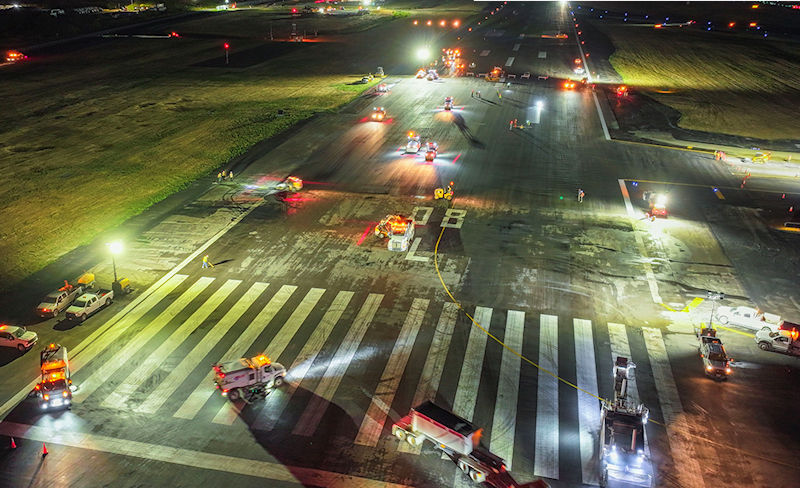
Crews worked from 10 p.m. to 6 a.m., when the runway was already closed to operations.
Paving operations required precision, and were carefully orchestrated and intense, with two to three paving machines placing up to 2,000 tons of asphalt each night. Equipment was staged as close as possible, and Kiewit brought in standby equipment as a contingency. “We made sure we had all the redundant equipment in place so that if anything broke down, we’d still be able to open the runway on time the next morning,” Bing explains.
Thanks to comprehensive planning, Henschel says the project “ran quite seamlessly because we had done as much work in advance as possible in order to prepare the teams and prepare a plan that was easy for those on shift to follow.”
Precision and Contingencies
The North Runway project began early in the construction season, with preparatory work and installation of select electrical systems occurring from April to October. Because some lights and navigational aids had to be removed, the runway’s level of service was downgraded to non-precision approach beginning in April when heavy construction commenced.
 “There were lots of planning activities that happened through the day so that the night team would be prepared for the work of the evening,” Grams says.
“The amount of planning that went into the work shift was immense,” he emphasizes.
Each task of every evening was carefully planned because if individual elements weren’t finished on time, the morning return-to-service could be jeopardized. And ensuring the runway was safe and secure for operations at 6 a.m. was the priority. “We worked very closely with our contractor, and they developed the minute-by-minute schedule that was monitored throughout the night,” Grams explains. Plans also included detailed pivot strategies in case there was any sort of delay.
 Establishing a precise process that provided parameters and if/then scenarios helped crews remain on task. “We didn’t have time to waste figuring out what to do if we encountered a problem. Every minute mattered,” Bing emphasizes.
“It was a very challenging project with daily return-to-service requirements and very short work windows that required precision planning,” he summarizes. Teamwork, collaboration and coordination among all stakeholders was critical to maximize progress during the limited work windows.
On a typical evening, electrical crews kicked off the work by removing any lights that needed to be taken away before milling machines were mobilized. “Our team specializes in airfield electrical,” Pathmarajah notes. “Our fleet is designed solely for this purpose. We have the equipment and the process knowledge.”
Given the amount of time it took to mobilize and complete return-to-service procedures, Tristar crews only had about five hours each night to work. This made it challenging to maintain momentum compared to working during a full runway closure, Pathmarajah explains. “You couldn’t start something you were unable to finish,” he adds. “We were mobilizing and demobilizing every shift.”
Paving crews applied new asphalt directly on top of the existing concrete in three layers, each roughly 60- to 80-millimeters thick. After laying each segment, workers installed a ramp from the new asphalt to existing concrete so the runway could continue to be used during the day. One of the first activities on the next night shift was to mill out the temporary ramp. Once complete, paving equipment entered the site and put down approximately 80 meters of asphalt, installed another ramp and reinstalled any lights.
By 5 a.m., all paving tasks had to be complete and equipment cleared from the runway. Crews with lights then walked the entire length of the runway looking for any stray construction debris to ensure nothing was left behind that could be sucked into aircraft engines.
Return-to-service checks were then conducted and recorded on tablets in real-time and communicated to the appropriate personnel. The operations team and project team jointly reviewed elements of construction from the previous night, validating that all tasks were complete and that all predetermined inspections had been completed. After those conversations concluded, the operations team conducted a physical inspection of the runway before it was returned to service.
An engineering representative from YVR was on site throughout the project to liaise with contractors and lead the return to service checklists. “That was quite an involved process of checklists and reports to ensure we met all the requirements to return to service,” Grams says.
After airport operations signed off, the runway was returned to service each morning by 7 a.m. “Safety remains our top priority at the airport, and that was really demonstrated by all parties involved,” Henschel notes.
Throughout the project, crews placed more than 150,000 tons of asphalt over the entire runway surface and connecting taxiways. In addition, 120,000 square meters of topsoil was placed around the runway perimeter and seeded with indigenous vegetation.
Ready to Pivot
Occasionally, certain work had to be suspended or rescheduled, such as paving or painting when it rained. “When those situations did occur, we had already worked to anticipate in advance what would proceed and what would not proceed, based on the conditions driving the go/no go decision,” Grams explains. “If there was a challenge that came up, then we pivoted and came up with some sort of solution to keep the project going.”
That said, there wasn’t much slack in the schedule, and paving operations are heavily dependent on favorable weather. When conditions posed a challenge, other associated projects such as electrical and drainage work continued.
“Weather was one of those things out of our control, but lots of effort was made to increase production levels so that we were still able to meet our schedule,” he elaborates, adding that such contingencies were built into the initial, comprehensive planning.
However, midway through the project, the region experienced more wet weather than had been accounted for in the schedule. And crews could not simply work longer hours to compensate for lost time because the airport didn’t want to impact customers by closing the runway early in the evening or leaving it closed later into the morning.
Grams compliments Kiewit for developing ways to increase tonnage paved during a given shift as crews became more experienced on the challenging jobsite. “We found that production did increase significantly through the summer, and we were able to make up for those weather days,” he advises.
Clear and constant communication was leveraged to keep project partners on the same page and following the process. “The level of detailed planning that had to go behind every shift was intense,” Pathmarajah relates. Every activity, every night, had a detailed schedule to keep work on track, and there was always a “go or no go” point to determine if each task could be finished within the prescribed schedule.
“We are here to ensure the successful delivery of the operation end to end,” Henschel says, “which means heavy involvement with the airlines and with our air navigation service provider, NAV CANADA, to ensure that we had anticipated all the operating conditions that could occur during the window of construction.”
Preparation, contingency plans and the ability to pivot quickly when needed all proved to be crucial.
In addition to determining whether the project could resume each night, there were a number of checkpoints throughout each work shift. “Teams would work together with the contractors, our engineering teams and our design consultants to make any decisions they may need in the event that something came up,” says Henschel.
Machines not typically used for runway work helped achieve the paving pace needed to maintain the tight schedule. For the first few lifts, crews used large 10-meter screeds. “That was an innovation because they’re typically only used in road construction environments,” Grams explains, noting that YVR personnel had seen them used successfully at other airports. “It enabled us to complete more paving in the short window we had.”
The machines did, however, present challenges associated with GPS controls that proved to be “finicky” at times. “Over the course of our four months of paving we fine-tuned that,” Grams reports.
After paving was complete in October 2025, the airport turned its attention to recommissioning the runway for full service. “That was quite an effort,” he recalls, noting that all navaids and lighting had to be recertified for Category III operations.
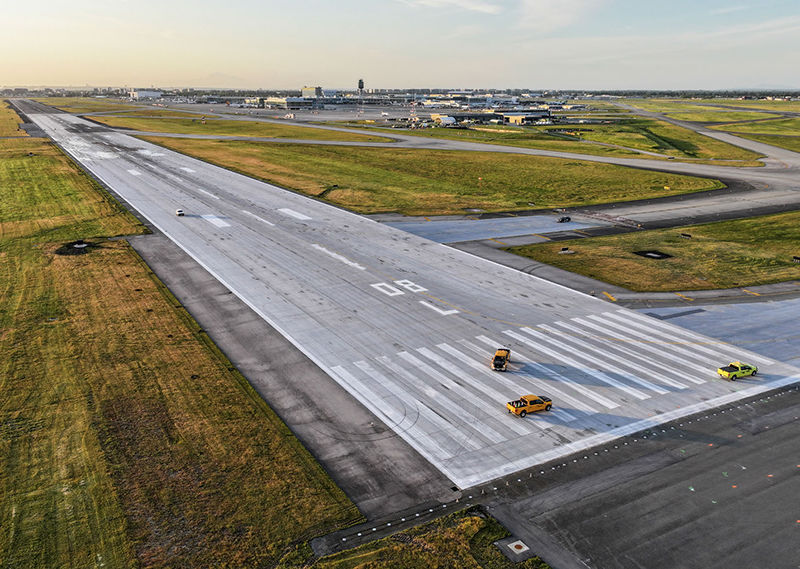
The 9,941-foot runway received an asphalt overlay and updated lighting.
Strategy, Safety, Service
Despite the challenges of an intense schedule, Pathmarajah says the strategic teamwork among YVR, stakeholders and project partners resulted in a successful project. “Complicated projects have very little room for risk,” he adds. “Early engagement and early partnership really help with risk mitigation.”
Some strategies established for the North Runway project will become legacy processes for the airport, Grams notes. They include the return-to-service protocol and safety management program used to ensure the runway was safe for use following every work shift.
“Our focus in the operations team is to be predictable, reliable and resilient and ensuring that we have a runway system that will serve us in that manner for decades to come,” Henschel reflects.
“The work we did extended the life of the runway so that we can reliably use it well into the future,” Grams concludes. “It will be another 20 years before we have to do any sort of major rehabilitation.”