At Abraham Lincoln Capital Airport (SPI) in Springfield, IL, the quiet hum of electric technologies may someday drown out the traditional roar of jet engines. Mark Hanna, the airport’s executive director for the past two decades, no longer sees the facility as simply a collection of runways and terminal gates; it is a laboratory for the next transformational shift in human transport.
 As the aviation industry pivots toward electrification and Advanced Air Mobility, SPI is positioning itself not just as a participant, but as a primary “node” in a high-tech regional network. Its game plan includes a massive “behind-the-meter” solar program, the strategic decommissioning of airfield pavement, and a workforce pipeline designed to train the aviation technicians of 2030. If the plan works, SPI may be writing the manual on how a midsized airport can outmaneuver major metropolitan hubs as the industry changes.
“Everything in aviation is about the micro-unit—the revenue per available seat mile, the cost per available seat mile, passengers daily each way,” says Hanna. “We are preparing to create a very specific site that can cater to the needs of future developers and operators while keeping start-up costs low. We are confident that we can provide and collaborate on everything a major metropolitan area is able to provide, but without space constraints and complications. Our facility is preparing in many ways for OEMs [original equipment manufacturers] of Advanced Air Mobility aircraft to come in and do business.”
 facts&figures facts&figures
Project: Infrastructure to Support Advanced Air Mobility Operations Location: Abraham Lincoln Capital Airport, Springfield, IL Primary Components: “Behind-the-meter” solar program; strategic decommissioning of runway; partnering with local colleges to create pipeline of aviation technicians for eVTOL & other new-technology aircraft; 180-acre Air Commerce Park Key Benefit: Positioning airport to become a primary node in regional network for Advanced Air Mobility service Electrification Study & Engineering Consultant: Hanson Professional Services |
Reclaiming Routes
The impetus for SPI’s “Smart Airport” program is rooted in a desire to reclaim lost regional connectivity. Hanna recalls a time when Springfield was a vibrant hub for regional point-to-point travel. In the TWA era, the airport had up to 10 flights a day to St. Louis, and non-stop service to Chicago’s Meigs Field provided a vital link for the state legislature and legal community.
But flight service at SPI dwindled when Meigs Field was famously dismantled in the middle of the night, and airline mergers shifted traffic toward large hubs like O’Hare and Midway. More recently, the state has made significant investments in “higher-speed” rail, which requires significant land-based infrastructure, grade crossings and vehicle-rail separation.
Advanced Air Mobility offers a vertical alternative to terrestrial-based systems, notes Hanna. By utilizing electric vertical takeoff and landing (eVTOL) aircraft, SPI can potentially restore lost corridors to nearby cities with greater efficiency and lower infrastructure costs than rail, he adds.
“Springfield could provide every single aspect of that inner-urban lift,” Hanna explains. “We have the space to grow out. We have the space to build. We figured Springfield would be a node in a bigger network. But maybe regionally, we have a hub in Springfield with other nodes coming into our downtown space from even the rural areas.”
Though Springfield was not selected as a primary site during the initial round of federal Pilot City designations, the project remains very much alive. Hanna reveals that the airport’s eVTOL OEM partner was selected by a subcommittee that includes SPI as a test site.
“There is a little bit of hope for us to actually engage in this endeavor sooner than later,” he reports. “We are currently engaged with a vertiport operator looking for an OEM to fly routes.” Another group is considering a St. Louis route, generally a 90-minute drive from Springfield, which is a “sweet spot” for some Advanced Air Mobility aircraft.
The Solar Foundation
Electric planes are impossible to integrate without a sustainable charging method, and SPI has been working to become a “power plant” for more than a decade. The journey began as a quest for non-aeronautical revenue, the silver bullet every airport seeks to offset operational costs.
“In the Midwest, we get decent rent for [growing] corn and beans,” Hanna says. “But the thought at the time was: Could we give up our agricultural property and make five times that amount? It was a nice proposition.”
The road to sustainability was not easy, mainly because SPI is served by a municipal power company—City Water, Light & Power—rather than an investor-owned utility. Developers consequently struggled to find a way to “plug and play” into the municipal grid.
The airport considered many different angles, including de-annexing property and boring under a road to tap into other utilities, but invariably ran into roadblocks. As a result, SPI decided to forge ahead for itself.
The result is a pioneering solar energy production farm spanning nearly 12 acres on the north side of the airport. The first phase was a 2.88 MW solar array that powers the airport’s public safety and airfield operations center, the FAA Flight Standards District Office and StandardAero, a major airport tenant. The second phase was an “aggregated net metering program”—reportedly the first for any airport in Illinois. Rather than cluttering the airfield with dozens of micro-grids and utility interconnections, SPI built one large 1.58 MW solar array with a single feed into the grid, adjacent to the original 2.88 MW array. Under Illinois legislation, the airport credits the power “punched into the grid” against remote meters located throughout the airfield.
“Abraham Lincoln Capital Airport is nearly 100% electrified with renewable power as of last week,” Hanna announced in mid-April.
This infrastructure is a major draw for tenants like a large maintenance, repair and overhaul facility. By sourcing nearly 100% of its energy from renewable sources, the shop can curb greenhouse gas emissions and offer “green” servicing for large business-class jets. As other tenants look toward future electric or hydrogen propulsion systems, SPI already has the “pipes” in place to support them.
The Megawatt Challenge
While 100% electrification is a significant milestone, accommodating regional electric aircraft requires a massive scale-up in power delivery. This was a primary focus of the 2½ year study Hanson Professional Services conducted for the airport.
 Susan Zellers, senior project manager and assistant vice president for the firm, notes that SPI is in a fortunate position because its municipal power company has the capacity to increase its feed to the airport. However, the sheer intensity of charging eVTOL requires a different technical approach.
“One of the key things we identified is that you have to develop Battery Energy Storage Systems, or BESS,” Zellers explains.
The amount of electricity potentially needed is staggering. The draw to charge a standard general aviation electric aircraft is akin to the amount needed for a large electric vehicle, but regional hybrid aircraft—the type likely to connect Springfield to Chicago—will require much more, especially for quick turnarounds.
“You’re just not going to be able to pull it off the grid in that amount of time,” Zellers says. “Realistically, it’s the [BESS] system you’re going to need to have.” That type of setup would allow the airport to charge the system in off-peak times when there’s less demand, which helps manage costs, she notes. If aircraft need charging during the middle of the day with peak power, BESS can provide more cost-effective fueling—with electrons instead of fossil fuel.
Strategic Land Use
Perhaps the most visible sign of SPI’s transformation is the decommissioning and removal of Runway 18-36 in 2022. While losing a runway is often seen as a step backward, it was a strategic calculation in this case.
Hanna explains how and why: Runway 18-36 needed improvements but did not qualify for associated FAA funding. Because the airport has two longer runways for aircraft to use, rehabilitating 18-36 without a federal grant was not affordable and seemed unnecessary given the infrequent use.
Instead, the airport explored opportunities to redevelop the airfield space into a stronger asset for the community, adds Zellers.
The result is the Air Commerce Park, a massive development zone with about 180 acres divided into two strategic areas. The north end is reserved for aviation use due to its proximity to the maintenance, repair and overhaul facility and other existing aeronautical development. The south side, located near a primary community thoroughfare, is open to a mix of aviation and non-aeronautical use.
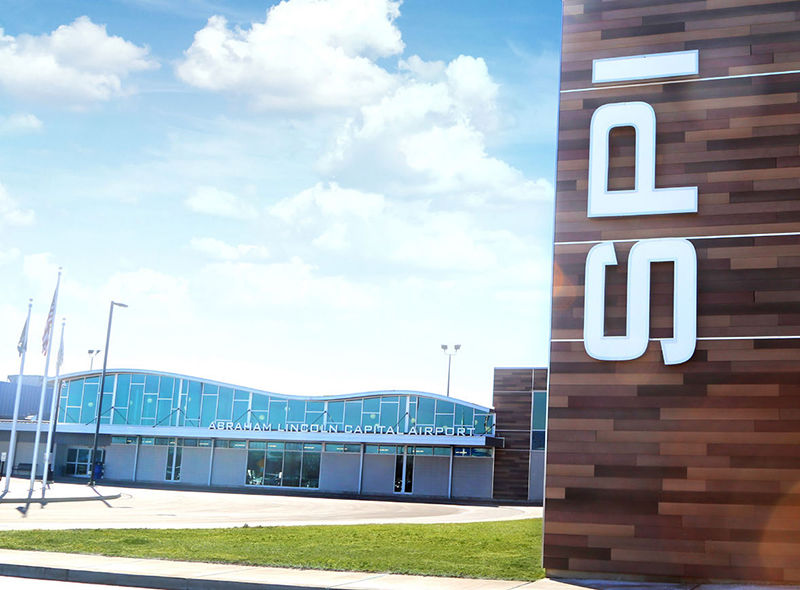
The airport is adding infrastructure now to support future Advanced Air Mobility traffic.
This synergy could attract restaurants, manufacturing and support industries for nearby National Guard facilities that complement the airport’s mission, notes Zellers.
The Vertiport Blueprint
A key component of the Air Commerce Park is the placement of vertiports. The team from Hanson used current FAA standards—derived largely from helicopter guidance—to identify potential sites in each quadrant of the airport.
“Our goal was to give the airport a plan with the flexibility to adjust as the industry develops,” Zellers says.
The study identifies alternatives based on specific use cases:
- Terminal sites for regional passengers arriving on eVTOL aircraft and connecting to traditional flights.
- Commerce park sites for operators using Advanced Air Mobility to fly in high-value cargo.
- Control tower sites, potentially for a training facility where students can learn to maintain or fly these new airframes.
Zellers emphasizes that by reserving airfield space now, SPI is positioning itself at the forefront of innovation.
Training the “Avtechs” of Tomorrow
For Hanna, building a “smart airport” is about more than electrons and concrete; it is about human capital. As a result, SPI has cultivated a deep relationship with Lincoln Land Community College, which has an onsite program to train airframe and powerplant technicians.
“This allows students to learn this new technology with the OEM operators coming in,” Hanna says. “We want to start training the “avtechs” of the future—people who know how to troubleshoot the software and maintain the technology of these new airframes.”
The collaboration also extends to Southern Illinois University, which is working with SPI to bring a satellite flight training program to the field.
“Last-Mile” Connectivity
One of the most compelling concepts to emerge from Hanson’s study is the potential for regional “spokes” to feed into a SPI “mini-hub.” In discussing such a network, Zellers cites the success of American Airlines using Landline buses to shuttle passengers from smaller markets to larger hubs.
“I know they’re doing that in South Bend,” she says. “People clear security in a simpler manner, the parking is easier, and they end up right at the gate.” Even though transit occurs on the ground, the convenience of faster screening and ideal location provides a tangible benefit—one that Advanced Air Mobility could level up even further, says Zellers.
Regional connections to smaller communities like Jacksonville and Litchfield are being considered by the team at SPI. In this “last mile” scenario, travelers could access the entire national transportation system, including connections to international flights, by taking 15-minute eVTOL flights from their local airports to SPI.
Springfield’s location could be leveraged as a strategic asset, positioning the airport as a node between major Midwestern hubs. Zellers notes that its proximity to St. Louis, Indianapolis and Chicago is a significant factor, even though initial all-electric Advanced Air Mobility aircraft may not quite have that range yet. Still, she believes some of the larger hybrid-electric regional aircraft should have enough range, which positions SPI to take advantage of an opportunity to bring the technology to Springfield first.
Legacy of Innovation
As Hanna looks toward the next decade of his tenure at SPI, he views the shift currently in motion as a significant evolution. By “negotiating with themselves”—and calculating what manufacturers of Advanced Air Mobility aircraft will need before the standards are even fully written—he says SPI has jumped from being a regional player to a national blueprint.
“With all that goes on in a given day at an airport, the question, ‘Where is my power coming from?’ has jumped from number 15 on the list to number one,” Hanna says. “Can we continue to buy it from the utility, or do we need to start generating our own?”
By answering that question today, SPI is trying to ensure that when the first commercial eVTOL aircraft clear the horizon, it won’t just be watching. It will be a destination.
For professionals who design and build airport infrastructure, the “Springfield model” offers a clear lesson: An airport’s most valuable asset isn’t necessarily its current traffic, but its willingness to imagine—and power—what comes next.