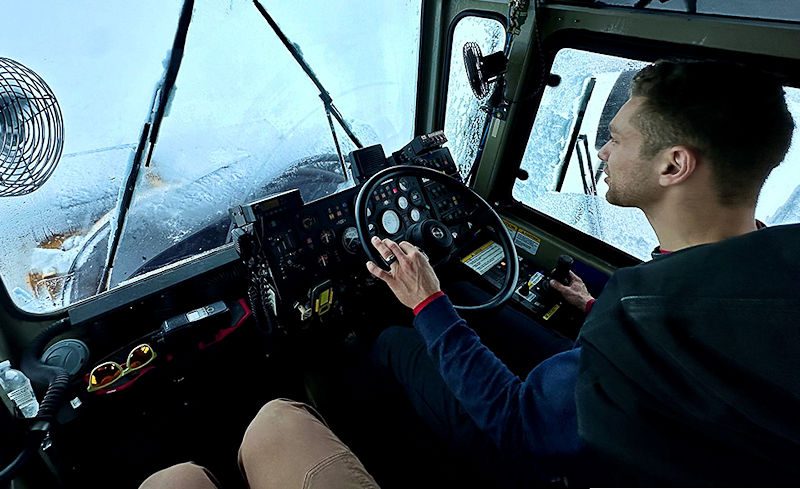
Three years ago, the busiest general aviation airport in Wisconsin brought all snow removal operations in-house. Service from long-term contractors had produced mixed results at Waukesha County Airport–Crites Field (UES) near Milwaukee, and Airport Manager Kurt Stanich and his staff believed they could manage the workload more effectively at a lower cost.
Stanich justified the change to Waukesha County, which owns and operates UES, and Director of Public Works Allison Bussler agreed that a different approach would be more fiscally responsible. It took two years from the initial proposal to official approval, and the transition began just before the 2022/2023 snow season. Stanich applied his experience in the U.S. Marines and implemented the Corps’ “Improvise, Adapt and Overcome” strategy to quickly acquire more equipment and hire additional personnel.
At the time, UES owned a barebones fleet of snow removal equipment used by some of its outside contractors. But switching exclusively to in-house crews meant the airport needed more units to keep its two runways and other airside areas clear for winter operations. Staffing also needed to increase beyond three employees—including Stanich—to perform the imminent extra work. “It wasn’t like we were starting from zero, but it was pretty close,” Stanich muses.
| facts&figures
Project: Location: Waukesha County Airport-Crites Field, in WI Owner/Operator: Key Components: Acquiring new equipment; recruiting permanent & seasonal workers Airport Footprint: 577 acres, with 5,849-ft. concrete runway & 3,599-ft. asphalt runway 2025 Aircraft Operations: About 94,000 (16,587 Oct.-Dec.) Tenants: 1,300 Based Aircraft: 247 Winter Season: Oct. to April, with avg. snowfall of 40-46 inches Switch From Outside Snow Removal Contractors: 2022 Current In-House Crew: 5 full-time employees, 16 part-time drivers, 1 part-time Operations staff member Seasonal Labor Budget: $50,000/yr. 2025 Snow Equipment & Maintenance Budget: $130,000 Current Fleet:
Recruitment Tool: Humorous homemade videos that parody popular aviation movies to help attract seasonal snowplow operators Airplane! Spoof: https://youtu.be/wcVp6X8VWLQ Top Gun Spoof: https://youtu.be/8LutZfrn9zY Noteworthy Details: Busiest general aviation airport in WI; Terminal Aerodrome Forecast site |
The first year after the switch, UES hired two full-time supervisors and eight part-time drivers. Since then, its winter operation staff has grown to five full-time employees, 16 part-time drivers and one part-time Operations staff member. In 2025, the airport logged about 94,000 aircraft operations, with nearly 16,600 occurring between October and December.
The associated equipment and maintenance budget was $130,000, with another $50,000 for seasonal labor to help airport staff manage the effects of Wisconsin’s unpredictable winter weather. Some seasonal hires stay on for summer groundskeeping duties, but most are asked to reapply each winter due to administrative requirements.
When asked how long the snow removal season lasts at UES, Stanich deadpans, “11 months.” In reality, it runs from October to April, peaking in January. However, this season included early storms that dropped more than 20 inches of snow from October to December 2025. On average, the airport experiences 20 to 25 snow events per season, with 40 to 46 inches annually.
The Equipment Guru
Over the last three years, UES has substantially expanded its equipment fleet with support from Waukesha County. (See equipment list in box to the right for specifics.)
Stanich credits Thomas Zembruski, fleet manager for the county’s Department of Public Works, with identifying and negotiating innovative equipment opportunities. For instance, Zembruski has transferred older units from the Highway Department to the airport, including a front-end loader with a fully articulating Metal Pless plow blade.
“Unlike private industry, government and quasi-government agencies can call on peer agencies, share advice and help each other improve processes or save money,” he says. “Ultimately, we all operate under the Department of Public Works umbrella—highway, fleet, engineering and airport—and our success comes from supporting one another as one team.”
Clearly, having Zembruski in charge of all Public Works equipment has benefited the airport, and it’s just one reason Stanich calls him “the equipment guru.”
While Zembruski’s experience is not in the aviation industry, Stanich appreciates that he understands how highly specialized airport snow equipment is—and knows that options for larger units are limited. Case in point: A timely call Zembruski made to Minneapolis-St. Paul International Airport (MSP) led to a deal that brought four of its older Oshkosh vehicles to UES: a runway sweeper, two plows and a snow blower. “They were exceptionally well maintained, and we believe they still have significant service life,” he notes.
Airport employees handle daily equipment inspections and make minor adjustments, but more substantial work such as changing oil, fixing hydraulic leaks, performing annual inspections and refurbishing units is performed at the county’s maintenance facility about one mile from the airport.
Zembruski acknowledges that maintaining older equipment can be challenging, but the associated cost-savings make the challenges worthwhile. Maintaining that balance became more difficult after Oshkosh sold its snow products division to M-B Companies in 2023. “M-B has indicated that they will be sunsetting parts support for equipment over 20 years old, which is nearly all of our units,” says Zembruski, adding that future purchases for UES will likely involve new vendors, training and warranties. “Price alone isn’t enough. In airport operations, reliability, service response, warranty support and safety are important,” he emphasizes.
Hollywood on Line 1
Finding qualified personnel to operate snow removal equipment is difficult for many general aviation airports, but UES seems to have cracked the code with funny homemade recruitment videos.
Waukesha County Public Information Officer Hillary Mintz suggested the idea of creating movie spoofs to help attract applicants for seasonal positions, and Stanich agreed to give it a try. Mintz, who previously worked as a television reporter, helped produce the first video, which was patterned after Airplane!, the 1980 film that parodied Zero Hour! and the Airport disaster movies from the 1970s. In the video UES created (essentially a parody of a parody), a passenger is asked if he can drive a snowplow to clear the runway. “Surely, you can’t be serious,” the passenger answers, prompting the reply: “I am serious, and don’t call me Shirley.” (See Facts & Figures box on Page 19 for the video link.)
The video enjoyed success on the county’s social media channels and was even featured on local news broadcasts, prompting the airport to create a sequel. “Kurt [Stanich] is one of my more motivated colleagues,” notes Mintz.
This time, Stanich channeled his military service and experience as a Certified Flight Instructor to parody Top Gun: Maverick, the 2022 box office hit about an aging hot-shot Navy fighter pilot (played by Tom Cruise) now teaching young recruits to fly. The UES version was aptly titled Top Plow: Waukesha, complete with red and blue wings around the logo. (See Page 19 for video link.)
 “Basically, the scene we recreated was the new snowplow drivers meeting Maverick in an airport hangar, and I exchanged the word ‘airplane’ with ‘snowplow’ in the script” explains Stanich. A floor-to-ceiling American flag hanging in the background and a soundtrack filled with familiar electric guitar riffs make the similarities to Top Gun nearly impossible to miss. And naturally, the recruits “feel the need, the need to plow.”
Stanich plied employees with pizza and promises of fame to secure on-air talent. “No real actors or actresses were harmed in the filming of this video,” he quips. Mintz again handled filming, editing and promotion. “You don’t need a big budget,” she emphasizes. “We put these videos out for free and we shot this one on a phone.”
The results were over 5,000 views on Facebook, TikTok and YouTube; more coverage on the local news; and, most importantly, a significant spike in applications for seasonal snow plowing positions.
 “Our recruitment at least tripled,” reports Supervisor Lowell Holcomb, who starred as Maverick. The wide pool of applicants ranged from those in their 20s to retirees.
Encouraged by the success of this year’s video and the fun they had making it, Stanich and his crew are already planning their next video project. In true Hollywood form, they are keeping details about possible storylines strictly under wraps.
Everyone Is an Operator
The airport’s snow removal crews work in two 12-hour shifts: 7 a.m. to 7 p.m. and 7 p.m. to 7 a.m. Day shifts are especially challenging after storms because airfield activity surges as soon as the skies clear—particularly from the four on-field flight schools.
With strong response from recruitment videos, rapid hiring and onboarding were critical to prepare for the 2025/2026 snow season. In addition, UES operates under the philosophy that “every staff member is an airport operator” and all employees—regardless of role—receive training in airfield inspections, basic operations and wildlife management.
 For instance, Administrative Specialist Sarah McCalvy has helped with plowing and airfield inspections during staffing shortages. “We are all cross-trained,” she says, adding that this approach allows the airport to pivot quickly during snow events and respond effectively to tenant needs.
While operating big equipment attracts a variety of applicants, Stanich often prefers candidates with a willingness to learn over those with prior plowing experience. Flexibility to operate different types of equipment and adaptability to on-call scheduling are other sought-after attributes. Hiring several pilots from the airfield has added new perspective to the team and provided a conduit for feedback about performance.
Stanich highlights commitment, teamwork and innovation as defining strengths of the airport’s winter operations team. “We’ve built a crew that cares, and it shows,” he adds.
Safety and Training
Comprehensive instruction about the equipment and basic airfield operations is crucial for all crew members, but especially seasonal employees because many are inexperienced or come from unrelated professions. For instance, one of the first season hires is also a real estate agent.
 Josh Matekovic, airport operations supervisor, shares that training combines classroom instruction and hands-on experience. New hires receive movement area and airfield safety training, including information about signage, markings and safe operations. This is followed by training about specific equipment, snow placement priorities and radio communication with the control tower.
Training typically totals about 20 hours spread across several days in the fall. Light snowfalls early in the season are often used as real-time training opportunities.
New hires often find operating equipment at night and learning proper radio communication to be the most challenging aspects of the hands-on training. When teaching trainees how to communicate with the control tower, Holcomb emphasizes the importance of using the correct jargon and conveying information in the proper order.
 After a few classroom run-throughs, supervisors Holcomb and Nick Marszalkowski train new hires on the airfield—sessions that require patience from controllers in the tower. Once trainees are competent with radio communication and movement area procedures, the next step is learning where to put the cleared snow. “And then,” Marszalkowski says, “It’s, ‘Welcome to the jump seat. Welcome to the show.’”
During actual snow events, runways, connecting taxiways and terminal ramps are Priority 1 areas. Taxi lanes to hangars are also maintained, but individual tenants are responsible for clearing the aprons of their respective hangars.
In addition to key airfield surfaces, the airport maintains parking lots, hangar roads and internal roads. The county highway department provides support for Aviation Drive, which leads into the airport from the county highway.
According to Holcomb, a light dusting of snow takes two to three hours of machine time to remove. This means daytime removal efforts may take up to 10 hours due to airfield traffic. Night-time efforts are typically much faster because equipment operators don’t need to yield to nearly as many aircraft. If needed, UES can deploy 12 crew members and seven pieces of equipment at one time throughout the airport.
Because weather dictates the schedule, crews are often on standby, sometimes waiting overnight for storms that never materialize. “We have to be here just in case,” says Holcomb. Stanich notes that protecting staff downtime can be difficult, as someone must always be monitoring the weather.
There’s an App for That
The team uses a variety of resources to help with forecasting, including the government website Aviation Weather. Among the countless smart phone apps that employees have tested over the years, Weather Underground, MyRadar and trueWeather have emerged as favorites.
Marszalkowski favors an app that provides forecasts for 6 a.m. and 6 p.m. based on zip code location. “We focus on trends, looking 72 hours out, and escalate our response from there,” he says.
The National Weather Service in nearby Sullivan, WI, is a key partner. Since 2009, the airport has had its own Terminal Aerodrome Forecast, made possible by an AWOS (Automated Weather Observing System) upgrade prompted by a formal request from the tower manager to better support FAA requirements for controllers. Stanich values the myriad of National Weather Service data that is available—email briefings, slides, webinars and forecast details—to help snow removal crews plan their strategies.
 Marcia Cronce, a lead meteorologist and aviation program leader with the Milwaukee-Sullivan National Weather Service, notes that advances in radar and computer processing have significantly improved forecasting with higher resolution scans and faster updates. Stanich originally met Cronce at a Wisconsin Airport Managers Association conference, and their two organizations have worked together since 2010. UES is one of only 17 Terminal Aerodrome Forecast sites in the state.
Cronce encourages other airport managers to reach out to the National Weather Service office in their area and connect with the aviation program leaders to learn more about available services.
Budgets, Funding and Wish Lists
Stanich values having bottom-line budget authority that allows savings in one area to cover cost overruns in another. “We don’t have any tax levy, so we get our revenue, or a majority of it, from fuel sales and land leases for hangars,” he notes.
Looking ahead, his crew members have ideas about future equipment purchases designed to reduce ongoing maintenance and labor costs. Holcomb and Marszalkowski propose transitioning to multi-function equipment, such as plow-and-broom combinations that allow one operator to accomplish two tasks.
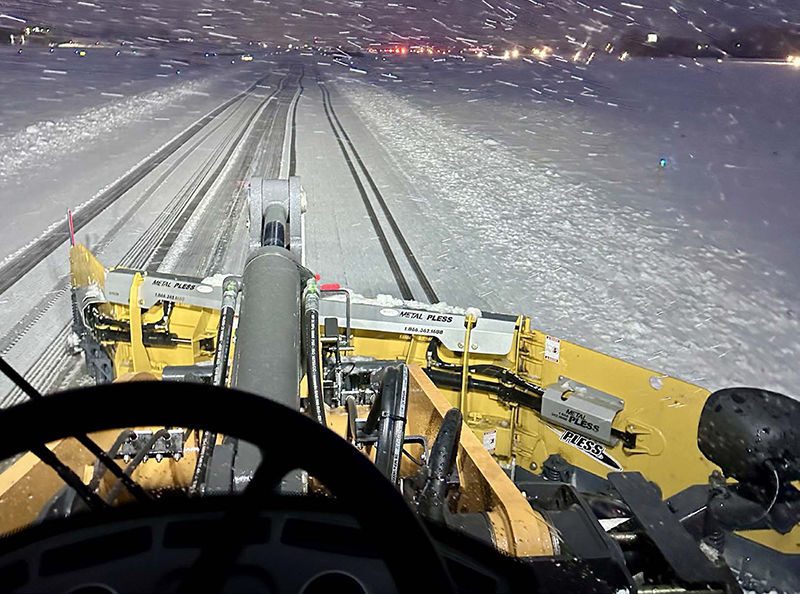
A front-end loader previously operated by the Highway Dept. is proving valuable at the airport.
Like other general aviation airports, however, UES faces funding challenges. In particular, Stanich is frustrated that FAA only funds two pieces of snow removal equipment per airport, and a multi-function vehicle—such as a plow-and-broom combo—counts as two. That effectively means funding for just one machine. “From an operator’s perspective, that makes no sense,” says Stanich. “The FAA doesn’t actually say you only need one piece of equipment, but that’s all they’ll fund.”
He and managers of other general aviation airports are working together to change this policy, though they know it won’t be easy. Another topic of concern is that FAA applies the same standards nationwide, even in southern states that rarely need snow equipment. Stanich and his peers want to explore whether federal funding can be redesigned to a region-based approach.
That Was Then, This is Now
More than three years after UES shifted snow removal to in-house crews, Stanich remains energized by the change. He’s also grateful for the trust Bussler and the county placed in him and his team to lead the largest operational shift in the airport’s 90-year history.
 While the transition wasn’t easy, he says it delivered unexpected year-round efficiencies and flexibility. Looking back, Stanich wishes the change had happened sooner, noting that the key financial benefits came from having greater operational control—allowing decisions on staffing, equipment and tactical storm response. The former contract model, with fixed per-inch pricing and escalating costs, proved unsustainable, he adds. Equally important is the ability to recruit and retain skilled operators over multiple seasons instead of relying on rotating contractor crews.
“There’s some financial benefit,” Stanich says, “but the greater benefit is having a veteran crew of hardworking people that make this job less stressful and far more enjoyable. I’m thankful for the challenges that pushed us to succeed.”
County resources have certainly been valuable, including creative support from Mintz for the recruitment videos. And the strategic procurement skills of “Equipment Guru” Zembruski will continue to be valuable as the industry evolves toward multi-function vehicles, which come with inherent funding challenges.