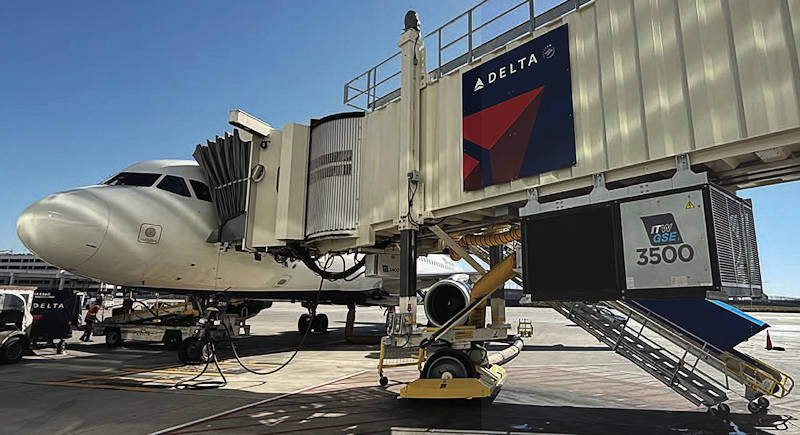
The adage “time is money” rings painfully true about ramp operations. Aircraft engines idling while pilots wait for open gates, passengers waiting to board or deplane, and ramp personnel waiting to service aircraft all cost money.
Prior to the advent of electric- and battery-powered ground support equipment, all of this wait time added up to dollars disguised as fossil fuel fumes.
Detroit Metropolitan Wayne County Airport (DTW) in Michigan is nearing the end of a multi-year, $13 million project to replace its diesel-powered ground power units (GPUs) and pre-conditioned air (PCA) units with low-emission electric alternatives. This eco-upgrade—part of the airport’s long-term development plan—is designed to reduce emissions and fuel consumption by eliminating trucks that fuel ground support equipment. And while all ground support equipment can eliminate the need for fuel-burning aircraft to run their auxiliary power units (APUs) to power electrical systems, air conditioning and pressurization, DTW’s new electric versions do it with a cleaner environmental twist. In turn, less noise and fumes on the ramp will create a healthier work environment for ramp workers.
| facts&figures
Project: Implementing Point-of-Use Electric Ground Support Equipment Location: Detroit Metropolitan Wayne County Airport, in MI Installation Site: McNamara Terminal Concourse A Key Components: Updating electrical infrastructure; replacing 61 pre-conditioned air & ground power units Airport Operator: Wayne County Airport Authority Est. Project Cost: $13 million Funding: 75% FAA Voluntary Airport Low Emission (VALE) grants; 25% airport bonds Timeline: 2022-present (completion expected Feb. 2026) Electric Ground Support Equipment Supplier: Design Consultant: Design Subconsultant: AERO Systems Engineering Prime General Contractors: AERO BridgeWorks Inc.; Bayview Electric Company LLC Electrical Contractor: Bayview Electric Company LLC Key Benefits: Reduced emissions & fuel consumption from eliminating fuel trucks & need for on-aircraft auxiliary power units; consistent equipment at all gates simplifies training & use for ramp staff; enhanced safety due to fewer people, carts & vehicles on ramp; healthier environment for ramp personnel due to lower emissions & noise levels |
But, this type of improvement initiative requires time and money.
Keen to Go Green
A decade ago, DTW’s operator, the Wayne County Airport Authority, worked with utility provider DTE Energy and the Electric Power Research Institute to perform an audit on existing ground support equipment that could be electrified. In its “Zero Emissions Roadmap” presented in 2020, the Airport Authority officially encouraged airlines to consider switching to all-electric or battery-powered PCA and GPU equipment and offered partnerships for grant assistance. However, this strategy hinged on funding and cooperation from the airlines. The 2020 report also included information about the DTE Rebate program, a public funding tool the Airport Authority previously used and plans to continue using to improve energy efficiency for new construction and major renovations.
In late 2021, DTE Energy announced a $7 billion, five-year investment in the electric grid for southeast Michigan, where DTW is located. Its goal is to prepare for demands by consumers and businesses for more electrification of current and developing technologies as well as increasingly severe weather trends.
A few years ago, Alberto Rocha, sales director for the Americas at ITW GSE, had the unenviable task of telling the Airport Authority that its aging fleet of the company’s ground support equipment was no longer sustainable. Rocha explained that the 15- to 20-year-old equipment was obsolete and very difficult to support because many components were no longer available, the refrigerant was not EPA-compliant, and, importantly, none of the units had sufficient capacity for new aircraft.
- Rocha highlights the many benefits of battery-powered PCAs and GPUs, also known as eGSE, as well as the point-of-use all-electric equipment DTW ultimately chose to purchase and install: all-electric units connect to the main grid of the airport;
- reduced emissions and fuel consumption from fuel trucks and on-aircraft auxiliary power units;
- greater EPA compliance;
- the opportunity to standardize equipment at all gates to ease training and use for ramp workers;
- increased safety thanks to fewer people, carts and vehicles on the ramp;
- a healthier work environment with reduced emissions and noise for ramp workers; and
- a more comfortable experience for passengers boarding and deboarding aircraft.
To realize those benefits, however, DTW needed funding for an extensive transition to electric equipment.
Kelly Tally, director of Facilities, Design and Planning for the Airport Authority, recalls that many of DTW’s airline tenants were interested in switching to electric ground support equipment, but the airport did not have the infrastructure to do so quickly.
While researching funding sources, Tally and her team found an FAA category for priority projects called Emissions and Energy Improvements and the Voluntary Airport Low Emissions (VALE) program. They applied for and received $6.5 million in fiscal year 2023, and $6.2 million in fiscal year 2024 to purchase and install new, all-electric ground support equipment for 61 gates at the McNamara Terminal, which is used exclusively by Delta Air Lines and its partners. These VALE grants covered 75% of the project cost, with the 25% required local match coming from airport bonds.
The federal funding provided money fairly quickly to update electrical infrastructure and purchase the new PCAs and GPUs, and the grant criteria narrowed the scope of equipment providers.
“When we wrote the performance specs, we really wanted vendors to hit certain capacities because we’ve got 120-ton [PCA] units, which are very large, and there are only two or three companies that make these larger-sized units for wide-body bridges,” says Tally, adding that ITW GSE, which ultimately won the business, is “well-known and on the forefront of eGSE.”
The timing was right for transitioning to electric ground support equipment because ITW GSE was discontinuing its diesel-powered PCA and GPU models the airport had operated for years. In addition, the new, fully-electric 3500 series PCA units include a feature that automatically detects what type of aircraft is being serviced and delivers precise airflow tailored specifically for it—rather than using average values based on aircraft category. According to the company, this increases cooling efficiency by more than 50%, which improves passenger comfort while minimizing energy waste.
The airport’s new PCA units and solid-state 400Hz GPUs are fully compatible with ITW GSE’s EcoGate system, which allows the GPUs to share power with PCA units and other connected equipment through Intelligent Power Management to optimize gate power usage without overloading existing infrastructure.
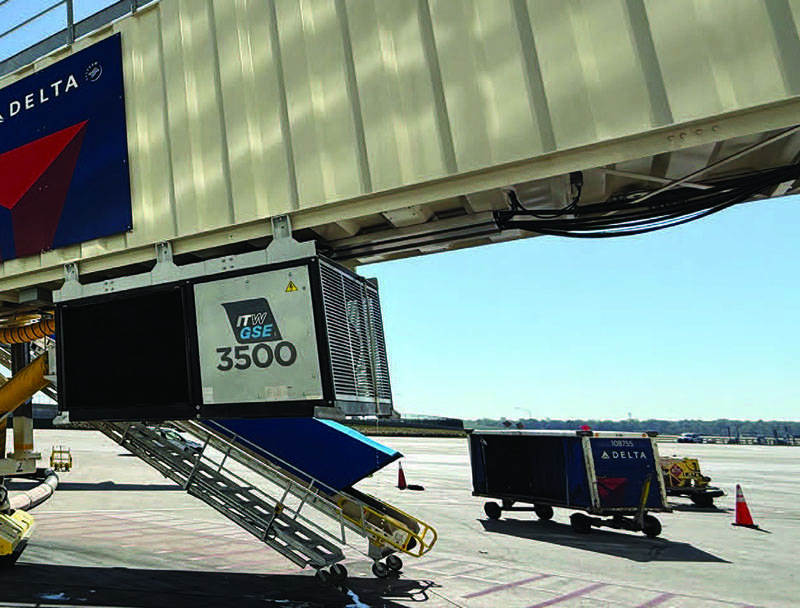
With deliveries of the new equipment in 2023 and 2024, DTW became first U.S. airport to receive ITW GSE’s new 3500 series PCAs and 2400 series GPUs. All 122 units were earmarked for Concourse A in the McNamara Terminal, but that’s apparently just the beginning.
Rocha reports that DTW has a very aggressive plan to replace all of its boarding bridges in both terminals, and the ITW GSE factory in Florida has dramatically increased production to outfit them with electric ground support equipment. Because it takes longer to build boarding bridges than PCA units and GPUs, the airport purchased and installed its new units on existing boarding bridges, and will reinstall them on the new bridges as they arrive.
Rebuilding Infrastructure
The electrical infrastructure in McNamara Terminal, which was two decades old, required a major update to accommodate the power needed to service more wide-body aircraft.
 Tally explains that the upgrades, which began in 2023, involved more than just replacing old wires. Because the new electric equipment is more robust, the airport needed to upsize its breakers, conduits and wiring. It also switched to larger disconnects—high-capacity switches located close to the equipment they serve that allow operators to safely control circuits carrying large amounts of electrical power. Mountings for PCA units were upgraded, and some of the new units were mounted above or below jet bridges to create more ramp space.
ITW GSE’s EcoGate system connects the equipment through Intelligent Power Management hosted in the 3500 PCA units, which constantly monitors consumption and allocates power dynamically to ensure the GPUs always have the necessary amount of power without exceeding a gate’s capacity. Even so, the airport was still able to install 45-ton PCA units with the limited existing infrastructure. “They [DTW] did not have to spend millions running new cables or even building a new substation to supply power to these gates,” says Rocha.
“We have our own power distribution center here,” adds Tally. “So everything is readily available and that made it really nice.” Each of the airport’s terminals, McNamara and Evans, has its own Metro Energy center operated and managed by DTE Vantage. The center for McNamara provides 17 MW backup electric power.
Making the Swap
The Airport Authority and its project partners plotted a schedule to install the new ground support equipment: one day to remove the old equipment, pull the old conduit and wire, and then mount the new unit and run new conduit wire; and one day for commissioning with the ITW GSE team. “We would work with our Delta Operations team and close two bridges at a time for no more than three days,” Tally recounts.
Weekly meetings helped identify and plan for the extensive project. Participants included the Airport Authority’s project management team, its designers, construction management staff, stakeholders and Operations staff along with AERO BridgeWorks Inc., which served as a prime general contractor and performed several installations. When the airport elected to upsize some of its GPUs and PCA units to accommodate larger aircraft, these meetings were crucial for making the upgrades without impacting the project schedule.
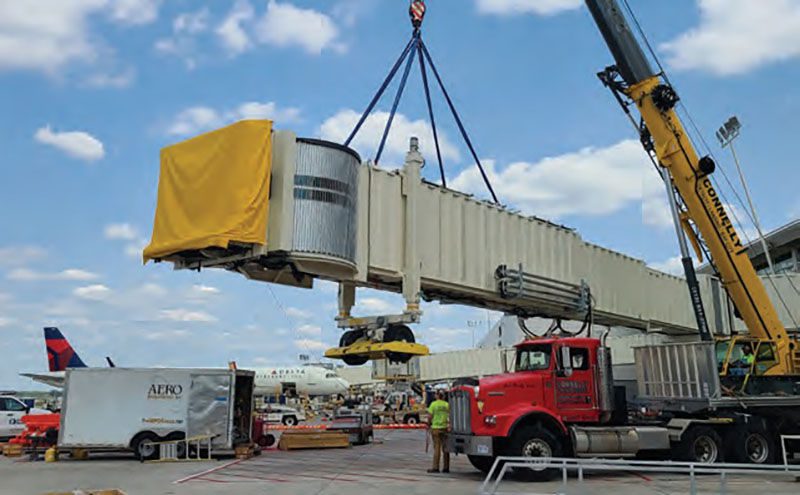
AERO BridgeWorks Inc. was the prime general contractor for the project.
From August 2023 to February 2024, AERO BridgeWorks installed 23 new GPUs and 23 PCA units in Concourse A of the McNamara Terminal, which stretches for nearly a full mile, making it the longest airport concourse in the U.S. and the second-longest in the world.
In May 2025, the company began installing the remaining 38 PCA units and 38 GPUs, with completion expected in February 2026.
Commonality Breeds Familiarity
 Training ramp personnel on the new equipment is easier as all the units for Concourse A are now the same. Additionally, the new units produce lower emissions and less noise. With fewer workers and carts on the ramp, service activities are logically safer and more efficient, which can lead to quicker turnaround times.
Rocha explains that installing the same equipment with the same control panel adds to the efficiency because once personnel know how to use one control panel, they can operate ancillary products.
Tally adds that this commonality of equipment facilitates on-time departures and arrivals, which is key. “The GSE teams on the ground really like the new units as they’re much more streamlined, with fewer buttons, and easier to use,” says Tally. “ITW has given us great training and we have their onsite, third-party commissioning team that is local. If there are ever any issues, they are deployed within the same day, which is great.”
By the Numbers
So, what are the specific financial and environmental impacts of DTW’s recent conversion?
According to the DTE Rebate team, the airport’s rebate will come in 2026 with an estimated savings of $100,000. Tally highlights the projected reduction of criteria pollutant emissions, including more than 126.6 tons of nitrogen oxides, 21 tons of volatile organic compounds, 306.9 tons of carbon dioxide and 26.8 tons of particulate matter, over the 20-year lifespan of the electric units.
“What also saves a lot of money is that Delta does not have to run their APUs on the planes, which is a huge savings of hundreds of thousands of dollars,” she adds.
As of October 2023—when DTW was just getting started with its electric ground support transition—VALE grants have funded 141 projects at 58 airports. In total, these projects are expected to reduce ozone emissions by 1,768 tons per year for the next five years, which is the equivalent to removing 98,700 cars and trucks off the road each year.
It’s Time
Tally notes that DTW and the Airport Authority are always looking for ways to keep customers happy and comfortable throughout their airport experience.
A champion of further ramp electrification, she says, “I think that’s really the way to go. It makes the environment cleaner, it enhances the passenger experience and that’s really what we’re here for is to ensure a smooth transition from when you park your car, check in, to when you get on that bridge—that’s really the portal to leave the terminal, so we really want to have a good feel for when you leave.”
Given the environmental benefits and potential to reduce wait times for ground support staff, passengers and airlines alike, it seems now is the time for more ramp electrification at DTW.