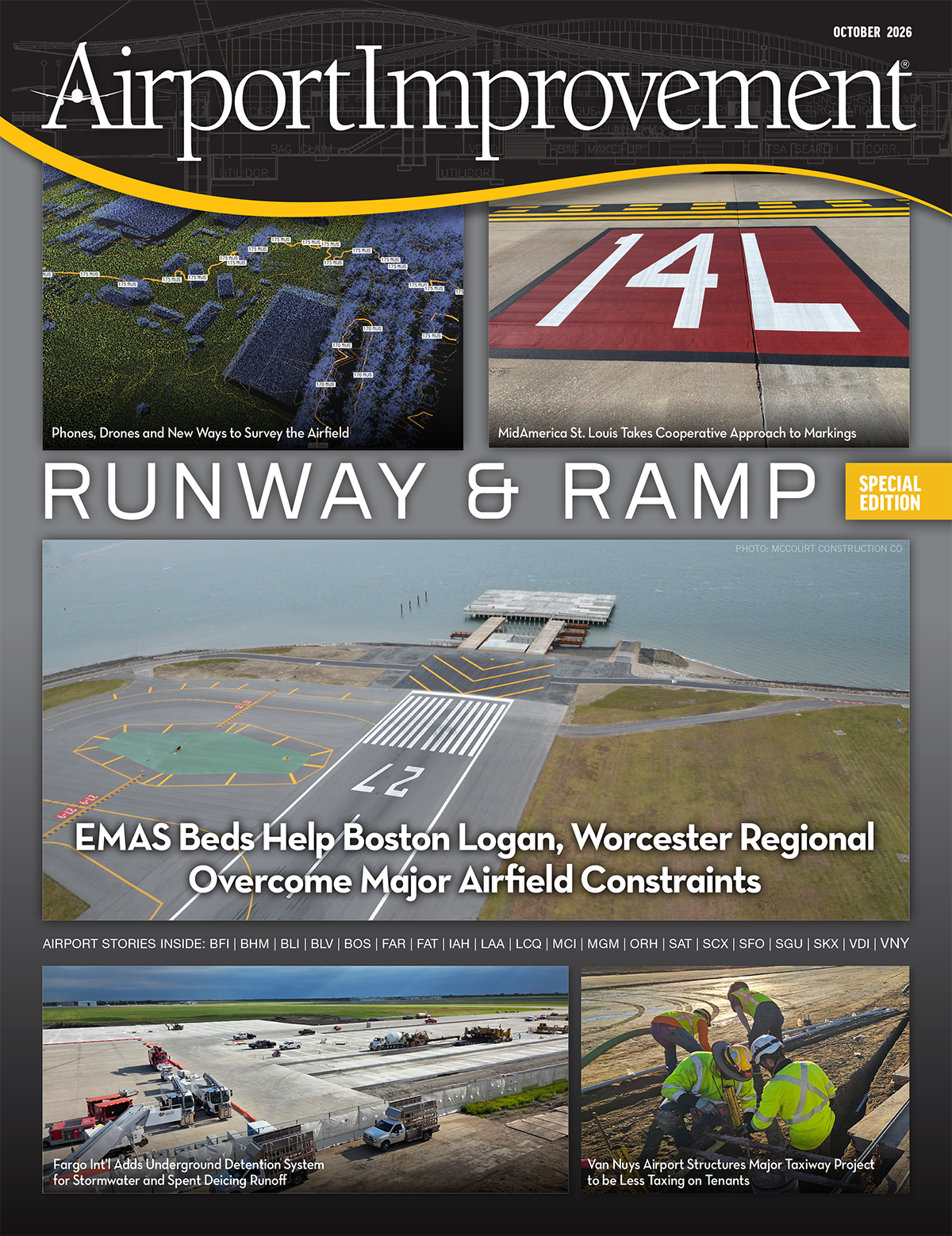
Patience, they say, is a virtue. But there’s also a wise adage about answering the door when opportunity knocks.
Erie-Ottawa International Airport (PCW) in northern Ohio promptly opened the door when the FAA knocked with funding to expand its cramped aircraft parking apron.
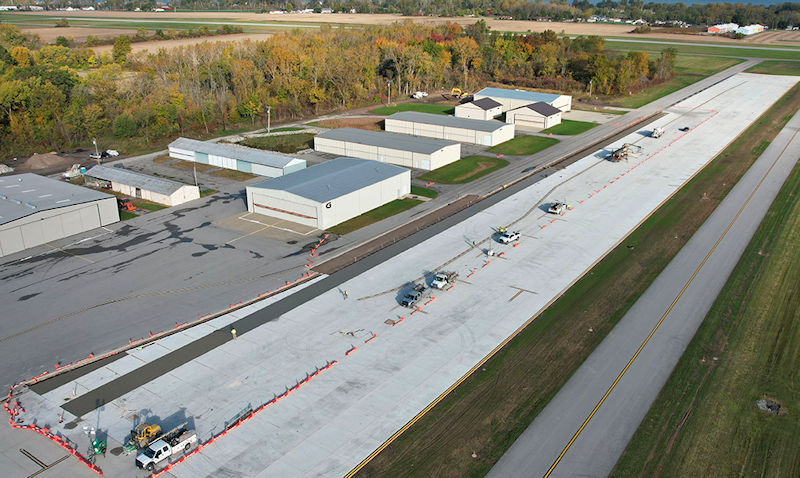
The subsequent project completed a buildout that began in 2020 with 5,000 square yards of concrete apron. The general aviation airport intended to tackle the remaining portions in multiple phases spanning decades, but instead began construction of the 25,200 additional square yards in May 2025 and completed it all by early November.
facts&figures Project: Apron Expansion Location: Erie-Ottawa Int’l Airport, near Port Clinton, OH Catalyst: Increased general aviation traffic Key Benefit: Room to park up to 30 small-engine aircraft & 5 larger jets Project Scope: 25,200 sq. yds. Cost: $7.1 million Funding: $6.4 million FAA Airport Improvement Program grant; $357,552 from OH Dept. of Transportation; $357,552 from Erie & Ottawa counties. Construction: May-Nov. 2025 Engineering Consultant: C&S Companies General Contractor: Mark Schaffer Excavating & Trucking Concrete Subcontractor: Smith Paving & Excavating |
The $7.1 million project was funded with a $6.4 million grant from the FAA Airport Improvement Program, plus $357,552 from the Ohio Department of Transportation and another $357,552 from Erie and Ottawa counties.
More Traffic, More Parking
The small airfield near Port Clinton, OH, exclusively serves business jets and other private planes on its two asphalt runways (5,646 feet and 4,000 feet long). Even without scheduled service from commercial carriers, PCW still logs about 50,000 operations per year.
Located on the shores of Lake Erie just 30 miles south of the Canadian border, PCW is a U.S. Customs Port of Entry Landing Rights airport and also the main air hub serving the Lake Erie Islands, a chain of archipelagic islands with luxury homes, beaches, wineries and other attractions that draw tourists year-round. Transport to the islands is only possible by boat or air service.
Over the past 15 years, PCW has experienced substantial growth—in part due to the 2013 closure of the private Griffing Sandusky Airport just 16 miles away. “If you want to get to north central Ohio, there is no better general aviation airport supporting business aviation needs,” says PCW Airport Director Clay Finken. In addition, it is the largest airport between Toledo and Cleveland, and can accommodate aircraft up to Global 7000s.
With the recent traffic growth came an increased need for aircraft parking, especially during summer, which is peak season for the Lake Erie Islands. Another particularly busy time for the airport comes in late spring, when an annual youth basketball tournament draws more than 300 teams to the nearby Cedar Point Sports Center.
In recent years, business jets carrying college scouts to the tournament crowded PCW’s small apron. “We were playing ‘airplane Jenga’ to get everybody in and parked safely on our ramp,” Finken remarks, referring to the game where players stack wooden blocks in a tower and then try to remove pieces without collapsing the whole structure.
The airport’s 2020 master plan identified 30,000 square yards of land for aircraft parking to be developed in phases, and the initial 5,000 square yards was constructed that same year. When Finken went back to the FAA in 2023 to request funding for another 5,000 square yards of parking apron, FAA officials suggested applying for enough money to complete the remaining 25,000 or so square yards all at once.
Navigating Challenges
 Because the new swath of apron is situated between two taxiways, PCW did not have to suspend or even reduce flights during construction.
Another factor working in the airport’s favor was that its project team was selected through a competitive process and had also successfully completed the first project phase in 2020—C&S Companies for engineering, Mark Schaffer Excavating & Trucking as general contractor, and Smith Paving & Excavating as concrete subcontractor.
However, even projects that seem straightforward include challenges. A main concern at PCW was diverting groundwater to a retention pond beside one of the taxiways.
“The whole area is flat, so it was important that we made sure the stormwater didn’t cause problems somewhere else,” comments Ted Mann, project manager with Mark Schaffer Excavating & Trucking.
 It was especially important to make sure expanding the parking apron didn’t create standing water that could potentially attract wildlife to the airfield, specifies Maria Benovic, managing engineer with C&S Companies.
Proper discharge was also a key issue. An existing holding pond east of Runway 18-36 was expanded to allow more time for sediment to be filtered out of groundwater before it is released to the public storm management system—as required by the Ohio Environmental Protection Agency.
To prepare the parcel where the expanded apron would sit, crews stripped away approximately 15,000 cubic yards of topsoil. Twice as much underlying dirt—about 3,000 dump truck loads—was then removed to make room for base materials and concrete.
Before they were installed, contractors laid about 2,900 feet of 12-inch through 36-inch reinforced concrete pipe to carry groundwater away from the apron to the holding pond. Another 6,700 feet of smaller-diameter perforated plastic pipe was laid in similar branches stemming from the concrete pipe to move groundwater into catch basins, then into the larger storm pipe.
Contractors further prepped the excavated land by installing a 12-inch layer of P-154 subbase material mixed with crushed stone, per FAA requirements. That layer was topped with a 6-inch layer of P-209 crushed aggregate, which is a courser stone. These subbases provide strength and support longevity for the final 11-inch concrete apron, explains Mann.
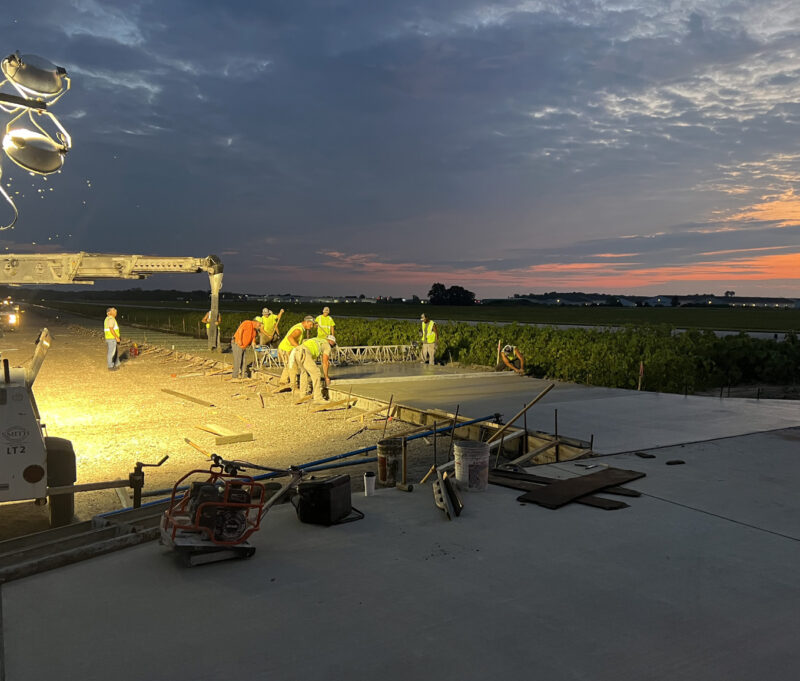
Paving crews started work at 4:00 a.m. to help trucks delivering wet concrete avoid traffic delays later in the day.
Laying the pipe and subbases required two months of work. Rain was a concern during that stretch, as heavy precipitation could have compromised ground conditions and delayed progress. Fortunately, the airport didn’t experience any serious downpours. Crews quickly covered exposed subgrades with stone to protect them from the threat of heavy precipitation throughout the six-month construction period.
On the Clock
 Another challenge the project team faced was transporting wet concrete to the jobsite without it beginning to set while en route. Mixing the concrete on site was considered but deemed too expensive, notes Derek Dilger, vice president of Smith Paving & Excavating. Instead, the contractor trucked it in from a plant about 31 miles due east of the airport.
Transporting wet concrete more than 30 miles is somewhat risky under normal conditions, and that risk was further magnified by bridge construction on the only direct route to the airport from the plant. Construction that lasted the entire duration of PCW’s project reduced traffic on the bridge from two lanes in each direction to a single lane in each direction, significantly impacting the travel time of all vehicles. A roundtrip that would normally take 45 minutes could easily take three hours due to the bridge work.
To beat the traffic and avoid such delays, crews started their work days at 4:00 a.m. They also didn’t transport or lay concrete on Fridays, when tourists heading to the Lake Erie Shores and Islands vacation region congest roads even more.
Every Parcel Counts
With only 800 acres at its disposal, PCW has to be strategic about any development.

“We’re getting near the full buildout of available property, but we’re pretty savvy when it comes to identifying areas that we can use to build hangars and infrastructure to support the aviation community that is growing here,” says Tom Corcoran, an engineering consultant with C&S Companies.
His team and airport personnel worked closely with the FAA to analyze operations data, existing parking conditions and potential parking layout options to determine how best to serve the increasing traffic at PCW.
“We configured a lot of layouts with the FAA during the justification process to get the area to work for what the demand is,” Finken recalls.
The expanded parking ramp that opened in fall can accommodate 30 small-engine aircraft and up to five jets. The airport also has 64 hangars.
In yet another promising sign for PCW, Finken was named the 2025 Airport Manager of the Year by the Ohio Aviation Association.