For Norfolk International Airport (ORF), the movie line “If you build it, [they] will come,” could instead be “If you build it, even more will come.”
The Virginia airport is, indeed, building, changing and growing. A full slate of projects in various stages of development is addressing the entire travel sequence for passengers, from roadway alignments, parking and car rental facilities to more expedient curbside drop-offs, ticketing, check in and security screening. There is also a new federal inspections facility to streamline international arrivals, additional concourse space with new gates and concessions, two hotels in the works, and more.
“We’re touching just about every piece of the terminal complex,” says Norfolk Airport Authority President and Chief Executive Officer Mark Perryman. “By the end of 2029, this will be a completely new facility.”
| facts&figures
Projects: Int’l Arrivals Building; Concourse Expansion Location: Key Benefits: Accommodating new int’l service & overall passenger growth; improving operational efficiency Federal Inspection Services (FIS) Facility: Cost: $31 million Funding: $7 million in Airport Improvement grants; $6 million in Airport Terminal Program discretionary funds; $3 million in Congressionally Directed Spending; remainder in airport funds Concourse A Expansion: 2 stories; 19,000 sq. ft.; 3 new gates Cost: $30 million Funding: $22 million in passenger facility charges; $8 million in Airport Improvement Program grants Timeline: FIS facility opened March 2026; Concourse A expansion opened April 2026 Architectural Design for Both Projects: Construction Manager & General Contractor for Both: W.M. Jordan Co. Construction Consulting for FIS: Passenger Boarding Bridges: Oshkosh FIS Facility Baggage System: G&S Airport Conveyor Plumbing & HVAC: Food & Beverage Concessionaire: |
The two newest showpieces are a $31 million Federal Inspection Services (FIS) International Arrivals building operated by U.S. Customs and Border Protection (CBP) and the $30 million expansion of Concourse A. Among other things, the concourse addition provides more space for the airport’s largest carrier, American Airlines, plus Southwest Airlines and Breeze Airways.
This January, Breeze, which has operated at ORF for five years, launched the airport’s first scheduled international service since 2001, when Air Canada discontinued its flights to Toronto Pearson a few weeks after the Sept. 11 terrorist attacks. The new nonstop flight to Cancun International Airport (CUN) in Mexico began on Saturdays, and in May the airline added a second flight on Wednesdays. The plan is to continue twice weekly flights through mid-August, pause during hurricane season, and then resume in late December. The launch at ORF was Breeze’s first international flight, followed closely by new Caribbean service from four other U.S. markets.
Passengers arriving at ORF from CUN used the airport’s former FIS facility until the new station opened this March. Perryman reports that flow in the updated facility has been “very smooth.”
Given this and other changes, there are a lot of moving parts within ORFs two concourses. In fact, mere hours after Perryman spoke with Airport Improvement for this article, American Airlines moved gate podiums into the newly added space in Concourse A, with the first Remain Overnight and early departure both scheduled within 48 hours. Breeze now occupies the Concourse A gates formerly used by American.
Even before these recently completed changes, the landscape had already changed considerably. “For many years, this airport was well-performing but small, with few major capital projects,” says Chris Jones, vice president and chief marketing and communications officer for ORF. “Since 2022, there’s been a rapid uptick in passenger activity coupled with the addition of three new carriers: Breeze, Spirit and JetBlue. We’ve grown to 45 nonstop markets, plus a flurry of capital projects.”
Passenger volume has increased the past four years, reaching 4.89 million in 2025—up nearly 23% from 2019’s pre-pandemic high, Jones points out.
Still, international service had been absent since 2001, and Norfolk Airport Authority officials saw the demand and potential for more growth, including new international routes.
When Perryman assumed leadership of the airport in 2022, he continued long-standing efforts to attract international service. For years, Cancun has been the most popular destination for travelers departing the Norfolk region, but passengers had to make stops elsewhere to reach the Mexican resort city. Within months of Perryman taking the reins at ORF, he met with the port director of CBP’s Area Port of Norfolk-Newport News about adding international flights. When it became clear that CBP felt the existing, outmoded FIS facility would not work for new service, Perryman remained determined and offered to build CBP a new version. Despite initial skepticism from CBP that the project would transpire, it worked with the airport to design a new FIS facility.
Process Matters
The FIS and Concourse A projects are part of TransformORF, the airport’s nearly $1 billion capital improvement/modernization program.
For the most recent phase, ORF used the Construction Manager at Risk project delivery method. Perryman highlights design control and cost containment as two of the main reasons why. “We get it [the project design] to a certain point, then we bring the construction manager in,” he explains. “They get involved with the costing and trying to make sure we are doing the value engineering and work necessary to make sure we’re keeping our costs low and getting delivery of the design that we want.”
Another compelling factor was the potential for lower costs, chiefly because the construction manager (W.M. Jordan Company for the Concourse A expansion and new FIS facility) established a guaranteed maximum price and was responsible for any costs over and above it. To date, Perryman estimates that using the Construction Manager at Risk delivery method resulted in about 10% savings on both projects.
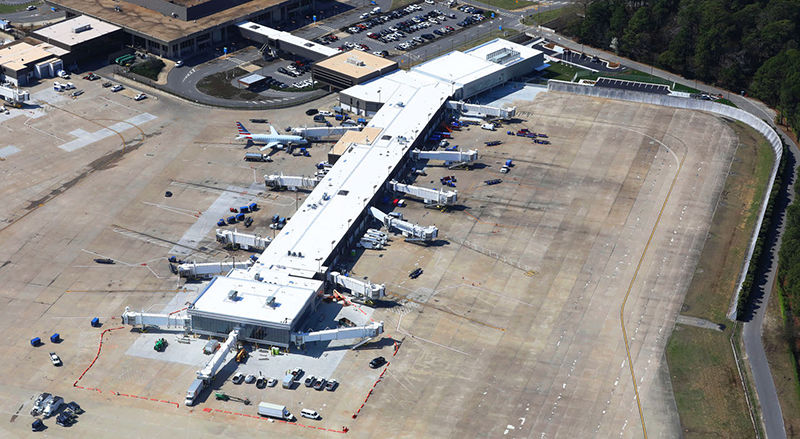
The new $31 million FIS building opened this March. The two-story, 26,000-square-foot structure located at the end of Concourse A near the Departures Terminal replaces an outmoded, 25-year-old facility about half its size. The previous facility required passengers to go from the concourse level to the lower ramp level to be processed before proceeding back upstairs to board other flights or exit the airport. Now, passengers entering the FIS facility stay on the same level to board or exit, thus boosting efficiency. The airport plans to use the previous FIS space for offices and storage.
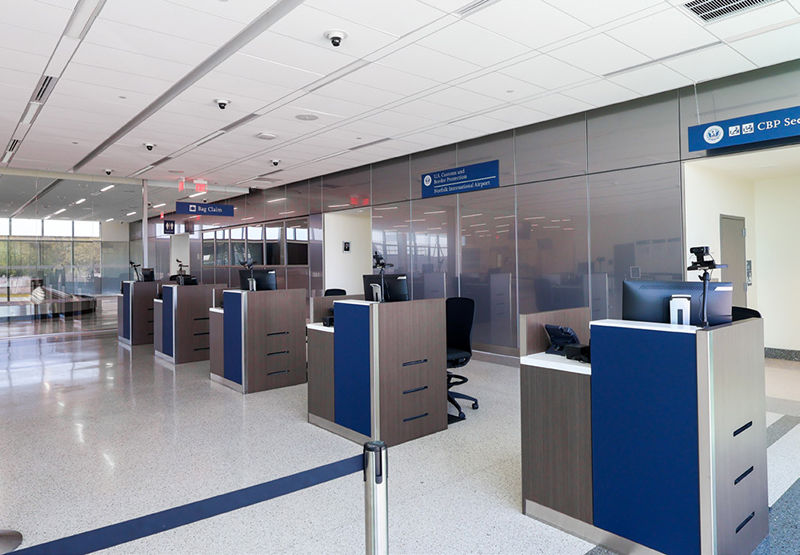
A new Federal Inspection Services facility is helping streamline international arrivals.
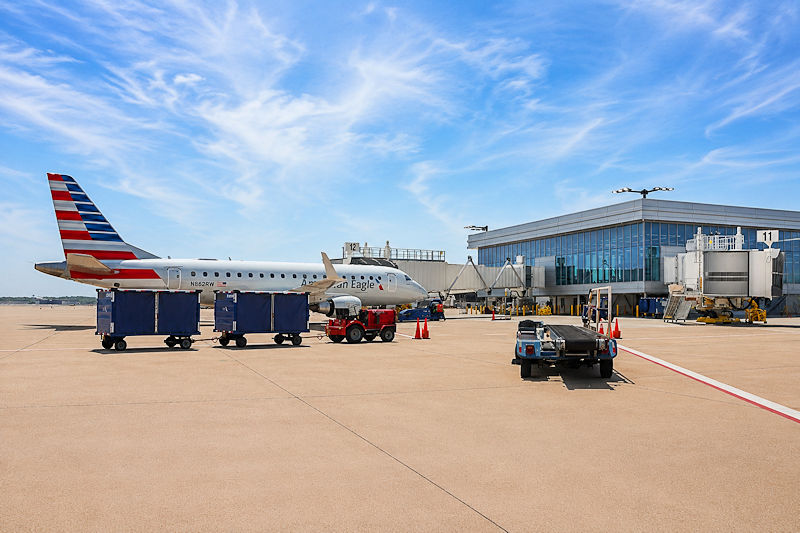
The $30 million Concourse A expansion, built on the opposite end from the new FIS facility, opened this April. Notably, it added three aircraft positions used by American—the first new gates at ORF in 50 years. The two-story, 19,000-square-foot space also includes a larger seating area, new restrooms, a central bar, two grab-and-go food concessions and a pet relief area.
Design Highlights
The airport worked closely with architectural firm Gresham Smith on the design of the FIS facility and Concourse A expansion. The shared goal was to create sleek, modern spaces that help foster a fresh identity for the changing airport yet still blend with its existing spaces. “This language would ultimately extend seamlessly to all other future airport projects,” says Luca Carraro, the firm’s Market Design leader.
 “It was really important for the client to open the buildings to sweeping views of the airfield,” he adds, noting that both the FIS facility and Concourse A expansion maximize glass openings. In the latter, designers took this to the limit by creating a pavilion-like building, with perimeter glass on all sides.
“When you are in the space, you’re surrounded on all sides by glazing, which gives passengers and staff direct connections to the exterior of the building,” says Krystal Anderson, senior aviation architect with Gresham Smith.
Views include aircraft on the runway, expansive skies and the Norfolk Botanical Garden, located just northwest of ORF.
“Large areas of glass also mean natural light is the protagonist,” says Carraro. “The quality of the light changes with time and the passing of seasons.”
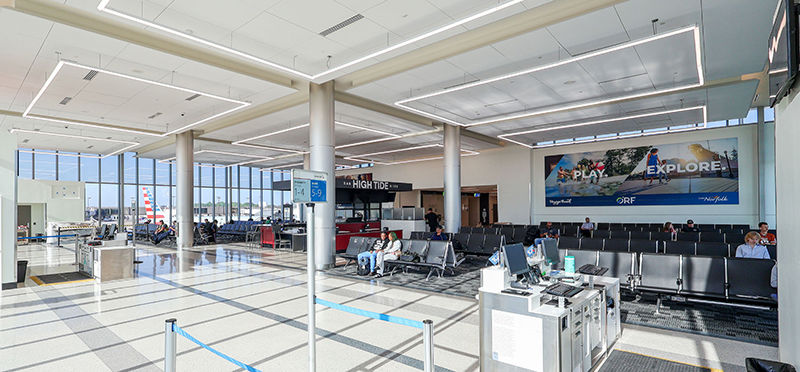
The Concourse A expansion spanned 19,000 square feet and added three gates.
Another overriding intention was to alleviate some of the inherent stresses of travel by creating a comfortable environment for passengers with airy spaces.
 When working with all types of airports, Anderson encourages project teams to be open to adding elements that “make the experience for passengers and staff unique, efficient and less stressful.”
Carraro notes that achieving the best end result requires time to explore ideas.
“Trust the process of arriving at solutions, based on a lot of good information,” he advises.
More Development, More Marketing
With multiple capital projects taking place, the airport has implemented a more robust, strategic marketing effort to help tell its story. “In terms of the local buzz, the past few years have sparked significant increases in public interest related to what’s taking place at ORF,” reports Jones. “These are improvements the customers can see or anticipate, and that’s made all the difference.”
 And there are more improvements to come, as the airport has a bustling agenda of projects Perryman describes as “very synergistic.” For example, ORF began to unveil a revamped concessions program this year, with additional debuts continuing into 2027. And a new TSA checkpoint that will consolidate the two checkpoints now located in its outer lobby will begin to take shape next year. By 2029, a new ticketing lobby will combine currently divided check-in areas. Together, these changes are designed to ease flow throughout the Departures Terminal, from curbside drop-offs to post-security movement between concourses A and B.
A consolidated rental car facility currently under construction is scheduled to open by 2028. Pulling rental cars out of the parking structure will open up space for more than 600 customer parking spots—spots that are desperately needed, Perryman emphasizes. In addition, ORF is consolidating its administrative offices into an underused area in the Arrivals Terminal to create room for the consolidated checkpoint. The existing checkpoints will then be converted into retail spaces, including a food court and possibly a shared airline lounge.
 Looking further ahead, plans are in the works for two hotels. The strategy is to offer different price points and build in different areas of the airport campus, with one hotel a short walk away from the Departures Terminal.
“We’re very intentional with what we do,” Perryman advises. “We’re not going to build something for the sake of building it. We’re going to build it so it meets what our traveling public needs—what they want, within reason, and what delivers a good product that we can be proud of and stand behind.”
Balance is a guiding principle for the unfolding TransformORF program, he adds. Key priorities are return on investment and maximizing revenue as well as creating a consistent passenger experience from the curb to the gate.
There’s also balance in another sense. “It’s one thing to do things for just the public, the airlines or the Airport Authority,” says Perryman. “But we are intentional, by balancing all these needs, making sure that all those factors are being developed, enhanced and modernized without breaking the bank.”
Passenger volume is up significantly since 2022, and the airport has added three new carriers.