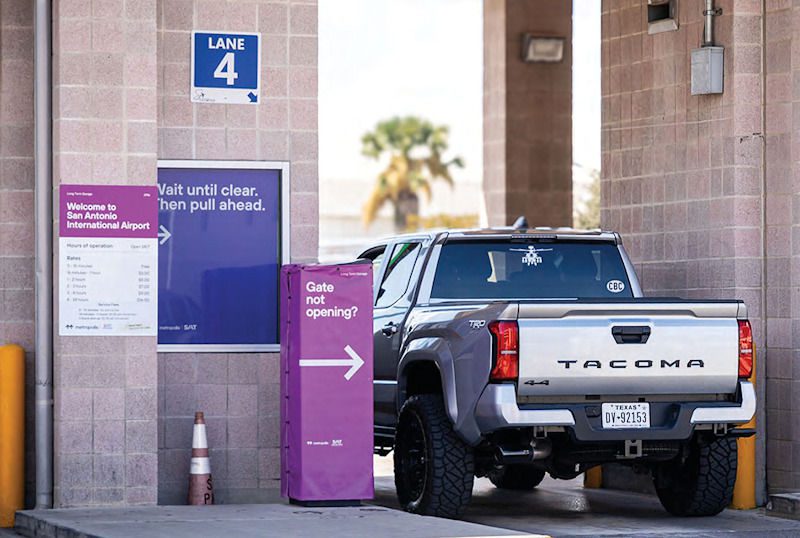
The passenger experience is a hot topic for C-suite executives at airports large and small, urban and rural. Typically, the focus is on what happens inside the terminal, from the efficiency of check-in, baggage handling and security checkpoints to the quality of restaurants, shopping and other amenities.
However, savvy airport managers know that for many travelers, the beginning and end of each trip take place in a parking facility. What they encounter there—ease of entry/exit, cleanliness of the garage or lot, convenience and safety—can create a good impression or potentially sour their entire airport experience.
What’s more, parking fees are a crucial source of non-aeronautical revenue for most airports, so creating an experience that’s reliable and enticing is simply good business.
| facts&figures
Project: App-Based Parking Payment Option Location: San Antonio Int’l Airport, in TX Strategy: Outsource parking services previously managed by the city to company with app-based system for payment Objectives: Enhance customer experience; increase parking revenue; lower operating costs Parking Services Provider: Metropolis Technologies Cost to Airport: $565,000/yr software as a service fee, with 3% annual escalator; $282,000 fee for overall management of parking & ground transportation operations (1st year of 10-year contract, also with Cost to Customers: Per transaction fee of New Features: Valet parking; space reservations; pricing based on demand; limo revenue management system Timeline: Airport awarded contract in spring 2024; Metropolis began operating in June 2024, with no interruption to parking services; new drive-in, drive-out technology available for customers mid-November 2024 Projected Returns: Dynamic pricing, reservations, new revenue management system, new parking products & new shuttle management expected to boost parking revenue by $67 million over next decade (not including recent changes to program for disabled veterans |
Executives at San Antonio International Airport (SAT) had all of this in mind when they shifted parking management away from the city and outsourced the function to Metropolis Technologies, a California-based company with a proprietary app that provides what it calls checkout-free parking.
Vision, the system from Metropolis, leverages cloud-connected video cameras that read vehicle license plates and a software platform driven by artificial intelligence to enable customers using the company’s app to skip the payment booth or self-service kiosk and pay for parking from the comfort of their own vehicle, or even while waiting at Baggage Claim.
“It was a big, bold bet,” says Jennifer Mills Pysher, assistant director, Commercial, at SAT.
She began overseeing all landside operations, including parking, shortly after the airport launched Metropolis Vision in mid-November 2024. Since then, more than 100,000 local travelers have registered to use the new parking platform.
A Welcomed Infusion of Technology
Prior to joining the SAT team five years ago, Mills Pysher worked for Uber, helping the rideshare company build and maintain partnerships with airports and other businesses. She says experience working for and with technology companies gave her an appreciation of how aggressively and quickly many of them engineer solutions to challenges.
Metropolis was similarly responsive to the airport’s needs as they broke in the new parking system last year, she notes. For example, limos that move through the airport property using an automatic vehicle identification (AVI) card-based reader system encountered significant delays after the Vision parking system was deployed.
Last fall, SAT representatives explained the challenge to Metropolis and, within days, the company had devised a solution that was beta tested and is now fully operational for limousines. The airport is subsequently looking to use the system for other transportation modes, such as cabs and hotel shuttles.
Ryan Rocha, assistant director of Operations at SAT, notes that the airport received approval to put the parking management contract out to bid in 2023. Metropolis started operations in June 2024, and airport guests began using the new drive-in, drive-out technology by mid-November 2024.
Notably, there were no upfront costs to SAT. Metropolis provided and installed new video cameras and new barrier gates, and also posted onsite “ambassadors” and valet staff with tablet computers and other handheld equipment. The airport paid an annual software as a service fee of $565,000, as well as a fee of $282,000 for management of overall parking and ground transportation operations (the first year of a 10-year agreement). Both fees include built-in 3% annual increases. Metropolis also collects a fee from customers for each parking transaction it processes.
The transition to a new parking system, which is now completely managed by Metropolis, coincided with the December 2024 groundbreaking for a third terminal—the centerpiece of the airport’s 20-year, $2.5 billion strategic development program. The new Terminal C is expected to open in the second quarter of 2028 at a cost of $1.4 billion.
“The limousine solution was eye-opening,” Mills Pysher recalls. “We’ve gone from having no technology in our parking system to being light years ahead of everybody else. Our team is really embracing it. It ties into the larger development and modernization project. It brings new vision and new energy.”
No More City Management
Currently, SAT has two parking garages and three surface lots, with a total of 10,000 spaces. Airport officials report that the airport reached 98% capacity in December 2024, and parking was essentially sold out over the 2025 Fourth of July weekend.
With annual passenger traffic reaching approximately 11 million in 2025, a project was approved to build another garage that will add 2,500 spaces. Slated to be completed in 2027, that project also includes a new ground transportation center for shuttle, taxi and rideshare services.
 Rocha reports that parking accounts for 39% of SAT’s non-aeronautical revenue. The city had long overseen and staffed parking services at the airport, but a desire to shift from a traditional ticket-based system to a more modern, touchless pay system was the primary catalyst to outsource, he explains.
Additional goals were to increase profits and reduce operating and maintenance costs. In fiscal year 2023, parking fees generated $31 million at SAT. Airport officials project that privatizing parking and shuttle operations could bring in an additional $67 million over the next decade.
Previously, SAT was one of the last medium-hub airports to be managing its parking in-house, notes Rocha. When the contract to outsource parking management went to bid in 2023, Chicago-based SP+ Corporation emerged with the business. Metropolis Technologies was in the process of acquiring SP+ at the time the contract was awarded, which airport officials were aware of. The deal between SAT and SP+ was completed in April 2024.
Metropolis now employs all parking lot attendants at SAT (customers can still pay by cash if they prefer), as well as drivers for economy lot shuttles, valet parking staff and security personnel. A concierge service that allowed travelers to check bags at the valet service stand was initially offered but discontinued in early 2025 due to lack of use. Metropolis also provides shuttle service for airport workers who use a designated employee parking lot.
 Jason Finch, president of West Airports at Metropolis, reports that the company employs more than 100 workers at SAT—from managers and administrative personnel to drivers, valet parkers, dispatchers, security guards and janitorial staff.
The company was founded in 2017 and has become the largest garage network operator in the United States through a handful of acquisitions, he adds. Its technology is in use or being implemented at about 4,200 locations across North America. SAT was the first airport in the world to implement the Vision system, and eight others have since added it.
Cameras at the entrances of SAT’s parking lots photograph each vehicle, including their license plates. Customers do not need to pull a ticket when entering or pay with a credit card when exiting.
Prominent signage throughout each garage and surface lot notifies customers about the tech-forward parking system and encourages them to use a smartphone to scan a QR code that directs them to a registration website where they provide payment information. When customers exit, cameras record their vehicle information and match it with registration information on file. The corresponding customer is automatically charged, the gate lifts to allow exit, and notification of payment is sent immediately to the person’s phone. Transaction fees collected by Metropolis range from 99 cents (for customers parking less than three hours) to $3.99 (for those using valet services).
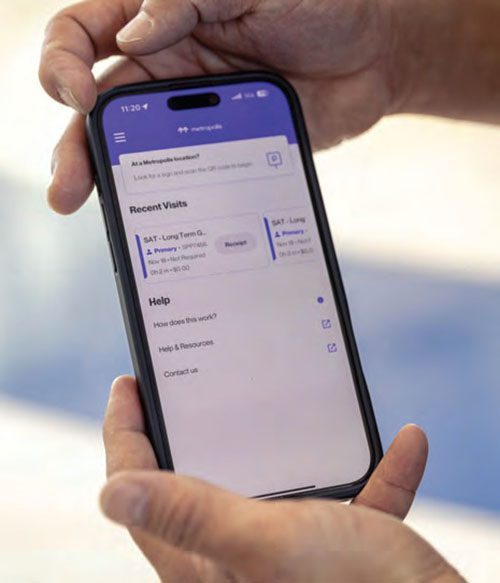
Airport guests can now pay for parking directly from their phones.
Registration is required only once and takes less than one minute, Rocha notes. On subsequent visits, the system automatically recognizes registered vehicles.
New Features, New Profit Potential
Previously, customers could not reserve parking at SAT. With the Metropolis system, travelers can have peace of mind that a space will be available on their departure day.
From the airport’s perspective, the ability to adjust pricing based on usage analytics is a valuable new feature. If parking is in high demand, SAT can charge full rates in lots and garages. Conversely, when fewer travelers are parking, the airport can promote lower rates on its website and through push notifications. The strategy is to entice travelers who might otherwise choose to get dropped off by a taxi, rideshare service or private vehicle to drive themselves and park at the airport instead.
 An additional advantage of the Vision system is the vast amount of data it collects about customers, including postal ZIP codes. “I’m getting metrics in real time that are valuable in our marketing efforts,” says Mills Pysher. “We can look at average transaction values, slice the data by different periods of time, and know where our customers are originating from.”
Early analysis of the data shows the system’s reservation capabilities have helped improve revenue per passenger by about 91 cents, she adds.
Rocha notes that Metropolis’ AeroParker software platform has a strong track record of enhancing parking revenues at leading domestic and international airports. “The revenue growth potential at each airport is influenced by its unique competitive landscape, including on- and off-site capacity,” he says. “At SAT, optimizing pricing strategies based on supply and demand dynamics will be essential in driving parking revenue.”
According to Rocha, customer response to the new app has been positive, though some travelers say they prefer pulling a paper ticket and paying an employee. Although SAT has removed all of its ticket dispensers, customers can still pay their parking fees to a cashier.
The airport also recently evolved its parking program for disabled veterans and customers with special military license plates. Previously, SAT offered such guests free parking in all lots and garages, at a cost of $11 million in fiscal year 2025. In response to an FAA audit, the airport was required to modify this program to ensure its cost was “de minimis,” or, in essence, small enough to be insignificant. Metropolis engineered a web-app that allows SAT to offer disabled veterans and customers with special military license plates up to 30 days of free parking in economy lots, and discounted parking in garages. Additionally, the new system allows the airport to offer reservations in all of its facilities as well as provide automated validations, which reduced transaction times from four minutes to two seconds. “This greatly improved the customer experience for qualified service members,” says Mills Pysher.
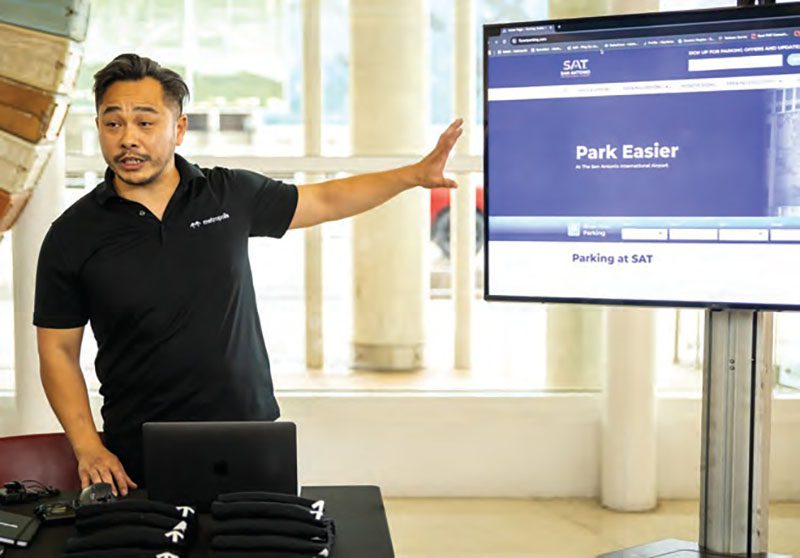
A press conference helped promote the new system to customers.
The new iteration launched on Nov. 1, 2025, and SAT had received more than 17,500 applications for the program by late December. “Customers are extremely happy with the changes to the program and the level of customer service they are receiving with the new technology,” reports Mills Pysher.
For her, the beauty of the airport’s high-tech parking system is that artificial intelligence continues to learn over time, meaning its capabilities have already increased and become even more accurate with each passing day.
“Move fast and break things,” Mark Zuckerberg’s motto from the early days of Facebook, doesn’t seem to apply at SAT. “Move fast and solve challenges” seems more apropos.