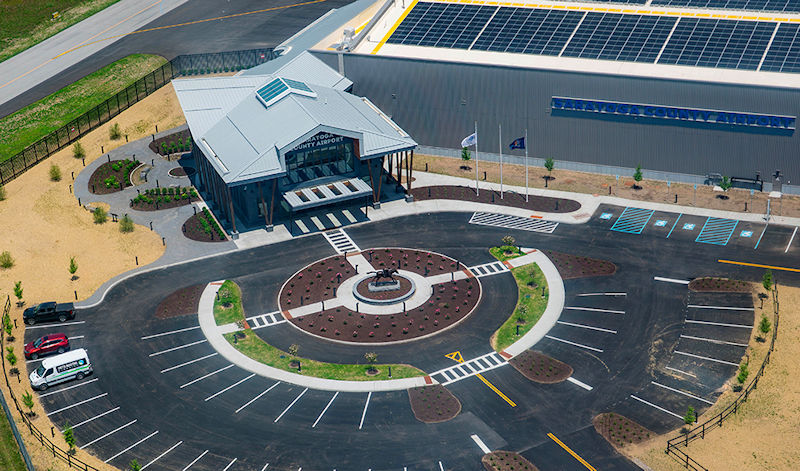
In an area of upstate New York known for horse racing, the team at Saratoga County Airport (5B2) ran hard to design, plan and construct a new terminal, hangar building and rehabilitated apron in less than 30 months.
Why the rush to complete projects not on the master plan or updated airport layout plan? Because the improvements were heavily subsidized by prize money from Governor Kathy Hochul’s $230 million Upstate Airport Economic Development and Revitalization Competition, administered by the New York State Department of Transportation; and the grant requirements included a June 2025 deadline to prepare for increased traffic from the Saratoga Springs horse racing season and the temporarily relocated Belmont Stakes.
Together, the projects totaled about $36.3 million, with $27 million covered by the competition award and another $1.9 million by FAA Grants. (See Facts and Figures for other funding details.)
Members of the project management team note that minimizing disruption to the community and those living around the airport was another major factor driving the schedule.
 In addition to upgrading infrastructure, the projects also prompted a shift in management of the county-owned airport from North American Flight Services, the field’s primary fixed base operator, to Airport Manager Neil Kelsey, who had decades of experience at the FBO. With Kelsey at the reins, various project teams delivered a new two-story terminal, an almost 20,000-square-foot hangar and a 1.56-acre apron.
The nearly 21,000-square-foot terminal replaced a 100-by-80-foot tin structure built in the 1970s. “It required quite a bit of maintenance annually, and we needed an upgrade,” says Kelsey.
Even though jet traffic related to horse racing June through Labor Day accounts for about 70% of the airport’s 50,000 annual operations, recent upgrades also were designed to accommodate other users. The airfield’s diverse mix of traffic includes smaller general aviation aircraft, state police, military personnel undergoing helicopter night training, students from a helicopter school and 40 to 50 gliders from two clubs based on the field.
In the Money
McFarland Johnson, the airport’s long-time consultant, helped assemble its application for the state funding competition in 2021.
 “We were all excited about the possibility of getting a new building,” recalls Kelsey, who was still employed at North American Flight Services at the time.
McFarland Johnson Grants Administrator Kelli Walters explains that competition was stiff for the special state grants, so the project team had to be ready right out of the gate. “The size of airport is not as big of a factor as you might think,” says Walters, noting that Saratoga County was competing with larger airports in Syracuse, Albany and Westchester County.
Senior Project Engineer Turner C. Bradford, PE, quickly assembled a team and worked with Fennick McCredie Architecture and county personnel to plan the project in case the special state grant was awarded.
 Amanda DeCesare, PE, senior vice president and national aviation design director from WSP USA, worked with the New York Department of Transportation to evaluate the applications to determine which airports would receive funding through the $230 million grant competition. “It’s not like a standard FAA grant,” says DeCesare. “NYSDOT had their own specific project evaluation criteria for this program, which focused on design innovation, enhancing passenger amenities, customer experience, operational efficiencies, economic feasibility and geographic diversity.”
Of the 24 New York airports eligible to apply, 20 submitted project proposals and nine made the final cut. Saratoga County Airport, considered by some to be a longshot, made it to the winner’s circle but still had to meet strict grant requirements to collect its $27 million.
Probably the toughest criterion was a high-stakes timeline that required projects to be substantially completed in two years from the date the grant was fully executed. “That means designed, bid and constructed,” Walters specifies.
| facts&figures
Projects: New Terminal & Hangar; Apron Rehabilitation Location: Saratoga County Airport – Ballston Spa, NY Owner: Saratoga County, NY Approx. Cost: $36.3 million Funding: $27 million NYSDOT Upstate Aviation Grant (for terminal/hangar project); $1.9 million FAA grants; $5.8 million from Saratoga County; $1.4 million NYSDOT Aviation Capital Program (for terminal generator); $88,000 state match for FAA Funding; $88,000 county match for FAA funding Key Benefits: Updating & improving infrastructure for aviation customers; adding facilities for community use; accommodating traffic during horse racing season, which this year includes the Belmont Stakes while its home track is being renovated Project Timeline: Demolition of existing hangar mid-Oct. 2023; excavation for concrete foundation mid-Jan. 2024; construction of new terminal & hangar mid-Jan. 2024 to mid-July 2025 Catalyst: Application for Upstate Development Competition in 2021; awarded Feb. 2023 Terminal: 20,784 sq. ft. Hangar: 19,698 sq. ft. Apron Rehabilitation: 1.56 acres Environmental Aspects: On-site habitat for endangered butterfly; installation of solar & geothermal systems Terminal Features: Public restaurant & meeting room; updated fire suppression system; Consultant: McFarland Johnson Inc. Design: Fennick McCredie Architecture State DOT Grants Management: WSP USA Hangar Demolition: Murnane Building Contractors Inc. Prime Contractor for New Terminal/Hangar: LeChase Construction Services Prime Contractor for Apron Rehab: Callanan Industries Inc. Geothermal Well Drilling: Hawk Drilling Company Inc. Geothermal Pipes & Heating Equipment Installation: Eckert Mechanical LLC Hangar Doors: Door Engineering & Manufacturing, a Senneca Co. Terminal Windows: Marvin Windows Landside Paving, Parking Lots & Landscaping: LeChase Construction Annual Operations: 50,000 (70% during horse racing season July-Labor Day) plus 2026 Belmont Stakes in June Based Aircraft: 100 (airplanes, gliders & helicopters) Tenants: 50 |
Bradford wasted no time creating the scope and design agreement. “Saratoga County received its grant in February 2023,” he recalls. “The reason I remember that is that essentially, we got the entire project planned, designed and constructed in less than 30 months.”
Saratoga County Board Chairman Phil Barrett notes that major local investments from companies such as Regeneron and GlobalFoundries emphasize the need for a modern airport to support rising business travel alongside other general aviation uses. State Transportation Department data indicates 5B2 generated over $9.7 million annually before the recently completed revitalization. “The airport is a key economic driver,” says Barrett, who expects further growth in the county from industry investments and use of the upgraded terminal and hangar.
Designed With Community in Mind
A team from Fennick McCredie toured the FBO and collaborated closely with its personnel to tailor the new terminal to the complete range of operations at 5B2. Designers also met regularly with county staff members to present ideas and gather feedback, aligning building plans with their goals.
“They wanted it to be accessible to everyone in the community, not just for pilots, passengers and aircraft owners,” says Lead Architect Scott Brodsky. “And that became one of the design challenges.
“Every airport has two front doors: one on the landside and one airside,” he elaborates. “Creating inviting architecture on both of those sides created some challenges in developing the building’s geometry.”
Architects created a boomerang shaped facility to reconcile angles of airside and landside facilities and respond to the county’s desire to have a welcoming public façade facing both of those entries. Geothermal and solar energy systems added green elements to the design. The orientation of the hangar and roof slopes provided a large open area for the photovoltaics installation, notes Brodsky.
Barrett expects the restaurant and public meeting room inside the new terminal to help strengthen the airport’s role within the community as well as boost county revenue. “Local organizations can use the facility, and travelers and residents can partake at the restaurant,” he says. “That’s something we’ve never had before.”
Designers aligned the space so it has two sets of windows, one parallel to each axis of the runway. “We wound up rotating the whole building and moving the restaurant up to the second floor so that it has that view of the airfield,” Bradford adds.
Kelsey agrees that the restaurant is a nice amenity; but he’s more excited about the new 20,000-square-foot hangar. With 92-foot-wide doors, each of its two bays can hold aircraft such as a Challenger 300 or Challenger 650. Previously, some aircraft operators avoided landing at 5B2 during the winter because the airport doesn’t offer deicing services. “The environmental impact would be too great on our protected butterfly, the Karner Blue,” Kelsey explains. “But now we can offer parking inside the hangar to keep the ice and frost from forming.”
Because the airport sits on federal- and state-protected land, all facilities have to be carefully designed to balance safety for users and sensitive wildlife. Approximately 527 acres, including turf areas, are designated as a year-round protected habitat for the Karner Blue butterfly, which has been on the endangered list since 1992. Most of the property can only be mowed once a year after Oct.15 to avoid disturbing the Blue Lupine plants the butterflies depend on. An off-site mitigation project established 183 acres of alternate habitat nearby as a condition of FAA funding for safety improvements at the airport.
Throughout the design process, the project team focused on preserving core elements despite value engineering to reduce overall costs. For instance, downsizing the hangar by about 10,000-square-foot and the terminal building by 2,000-square-foot changed the hangar’s maximum aircraft size from C-III to B-II—excluding only the largest aircraft, but still accommodating 90% of planes that use the airport.
And They’re Off
Planning and communication during the design phase helped limit operational disruptions during construction phases. No runway closures were needed, and the FBO was able to use an existing hangar while crews worked elsewhere. The main impacts were landside, affecting public access to the airport and involving measures to avoid disturbing the butterfly habitat.
The project was designed and permitted as one package, but went to construction as three separate contracts: demolition of the existing hangar; construction of the new hangar and terminal, plus sitework for the entrance driveway; and the apron rehabilitation.
Work commenced in mid-October 2023, when Murnane Building Contractors began demolishing the more than 50-year-old hangar located in the center of the airfield. Because it housed an antenna that communicates with the air traffic control tower at Albany International Airport, the project team coordinated with the FAA to relocate the antenna and construct a shelter for its equipment. The hangar also carried power for the airfield’s Automated Weather Observing System, which had to be repowered.
 After demolition was complete in December 2023, LeChase Construction Services promptly began excavation for the new terminal’s concrete foundation in mid-January 2024, amid warmer-than-usual winter temperatures for upstate New York. They also benefited from a lack of rock and clay in the local soil. “The airport’s beautiful sand allowed us to work well in the wintertime as it drained well and there wasn’t water collecting everywhere,” Project Executive Tim Hanke recalls.
Hawk Drilling Company drilled 24 wells, each 450 feet deep, for the geothermal system under the apron in front of the hangar. LeChase excavated a 20-foot pit for the 30,000-gallon fire suppression system water tank and dug even deeper to place pump vaults for the fire suppression pumps. “All of that is under the hangar slab so that was a heavily coordinated effort,” says Hanke.
To prevent excavated soil from posing foreign object debris damage to aircraft, it was stockpiled about one-half mile to the south.
Construction of the new termina/hangar building lasted from mid-January 2024 to mid-July 2025. “From the time of bid, we basically had 18 months to get this constructed,” says Hanke.While LeChase finished its contract, Callanan Industries began the apron rehabilitation, which stretched from the new hangar out to the ramp. That work occurred September 2024 to April 2025.
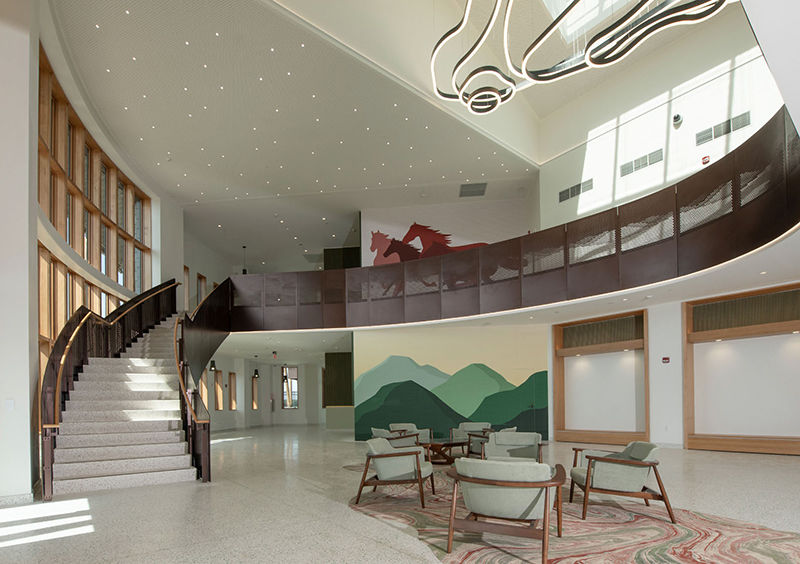
Designers incorporated references to the local horseracing culture and regional landscapes.
Local and Personal
Incorporating local design elements and building materials helped the airport tie its project to the local community. The terminal design draws on Victorian architecture prevalent throughout Saratoga County, with slate siding sourced from Vermont, and Adirondak-style elements such as a lean-to roofline over the outside patio.
 In addition, the project team was stacked with locals. Hanke lives minutes from the airport and is active in a glider club based there. Kelsey, Bradford and Saratoga County Commissioner of Public Works Chad Cooke, who is a private pilot, all live in the area as well. Barrett is also supervisor of nearby Clifton Park, NY; and Brodsky is an alumnus of Skidmore College in Saratoga.
“I have a close personal relationship with the county and the locale,” says Brodsky. “People were really invested in the project on a personal level.”
Final Stretch
In June 2025, New York Governor Kathy Hochul announced completion of the new terminal/hangar project.
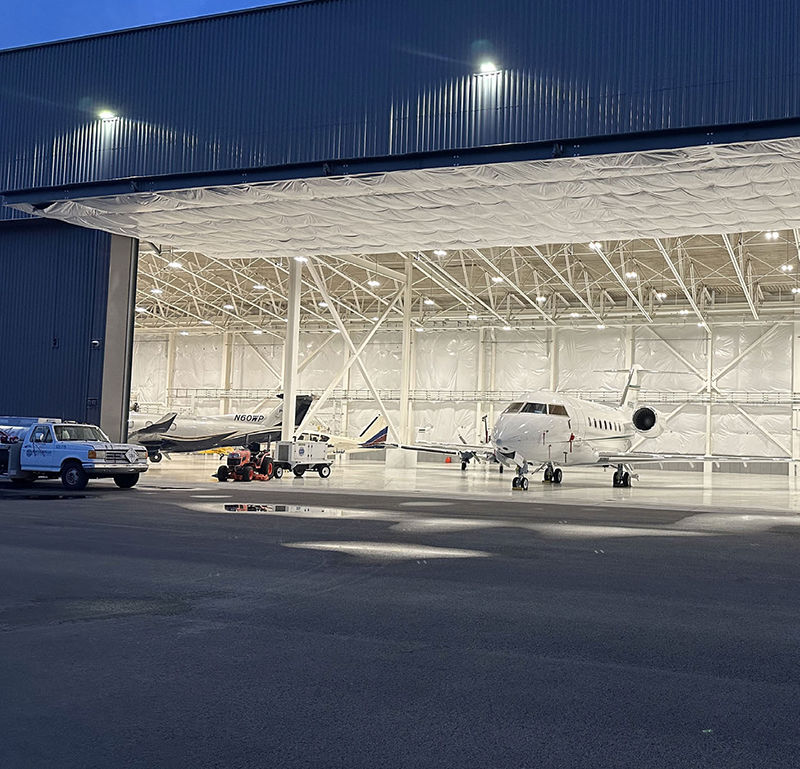
The new hangar provides nearly 20,000 square feet of indoor parking for aircraft.
WSP’s DeCesare praises the airport for meeting the grant’s tight timeline and other requirements. She cites support from other funding sources and a diligent, cohesive project team for helping 5B2 be among the first of all grant recipients to complete its project and achieve the award.
 From the start, Bradford recognized that the county was aiming high. As a non-towered, non-Part 139 airport, 5B2 was competing with major airports in Albany, Syracuse and Buffalo. Yet it qualified because it serves jet traffic. “Not that I don’t value all my projects, but this was a ‘home game,’ and I take a lot of pride in it,” says Bradford.
Thinking back on the design process, Brodsky recalls visiting the airport and seeing a father and son sitting in their car watching planes take off. “That came back to me when designing this space to maintain that connection to the community,” he says. “It is truly a community building and not just an airport.”
Hanke, who began flying out of 5B2 as a 1-year-old with his father, enjoyed watching the airport transform. “I hope it brings people into the flying aspect,” he says. “It’s nice to see younger people get involved in aviation, whether it becomes a career or just recreation.”
Kelsey is thrilled with the new terminal and hangar. “I think this is one of the most beautiful buildings in the county, and every part of it is being used as intended,” he reports. “We’ve got more ramp space and the added space is more than welcome because it makes it easier to accommodate some of the larger aircraft that do come in.”
Barrett and other county officials expect the infrastructure improvements to reap financial benefits for many years. “If you’ve been to this airport in the past, you won’t recognize it,” he remarks. “In all respects, I see nothing but incredible opportunities ahead of us.”