The $160 million transformation Glacier Park International Airport (FCA) completed this summer brings a mix of old-world charm and modern convenience to the thriving small hub airport located just outside Kalispell, MT.
Given the airport’s recent growth trajectory, the improvements couldn’t have arrived at a better time.
The project spanned seven years, including a brief pause for the COVID-19 pandemic. Over three distinct project phases, FCA expanded its terminal from approximately 90,000 square feet to more than 210,000 square feet while retaining much of the existing footprint. A massive basement was carved from the earth to house an inline explosives detection system and core utility corridor, while space for new administrative offices was created by adding a third floor.
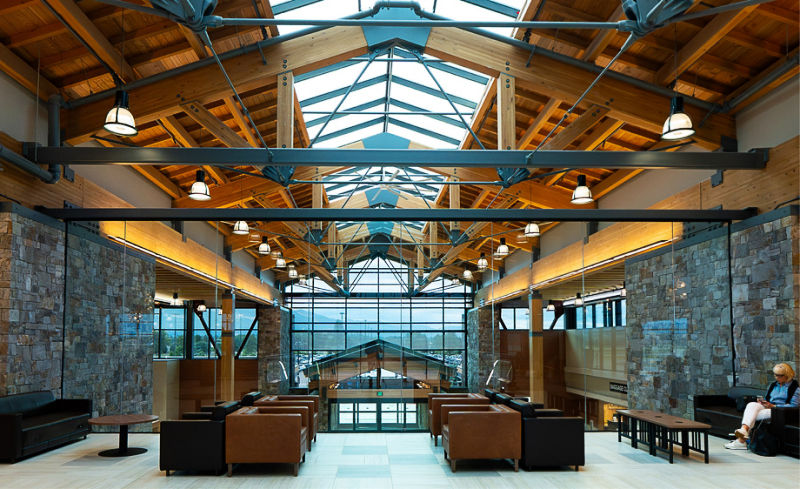
The facility is noticeably larger thanks to its new centerpiece, a Great Hall that evokes the look and feel of both traditional European mountain lodges and nearby National Park structures.
| facts&figures
Project: Terminal Expansion Location: Glacier Park Int’l Airport, near Kalispell, MT Size: 210,000 sq. ft. (new & renovated spaces) Highlights: Wood-themed Great Hall; 3 holdrooms renovated, 4 added; 6 new passenger boarding bridges; inline baggage screening; expanded security checkpoint; additional retail & dining options Cost: $160 million spread over 3 phases Funding: $70 million in local loans backed by future Passenger Facility Charge proceeds; $41.5 million Airport Improvement Program (AIP) Entitlement/FAA Discretionary funds; $16.4 million local funding; $13.6 million in AIP Airport Terminal Program grants; $12.7 million in AIP Airport Infrastructure Grants; $9 million from TSA; $820,000 from Passenger Facility Charges Timeline: Joint venture construction bid awarded in Feb. 2020, with design work beginning in 2019 & resuming in 2021; construction completed in spring 2026 Design: Mead & Hunt Contractors: Q&D Construction; Swank Enterprises Water Barrier for Basement: Zypex Carry-on Item Screening: ConnectCT from Analogic Inline Baggage System: Robson Handling Technology USA Outbound Handling & Sorting Systems: G&S Airport Conveyor Common-Use Systems: SITA Jet Bridges: Holdroom Seating & Furniture: AGATI; Arconas 2025 Passenger Volume: About 1.1 million Owner/Operator: Flathead Municipal Airport Authority |
The airport expanded and modernized its TSA checkpoint and baggage claim areas; and the concessions lineup was updated with both remodeled spaces and new locations. Behind-the-scenes upgrades include new HVAC systems, electrical components and technology infrastructure that meet today’s needs and will support future growth.
Three existing holdrooms were remodeled from top to bottom, with four more added. Six new passenger boarding bridges arrived from Oshkosh AeroTech to provide much-needed protection for travelers, especially in frigid winter conditions. A seventh bridge will be added later to replace a ramp-loaded gate.
Hand-screening of baggage was upgraded with an inline system from Robson Handling Technology USA. Because that equipment is located in the basement, engineers collaborated to add flood mitigation measures.
The complexity of all these renovations was magnified by completing work during the COVID pandemic. Keeping the peak-heavy airport fully open throughout the multi-year overhaul was another significant factor.
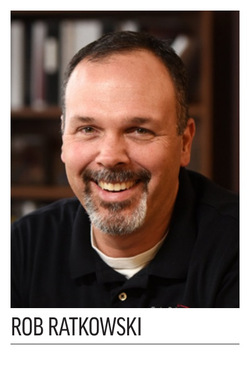
“It was like rebuilding an engine while it’s running,” says Rob Ratkowski, who has been FCA’s airport director for the past decade.
Despite a series of known and unforeseen challenges, commitment from the Flathead Municipal Airport Authority to deliver a first-class facility never wavered, he adds.
Ratkowski credits the broad set of talents within the Authority’s board of directors for fostering a vision for FCA that combines civic pride with sound business practices in a tourism-dependent region. Board members include a former pilot, an engineer, a banker, the chief executive officer of a construction company, and a former airport executive, among others.
When faced with the choice of building the smallest, most modest possible addition or creating an important building that would make a statement for the community, the board chose the latter.
“If we can pay a nickel more to go first class, we’re going to do that,” explains Ratkowski.
Meet Me in Montana
Many factors propelled the airport board and staff’s desire to upgrade FCA, most notably recent changes in travel trends that have created dual peak tourism seasons in the area.
Summertime has historically delivered a surge of visitors heading to Glacier National Park, a 45-minute drive northeast of Kalispell where natural wonders attract more than 3 million people annually. In fact, 2025 was its third-busiest year ever with nearly 3.14 million guests, according to National Park Service statistics.
Many of those visitors first flew into FCA amid the pandemic when outdoor recreation was among the few travel options that allowed for effective social distancing, Ratkowski explains.
When temperatures drop, a smaller but growing passenger peak occurs as skiers and snowboarders flock to Whitefish Mountain Resort, just 30 minutes from FCA. The resort has flourished over the past two decades under the ownership of billionaire Bill Foley, chairman of Fidelity National Financial and owner of the NHL Vegas Golden Knights.
His Rock Creek Cattle Company, located three hours south of Kalispell by car, is a historic working cattle ranch that now includes a private golf course and outdoor adventure club.
Investing heavily in Big Sky hospitality, Foley has remade and widely promoted Whitefish Mountain Resort and its adjacent namesake town. Winter sports enthusiasts have taken notice and are increasingly flying through FCA as a result.
Airline traffic has also enjoyed a boost from passengers who discovered the region as vacationers but later chose to move there, particularly since the pandemic when work-from-home opportunities flourished. U.S. Census Bureau data shows Kalispell’s population is now 33,342 residents—a 32% increase since 2020.
The airport hosts a mix of seasonal and year-round service to more than a dozen cities via six air carriers: Alaska, Allegiant, American, Delta, Sun Country and United. Last year, United was its busiest carrier with more than 450,000 seats in and out.
General aviation traffic has likewise expanded at FCA, so much so that Atlantic Aviation was inspired to purchase the airport’s fixed-base operation last September.
With multiple factors simultaneously driving growth, airport traffic has skyrocketed. When Ratkowski arrived in 2004 as manager of operations and maintenance, FCA served approximately 350,000 annual passengers; last year brought more than 1.1 million.
Currently, FCA is Montana’s second-busiest airport, trailing only Bozeman Yellowstone International Airport (BZN), which handled a record 2.8 million passengers last year.
 “Post-COVID, [our traffic] just went crazy,” Ratkowski says, citing many consecutive years of double-digit gains. “We recovered almost immediately and it’s been off to the races ever since.”
Previously, financial limitations had forced FCA to find more room for passengers without expanding the terminal. But that only worked for so long.
“We just ran out of options,” Ratkowski remarks. “There was no more gift shop space that we could convert to holdrooms.”
Upon taking the helm in 2016, Ratkowski launched a Master Plan update. Designs for a terminal expansion were completed in 2019—only to be abruptly shelved as global air travel temporarily plummeted beginning in spring 2020.
Looking ahead to an expected post-COVID recovery, airport management knew FCA’s existing spaces could handle passenger volume comparable to that of 2015. A return to that level, leaders agreed, would trigger a revival of the expansion plans, though no one expected that to occur anytime soon. Their measured expectations quickly unraveled.
“By December of 2020, we were seeing those [2015] numbers,” Ratkowski recalls.
Accordingly, construction of FCA’s expansion kicked off in spring 2021.
Bigger, Better and On-Brand
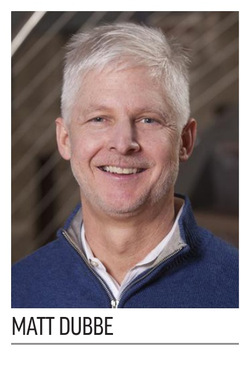
Matt Dubbe, national design and market leader for aviation architecture at Mead & Hunt, came away with two design imperatives after initial evaluations of FCA: The terminal had to be bigger and more representative of its region.
The holdrooms, says the Montana native, were relics of an outdated era when smaller aircraft served FCA; they did not have adequate seating for the airport’s current fleet mix of larger Boeing 737s and Airbus A320s. Dubbe also describes the previous aesthetic as functional but lacking any allusions to the magnificent surrounding landscape that’s ringed by rugged mountains.
 Drawing inspiration from Glacier Park structures and Central Europe’s massive, historical mountain lodges, Dubbe intended to erase any vestiges of FCA’s 1980s-era appearance.
“I recognize some styles stick with certain time periods, but that’s what I felt this airport should not be,” he says. Instead, Dubbe sought to create a “timeless piece” that shapes travelers’ experiences moving through the aviation gateway to a beloved national park.
Mead & Hunt consequently held a series of workshops to school airport authority board members about basic aspects of airport design. Field trips to other Montana airports were held to lean into how and why certain spaces might be perceived differently based on factors such as natural vs. artificial lighting, or ceiling height.
“These individuals are so fiercely proud of their surrounding region; so the first image we ever showed them was a [rendering of] an uninterrupted wall showing the mountains,” Dubbe notes. That visualization, in turn, created interest among board members in a wide-open central terminal area that later became FCA’s Great Hall.
Continuing with a mountain lodge aesthetic, the design palette was simplified to a handful of basic, often natural components: wood, stone, steel and glass. Many functional elements were purposefully left exposed, including timber joints that support the ceilings.
“The beam work is breathtaking,” Ratkowski notes.
To meet the extra demands of summertime travel peaks without overbuilding for the rest of the year, Dubbe created a secure exterior patio that functions as extended holdroom space. It offers another chance for travelers to “embrace the exterior,” he adds.
Small touches were carefully considered, from four distinctive soft seating options to providing chess tables and a piano for guests to enjoy. Those who make or listen to music in the new terminal space appreciate the pitch-perfect acoustics created by the wooden walls and ceilings.
Accessories retained from the previous facility include a taxidermized black bear that has been a staple at FCA for decades. In addition, the Great Hall features a rare Cadillac Phaeton from the 1930s—a massive touring vehicle built to transport VIPs through the Montana mountains. President Franklin D. Roosevelt famously rode in a Phaeton when he toured Glacier National Park in 1934, Dubbe shares.
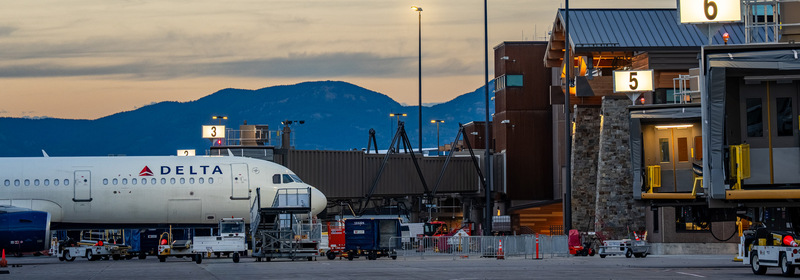
The project added six new boarding bridges from Oshkosh AeroTech
Building on Mead & Hunt’s rustic design theme, master concessionaire Metropolitan Culinary Services developed the Goat Haunt Saloon, an old-style whisky bar and restaurant with wood-beam ceilings and low lighting. Dubbe reports that the new concession’s lodge-style vibe has already proved to be wildly successful among flyers.
“There are a lot of big spaces that encourage people to not only hang around their gate but explore the airport and take their time,” he adds. “It’s truly an awe-inspiring space.”
Ratkowski emphasizes that cultivating a sense of place was especially important. “A lot of what you’ll see are modernized echoes of the historic lodges in the park,” he relates.
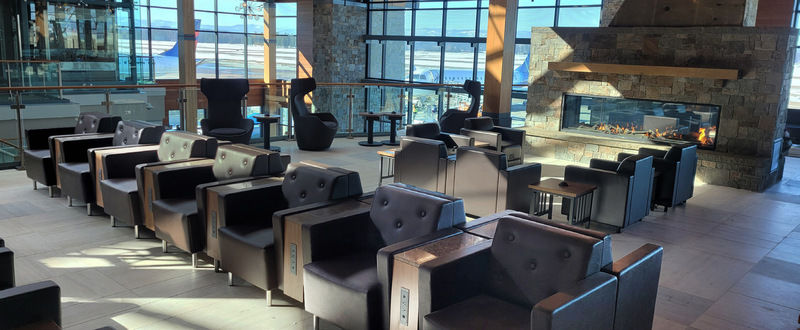
Design elements set the stage for passengers visiting Glacier National Park.
Construction Challenges
What began in 2014 with the need for a couple more gates grew into a much more complicated project over time.
“As passenger growth snowballed, we quickly realized we that we needed more everything,” Ratkowski explains.
The airport board approved a construction joint venture bid in February 2020. Reno-based Q&D Construction was selected as general contractor in tandem with Swank Enterprises, a local firm with a history in Montana that traces back to 1960.
The two companies used a Construction Manager at Risk, or CMAR, process while Mead & Hunt served as the design lead and provided oversight of construction processes such as plan submittal and documentation.
Initially, the project was packaged as one large contract, but the airport later split work into three phases to better manage resources during the pandemic. Phase One, valued at $70 million, opened in March 2024 and included half of the Great Hall, three new passenger boarding bridges with accompanying holdrooms and other passenger and operational spaces.
The next phase delivered the second half of the Great Hall, including ticketing counters and kiosks; another new boarding bridge; and the replacement of two older boarding bridges. It wrapped up earlier this year and included $50 million in renovations and additions. The $10 million third phase, built concurrently, included the new baggage handling systems.
“There was a ton of infrastructure work—it wasn’t a remodel or a little add-on,” says Q&D Aviation Vice President LaMonte Forgays. “There is maybe one wall we left that has its old finish. Everything else is completely new.”
Scheduling construction around ongoing airport operations required complex phasing, he notes. Other challenges included a lack of available labor at times, as well as materials shortages stemming from COVID-related supply chain disruptions.
Ratkowski recalls watching the cost of steel soar before the team chose to shift much of the structural framing to heavy timber instead. But even that workaround became difficult when border closures hampered imports of wood from nearby Canadian mills.
Supply chain disruptions also affected electrical, mechanical and roofing system deliveries. Still, the project team found solutions, including alternative manufacturing or other viable methods to expedite delivery and/or bridge gaps within the budget.
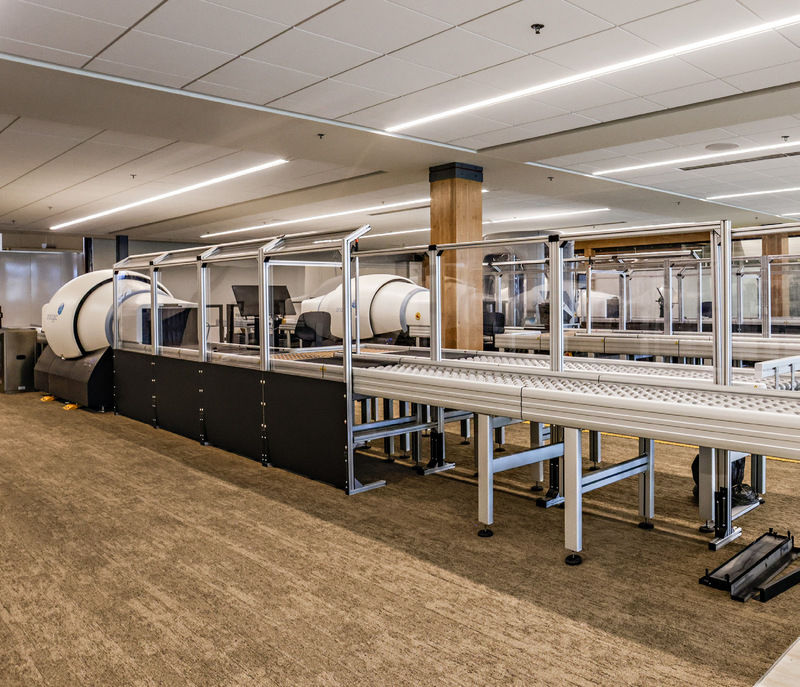
The passenger checkpoint was expanded and upgraded with analogic ConnectCT machines for screening carry-on items.
Forgays credits Ratkowski and his staff for their partnership during that challenging period, particularly FCA Director of Development Daniel Reimer, who served as an in-house owner’s representative during construction.
“He’s lived and breathed this job for the last six or seven years,” Ratkowski says of Reimer.
Forgays also highlights Swank Enterprises’ ability to secure timber and execute the project’s many wood-based elements. The firm’s local relationship with trades proved critical, he notes.
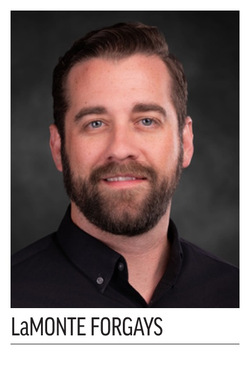 “We sought Swank as the premier local general contractor and combined that with our aviation expertise to deliver the project,” Forgays says. Close to 40 subcontractors were involved throughout the three phases. At peak, 150 skilled workers could be found onsite.
Beyond the pandemic, additional challenges lurked underground due to water tables near the airport that rise close to the surface. Engineers overcame the natural impediment by adding a massive water-retention barrier to keep the airport’s new basement spaces dry. They specified Zypex, a material typically used to keep water inside concrete tanks.
Forgays explains that crews dug wells to measure water levels each week. Once the groundwater hit its nadir in the fall, workers quickly dug deep into the earth to build foundations before ground water levels rose following the winter snowfall and springtime runoff. Once more, Swank’s local expertise played a huge role.
“They’re quite familiar with how to work in the winter out here,” Forgays notes. “We didn’t get too much of an impact from weather because we teamed up with the right folks.”
Q&D had supervisors onsite and its project management leads traveled to FCA regularly. Swank provided or oversaw most of the local trade workers.
Balancing construction timelines with available capital was sometimes like a high-stakes chess match due to COVID-related price increases on almost all materials. Ratkowski says the airport “pulled out every stop we could” to obtain the money necessary to complete each phase in a timely manner.
In addition to its own funds, the airport used FAA Airport Improvement Program entitlement dollars collected over the course of five years. The Bipartisan Infrastructure Law and Airport Terminals Program also provided federal money, as did TSA’s Checked Baggage Inspection System program.
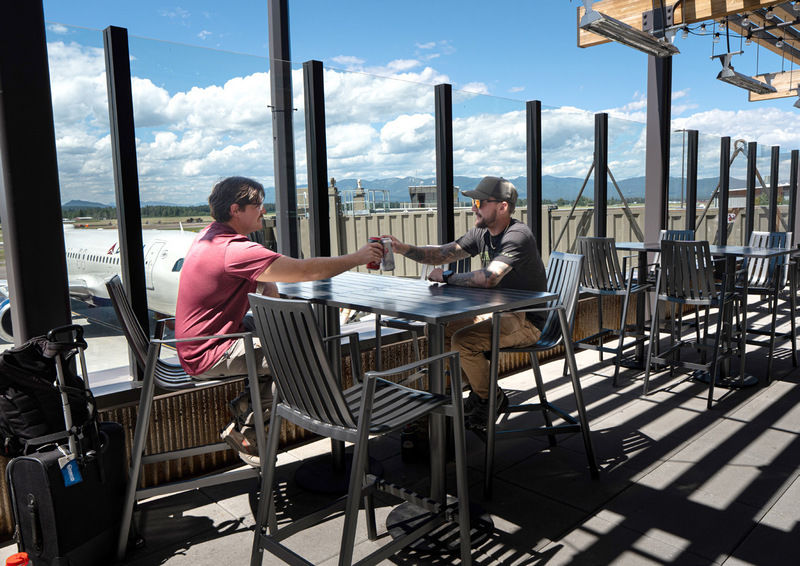
A new outdoor patio gives departing travelers one last look at the airfield and Big Sky Country.
Some debt was incurred, with the airport using future Passenger Facility Charge proceeds to secure $70 million in loans from a consortium of local banks. Extremely low COVID-era interest rates helped reduce the monthly payments, and no bonds were issued, notes Ratkowski.
Leaving a Legacy
Looking back on a project that occupied several years of his professional life, 52-year-old Ratkowski describes the recent improvements at FCA as the pinnacle of his career. Everyone from the airport’s 50+ employees to its hired contractors and subs more than pulled their weight, he adds.
Forgays says he’ll reflect fondly for years on the end results, calling the new FCA “one of the most beautifully tied-in pieces of architecture I’ve seen. It really speaks to the region.”
For Dubbe, a Montana native who now lives in Minneapolis, the lasting afterglow will include memories about those who performed the work.
From Day One, the subcontractors looked at the project as if it were “almost their moral imperative to do something they could be proud of, that someone who came there would know and intuitively love,” he explains.
“We had fourth-generation masons on the job whose grandfather came out and said, ‘I laid this stone here.’ Those things really mattered.”