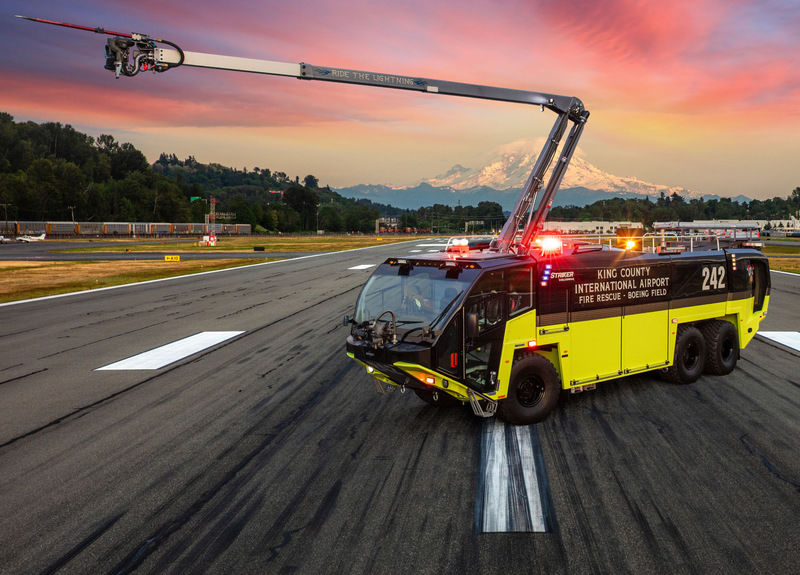
King County International Airport-Boeing Field (BFI) in Seattle has amassed a $4.1 million fleet of hybrid electric vehicles in its ongoing mission to become carbon neutral by 2030.
Primary purchases include a $2.8 million Oshkosh Striker Volterra hybrid electric firetruck last year, and an R4 Air electric-powered sweeper from Global Environmental Products for about $804,000 in 2024.
With those additions, BFI became the first airport in the United States to own a hybrid electric aircraft rescue and firefighting (ARFF) vehicle, and the first with an electric-powered runway sweeper, notes Airport Director John Parrott.
| facts&figures
Project: Hybrid Electric Vehicles Location: King County Int’l Airport-Boeing Field, in Seattle Key Benefits: Reduced emissions; supporting goal to be carbon neutral by 2030 Approx. Cost: $4.1 million Funding: General airport revenue from user fees; $500,000 state grant to defray sweeper purchase Consultants: WSP; King Co. Division of Fleet Services Timeline: 2024-2025 Electric Vehicles: Striker Volterra hybrid electric firetruck, by Oshkosh Airport Products ($2.8 million); R4 Air electric-powered sweeper, by Global Environmental Products (roughly $804,000); 6 Ford F-150 Lightning hybrid electric pickup trucks ($450,000); 2 eL XD light-duty landscaping trucks, by Global Electric Motorcars (nearly $77,350) Infrastructure for Maintenance Shop: Electrical upgrades; 18 charging stations for maintenance shop Approx. Cost: $350,000 Funding: State grant Infrastructure for Fire Station: Electrical power upgrade; Level II charging station Cost: $15,000 Funding: General airport revenue from user fees Third-Party Certification: Level 3 of the Airport Carbon Accreditation program |
The airport also bought six Ford F-150 Lightning hybrid electric pickup trucks for a total of $450,000 and two eL XD light-duty landscaping trucks built by Global Electric Motorcars for a total of nearly $77,350. All were purchased in 2024 and 2025.
General airport revenue from user fees paid for the lion’s share of these acquisitions, but a grant from the Washington State Department of Transportation (WSDOT) covered the $500,000 cost difference between the electric sweeper and a less expensive conventional counterpart. The grant also provided $350,000 to update electrical infrastructure and install 18 battery charging stations for the vehicle maintenance shop.
Beyond its equipment purchases, the airport spent about $15,000 to upgrade electrical infrastructure—including a Level 2 charging station—at its ARFF station.
The airport’s multimillion-dollar investments support the Strategic Climate Action Plan for King County, which owns and operates BFI. “The plan has a number of facets to it, including a goal to reduce the carbon footprint of county-owned vehicles,” explains Parrott, adding that the airport is doing its part and leading by example.
“Our region is experiencing the effects of climate change, and these challenges will only intensify,” former King County Executive Dow Constantine said in a news release last spring. “We are taking bold and decisive action to reduce emissions.”
To help navigate the challenges of incorporating electric vehicles, airport officials sought advice from engineering and consulting firm WSP and the King County Division of Fleet Services.
Updating the Fleet
The new Striker Volterra is the centerpiece of BFI’s move to more sustainable vehicles. Clint Herman, a sergeant at the airport fire department, highlights the truck’s lack of emissions when operating in full electric-power mode—a particularly important benefit when operators start the vehicle inside the station apparatus bay.
“We start it only in electric mode, so our firefighters aren’t exposed to exhaust fumes that contain diesel particulate and toxins, which are the biggest (negative) contributing factors to firefighters’ health,” Herman explains.
“It’s also very quiet,” he adds. “When it’s in electric mode, you almost can’t tell it’s even operating.”
Other benefits include reduced wear and tear on the diesel engine, which doesn’t need to run as often, and increased longevity of brake pads and rotors because the vehicle slows down significantly when drivers take a foot off the gas pedal.
With fully charged batteries, the hybrid electric ARFF unit can travel about 44 miles at 50 miles per hour before needing another charge, Herman reports.
“After we got the truck, we fully charged it and drove it around the airport to simulate normal driving conditions,” he relates. “We didn’t have to charge it again until the third day.”
Not surprisingly, there was a slight learning curve for drivers. The Volterra accelerates 28% faster than similar diesel-powered Strikers and tops out at 72 miles per hour in hybrid mode, when both the diesel engine and electric motor propel it. Four department members attended a two-day training session at Dallas Fort Worth International Airport (DFW), which Herman says helped significantly. The DFW Fire Department owns six Volterras—more than any other U.S. airport.
He and other firefighters were most surprised by the way the diesel engine and electric motor work together. “I didn’t suspect it would be so smooth,” he says, crediting the vehicle’s electromechanical infinitely variable transmission. “When you need speed, you press the throttle all the way down and it assumes you need more power and torque, and seamlessly shifts into electric hybrid mode.”
As expected, there were a few operational hiccups with the first hybrid electric ARFF vehicle in the field. But Herman reports that Oshkosh personnel have been very responsive and fixed issues quickly.
Not Completely Different
Because the new ARFF truck still has a diesel engine, its maintenance needs—such as oil and other fluid changes—are similar to a conventional firetruck.
“It has the same four-wheel drive (as a conventional firetruck) and the same suspension,” Herman says. “There’s no difference functionally, either. There are just a few nuances that operators need become familiar with.”
Although the Volterra cost about $1 million more than a conventional diesel-engine Striker, airport officials didn’t calculate a payback period because ARFF vehicles aren’t used very often.
 “This is not a money-saving endeavor,” Parrott explains. “We knew electric vehicles are more expensive. But we felt that buying them was the right thing to do in order to support the county’s strategic climate plan.”
Purchasing the Volterra allowed the airport to retire its oldest ARFF truck— a 1993 diesel model that was used as a reserve vehicle. The airport also owns a 2020 Oshkosh Striker ARFF vehicle and a 2008 Oshkosh Striker that is now designated as a reserve unit. Both are diesel-powered.
Sweeping Benefits
Just as firefighters endured a few blips with the new ARFF truck, airport maintenance employees had similar experiences with the electric sweeper from Global Environmental.
“The first version of anything usually has some unforeseeable issues that pop up,” says Casey Henderson, lead equipment operator at BFI. “This is not a knock on the manufacturer, it’s just inherent—especially when it involves new technology.”
To ease the transition, an engineer from Global Environmental met with airport employees to discuss performance expectations and the machine’s capabilities and limitations.
“That was priceless,” Henderson remarks. “We walked him through our normal setup and operation of a diesel sweeper…and he was able to break down how certain things make a difference.”
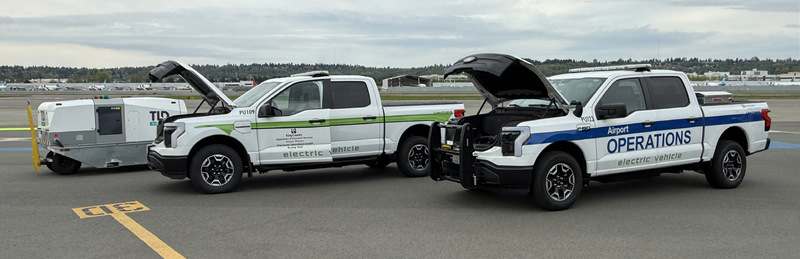
The airport also purchased hybrid electric pickup trucks (pictured) and light-duty landscaping trucks that are full electric (not pictured).
For example, applying slightly too much downward pressure on the brooms causes the main batteries to lose a half-amp of power per hour. While that may not sound like much, it adds up quickly during a 10-hour day. And the batteries power not only the motor, but also the water pump, wipers, heating/cooling systems, lights, etc.
“Although the core functionality of the electric sweeper is the same as a diesel, there are little nuances that you must keep in mind if you’re going to utilize the machine to its full potential,” Henderson says.
Tips to Remember
Thorough research is critical for successful fleet electrification, says Chauntelle Hellner, director of the county’s Fleet Services Division, which purchases and maintains its vehicles and equipment.
 “The industry is always changing, so we try to stay on top of the current technology and industry trends,” says Hellner. “We have a team of zero-emission coordinators that do a lot of research. We also have an asset purchasing team that focuses on understanding the operational needs of the airport.”
Department officials stay abreast of trends in sustainable vehicle technology by attending events such as the NAFA Institute and Expo, the Advanced Clean Transportation Expo and the Forth Roadmap Conference.
Parrott encourages airport officials who are considering electric vehicles to define what success will mean to them. “If you’re trying to move the needle on electrification as a goal, sure—that’s a success,” he explains. “But if you’re trying to operate more economically, that’s probably not going to be a success because a lot depends on fuel and electricity prices and the cost of new infrastructure and vehicles. So you have to define success going into the project.”
Parrott also advises making sure there will be enough local electric power to meet the airport’s new needs. “If you’re in an area where two or three data centers have set down stakes, you’re going to be hard pressed to get enough electricity,” he cautions.
Hellner agrees that early engagement with local utilities is vital.
“You also need to be patient about the process,” she adds. “It always takes longer than you expect it should in terms of purchasing vehicles, then taking delivery and getting them operational. If you’re not prepared for that, it can be very challenging.”
In addition, Hellner recommends being thorough when searching for grants and other funding opportunities. “We apply for everything we can find,” she says.
Last, but not least, she says it helps immensely to have visionary airport executives that support electrification. “The leadership from John [Parrott] and his team has made all the difference,” she comments. “Sponsorship from the top down makes it easier.”
Striving for Sustainability
Although it is too early to quantify how BFI’s 10 new electric vehicles are impacting its carbon footprint, the Fleet Services Division is working on a report to provide that data. The airport’s most recent carbon footprint calculations, compiled in 2023, showed a 37% total emission reduction since 2007.
According to Hellner, the case is strong for electric vehicles—particularly light-duty trucks—because airport vehicles have very predictable duty cycles, don’t travel far on a daily basis and have easy access to charging stations.
Looking at the bigger picture, BFI achieved Level 3 status in the Airport Carbon Accreditation program last year. This is third-party recognition of a measurable reduction in its operational carbon emissions. So far, 663 airports in 94 countries are working with the organization to reduce their carbon footprints. (For more information, visit www.airportcarbonaccreditation.org.)
“Reaching Level 3 puts us about halfway through the certification program,” Parrott says. “It also means we’ve engaged third parties in and around the airport in carbon-footprint reduction.”
The airport’s electrification goals also align with the WSDOT Statewide Aviation Sustainability Plan, which addresses reducing energy consumption and waste, improving air and water quality, increasing resilience to climate change and other environmental and operating factors.
“By incorporating sustainable practices into airport operations and other activities, airports can contribute to a more sustainable future and reduce environmental impacts while also improving their efficiency, finances and long-term viability,” the plan states. “Sustainable practices not only reduce airports’ environmental impact, but also help build goodwill with passengers, employees and the surrounding community. A well-executed sustainability plan can provide a competitive advantage, attract travelers and tenants and reduce operating costs over time.”
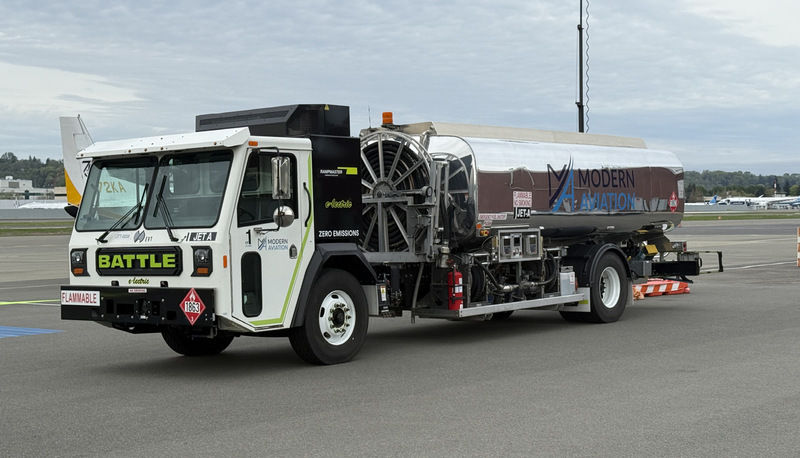
Modern Aviation operates an electric fuel truck and electric tugs.
Green Ripples
Tenants at BFI are contributing with sustainability projects of their own. A UPS facility, for instance, uses half as many fossil-fuel burning tugs that burn fossil fuel since installing caster decks—industrial flooring systems embedded with millions of flush-mounted caster wheels and ball bearings that allow workers to manually push and pull heavy air freight cargo containers.
Elsewhere on the field, fixed-base operator Modern Aviation operates electric tugs, and purchased an all-electric fuel truck early last year.
“We’ve led the way for our tenants to reduce their carbon footprints,” Parrott says.
The airport also plans to offer tenants reduced fuel prices if they use sustainable aviation fuel, a cleaner alternative to standard petroleum-based jet fuel that significantly reduces carbon emissions. “We can’t force people to use it, but we can incentivize them to use sustainable aviation fuel,” says Parrott.
Looking ahead, BFI might invest in more electric vehicles, but that depends on several factors, including the availability of electric vehicles as the auto industry adjusts its push toward electrification in the wake of poor sales.
“The desire to convert is one thing, but the ability to convert is another,” Parrott observes.
“As our firetrucks age, we’ll talk about replacing them with hybrids or electric vehicles,” he continues. “But it’s a slow process—you take what you can find. If something fits your needs, great. If not, you pass and wait until something comes along.
“But the bottom line is, we’re committed to this for the long haul.”