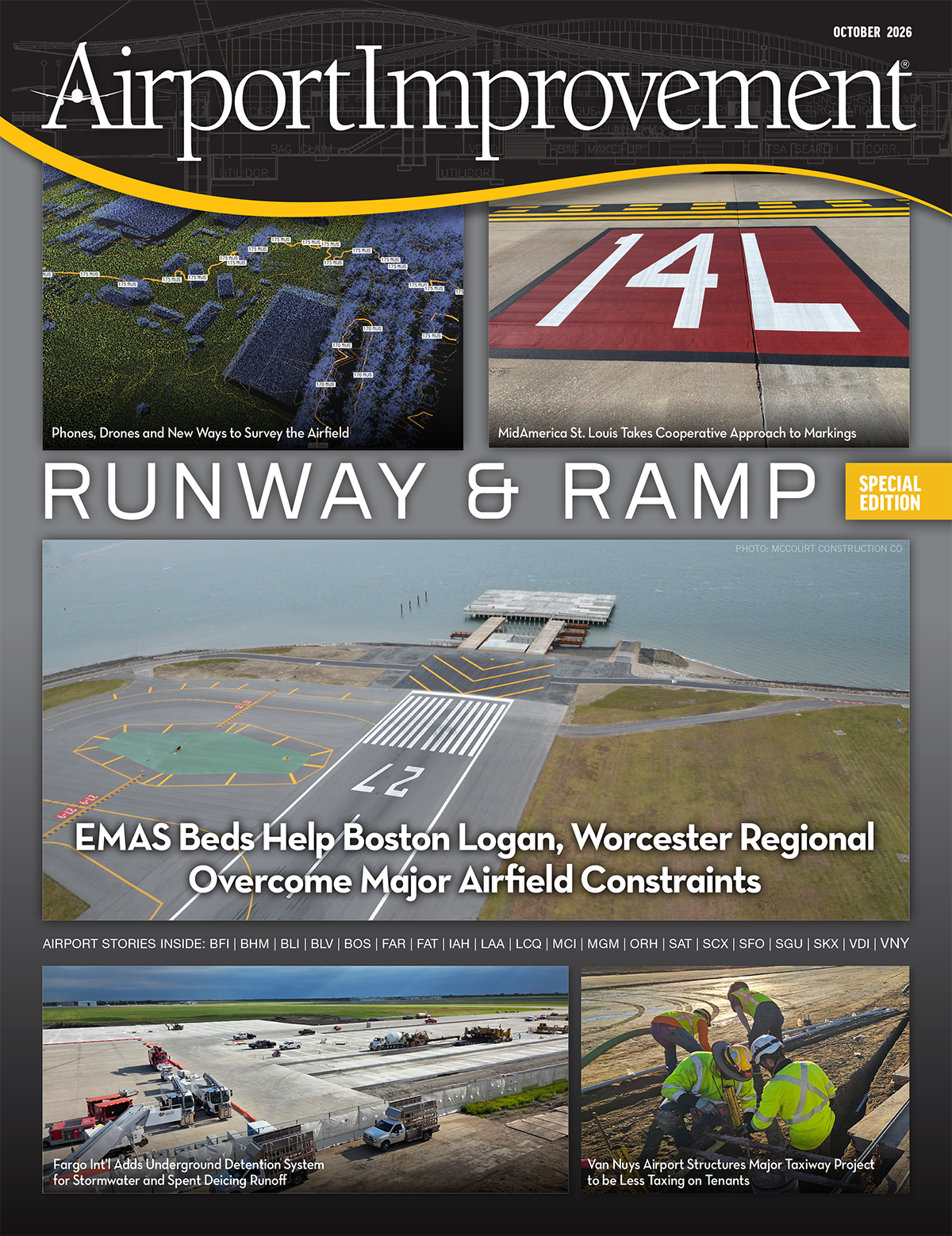
Rebuilding 11 taxiways at Van Nuys Airport (VNY) in Southern California went well beyond replacing aging pavement. The project’s complex choreography included shortening the primary runway, a series of 80-hour closures, nighttime work, tenant relocations, weather decisions, complicated construction sequencing and funding constraints—all while keeping the active airport operating safely.
And “active” is not just standard industry boilerplate. VNY, located just 15 miles north of Los Angeles International Airport (LAX), is one of the 10 busiest general aviation airports in the United States.
Rebuilding From the Ground Up
The $33.8 million project grew out of a straightforward need: VNY’s taxiway pavement had reached the end of its useful life.
| facts&figures
Project: Reconstructing 11 Taxiways Location: Van Nuys Airport, in CA Owner/Operator: Los Angeles World Airports Project Scope: Full-depth asphalt concrete pavement reconstruction; grading & drainage; airfield electrical; pavement markings Key Components: Stakeholder coordination; construction phasing; NAVAID impacts Phase 1 Taxiways: D, E, F, Q Cost: $15.5 million Funding: FAA Airport Improvement Program grants; airport’s capital improvement program Design: Jan. 2023-Oct. 2024 Construction: Nov. 2024-Oct. 2025 Prime Consultant: RS&H Engineer of Record: Phil Leung, PE Airfield Electrical Designer: Lean Technology Construction Management: Advanced Pavement Consulting Prime Contractor: Griffith Asphalt Supplier: All American Asphalt Electrical Contractor: Royal Electric Markings: Sterndahl Lighting Supplier: ADB SAFEGATE Airfield Signs: Lumacurve Grading & Drainage: VCA Geotechnical: Diaz Yourman Topographical Survey: Wagner Subsurface Utility Engineering: Bess Geotextile Fabric: Mirafi; US Fabrics Phase 2 Taxiways: C, H, M, N, P Cost: $18.3 million Funding: FAA Airport Improvement Program grants; airport’s capital improvement program Design: Oct. 2024-May 2025 Construction: July 2025-April 2026 Runway Closures: 6 intermittent 80-hour windows Nov. 2025-Jan. 2026 Prime Consultant: RS&H Engineer of Record: Phil Leung, PE Airfield Electrical Designer: Lean Technology Construction Management: Advanced Pavement Consulting Prime Contractor: Sully-Miller Asphalt Supplier: Blue Diamond Electrical Contractor: Aldridge Markings: Statewide Lighting Supplier: ADB SAFEGATE Airfield Signs: Lumacurve Grading & Drainage: VCA Geotechnical: Diaz Yourman Topographical Survey: Wagner Subsurface Utility Engineering: Bess Geotextile Fabric: Mirafi; US Fabrics |
Phillip Leung, RS&H principal engineer, Aviation, and engineer of record for the project, explains that the best solution was full-depth reconstruction, plus upgrades to taxiway geometry, electrical systems, lighting and markings. The work was ultimately scheduled and completed across two years: Taxiways D, E (east and west), F (east and west) and Q in the first year, followed by C, H, M, N and P in the second.
Byron Chavez, RS&H vice president and senior project manager, Aviation, says the project team worked to make the case that accepting the greater disruption of a full reconstruction up front would produce a longer-lasting result.
“We knew this was going to be very impactful in one way or another,” Chavez says. “And, sure, it would be a lot quicker for us to just do a little bit of a Band-Aid patch. But then they’d have to just keep fixing it and fixing it and fixing it and fixing it.”
Instead, the team advocated for taking the pavement all the way down to the subgrade and rebuilding it properly. “Our argument was that if you let us get in here and do what really needs to be done, we’ll be out of your hair for the next 20 years,” Chavez relates.
Phase 1: Shortening the Runway
The original plan called for the project to be treated as one large package. But because it was funded primarily with federal grants, the work had to align with two FAA grant cycles: one for 2025 and one for 2026. “Because of the timing of those FAA grants, we had to strategically prioritize which taxiways would be reconstructed during each year,” explains Laurel Soriano, the airport engineer that oversaw the VNY project for Los Angeles World Airports (LAWA).
The solution was a detailed phasing plan, with the first phase of construction relying on the airport shortening its primary runway.
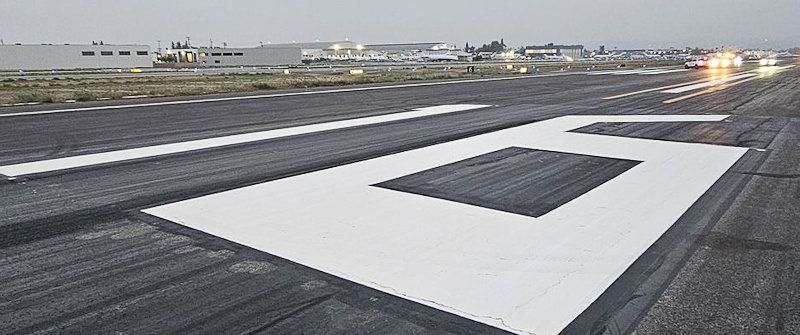
Under normal conditions, Runway 16R is approximately 8,000 feet long. During the project, the team first shortened it to about 6,700 feet and later reduced it further, to approximately 5,824 feet, for about 30 days.
The first adjustment removed the portion of runway used for takeoffs but retained the existing landing threshold and vertical instrument guidance. That allowed the Phase 1 prime contractor, Griffith, to test its paving materials on Taxiway D and get them approved before starting full production on the other taxiways.
When the runway was shortened further in April 2025, the team had to make additional changes to lighting and signage and install temporary vertical guidance. Throughout this process, VNY worked to keep as many crossing taxiways open as possible so aircraft would have alternative routes to access points for the remaining runway.
Those changes required coordination not only with the Airport Operations Department and tenants, but also with the air traffic control tower and FAA. The team conducted Safety Risk Management Panels and formal risk management workshops to evaluate the implications of the shortened runway and the concentrated aircraft movements.
Phase 2: Scheduling Closure Windows
Shortening the main runway wasn’t enough to rebuild four of the five taxiways scheduled in Phase 2. That work required full runway closures, which the project team scheduled during six intermittent 80-hour windows between November 2025 and January 2026.
Given the airport’s diverse general aviation community, operational planning couldn’t happen in a vacuum. Scheduling the closure windows, in particular, required input from airport tenants. Christian Moreno, chief of Airport Operations and Maintenance for VNY, and his team held workshops with 18 flight schools, fixed-base operators and other on-field entities to determine how aircraft would be relocated and when the airport could absorb the closures. Some operators made plans to use Hollywood Burbank Airport (BUR), Long Beach Airport (LGB) and LAX during the closures. Staff also conducted outreach through the Van Nuys Airport Association and its bimonthly Safety, Security and Sustainability meetings.
Ultimately, a plan was collaboratively hatched. “Through continuous communication and collaboration, we were able to find a closure window that minimized disruption while still allowing the project to move forward safely and efficiently,” Moreno explains. The resulting plan called for Runway 16R to close at 6 a.m. on select Mondays and reopen the following Thursday mornings, avoiding the airport’s busiest periods, which typically occur on weekends. The team also strategically incorporated breaks around the Thanksgiving, Christmas and New Year holidays to further reduce impacts on airport users and businesses.
Goran Lazarevic, LAWA Airside Element (Program) manager during the project and now senior airport engineer, credits the success of the plan to the detailed knowledge Airport Operations staff has about VNY’s based customers.
“They know how each of these tenants operates and what their needs are; where they need to relocate airplanes; how they need to do it,” Lazarevic remarks. “So, they provided major feedback to designers about when and how to coordinate the closures based on each tenant’s needs.”
The VNY Operations Department and many tenants performed routine maintenance and scheduled inspections while traffic was halted during the closure windows.
Hour-by-Hour Planning
Construction sequencing for Phase 2 began during the design phase rather than being left up to the contractors. Work began as it did before, with the prime contractor—Sully-Miller for Phase 2—testing materials and securing approvals, this time on Taxiway C. RS&H developed detailed plans, including hour-by-hour schedules for the six runway closures, to help contractors accurately determine if the proposed work could be completed in the available windows. Behind the scenes, the team used four-week “look-ahead schedules,” moving to day-by-day coordination during the 80-hour closures. That kept LAWA’s Project Management Team, the designers, contractor, Airport Operations and Communications team working from the same information.
The “FIFA factor” added extra rigidity to the project deadline. With Los Angeles hosting FIFA World Cup soccer matches in June and July 2026, VNY wanted the airport fully operational before the tournament. That pressure helped compress what had originally been a six-month construction schedule for Phase 2 into about four months, Moreno notes. Fortunately, VNY was able to shift the start date to add necessary wiggle room to the schedule and provide a safer cushion ahead of the World Cup.
Each 80-hour clock also came with its own hard deadline on the back end. By Thursday morning, the runway had to be ready to reopen. Excavations had to be covered, the area graded and the runway safety area restored to compliance.
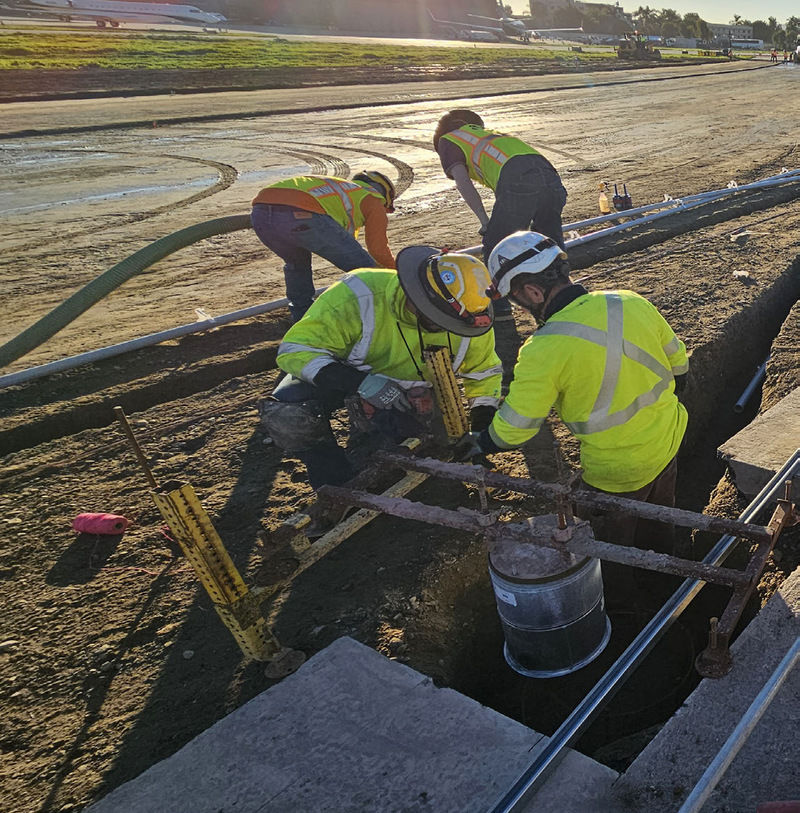
During Phase 2, crews worked in six intermittent 80-hour closure windows.
During the six closures, Sully-Miller worked around the clock. This meant undocumented conditions or urgent questions could arise in the middle of the night.
 “If any engineering decisions or judgment calls came up, we had to have somebody on call to respond immediately because the clock was ticking,” Leung says. “Between LAWA inspection, LAWA’s construction manager and the RS&H engineering team, we had to coordinate to be on call, collaborate and make those decisions. There were a lot of decisions that we had to make on the fly.”
As always, weather added another variable. “We didn’t want to start that 80-hour clock if there was rain in the forecast,” Moreno explains. “That meant making decisions all the way up to the weekend before we started that Sunday night; and that involved engaging with each and every tenant out there.” In the end, two of the 80-hour closures were postponed because of rain.
Continuous communication was essential throughout construction. Jessica Yas Barker, director of External Affairs for VNY, used the airport’s website IflyVNY.com to provide real-time updates as construction schedules changed. She worked directly with RS&H to translate detailed construction schedules into information airport users could understand.
 “It was like a constant game that we played with the website to make sure it was digestible and understandable to the stakeholders,” Yas Barker says. “But we found that overexplaining was always better than underexplaining.”
Engineering Around the Unexpected
Operational challenges were only part of the puzzle. The project team also encountered physical conditions that required modifying the construction approach. The subgrade was poor enough that it needed stabilization, prompting RS&H to make two changes to its reconstruction plans. Rather than use chemical stabilization, which would have required a seven-day curing period, engineers opted for mechanical stabilization. By placing geotextile fabric first, crews could immediately build the pavement section on top. And, instead of specifying two aggregate materials for the 2½-foot thick pavement section, RS&H opted for a single higher-quality aggregate between the geotextile fabric and asphalt.
“This approach allowed us to limit the complexity, so the contractor was able to build it quicker using a uniform material,” Leung explains. “It saved them from having two different stockpiles of aggregate materials that each had to be approved and tested separately.”
Taxiway Q presented another challenge because it sits over the tunnel where Sherman Way, a four-lane arterial road, passes the airfield underneath.
 “The main issue was that we didn’t know the exact thickness of the pavement on top of the tunnel,” Lazarevic explains. “So, with any boring or milling of that surface, the goal was always not to touch the structure of the tunnel itself.”
The team conducted additional test cores to establish the tunnel’s location and had inspectors monitor pavement removal. Because the pavement above the tunnel was much thinner than the typical pavement section, the work could be completed during nighttime closures, with the taxiway recovered and regraded before reopening each morning.
Beyond the Construction Footprint
With so much complex orchestration of construction activity on the airfield, the project team had to remain constantly aware of potential ripple effects. This was especially true when the runway was shortened.
Chavez says the team initially focused heavily on the construction footprint and whether aircraft could safely clear the work area. But changing the runway configuration also changed where aircraft were otherwise operating, taxiing and parking. “We had to make sure to look outside of that bubble,” he explains.
The team also learned the value of creating opportunities for contractors to work out construction issues before entering the most operationally sensitive areas. The “test runs” on taxiways C and D, for instance, set up success for both major construction phases before crews began work that required runway closures.
 The experience reinforced the importance of bringing detailed construction sequencing into the design process, and recognizing that different trades cannot necessarily work simultaneously in a constrained airfield environment. It also underscored the need for Airport Operations, tenants, FAA and air traffic control personnel to be part of the planning process from the beginning.
The control tower was a critical component of coordination throughout construction. With runway configurations changing and aircraft traffic being funneled through fewer access points, the project team worked closely with air traffic controllers to make the temporary operating conditions work. Moreno says the controllers really stepped-up during scheduling decisions and played an important role in making the closures possible.
Measures of Success
The accomplishment at VNY wasn’t simply reconstructing 11 taxiways. It was also minimizing operational disruptions for the high-traffic general aviation airport while completing the major airfield work.
 The project team points to the schedule, budget, safety record and stakeholder response as measures of success. For Lazarevic, the experience reinforced the importance of collaboration. “Partnering goes on the top of the list,” he stresses. “Partnering with contractors, partnering with all stakeholders, partnering with Van Nuys Operations, plus transparent communication that keeps everybody in the loop.”
For Leung, the most important measure was safety: “Making it through the project, having a safe execution—that’s something I’m definitely really proud of.”
The impressive combination of engineering, operations and logistics is what makes the project memorable for Chavez. Looking back, he marvels at the large work scope and what it took to minimize the impact to airfield traffic during construction. “And then to come out on the back end pretty unscathed,” he muses. “It’s a cool project to talk about, especially when somebody understands the implications all of it had. You can see it in their eyes, like, ‘Oh my gosh, really? You did that?’.”