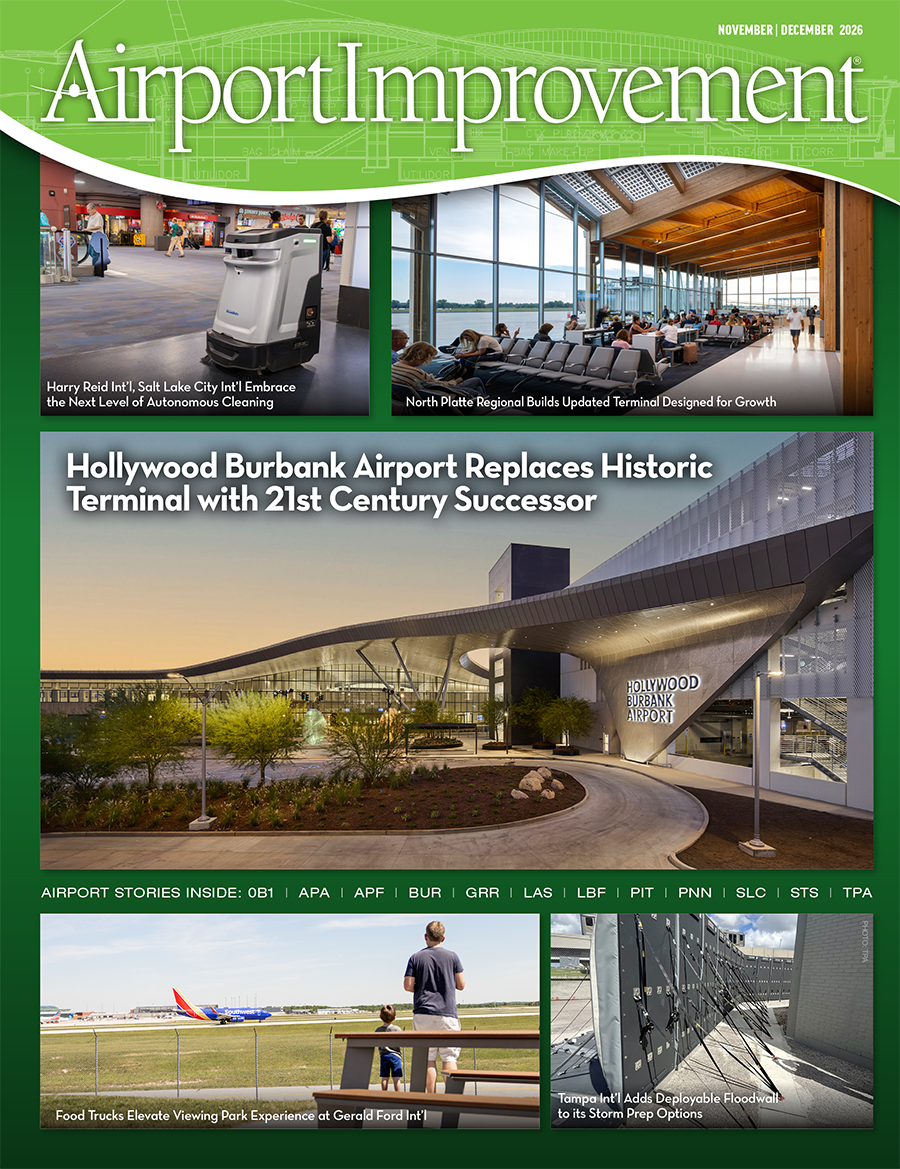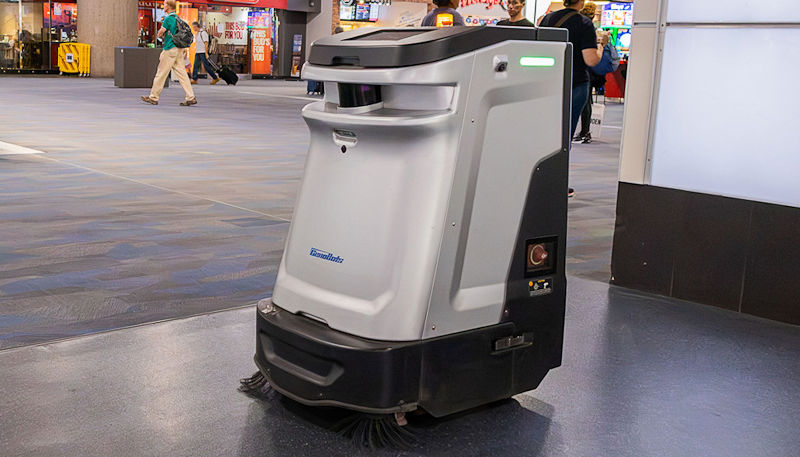
At Harry Reid International Airport (LAS) in Las Vegas, autonomous floor scrubbers begin their overnight work with very little assistance. Each machine fills itself with water and cleaning solution, leaves its station and follows a predetermined route through the terminal. When it needs more water, additional battery power or a place to empty its tank, the unit automatically returns to its station before heading back out.
The machines also report what they accomplish.
Scott Kley, managing director of Aviation, Terminal Operations for the Clark County Department of Aviation, shares data from a recent shift for one unit as an example. The machine had a total runtime of 5 hours and 17 minutes, including 4 hours and 16 minutes of active cleaning, and it used 48.5 gallons of water and 15 ounces of detergent.
 facts&figuresProject: Automating Facilities Maintenance Location: Harry Reid Int’l Airport, in Las Vegas Space to Clean: 2 terminals; 12 million sq. ft. Janitorial Staff: 253, including 68 senior personnel who run autonomous machines & 22 supervisors Equipment Research/Selection: 1 year Deployment: Sept. 2025 Fleet: 12 autonomous cleaning units, including 10 floor scrubbers Equipment Manufacturer: CenoBots Key Benefits: Automated units clean 45,000-50,000 sq. ft. of floors/night, allowing employees to complete other work; low water use & battery replacement; consistent metering of soap; app monitors machines’ progress & consistency
Project: Automating Facilities Maintenance Location: Salt Lake City Int’l Airport Space to Clean: 2 concourses; 90 acres of flooring (terrazzo, vinyl composition tile & carpet) Janitorial Contractor: Flagship Facility Services Janitorial Personnel: 440 Fleet: 20 Gausium cleaning robots (7 Omnie scrubbers, 1 S50 scrubber, 2 Phantas, 10 V40 2.0s equipped with 3D lidar); 12 Marvel units currently on order Key Benefits: Cleaning can occur 24/7 with minimal passenger impact & greater efficiency/optimization |
“We can take all this data and see how much we are actually accomplishing every single day,” Kley remarks.
Naturally, the autonomous units do not make strategic decisions about scheduling. Airport operations change too quickly for that.
“The flights are never standard,” Kley says. “You get delays, mechanical issues, ground stops, anything that can kind of manipulate the way the robot works.”
The combination of automation, information and human judgment being leveraged at LAS illustrates where autonomous airport cleaning is headed. The first phase put robots to work. The second added sensors to reveal what is happening throughout the terminal. The third phase, which is still emerging, connects those technologies with real-time flight, gate, weather and facility data to help determine what needs cleaning next and where human employees can have the greatest impact.
Robotic units may be the most visible part of the autonomous cleaning transition, but they are only the beginning.
Putting Robots to Work
Labor shortages provided the initial push toward autonomous equipment at some airports.
Recruiting and retaining workers for facilities maintenance has traditionally been a challenge for many airports and also the third-party cleaning contractors that service them. But even during a tight labor market, guests still expect airports to properly maintain their facilities. The link between overall customer satisfaction and facility cleanliness—especially restrooms—is well established in many annual passenger surveys.
When good help is hard to find, some airports turn to autonomous equipment to fill the gap. Cleaning robots perform repetitive tasks and free up employees for work that requires human attention and judgment.
Bruce Arnold, assistant director of Facilities Maintenance, Aviation Services at Salt Lake City International Airport (SLC), has personally experienced these dynamics. Arnold has worked at the airport for about 19 years and in various other related capacities since 1985. Today, he oversees the airport’s 11-person Aviation Services team, approximately 440 janitorial personnel and associated administrative staff. Together, they are responsible for 11 miles of baggage conveyor, about 100 passenger boarding bridges, vertical transportation, waste management and other contracted services.
For Arnold and many others managing facility maintenance, workforce shortages during and after the COVID-19 pandemic accelerated the need to find other ways to get work done.
“Complacency has no part of anyone’s job, no matter what job you’re in,” he asserts. “We can’t just say, ‘Well, this is the way we did it for the last 40 years.’”
Autonomous scrubbers and vacuums offered SLC a practical place to start. They handle repetitive, measurable maintenance tasks in open areas while employees focus on detailed work and other jobs that require a human touch.
Today, the airport operates a fleet of 20 cleaning robots from Gausium. (See Page 22 for list of various models.)
The scale of SLC—two large concourses and 87 aircraft gates—lends itself to automating cleaning tasks. “We measure our terrazzo in acres now, not square footage,” Arnold points out. Currently, the airport has about 90 acres of various flooring surfaces to clean.
At LAS, Kley brings a hospitality perspective shaped by previous experience with Disney, Universal Orlando, MGM, Hilton and other hotel and resort operations. He oversees passenger services and custodial operations for 12 million square feet of terminal space and considers the condition of those areas an important part of the first and last impressions that Las Vegas makes on visitors.
Kley says 12 autonomous cleaning machines from CenoBots help protect the airport’s investment in its floors. “If you don’t have a strong cleaning program, your floors will never last,” he advises.
In addition, Kley highlights the consistency such equipment provides: “They’ll do the same path, the same square footage with the same pressure, same pads and same chemical every single time that you run these machines.”
Flagship Facility Services, a third-party cleaning contractor for SLC and more than 30 other U.S. airports, operates nearly 150 autonomous floor scrubbers and vacuums. Jeff Williams, the company’s director of autonomous operations at the airports it services, notes that Flagship’s fleet has evolved over time. It started with units from ICE and Tennant years ago, including Tennant equipment powered by Brain Corp’s BrainOS technology. Currently, Flagship is partnering with SoftBank Robotics to deploy its autonomous units.
Williams notes that newer cleaning contracts are more likely to include at least one or two autonomous units, while some legacy clients have been slower to adopt the technology.
Beyond performing the physical work, the machines create an objective record of where they went and what they completed. If chairs, passengers or other obstructions prevent a robot from reaching part of its mapped area, the report shows it— a feature airports appreciate and monitor, notes Williams.
Autonomous equipment also facilitates daytime cleaning, which benefits airports that are busy all day long. A robotic vacuum can work around seated passengers, luggage and foot traffic without its cord stretching across a busy holdroom, he explains.
That said, Flagship also deploys human workers. An employee typically picks up cups, newspapers, water bottles and larger debris before launching the vacuum, and then monitors the space while the machine works.
The visibility of autonomous equipment can change the public perception of an airport, Williams reasons. If a passenger walks through a holdroom and sees an autonomous vacuum picking up popcorn, then encounters a messy gate area farther down the concourse, that can improve public perception, he reasons.
The technology is also somewhat of a novelty. “Kids love our units; they love the vacuums,” Williams says. “Passengers stop all the time to take pictures of them.”
Cleaning robots still have to make operational and financial sense—for Flagship and in-house facility maintenance departments. Beyond equipment cost, considerations include storage, charging, battery life and connectivity.
Getting the Setup Right
At LAS, Kley spent a full year comparing equipment and manufacturers before settling on units that best met the airport’s needs. He encourages other airport personnel to attend the ISSA (International Sanitary Supply Association) Show North America, talk with manufacturers and, most importantly, demo equipment in their own terminal environments.
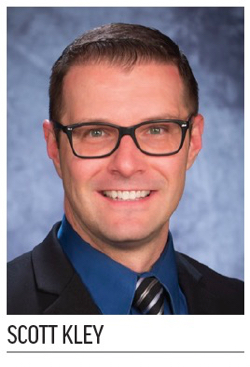 “You need to define the goals of what you’re looking for every night,” Kley advises. “Before you just invest in a company and say, ‘Yeah, I’m going with this one because they sold the dream,’ you need to know if it will allow you to actually live out that dream.”
Mapping is one of the most important parts of deployment and testing, he adds. Machines need accurate routes, zones and operational boundaries. Teams also need to test speed, water flow, pads and cleaning performance on different flooring surfaces.
Employee acceptance matters, too. When Kley arrived at the Aviation Department, an earlier autonomous program had not been embraced because the machines were not cleaning the expected square footage.
Frontline employees often spot problems first—a pad that doesn’t suit a particular floor, a route that creates an issue, or needed adjustments to water flow and speed, for instance.
“You’ve got to listen to your team,” Kley emphasizes. “Make sure you get their buy-in because they’re the ones running these machines.”
After LAS mapped the machine routes and put the equipment into operation, Kley says the program needed about three months to find its rhythm. The airport began its current program last fall and now operates 12 units daily, including 10 floor scrubbers. (See Page 22 for list of various models.)
The machines have even become part of the team, and are highlighted during Bring Your Child to Work Day. The airport plans to let the kids name one piece of equipment each year, and then display that name on the machine. The inaugural choice was “Wally.”
That team strategy is intentional.
“I’m not in the business of having AI replace or change our employee counts by any stretch of the imagination,” Kley stresses. “Each machine is a partner working alongside our team.”
Cleaning on Demand
The second phase of autonomous cleaning moves beyond the machines to provide a clearer picture of conditions throughout the terminal. That’s where sensor and data platforms come in.
SiteIQ Technologies, for instance, offers a spatial intelligence infrastructure platform that connects data from robots, occupancy and supply sensors, flight information and gate systems, weather services and building management systems in a single, hardware-agnostic environment.
Sensors count restroom users, track paper towel and toilet paper levels, monitor trash receptacles and record when employees service a space. Rather than deploying staff based solely on a schedule, the system triggers alerts when use or supply levels reach a predetermined threshold. For instance, a people counter could alert staff after 200 visitors, then reset after an employee services the restroom.
 Naturally, specific thresholds vary by airport. The more significant factor is the shift from scheduled service to service as needed. Restrooms checked at a specific time may become untidy or need more supplies surprisingly quickly.
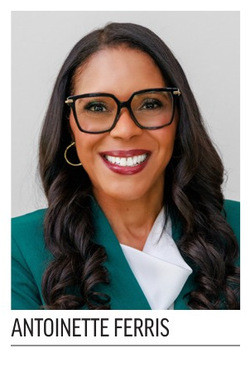
“A single arriving flight can put 250 people through a restroom minutes after it was serviced,” says Antoinette Ferris, vice president of Sales at SiteIQ and a 20-year industry veteran. “A fixed schedule can’t see that. Real-time data can.”
But sensor data does not capture every condition. For instance, a lightly used restroom in the baggage claim area may still require immediate attention because of one sick passenger or other unexpected circumstances. “You can’t base all of your cleaning off of that type of data alone,” Williams cautions.
Data gives teams another tool to direct resources. Employees still provide the observation and judgment needed to respond to what sensors cannot record.
Connecting the Data
Many airports have individual pieces of facilities technology in place. Robots vacuum or scrub floors and produce cleaning reports. Restroom platforms count users. Building management systems monitor facilities.
The next step is connecting those pieces.
“What’s starting to happen now is that airports are layering these technologies together, and that’s where the next level of performance comes from,” Ferris says.
Significant gains in efficiency will come from converging autonomous equipment, facility sensors and real-time information about flight arrivals and departures so they work together rather than operating as separate systems, she adds.
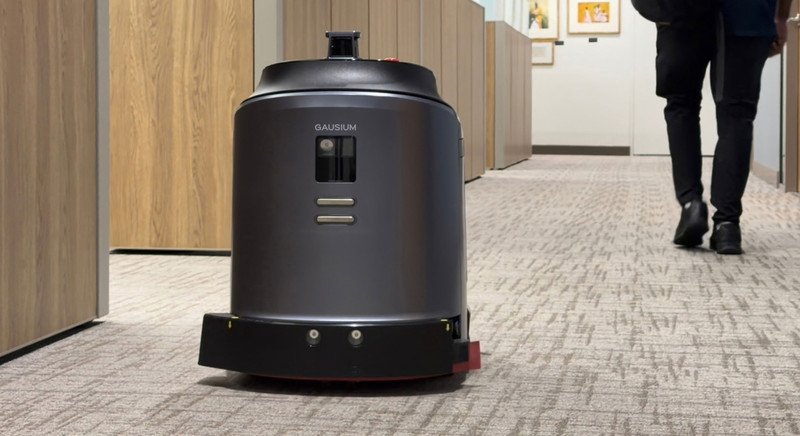
Salt Lake City Int’l leverages utonomous equipment to help clean its 90 acres of flooring.
Some within the industry estimate that about 25% of U.S. airports currently use cleaning robots. However, not as many are taking the next steps.
“Very few airports are connecting robots and sensors to real-time operational data yet,” says Ferris. “That integration is the opportunity.”
For SiteIQ, the opportunity is not simply collecting more information. It is making systems work together.
“When you connect all of the known data, you get a better result for the operation, the staff and the passenger,” Ferris explains.
That integration can change how facilities departments deploy equipment and employees. For example, an airport in Colorado could leverage weather data to indicate, or even anticipate, when passengers will track snow and ice melting materials into its ticketing lobby. Staff could program autonomous floor scrubbers on a route covering the first 50 feet of the terminal entrances. Real-time flight and gate information could identify an empty holdroom and flag an opportunity for a robot vacuum to work without navigating a crowd.
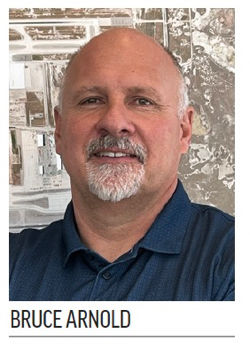 SLC is exploring an even more advanced application. An automated gate porter currently in development intends to use artificial intelligence to recognize and collect common items such coffee cups, without spilling. Connected to flight information, the unit could identify an open gate and move there without waiting for personnel to assign the route.
“It will intuitively go to that gate when it knows that there’s a free spot,” explains Arnold. “We won’t even have to tell it to go there.”
The airport hopes that eventually, one porter could serve about 12 gates.
That progression is significant. In the first phase, a person tells a robot where to clean. In the second, sensors describe what is happening. In the third, integrated data helps the operation determine what needs to happen next and, eventually, may dispatch equipment automatically.
Lessons From the Field
The experiences of LAS, SLC and Flagship offer several considerations for airport executives evaluating or expanding autonomous cleaning.
First, start with the desired outcome. Define the square footage, cleaning standard, operating window, labor challenge and passenger-experience goal before comparing machines.
Second, test the equipment in the airport where it will operate. Flooring, crowds, furniture, gates, connectivity and storage differ from facility to facility, and performance in a controlled demonstration environment does not guarantee the same result in an active terminal.
Third, plan for the infrastructure behind the equipment. Charging, water, cleaning solutions, dumping, drainage, Wi-Fi or cellular service and technical support all affect performance.
Fourth, treat mapping and training as part of implementation, not setup chores. Bring frontline employees into the process early. Their feedback helps refine routes, speed, water, pads and procedures, and their acceptance often determines whether a unit becomes a productive tool or sits unused.
Fifth, determine what to do with the information the technology produces. A dashboard alone does not improve an operation. Someone needs to review alerts, respond to areas autonomous equipment misses and adjust assignments.
Finally, measure the outcomes that matter. The number of robots in a fleet may attract attention, but cleaner terminals, documented performance, effective use of labor and, ultimately, passenger experience, determine return on investment.
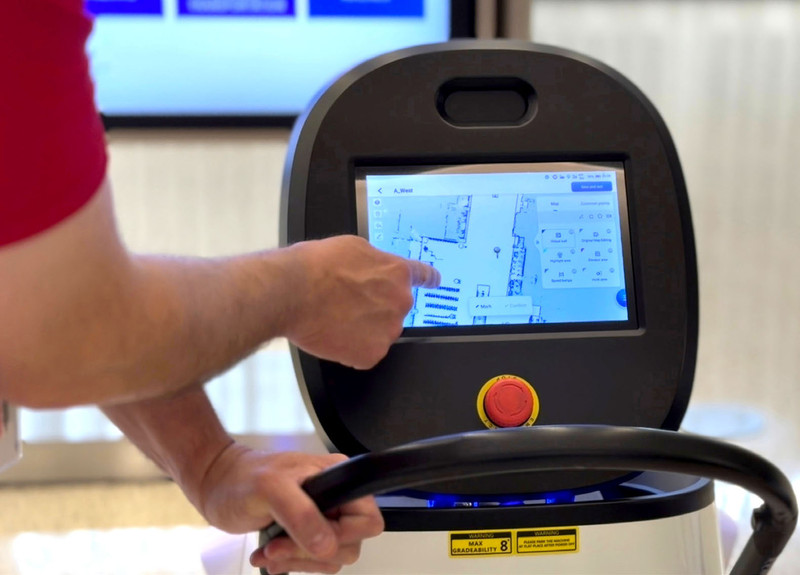
Personnel establish routes for the robot vacuums to follow.
Arnold believes the technology has moved beyond the point when airport leaders need to wait and see whether it can perform.
“The equipment works,” he says with extreme confidence.
He jokes that he hopes other airports wait five more years so SLC can acquire the equipment first. His actual recommendation is the opposite.
“Don’t wait to embrace it,” Arnold advises his peers. “The equipment is available and is functional right now.”
Clearly, airports are in various stages of adoption. Some are evaluating their first autonomous scrubber or vacuum. Others have added occupancy and supply sensors. A smaller group is beginning to connect machines, sensors and operational information.
Each phase adds another layer of capability without necessarily eliminating staff.
The robot cleans the route. The sensors reveal what changed. The data helps determine what happens next. Employees bring the judgment that turns all three into a cleaner terminal for passengers.