Punta Gorda Airport (PGD) has spent years building a reputation for getting travelers from curb to gate quickly—often less than 10 minutes. Until recently, though, an aging bag screening system behind the ticketing counters was putting its streamlined passenger experience at risk.
 The labor-intensive system at the coastal Florida airport relied on three standalone screening machines that together could only process about 250 bags per hour. “And that was if all the stars aligned,” remarks PGD Chief Operating Officer Ray Laroche, AAE. “Rarely did we see that kind of throughput. It was usually closer to 200 bags per hour.”
Rather than wait for baggage handling to become a crisis, airport leaders invested $25 million in a new handling system with inline screening that can process up to 2,100 bags per hour. The upgrade is the first major phase of the nearly $44 million Bailey Terminal Expansion.
As passenger traffic at PGD increased, baggage operations began to falter. Since 2013, passenger volume at PGD has jumped 20% to 30% annually, and rose a whopping 88% in 2014 alone. About five years ago, airport leaders realized the aging infrastructure could no longer keep pace.
“During our peak season, our baggage system was stressed to the point that it created congestion and backups,” Laroche recalls.
Over the Limit
| facts&figures
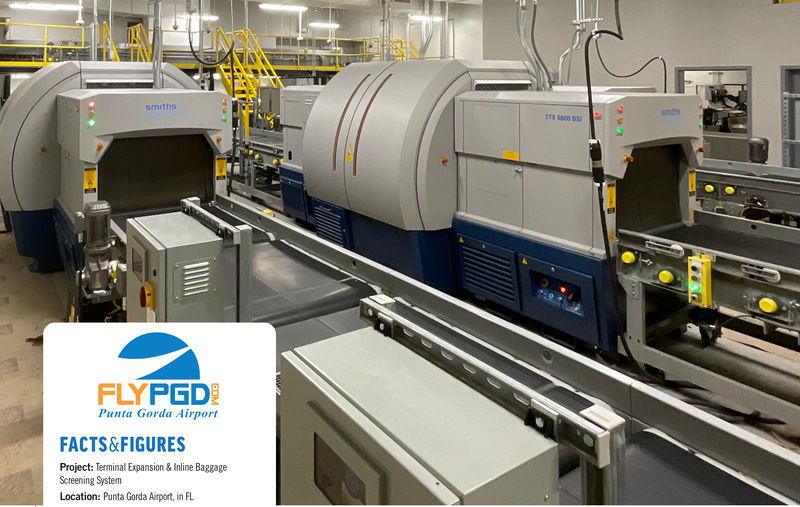
Project: Terminal Expansion & Inline Baggage Screening System Location: Punta Gorda Airport, in FL Owner & Operator: Charlotte County Airport Authority Cost: Approx. $23 million (plus $2 million for professional design & construction service fees) Funding: TSA; Florida Dept. of Transportation; Passenger Facility Charges Key Components: Automated multi-level conveyor network; On-Screen Resolution Room for remote image review; Checked Baggage Resolution Area for manual inspections; 2 chances for bag diversion to minimize manual screening; Automatic Tag Readers for tracking bags; curbside conveyor line Support Infrastructure: New 3-phase electrical service; emergency generator; additional chiller to improve conditions in handling area Capacity: About 2,100 bags/hour Project Timeline: Design in 2022; construction mobilization in Oct. 2024; system operational in Jan. 2026 Design: AECOM Construction: A2 Group Inc. Baggage Handling System: Diversified Conveyors Int’l Controls: ControlTouch Systems Screening Machines: CTX 9800s from Smiths Detection Noteworthy Details: Former baggage screening area was converted into a gate holdroom; new system includes provisions for 2nd baggage makeup carousel; project was 1st phase of larger terminal expansion Associated Improvements: Inline baggage screening project is part of the Terminal Expansion Program, which also includes relocating car rental operations & ongoing terminal construction. Overall cost is estimated around $83 million, including professional services. |
Although traffic leveled off during the recent Allegiant/Sun Country merger, Laroche expects growth to resume as the airline transitions from Airbus A320s to larger Boeing 737s.
Allegiant’s operating model leaves little room for delays, he explains. Every night, the carrier parks 12 aircraft at PGD, with flights departing in the morning, returning around midday and heading back out again.
Although Allegiant passengers check fewer bags than travelers on other airlines serving PGD, the airport’s previous manual baggage screening process generated delays. Checked luggage piled up behind the ticket counter, forcing airline employees to manually sort bags by flight before TSA personnel screened them.
“It was a pinch point, and we were seeing delays because of it,” Laroche acknowledges. “The equipment could only handle so much.”
Steven Henriquez, an AECOM vice president and project manager for the PGD project, notes that the airport’s rapid growth made a new baggage system unavoidable.
“Allegiant has expanded tremendously,” Henriquez says. “What had once been an adequate baggage system had become an operational bottleneck as passenger volumes climbed past 1 million annually.”
Funding the Upgrade
Modernizing the baggage system became possible when TSA approached airport officials in 2021 about participating in a year-long design process that would be 95% funded by federal grants.
After completing the design, TSA returned with another welcome offer—this time to fund about half of the $23 million needed to construct the new system. A combination of Florida Department of Transportation grants and passenger facility charges paid for the rest.
Henriquez notes that it’s important to determine exactly what various funding sources will cover.
“TSA won’t pay for the building shell, but they will pay for anything related to the inline baggage system, their office space and things of that nature,” he advises. “We try to not overbuild because the TSA won’t pay for it.”
The project was bid in June 2023, and a limited Notice to Proceed was issued in September 2023 for permitting, shop drawing submittals and material procurement. Construction began in January 2024 and was completed in June 2026. The baggage system was operational in February 2026, and the old system area was converted to holdroom space after a testing run-in period.
An Automated System
When commercial service began at PGD in 2007, the airport’s baggage screening operation included a single CT (computed topography) machine, one conveyor carrying bags into the screening room and another conveyor carrying them out.
As passenger traffic grew, the airport added two more CT screening machines and repeatedly reconfigured the space to squeeze out additional capacity.
“But the basic setup was still one belt in, one belt out, with a 90-degree turn onto a carousel that we had to expand two times as well,” Laroche explains. “The carousel was outside and wasn’t covered, and baggage handlers could only offload bags from one side.”
Florida’s frequent thunderstorms created another challenge. Whenever personnel spotted lightning, baggage handlers had to halt their outside work until the storm and associated safety risks passed.
“The ticket counter operation didn’t stop, so bags had to be stored behind the ticket counter until the ramp operation could continue,” Laroche notes. “They just kept taking bags and holding them behind the counter.”
Staff manually sorting luggage by flight before TSA screening helped minimize operational delays.
The airport’s new baggage handling system with in-line screening increased both capacity and automation. Three Smiths Detection CTX 9800 screening machines can each process approximately 700 bags per hour, giving the system a combined capacity of 2,100 bags per hour.
“During our busiest periods, we’re only seeing around 400 bags an hour,” Laroche says. “So, we’re well positioned for future growth.”
Previously, every checked bag had to be removed from the conveyor, lifted onto a screening machine and then placed back onto the belt. Bags needing further inspection required additional handling.
“The TSA agents were lifting every single bag, 100% of them, two and sometimes three times,” Laroche says. “This can lead to workplace injuries. This project is a huge workplace injury improvement.”
 Garrett Hass, a mechanical design engineer for AECOM who specializes in baggage handling systems, notes that PGD upgraded an entirely manual operation into a more sophisticated automated screening process.
“With the new system, most of the work is done automatically except when a bag needs further screening,” says Hass.
The environment where bags are screened is larger, cooler and ergonomically set up. The previous screening room was cramped and hot—conditions that were especially challenging for agents handling the high volume of golf bags checked by PGD passengers.
The new system automatically scans bag tags upon entry onto the conveyor, electronically measures each one for system compatibility, and directs them to the correct screening path.
It diverts oversized bags automatically for manual screening. “We made sure golf bags could get through the system without needing hand screening,” Laroche specifies. “It used to take a screener about 15 minutes to manually screen a golf bag.”
Smarter Technology
The new equipment significantly changes how TSA officers interact with checked baggage. Rather than reviewing every bag, advanced CT technology and automated algorithms identify those that require additional attention.
“TSA screeners only receive images on alarm,” Laroche explains. “In fact, nearly 95% of checked bags move through the system without additional screening.”
The system flags suspicious bags and routes them to the On-Screen Resolution Room, where TSA officers clear most bags by reviewing high-resolution CT images. “Less than 1% of the bags that we process need to be physically touched,” Laroche reports.
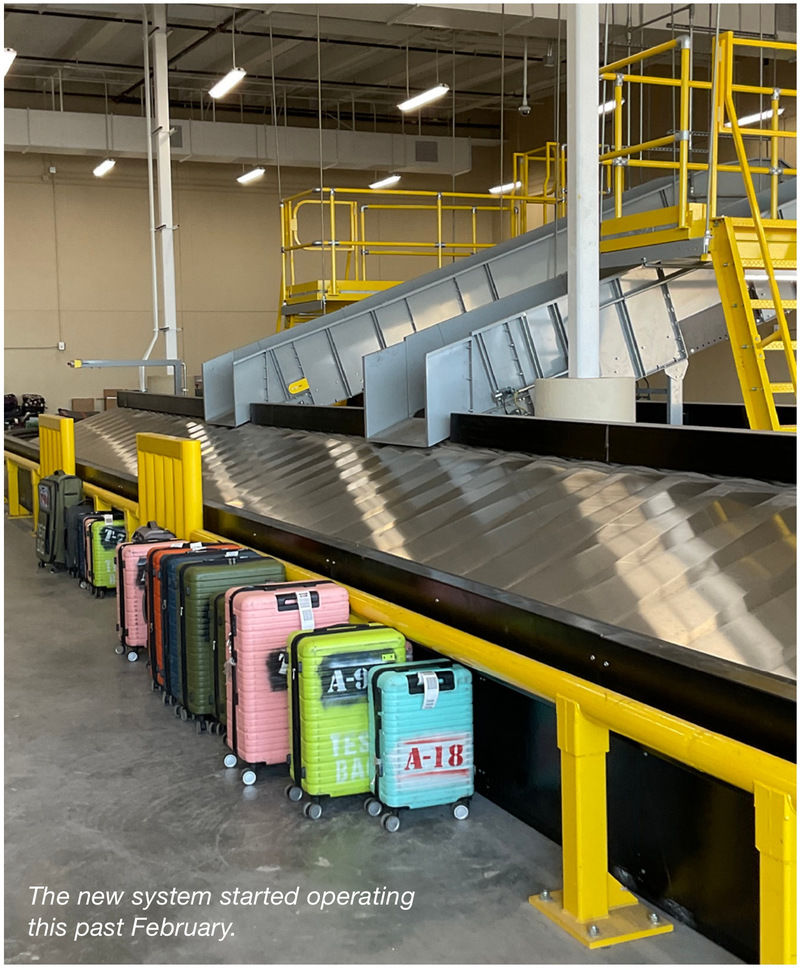
The new system started operating this past February.
The system diverts bags that require hands-on inspection to the Checked Baggage Resolution Area, where new ergonomic features were added to increase employee comfort and reduce injuries. Screening personnel now stand on anti-fatigue flooring, retrieve bags from a waist-high conveyor and slide them onto an adjacent inspection table rather than lifting them.
“They scan the bag tag to access the bag’s CT image, then they manipulate the bag and look through it,” Laroche explains. “Finally, they slide it using a sliding table top onto a conveyor that sends it out to the carousel. They no longer have to lift the bag at all.”
AECOM also incorporated TSA best practices into the design by creating both first- and second-chance diversion points, giving personnel multiple opportunities to clear suspicious bags remotely before a manual inspection is needed.
“Most bags which make it past the first-chance diversion point get diverted with the second chance,” Hass notes. “That means there are significantly fewer bags that need manual TSA screening.”
The system includes automated bag tag readers and sophisticated conveyor controls to log the journey of every checked bag from the ticket counter through screening to the claim carousel.
“The system takes a lot of the human factor out of the process,” Laroche says. “It’s much more secure. It ensures every bag is screened—and that bags that shouldn’t end up on airplanes…don’t.”
Design Constraints
“Working within the airport’s tight footprint meant every inch mattered,” Hass emphasizes. “The design was informed by the space we had.”
Working within those constraints, AECOM designed a three-dimensional conveyor network that stacks and crosses lines supplied by Diversified Conveyors International, with belts weaving around existing mechanical rooms and other building infrastructure. The design also includes a dedicated curbside baggage line, which allows luggage checked outside the terminal to enter the system directly.
Connecting the new baggage facility to the existing terminal presented another challenge because the terminal was constructed with tilt-up concrete wall panels that support their own weight.
 “We had to build a new wall next to the existing tilt wall,” explains Miguel Sanchez, RA, AIA, project architect for AECOM. “Once we did that, we had to make openings in the tilt wall. Some of the openings were as wide as 16 feet to provide conveyor passageways and room for TSA personnel.”
The design includes space for an additional baggage makeup carousel in case another is needed in the future.
Broad Input
Minimizing disruption during construction became a guiding principle from the earliest stages of design. Representatives from every airport department reviewed construction plans and identified potential operational conflicts before work began.
“We included all of our teams in the discussion,” Laroche says. “Everybody got to look at the plan and have input.”
That collaborative approach helped the project team develop strategies that kept passengers moving as construction progressed. And because AECOM designed the new baggage facility as a standalone addition, travelers were not in areas where work was occurring.
 “It wasn’t as bad as you might think from a passenger experience,” Henriquez says. “Ninety percent of the project didn’t impact the public. It impacted airport operations, but not the public.”
When making critical tie-ins between the new baggage system and existing terminal, crews worked at night and coordinated construction activities to minimize noise and operational disruptions.
When inline screening went live this January, PGD operated the old and new baggage handling systems simultaneously for several weeks to create a smooth transition.
“This way, if the new system went down, we still had the old system to use as a backup,” Laroche says.
Schedule Hiccups
The project team hit an unexpected obstacle when AECOM realized the airport lacked the electrical infrastructure needed to power the new system.
“We had to bring in new three-phase service immediately,” Henriquez recalls.
To improve resiliency, engineers added an emergency generator designed to keep critical portions of the baggage handling system operational during power outages. The generator is sized for the inline baggage project and the terminal expansion currently under construction.
“At many airports, the baggage handling system can’t function during a power outage,” Hass adds. “We wanted to give the airport limited baggage handling and screening functionality when the power went out.”
The project also included an additional chiller to keep the screening system and area cool during Florida’s hot summers. The new mechanical infrastructure was sized to accommodate future terminal expansion and support growth for years to come.
After construction, two federal government shutdowns delayed testing and commissioning; but Laroche took the schedule disruptions in stride. “Construction projects are easily delayed by any number of challenges,” he comments. “The shutdowns just added another layer of complexity to the project.”
Eyes on the Future
After the new baggage handling and screening system was fully operational, PGD decommissioned its old system and converted the space into an additional gate and concessions space. This allowed the airport to increase passenger capacity without adding new square footage.
The project is also serving as the foundation for the broader Bailey Terminal Expansion, which will add 52,000 square feet of new gates, concessions, restrooms and passenger amenities. Scheduling the baggage handling system project first gave PGD more holdroom space to better accommodate passengers throughout subsequent improvements, Henriquez explains.
Eliminating baggage bottlenecks, opening new gates and making additional terminal improvements are key components of the airport’s long-term plans to serve more passengers more efficiently.
 Notably, PGD didn’t incur debt during the first phase.
“We expanded without cost to our carriers,” Laroche emphasizes. “Funding through PFCs, grants and not taking on any debt positions us to make some big moves in the future if we have to.”
James Parish, chief executive officer of the Charlotte County Airport Authority, set the tone by emphasizing economy and function. From the very outset, his message to all involved was, “If this project wins an architectural award, we didn’t do our job!”
Awards may come; only time will tell. But even if they do not, this project will be a win for PGD passengers, who are already enjoying shorter waits at check-in.