America’s Great Plains are a physical manifestation of the term wide open spaces.
But the longtime terminal at Nebraska’s North Platte Regional Airport Lee Bird Field (LBF)? Not so much.
Built nearly 75 years ago, the building’s cramped terminal was a vestige of a bygone era. The holdroom seating was beyond inadequate and its bathrooms were likewise subpar. The only food or drinks to be had were inside a tired scattering of vending machines.
| facts&figures
Project: New Terminal Location: North Platte Regional Airport Lee Bird Field, in NE Highlights: Updated TSA checkpoint & equipment; 110-seat holdroom; passenger boarding bridge; upgraded restrooms & concessions; mothers’ room; indoor pet relief area; numerous energy-efficient features Size: 24,000 sq. ft. Cost: $29.6 million Funding: $21.8 million through Bipartisan Infrastructure Law’s Airport Terminals Program & Congressionally Directed Spending Timeline: Master plan update began in 2020; design work began in 2023; construction Oct. 2024 – Aug. 2026 Engineering & Architecture: HDR Subconsultants: BNP Associates; Connico; Faith Group Contractor: Sampson Construction Checkpoint Screening Equipment: Smiths Detection Passenger Boarding Bridge: Oshkosh AeroTech Automated Exit Lane Equipment: dormakaba HVAC Contractor: Midlands Mechanical Timber Contractor: Timberlab Photovoltaic Glass: Onyx Solar Skylight Installation: Glass Edge Inc. Well Drilling: K2 Construction Air Carrier: SkyWest Airlines, operating as United Express 2025 Passengers: Approx. 30,000 |
Even worse, over the 25 years since the Sept. 11 terror attacks, LBF too often moved travelers through the TSA checkpoint and then straight outdoors. There wasn’t enough indoor space to hold a planeload of people, not even for smaller 50-seat aircraft.
When space limitations forced LBF to pass up an explosives detections system two years ago, TSA put the airport on notice. Without security upgrades, its commercial air service would be at risk.
“(The terminal) looked its age,” acknowledges Justin Gosnell, who has been at LBF for 10 years, including the past three as airport manager.
All of these challenges were erased in mid-August with the debut of an all-new, nearly $30 million passenger terminal just east of the building it replaced. Federal, state and local leaders heralded the single-story, 24,000-square-foot development as the region’s most significant investment in commercial aviation infrastructure in decades.
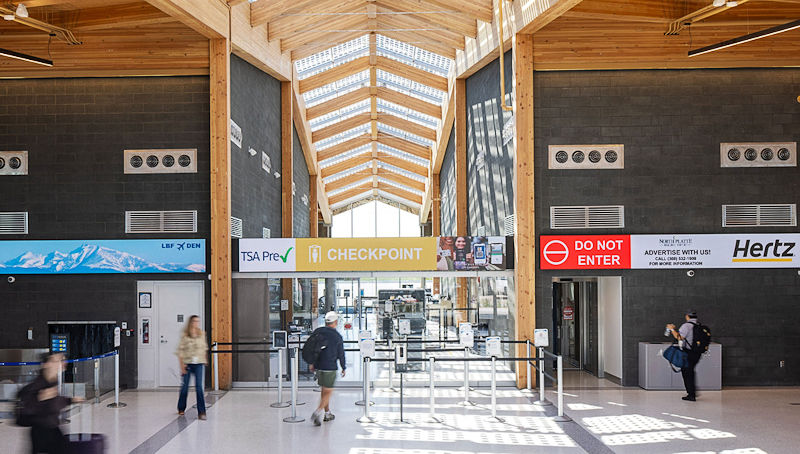
Upgrades include the airport’s first passenger boarding bridge, larger restrooms and food and beverage service on both sides of the security checkpoint. There’s space for modern TSA equipment, and a 110-seat holdroom has ample room for the airport’s current passenger volume – as well as extra capacity should an airline add service with larger aircraft in the future.
Automated exit lane equipment by dormakaba improves arriving passenger flow without tying up TSA officers who would have otherwise had to physically monitor the passageway.
“This was a need,” Gosnell says of the terminal. “We went from something that was pieced together, that we made work, into something that was designed with a purpose.
“It brought a lot of things we always thought would be nice (and turned those ideas) into a reality.”
Given North Platte’s remote location, LBF is an aviation lifeline for many communities in the western half of the Cornhusker State. Speaking at the terminal’s grand opening, Gov. Jim Pillen described the project as an extraordinary investment for residents and visitors.
“(It) helps us change the narrative,” he told KNOP News. “Nebraska is no longer a flyover state. We are a fly-to state and it’s because of investments and it’s because of the people.”
U.S. Sen. Deb Fischer, who serves on the Senate Appropriations and Commerce, Science, and Transportation committees, played a pivotal role securing $21.8 million in federal funding, including $8 million through FAA’s Airport Terminals Program and $7 million through congressionally directed spending. She characterizes LBF’s new terminal as a positive result of local, state and federal collaboration.
Her Washington, D.C. colleague, U.S. Sen. Pete Ricketts, says airports like LBF connect communities and help grow Nebraska’s economy. “Travelers from across our state will benefit from these strategic investments in critical infrastructure,” he says.
Getting There
The airport’s catchment area spans 15 counties within a 300-mile radius. North Platte acts as a de facto launch point for nearby travelers with Omaha, NE, and Denver each a four-hour drive away.
“We’re pretty much dead-smack in the middle,” Gosnell explains of LBF’s remote setting.
SkyWest Airlines, operating as United Express, runs a dozen LBF roundtrips per week, all to Denver International Airport (DEN) located approximately 260 highway miles to the southwest. So far, 2026 has been a banner year, including four consecutive months of record-breaking passenger numbers over the summertime. The carrier’s Essential Air Service contract runs through this year, though proposals for continued service in 2027 and beyond were due to the FAA in mid-July.
Most LBF passengers are locals, but North Platte has developed into a golf destination that’s luring more out-of-state visitors. Summer is the peak travel season.
Recent trends foster optimism that larger aircraft might soon serve LBF. Before Great Lakes Airlines shut down in 2018, it flew nine-seat Beechcraft 1900D turboprops to/from LBF, serving 2,000 to 4,000 passengers annually. Today, SkyWest uses larger capacity 50-seat CRJ200s. FAA data shows more than 30,000 passengers flew in and out of LBF in 2025.
The new terminal, Gosnell believes, could lead to service from 76-seat Bombardier CRJ700 aircraft, or the like-sized Embraer E170 or E175. Beyond that, many area residents also hope for the return of casino charters like those that flew gamblers to Wendover, NV, prior to the COVID-19 pandemic.
Two sizable local developments further fuel optimism for air service growth. One is the Nebraska International Port of the Plains, a multimodal inland port expected to support 5,200 jobs and create $2.4 billion in annual economic output for Lincoln County upon its completion. (With close to 24,000 residents, North Platte is the Lincoln County seat.)
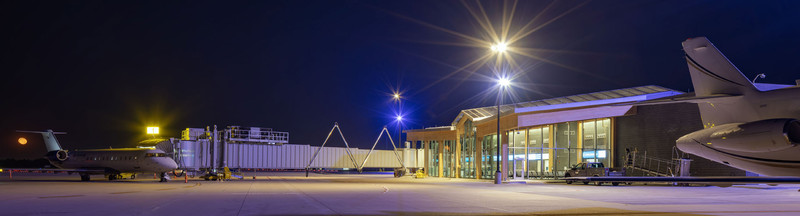
The new terminal allows the airport to serve regional jets with higher passenger capacities.
The other significant development is a $400 million meatpacking plant that opened last March. It sources genetic Angus beef only from a tight 250-mile radius, employs 800 to 850 local workers and is expected to pump $1.2 billion into the region annually.
Given the growth of well-paying jobs associated with these developments, planners project more locals will travel by air.
 Despite how or when that passenger demand materializes, new infrastructure has LBF at the ready. Among other contingencies, its new Oshkosh AeroTech passenger boarding bridge can also accommodate larger jets. Project leaders purposefully selected a size with future needs in mind.
“The first step was to get a facility that would support (air service growth),” Gosnell explains. “Now, we’re going to circle the wagons and look for more destinations.”
The new terminal also satisfies TSA’s previous concerns. A 6040 CTIX checkpoint computed tomography machine from Smiths Detection scans carry-on bags. Airport leaders are working with TSA to eventually replace the current hand screening of checked bags with a new Smiths CTX 5800 Explosives Detection System.
The airport’s existing CEIS walkthrough metal detector with an explosives trace detection unit and ProVision2 Advanced Imaging Technology devices, both from Leidos, were relocated from the old terminal to the new one during a single day in August. Now, LBF’s prior bottlenecks are mere memories.
Environmental Approach
Airport leaders initially considered remodeling the terminal, but ultimately determined that would have been too costly, and likely would not have achieved the desired functionality for LBF’s 10-person staff.
Six years ago, the project team began preliminary planning for a new build, though how it would be financed was unclear. The North Platte Airport Authority fronted design costs so construction could move quickly once funding was identified.
“If you really need something, you can’t just say, ‘I don’t have the money today,’” Gosnell explains. “You have to take a few risks, have a shovel-ready project and keep advocating for what your community needs.”
After Congress approved the Infrastructure Investment and Jobs Act in late 2021, LBF recognized that securing some of the newly available federal funds hinged on meeting certain criteria favored by FAA under the Biden administration. These included job creation—especially in rural areas like North Platte—and sustainable, resilient construction.
The airport selected HDR, a global architecture, engineering, environmental and construction services firm, to guide project planning and help prepare its federal grant applications.
 HDR Project Manager Ryan Hanson notes that it wasn’t happenstance that sustainability and resilience, key tenets of the company’s approach, are widely evident at LBF. “We improved the project in order to be more competitive for these grant programs,” Hanson explains. “You’ll see the same amenities at North Platte as you would at a hub airport, just at a smaller scale.”
With FAA scoring criteria in mind, HDR and airport leaders leaned heavily into enviro-friendly measures. A geothermal heating and cooling system facilitated by conducive local topography includes 60 wells drilled 400 feet below ground. The system circulates water back and forth to efficiently regulate temperatures within the terminal.
“[It uses] the earth’s relatively constant temperature to help cool the building in the summer and heat it in the winter, reducing overall energy consumption,” Hanson notes.
The geothermal system contributes to an overall reduction in energy use by as much as 53% vs. other means, he adds.
There’s also a nearly 6,000-gallon system that captures stormwater so it can be repurposed for non-potable uses such as landscaping and toilet water. Electric vehicle charging stations in the parking area further boost the project’s sustainability.
Structural elements were also carefully selected. The airport’s location on the Great Plains makes it susceptible to high winds, and potentially wildfires during serious droughts. To address those concerns, designers specified mass timber beams with wind and fire resistance that exceed those of steel frameworks.
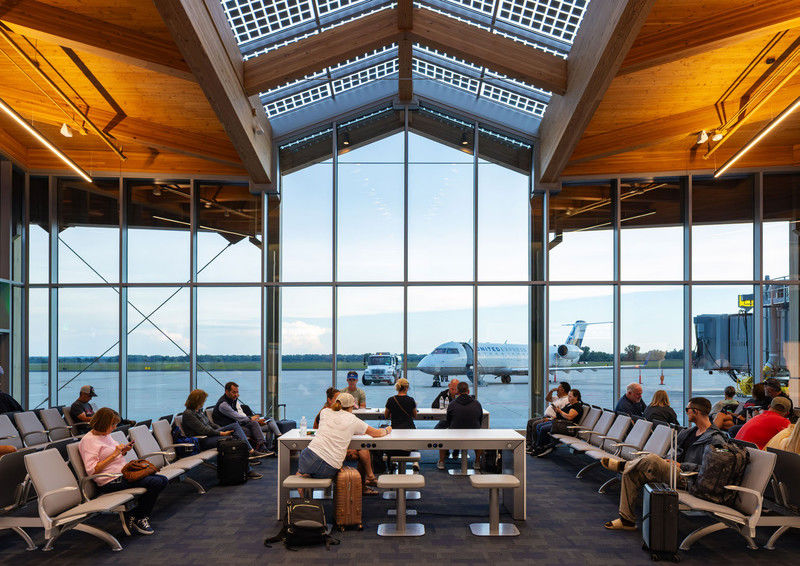
More holdroom seating, a skylight and views of the ramp have been well-received by passengers.
The terminal’s structural system is comprised of Douglas fir “glulam”—short for glued laminated timber—that was fabricated from sustainably sourced timber and imported in single pieces from a mill in Portland. Some boards were 4-feet-tall and 16-inches thick, with the longest beam measuring more than 60 feet from end to end.
Hanson says the timber structure’s complex geometry made it tricky to install, but precision cuts and standardized connections allowed for a sound roof with a look that mesmerizes those who stand underneath it. Gosnell agrees: “The mass timber construction is amazing and beautifully highlights the sandhills we have here.”
Beyond helping secure FAA funds, these design choices are expected to earn the project Leadership in Energy and Environmental Design (LEED) Gold Certification. The airport’s application was pending review when the new terminal opened.
Things Are Looking Up
Sampson Construction Co, the Nebraska-based company that served as general contractor for the terminal project, leveraged its experience in the health care industry when working at LBF.
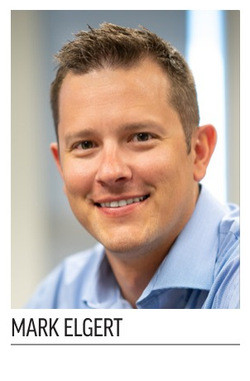 “[In hospitals and medical facilities] you’re working around patients in an occupied space,” explains Sampson Project Manager Mark Elgert. “Even though [the airport terminal] was a greenfield site, we had that same mentality of keeping pedestrians safe on our jobsite.”
The contractor has completed six projects on active airports with one more under construction.
Fixed-base operator Trego Dugan Aviation remained open on the ramp adjacent to Sampson’s jobsite; airfield fencing was relocated and replaced with temporary barriers to facilitate the work without affecting customers. Some Sampson personnel obtained badges to escort workers on and off secured portions of the airfield during their shifts.
At peak construction, the project team included 45 subcontractors and 70 to 80 onsite workers. Sampson worked closely with designers at HDR to ensure all building components worked together as intended, Elgert adds.
That wasn’t always easy. The mass timber, for example, arrived in huge pieces that could not be altered onsite. And in some locations, the gaps between the wood and adjacent masonry were as small as 1/16 of an inch.
“There wasn’t any room for error. We had to be true, plumb and level,” Elgert emphasizes. “It went together like a big LEGO set, which was really cool to see.”
Another signature design element is a 3,700-square-foot skylight that divides the building from front to back, with the TSA checkpoint directly underneath. Its photovoltaic glass was manufactured in Spain by Onyx Solar and installed by Glass Edge, a firm based in Lincoln, NE.
Lengthy, unpredictable transit times for European parts made scheduling installation a challenge, but the finished product is the largest skylight Elgert has seen in the state.
From the timber to the burnished block to the complex glazing, he doesn’t expect to lead another project like it again for the rest of his career. And he looks forward to reflecting on his role in developing a terminal that Nebraskans will use and treasure for years to come.
“Pictures truly don’t do it justice,” he says. “It’s a unique building. You could rent it out for a wedding reception; it looks that great.”
Bright History, Promising FutureWhat is now known as North Platte Regional Airport Lee Bird Field (LBF) opened more than 100 years ago, in 1921. It was built using private money to serve the needs of the U.S. Air Mail Service, just a few months after the nascent enterprise began the country’s first transcontinental air service carrying mail between New York City and San Francisco. In February 1921, LBF welcomed the first nighttime airmail flight after crews set fire to fuel barrels to help mark the airfield’s perimeter. “America’s First Lighted Airfield” was born. Despite horrific weather, the De Havilland 4 landed and then pressed eastward as part of 33-hour trek to demonstrate the viability of around-the-clock flying. While that achievement may seem simple now, the feat proved pivotal for overturing the entrenched practice of moving U.S. mail by trains. Eight years later, North Platte Field was purchased by its namesake city, which in turn leased it to the Boeing Transport Company, a forebearer of United Airlines. More runways were built in 1941, and the airfield was used to train B-17 flight crews during World War II. The North Platte Airport Authority was created in 1963, and a locally elected, five-member board governs LBF to this day. Lee Bird Field was added to the airport’s name in 1992 to honor a hometown military instructor who died in a plane crash during World War I. In 1960, local couple Terry and Gary Trego opened a small flight school and maintenance business at the airport. Their daughter Traci and her husband, Vincent Dugan, joined the company three decades later. Collectively they grew what’s now Trego Dugan Aviation, a national leader in air cargo, ground handling, fueling, maintenance, avionics and chartered jets. The business plans to renovate LBF’s old terminal building for use in its fixed-base operator portfolio. With the airport’s new terminal fully online, LBF leaders are now working on plans for a 200-acre business park overlooking the North Platte River, just west of crosswind Runway 17-35. |