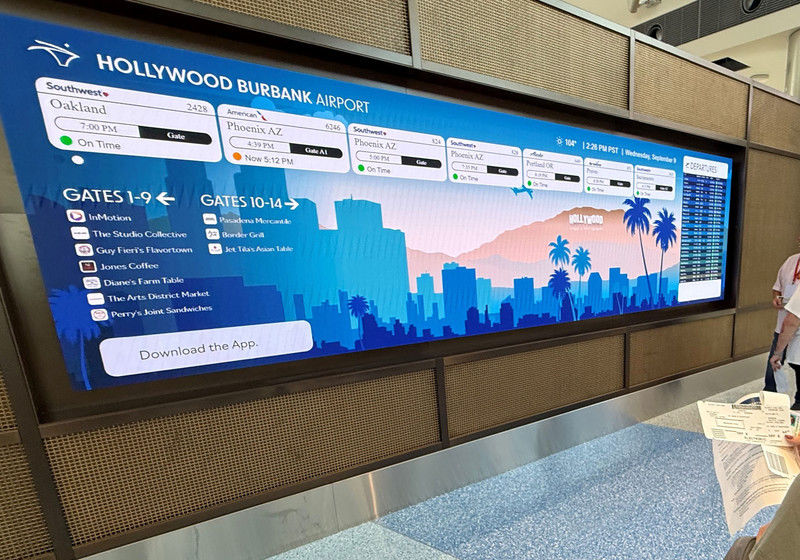
When officials at Hollywood Burbank Airport (BUR) were planning the $1.3 billion ELEVATE BUR project, including the appropriate infrastructure to support digital connectivity was a key goal. So was balancing the airport’s own operational needs with the needs and expectations of passengers.
 “Connectivity is a fundamental part of the passenger experience,” says Scott Kimball, deputy executive director of business development. “Everybody’s living in the digital age, and at any moment they expect reliable connectivity.”
To complement the new 355,000-square-foot replacement terminal and six-level parking structure, BUR officials prioritized a digital foundation to improve connectivity throughout the campus now and into the future. Technology enhancements keep passengers connected and informed, contributing to a sense of ease and “provide a higher, elevated level of customer service,” adds Executive Director John Hatanaka.
Another component of elevating connectivity at BUR is digital marketing, which Kimball says will bring in a new age for the terminal and transform the airport advertising experience through dynamic content and additional revenue.
| facts&figures
Projects: Upgraded Digital Connectivity & Messaging Location: Hollywood Burbank Airport, in CA Owner/Operator: Burbank-Glendale-Pasadena Airport Authority Cost: Component of $1.3 billion ELEVATE BUR replacement terminal project Funding: FAA Airport Improvement Program grants; passenger facility charge revenue; Airport Authority funds; General Airport Revenue Bonds issued by Airport Authority Terminal Grand Opening: Oct. 13, 2026 Project Manager: Jacobs Construction Joint Venture: Holder, Charles Pankow Builders, TEC Management Lead Architect: Corgan Lead Technology Consultant: Burns Engineering Wi-Fi/DAS: Boingo Wireless Digital Advertising: Clear Channel Outdoor Holdings Contract: 8 yrs Content Strategy: Synect Digital Content Management System: Passenger360® from Synect BUR Board & Ticketing Ribbons: Planar Content Design: Anyone Collective Motion Graphics & Implementation: Synect |
Constructing Connection
Constructed in 1930, the previous BUR terminal had a lot of “cellular dead zones.” Cellular companies installed or requested to install their own equipment within the facility, which made for a complicated or potentially cluttered environment. “We wanted to consolidate that into a common-use kind of environment managed by one vendor,” Kimball explains.
Today, one common system infrastructure supports all cellular function in and around the new terminal. “On the operations side, we don’t need to worry about having three different contracts with the three different cellular companies, with each of them deploying all their equipment throughout the terminal,” Kimball says.
Boingo Wireless was selected through a competitive request for proposals process, and engaged early in the planning phase to deliver and manage wireless connectivity throughout the terminal and parking facilities. The change would mean “passengers could expect fast and reliable Wi-Fi and cellular wherever they went, whether they wanted to use Wi-Fi or cellular supported by DAS (distributed antenna system),” Kimball notes.
The project integrates Wi-Fi 7 and Wi-Fi 6E technologies with a high-performance cellular distributed antenna system, forming a converged wireless foundation designed to create fast, secure and resilient airport-wide coverage.
The Boingo infrastructure “provides the required backbone for airport, airline and concession teams to communicate, coordinate real-time operations and implement emerging AI tools,” says Stephanie Czaplicki, senior vice president of account management at Boingo Wireless.
Notably, this deployment makes BUR one of the nation’s first airports with a Wi-Fi 7 network, bringing “next-level speed, capacity and reliability” to the new terminal, adds Czaplicki.
“BUR had a bold vision for the new passenger terminal, and they wanted a connectivity strategy that would evolve directly alongside construction,” she says.
The converged wireless infrastructure—with high-speed Wi-Fi and neutral-host cellular DAS—supports everything from high-demand passenger streaming to operational networks for the airport and its tenants.
To ensure adequate coverage throughout, Boingo worked with facility designers to develop a heat map of sorts for where each of the components would be installed. “We looked at all the different areas to make sure that the experience for the passenger was going to be met,” says Kimball.
While the terminal deployment includes both DAS and Wi-Fi, the six-level parking garage is strictly DAS. “It’s a little more reliable than Wi-Fi, especially to manage our electric vehicle chargers in the parking garage,” Kimball explains.
Capitalizing on Connection
Providing creative and effective digital communications will further enhance the passenger experience, reduce anxiety and improve operations, Kimball says. With a robust connectivity backbone in place, BUR officials plan to creatively reach passengers by leveraging a new digital content management system from Synect and a strategic partnership with Clear Channel Outdoor Holdings.
Signage at the old terminal was 99% static, which restricted the airport’s ability to be flexible and responsive in its messaging. “We wanted to change that,” Kimball explains. Digital screens allow BUR to present messages from multiple advertisers, with more flexibility regarding the content.
 The original scope for signage in the replacement terminal centered on conventional flight information displays. When the design was approximately 90% complete, and the Guaranteed Maximum Price had been established, Burns Engineering and airport leadership began exploring whether that same investment allowed in the budget could achieve more.
Burns helped the team evaluate a content strategy and digital content management system from Synect against the existing requirements. That evaluation indicated the airport could meet its operational needs at lower cost without disrupting schedule or budget. An agency called Anyone Collective helped develop the content strategy, and Synect implemented its Passenger360® system to connect signs and displays in key areas, and the airport and design-builder applied the money saved to enhanced post-security LED displays.
BUR’s new system is a visual communications platform and a broader approach to information displays for flight information, baggage information and gate information. “It allows for the delivery of the content we want to spread across the airport,” Kimball explains.
 Ian Birnbaum, project manager with Burns Engineering, says treating every display as a canvas creates room for airport messaging, branding, wayfinding, concession information, gate details, website promotion and sense-of-place graphics. “It’s kind of a one-stop shop,” he remarks.
The “BUR Board,” as it’s known internally, is made of two 15-food-wide displays located just after the new centralized passenger checkpoint. The direct-view LED dashboard powered by Passenger360® combines flight information, weather reports, wayfinding information, local imagery, information about terminal amenities and airport content in the area where departing passengers are orienting themselves after security screening. Adhering to the terminal’s overall design theme, it also includes images of searchlights used at Old Hollywood movie premieres. “Practical information and localization share the same canvas, helping passengers navigate their journey,” summarizes Synect Marketing Director Alison Weber.
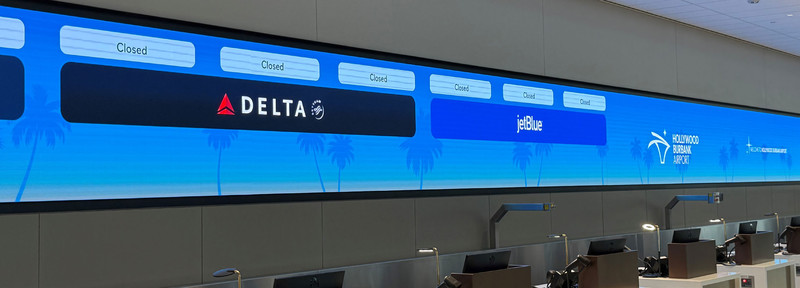
Displays include two long video walls in the check-in lobby.
The strategically placed, highly dynamic displays engage travelers and encourage them to explore the airport by using branding, art and dynamic content along with context-aware flight information. “It creates a unique experience and something that makes it more exciting than just sitting at your gate in the airport,” Birnbaum says. “It helps encourage [travelers] to explore and see what else is going on around the airport.”
In addition to the large BUR Board, Synect’s digital content management system coordinates:
• two large video walls in the check-in lobby with airline branding and counter information;
• four screens at the TSA checkpoint that show visual instructions to remind passengers of divestment procedures and help them prepare for screening;
• five post-checkpoint flight information boards with content arranged in both traditional formats and more intuitive, futuristic interfaces;
• 14 gate information displays in the boarding areas; and
• six baggage information displays for arriving passengers.
As a whole, the system is a combination of large-format LED video walls and high-resolution LED information screens. Content for a branded monument sign in the outdoor parking area is currently under development.
Weber notes that throughout the new terminal, content is designed around what travelers need at each location, with a consistent airport identity.
 “Hollywood Burbank Airport brought content strategy into its infrastructure planning, and it shows,” says Montee Fiely, head of Strategic Engagement at Synect. “When you know what every display needs to do for passengers and operations when planning the system, you put the right screens in the right places and get more out of the same budget. BUR did exactly that, and they did it all in one system that can keep growing long after opening day. Passengers are going to walk in, look up, and be amazed by what BUR has created.”
Under a separate eight-year agreement, Clear Channel Outdoor’s Airport Division is implementing a digital advertising and sponsorship program designed to elevate the airport’s media environment.
This “immersive, Hollywood-inspired experience” includes a digitally driven media network featuring themed design elements like gold-trimmed screen frames integrated into terminal architecture and strategically placed high-resolution screens capable of 3D anamorphic content and ultra-high-definition visuals. Sense of place and regional identity will be created through local imagery.
“Our vision is to turn Hollywood Burbank Airport into an iconic and immersive media showcase that celebrates the creative spirit of Los Angeles,” says Morten Gotterup, president of Clear Channel Outdoor’s Airport Division. “We’re combining design, technology and storytelling to deliver premium opportunities for both national and local advertisers to reach travelers in meaningful, memorable ways.”
The partnership also allows advertisers to deliver brand consistency outside of the airport, with Clear Channel’s roadside digital and printed billboards throughout the Los Angeles metro area.
Each of the 14 holdrooms will have Internet Protocol TV, yet another marketing avenue for the airport. Working with Clear Channel, Kimball says the airport intends to display relevant airport information for waiting passengers.
Kimball notes that the airport is actively working on its content strategy to define exactly the kind of messaging it will present to passengers. “It could be whatever we want, but we want to make sure it’s appealing and enjoyable,” he adds. Advertising screens are separate from airport-controlled content and flight-information displays. “That will be an ongoing collaboration with Clear Channel and our marketing team.”
Another way BUR is expanding its digital touchpoints across the passenger journey is through Boingo Media, an advertising platform from Boingo Wireless that reaches travelers as they connect to airport Wi-Fi.
The Virtues of New
Just as the design-build team gained significant latitude by having a greenfield site for the new terminal, technology specialists relished designing a network for a new building. Czaplicki considered it an incredible opportunity. “Rather than retrofitting older infrastructure, we integrated advanced wireless technology directly into the construction process,” she relates.
The importance of involving technology specialists, consultants, partners and airport staff from the first day of terminal design cannot be understated, Kimball adds—particularly given BUR’s aggressive program schedule. Changes made later, during construction, created additional costs, change orders and structural challenges.
For example, early planning allowed Boingo to map dedicated headend equipment spaces, cable pathways and coverage needs before facility walls were erected. It also provided time to engineer discreet mounting solutions so access points blend into the terminal’s architecture.
 “Because this was a brand-new terminal, the network also had to complement the architectural vision and construction schedule,” notes Czaplicki. “We worked closely with airport leadership, designers and other trades to integrate equipment discreetly and install it at the right stages of the build.”
That early collaboration proved invaluable for a project of this scale with an accelerated timeline, ensuring that technology was integrated from the start, Czaplicki says.
“It’s very hard when you’re going through the construction phase if you want to change something—there are costs and structural changes along with that,” Kimball notes. “You need to take time early on and develop a great plan; you need to have people around you that understand the technology and your objectives.”
Connection to the Future
“BUR’s new terminal opening represents an incredible milestone for Southern California, especially as the world turns its attention toward the 2028 Olympic and Paralympic Games,” Czaplicki says. “Seeing BUR lead the nation by launching one of the very first airport Wi-Fi 7 deployments is a testament to prioritizing innovation and the passenger experience.”
Bringing BUR into the digital age opens up opportunities for additional revenue streams, Kimball adds. “We’ll be working with our partners to try to leverage that.”