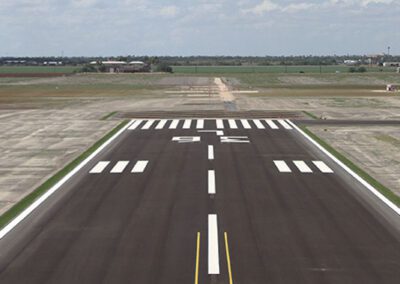
They say everything’s bigger in Texas. And although bigger isn’t always better, it’s definitely a good thing at Valley International Airport (HRL) in Harlingen, TX. The airport’s recently extended 17R-35L runway is now the biggest—longest—runway in South Texas.
A new $7 million ground run-up enclosure is boosting safety and operating efficiency at Oscoda-Wurtsmith Airport (OSC), a general aviation airport in northeastern Michigan, along the Lake Huron shoreline.
File it under “good things come to those who wait.” The roughly year-long reconstruction and rehabilitation of the primary runway at Punta Gorda Airport (PGD) was a welcome improvement that took patience, planning and lots of enabling projects.
Staff members at Vancouver International Airport (YVR) in British Columbia refer to the experience almost cryptically as 'the Four Days in December.' And it's as ominous as it sounds. A mix of snow, freezing rain, low temperatures and fog arrived in waves over four crucial holiday travel days in December 2022.
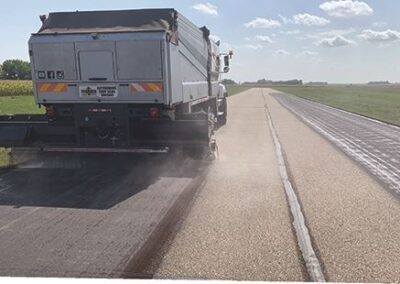
The history of airfield pavement is filled with products and technologies originally developed for the road and highway industry. The latest chapter in that story is an asphalt surface treatment that has been successfully applied in more than 20 significant airport projects since 2019, including three general aviation runways completed late last year in Colorado, Minnesota and North Dakota.
Lubbock Executive Airpark used to close on weekends so race enthusiasts could use its 3,500-foot runway as a drag strip. And until recently, the airfield was lit by all-weather 75-watt light bulbs purchased from the local hardware store.
This April, Raleigh-Durham International Airport (RDU) solved what many in the industry would consider a champagne problem with a new $33 million overnight parking ramp for aircraft.
After an extensive rehabilitation completed in a single construction season, the second-busiest runway at Toronto Pearson International Airport (YYZ) officially reopened in November 2022.
Earlier this year, San Francisco International Airport (SFO) revealed plans to repave its shortest runway, 1L-19R, with new asphalt. That's not unusual, because the airport regularly performs minor routine maintenance on its four runways combined with a full repaving every 10 to 12 years based on usage.
When it comes to airport improvements, some projects satisfy current needs and others address long-term growth or environmental goals. The latest development at Pangborn Memorial Airport (EAT) checks all three boxes.
A major rehabilitation of the main runway at St. Louis Lambert International Airport (STL) is nearing completion. Runway 12R-30L, which handles about 40% of the airport's flight operations, is scheduled to reopen sometime in November after being closed for the last two construction seasons.
The 30-year-old apron at Centralia/James T. Field Memorial Airport (YCE) in Huron Park, ON, has only recently started to show a few cracks, thanks to a fiberglass material installed between its asphalt layers in 1993.