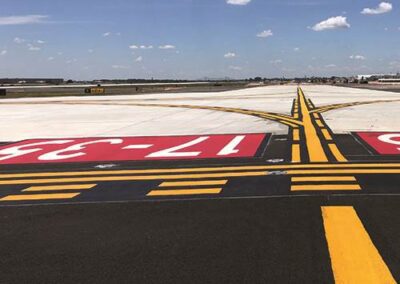
O'Hare International Airport (ORD) is in the final leg of a long journey to completely reconfigure its airfield. Soon, Chicago's primary airport will have six east-west parallel runways and two crosswind runways'with far fewer intersections. Last November, ORD moved one step closer to an improved configuration when officials opened the airport's first new runway since fall 2015.
After decades of continuous use by commercial and student aircraft, the taxiway parallel to the primary runway at Daytona Beach International Airport (DAB) was exhibiting multiple pavement distresses. The most prominent issues were weathering and longitudinal and transverse cracking. Pavement cores revealed that many of the cracks extended completely through the asphalt.
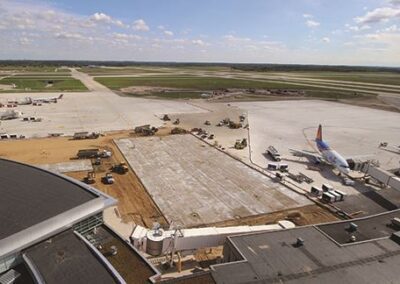
Earlier this year, contractors finished the final punch list for a much needed $50 million apron reconstruction and expansion project at Gerald R. Ford International (GRR) in Grand Rapids, MI. Casey Ries, engineering and planning director at GRR, was glad to close out the complex project the airport began planning back in 2015. Ries explains that 2018 to 2019 was the ideal time to reconstruct the terminal apron because the physical condition of the pavement was not great and the logistic conditions were favorable.
Maintenance personnel at McCarran International Airport (LAS) no longer put pen to paper when they log maintenance performed on runway lights. Instead, a digital asset management system uses GPS technology to track the work performed and pushes the information to a cloud-based platform to enhance the accuracy of maintenance records.
The multi-year $25 million East Airfield Rehabilitation at Philadelphia International Airport (PHL) was completed 71 days early'and that was after having to shut down due to COVID-19. 'With construction progressing so fast and money still in the budget, PHL even managed to take advantage of reduced airfield traffic from the pandemic to add extra taxiway overlays to the project scope.
March is usually a very busy month at Grand Cayman's Owen Roberts International Airport (GCM), with tourists streaming in to enjoy beaches, coral reefs and other western Caribbean attractions. After years of tremendous growth in passenger traffic, officials were looking forward to a record-breaking March last year. And then COVID-19 effectively closed the entire island, including its airport.
Knowing that late-spring snowstorms can be among the heaviest and hardest to clear, airport operations managers in cold-weather cities like Manchester, NH, and Minneapolis implemented plans to keep their maintenance crews safe while also remaining ready to clear away snow. Thankfully, most of North America was spared significant snowfall for the remainder of the season. The challenge of keeping workers safe increased in late spring as COVID-19 cases rose, but the concern about getting socked with a major snowfall subsided.
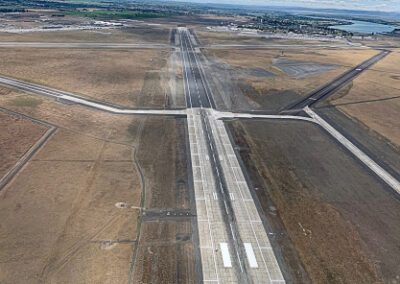
Airports throughout the world face many of the same challenges, but Grant County International (MWH) in Moses Lake, WA, recently tackled an unusual airfield issue. It leveled a gradual, but pronounced, hump in the middle of its main runway.
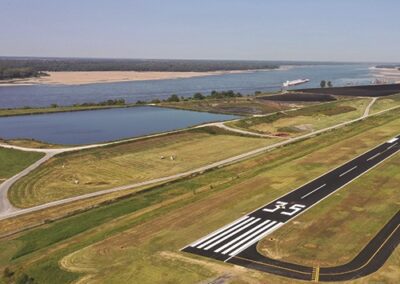
A recent runway resurfacing project at General DeWitt Spain Airport (M01) is proving that sealcoats are not just for maintenance anymore. The general aviation airport, located minutes from downtown Memphis, TN, opted to apply a protective sealcoat over brand new asphalt to help preserve the Airport Authority's investment and increase the life of its new pavement.
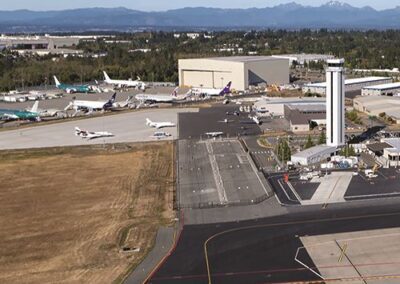
Paine Field (PAE), just north of Seattle, saved an estimated quarter of a million dollars and two months of time on recent ramp repairs by suspending commercial passenger flights and closing the terminal to complete the project while traffic was already slow due to COVID-19. The strategy also spared its airlines and passengers the service disruptions such work typically causes.
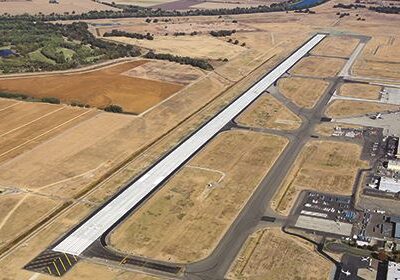
Despite surprising underground discoveries and a limited construction period due to impending seasonal fog, Sacramento International Airport (SMF) opened its critically important new $30 million concrete runway on time.
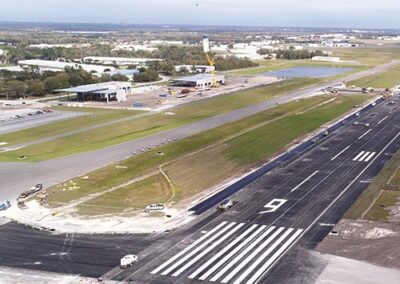
The Sun 'n Fun Aerospace Expo, held at Florida's Lakeland Linder International Airport (LAL), is one of the world's largest aviation events. The popular fly-in and airshow are such a big to-do that the FAA dispatches its most experienced air traffic controllers to manage the 1,200+ daily operations it draws. This would have been the 46th Sun 'n Fun, but like most large events in 2020, it was cancelled due to the COVID-19 pandemic.