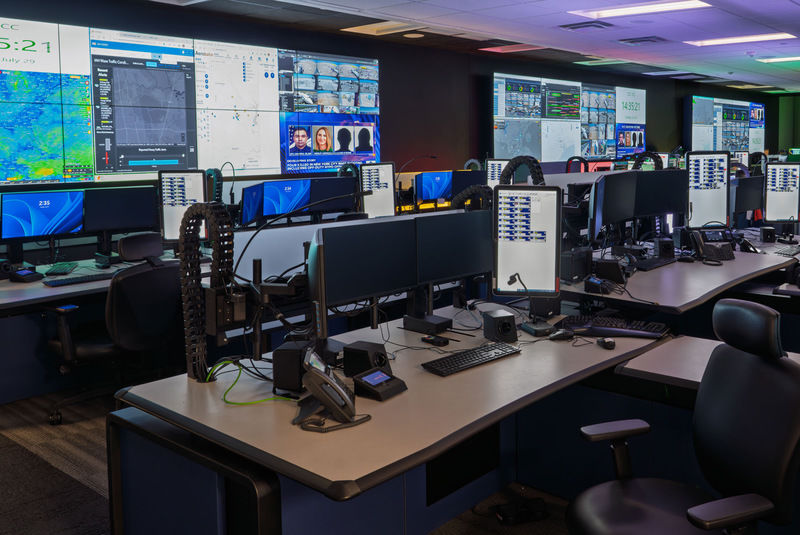
For Houston’s George Bush Intercontinental Airport (IAH), the objective was clear: Unite separate safety, security and emergency management departments into one facility to improve situational awareness, event coordination and response—and fill it with state-of-the-art technology.
The result is a $7.3 million command post dubbed the Integrated Coordination Center (ICC). The 9,300-square-foot facility not only operates 24/7 to help the airport handle routine operations and blips like weather delays and traffic surges; it is also capable of sheltering critical personnel for extended periods during more serious and protracted situations.
Functions/groups housed in the ICC include:
| facts&figures
Project: Integrated Coordination Center Location: George Bush Intercontinental Airport, in Houston, TX Key Components: Airport Operations Center; Emergency Operations Center; TSA Security Operations Center; Houston Police Dept.; Aircraft Gate Control; Facilities Maintenance Dispatch; Terminal Operations Key Benefits: Centralizes security/safety, airfield control & terminal operation functions; enhances everyday efficiency; monitors customer comfort & satisfaction; streamlines communication & speeds response during emergencies Cost: $7.3 million Funding: Airports Improvement Fund Project Timeline: Pre-bid conference Sept.21, 2023; construction started June 2024; official opening Aug. 25, 2025 Facility Size: 9,300 sq. ft. Operator Consoles: 18 Prime Architecture & Engineering Consultant: RDLR Architects General Contractor: Morganti Texas Security & Access Control Software Platform: Honeywell Pro-Watch Cameras: Honeywell Surface Management & Collaborative Decision-making Suite: Saab Aerobahn Radios: Motorola Digital Wall: Haivision |
- Airport Operations Center
- Emergency Operations Center
- TSA Security Operations Center
- Houston Police Department
- Aircraft Gate Control
- Facilities Maintenance Dispatch
- Terminal Operations
The multi-disciplinary nerve center, which opened on Aug. 25, 2025, was five years in development. Planning included a project team from IAH studying and visiting other hub airports to better understand the options available, and then considering what features would work best in Houston. RDLR Architects served as the prime architecture and engineering consultant.
Opening the ICC required the airport to relocate its Airside Operations Center and Emergency Operations Center from Terminal A to the new facility outside the terminal complex—an undertaking in itself that required extensive pre-move planning to ensure the transitions occurred on time, on budget and without coverage gaps.
Scope and Scale
Last year, IAH served more than 48.7 million passengers on a campus with five terminals, five runways and 11,000 acres of land. As the largest property in the three-location Houston Airport System, it presents unique challenges for coordinating personnel.
“Several of our work groups were spread out,” explains Houston Airports Director Jim Szczesniak. “When we wanted to collaborate, we had to make phone calls; we couldn’t address everyone in one room. We knew the airport was too big to be decentralized the way it was.”
Early in 2023, Morganti Texas won the construction contract to build out approximately 9,300 square feet of space for the new facility. The project scope also included integrating many technology elements: a video walls, a radio console system, video surveillance equipment, data-communications components, and improvements to fiber-optic cabling and the uninterruptible power supply system.
Previously, the Airport Operations Center was in Terminal A while Gate Control was in Terminal D. Uniting these two functions was particularly important. Terminal A could not accommodate an expansion, so Houston Airports opted to build the new ICC at the Houston Airport System General Services Facility, which is five minutes from the terminal complex by car via a dedicated road.
“By bringing everyone under one roof, we’ve torn down the silos,” explains Stephen Mamo, senior division manager of the ICC and Emergency Operations Center. “We’re streamlining communication, making collaborative decisions and improving our ability to respond—in real time—to whatever the day brings” for improved situational awareness and collaboration for reduced response time.
The ICC spans two floors, with the Emergency Operations Center and an attached media room for press conferences on the first floor; and the Airport Operations Center on the floor directly above. TSA operates a separate room nearby for regulatory reasons.
“At the airport, there are two emergencies to address: the actual incident and everything else it affects,” says Szczesniak. “The technology we use upstairs can be used downstairs as well, so senior leadership can work together on an emergency while keeping the pulse on normal operations at the airport.”
In the event of a major diversion, Gate Control can work directly with airline partners to execute solutions quickly. If a restroom is inoperable, Operations can coordinate across the board to dispatch staff to respond. When weather disrupts the schedule, passengers don’t see the brisk activity happening behind the scenes.
 Denise Yee, an associate architect with RDLR Architects, says moving key departments to a single off-terminal location drastically improves efficiency.
“With all the construction happening in the terminal and passenger traffic constantly increasing, emergency teams would have to navigate traffic on the airport roads in the past,” Yee points out. “The ICC pulls these departments out of the terminals, giving them a faster response time and better coordination efforts.”
Tech Heavy
An interactive digital wall is key to the ICC’s effectiveness. Visible, real-time information about the terminals and airfield allows anyone in the center to see instant updates. When employees arrive for their shifts, the airport’s status throughout the campus is apparent, so less time is required to brief incoming personnel. Data from Houston’s other commercial airport, William P. Hobby Airport (HOU), can also be displayed as needed.
Efficiency was taken a step further with a color-coding system for the 18 workstations. Each controller can change the color of a lighted panel behind their computer monitor to visually indicate the current status of their work. Red is for a serious active situation that disrupts airport operations; and green issues an “all clear” message when that situation is resolved. White signals the workstation is available and blue means someone is logged into the workstation but has stepped away from the desk.
“We have a very orchestrated approach,” says Mamo. “Once we learn of an event, the position is turned to red so we can respond quickly. At the same time, that person is encoding information to the video walls. It keeps chatter down and ensures a great level of consistency.”
The range of systems and the technology that strings them together are significant.
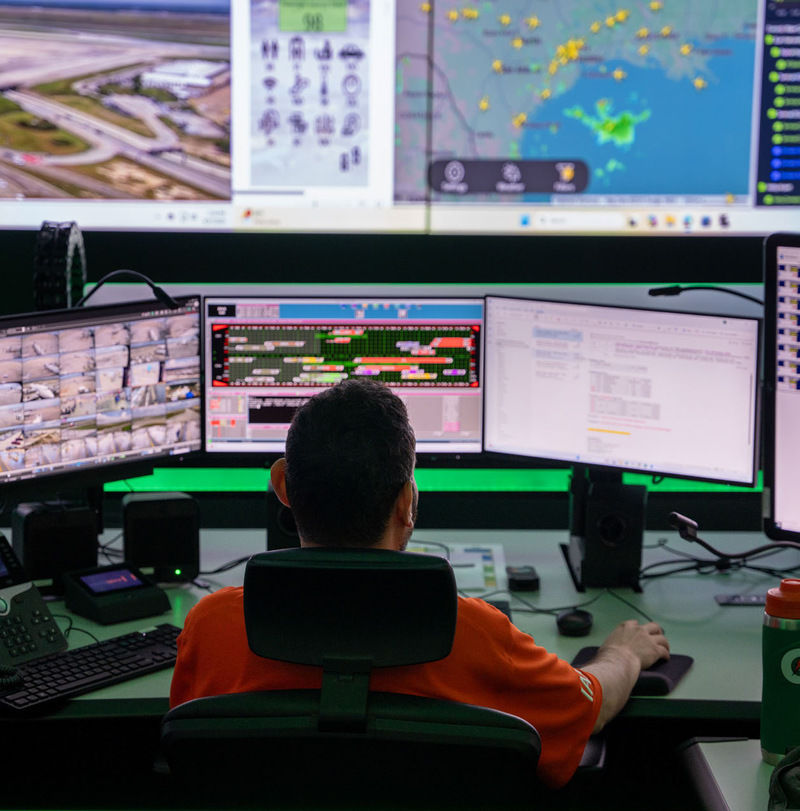
The Integrated Coordination Center uses some of the same desks as NASA.
“We have a lot of different protocols to help monitor airline operations,” Mamo notes. “We use radios, aircraft drone management, a drone spotter and radar services to alert us to diversions, flight cancellations and more.”
He highlights the MaxPro ProWatch camera system as one of the most critical elements. It identifies emergencies like airfield breaches, runway incursions and excursions and fire. The system is layered on top of capable, knowledgeable IAH staff who run a top-notch ship, Mamo notes.
The airport also leverages its proprietary “Passenger Journey Scorecard,” a real-time digital tracking platform that measures operational conditions from the moment passengers park until they board, as well as key steps along the way. Specifically, it collects performance data and customer feedback about eight key aspects that impact overall satisfaction:
- Roadway traffic flow and congestion,
- TSA checkpoint wait times,
- Transaction times at Customs and Border Protection facilities,
- Escalator function,
- Wi-Fi connectivity
- Restroom cleanliness,
- Water pressure, and
- Terminal temperature.
“We have a proactive versus reactive approach, and we constantly monitor every gauge,” Mamo says. “When needed, we can dispatch personnel or contractors to stay ahead of the bell curve.”
With so many tech-heavy systems, the airport installed an uninterruptible power system for the ICC. It is designed to act as an intermediary between the main power system and the emergency generator to ensure the ICC is never off-line.
Weathering Storms
Now into its second year of operation, the ICC has proved to be everything leadership hoped it would—including emergency shelter.
 Beyond being notoriously hot and humid, Houston receives powerful subtropical weather that blows in from the Gulf. “We get intense rainstorms here, and water pressure is something we watch carefully,” Szczesniak says. “If something happens, we have the ability to dispatch teams quickly based on the gauge readings.”
When ICC personnel detect impending hurricane conditions, the airport doubles or even triples up on some roles for full coverage. And there’s no telling how long recovery efforts will take if the storm is bad.
Fortunately, the airport and its design team carefully considered what comforts, conveniences and necessities to include in the new facility. “Together, we evaluated the full implications of not just running a 24/7 center, but also thought about how to handle prolonged emergencies,” says Yee. “We increased the scope slightly to include four showers in case employees needed to be there for an extended time, and lockers for staff to keep personal items and clothing.”
The ICC is also equipped with ergonomic chairs and stand-up desks along with a sleep pod and space for cots. The team, including Director Szczesniak himself, has already used some of these features.
“I’ve spent time in the ICC emergency complex for hurricanes, aircraft incidents, storms, and more,” he says. “It helps to have a place to stay.”
What’s in a Name?
Several other major airports operate similar facilities, and they are known by various names.
San Francisco International Airport calls its centralized hub the Airport Integrated Operations Center, as does Dallas-Fort Worth International Airport. Los Angeles International Airport has an Airport Response Coordination Center.
 Assistant General Manager Steve Runge notes that IAH leaders deliberated about the official name for its new nerve center, and Integrated Coordination Center seems to say it all. For starters, the facility integrates previously decentralized departments and also includes key external partners.
“Our design uniquely fits our needs,” Runge says. “The TSA, for instance, was eager to participate in our center while at other airports that may not be the case. Together, we were able to look at the pros and cons of hosting it on-airport or off-airport. Bringing it to the ICC made sense for us.”
Leaders also felt coordination was important to include in the name because that was a primary objective of the $7.3 million project: improving collaboration and communication among key departments to improve situational awareness and response time when action is needed.