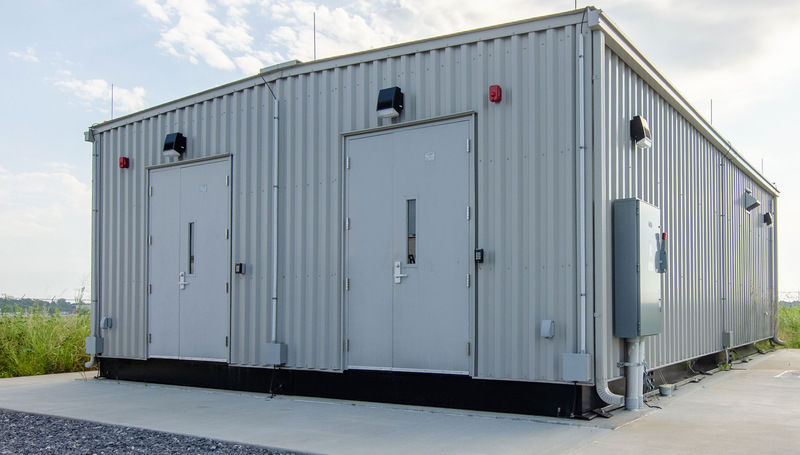
Replacing an airfield electric vault can wreak havoc on daily flight schedules, and the challenge is even greater at airports with only one runway for commercial traffic. Montgomery Regional Airport (MGM) in Alabama recently conquered that challenge by having its new vault constructed offsite, and then placed airside.
“We’re proud to be the first airport in the country to use this innovative strategy,” says Loyd Jenkins III, executive director of Montgomery Airport Authority. “We are replacing an electrical vault system that had reached the end of its useful life while accelerating construction timelines and reducing impact to our daily operations.”
Installing the $4.5 million prefabricated electrical center early last year was the first phase of a nearly $14 million airfield improvement project funded with grants from the FAA and Alabama Department of Transportation. During the $9.4 million final phase, which is currently underway, the airport is rewiring the airfield with copper lines and installing new LED lighting and signs.
| facts&figures
Project: Installing New Airfield Electrical Vault; Rewiring & Replacing Airfield Lighting Location: Montgomery Regional Airport, in AL Work Scope: Move all airfield lighting equipment out of cramped space in the terminal to new prefabricated electrical vault located on the airfield. Replace outdated airfield wiring, lighting & signage; remove old system (above & below ground). Creating & Assembling Prefabricated Vault: $4.5 million Funding: FAA Airport Improvement Program & ALDOT Aeronautics grants Building Size: 800 sq. ft. Timeline: Jan. 2024-Jan. 2025 Electrical Engineer: Goodwyn Mills Cawood Vault Design: ADB SAFEGATE Mfr. of Vault Structure: RDI Enclosures General Contractor: Hutcheson Construction Rewiring Airfield; Installing New Lights & Signs: $9.4 million Funding: FAA Airport Improvement Program & ALDOT Aeronautics grants Construction: Began March 2026; scheduled to be complete spring 2027 Electrical Engineer: Goodwyn Mills Cawood General Contractor: Precision Approach LLC Major Subcontractors: Davis Underground Solutions; Southeastern Land Surveying Electrical Cable: 126,000 linear ft. Lights: 42 in-pavement mounted runway edge, threshold or end lights; 64 base-mounted high-intensity LED runway edge lights; 576 base-mounted medium-intensity LED taxiway edge lights Signs: 84 base-mounted LED guidance signs of various sizes |
Naturally, choosing the right project partners was crucial—especially for the first-of-its-kind system installed during Phase 1. For starters, there are not many companies with experience designing this type of system. Ultimately, the airport selected ADB SAFEGATE, which provides integrated systems for airfield, apron and tower operations throughout the world.
Engineering consultant Goodwyn Mills Cawood collaborated with ADB SAFEGATE to determine exactly what equipment was needed for the electrical vault—constant current regulators, distribution panels, emergency power connections, etc. RDI Enclosures in Itasca, IL, was selected to manufacture the steel building to house it all.
Overall, it took nearly one year to build the vault and construct the associated building, with ADB SAFEGATE and RDI Enclosures working cooperatively and concurrently. Hutcheson Construction, the general contractor for Phase 1, was allotted 60 calendar days to complete the onsite “dirt work”—pouring the building foundation and digging paths throughout the airfield for the extensive underground electrical wiring that feeds into the building.
The location of the new standalone airfield vault, just north of the air traffic control tower, was selected to enable site construction to largely occur “outside the fence.” This helped airport operations proceed with minimal interruption and also simplified the credentialling process for crew members.
Undeterred by the Weather
The new 800-square-foot vault was built in two separate sections that crews placed atop a custom foundation and connected onsite in January 2025. Each portion required its own wide-load semi to transport it over 750 miles from Itasca to Montgomery. One section of the structure weighed 26,000 pounds; the other part, which contained all of the electrical equipment, was nearly twice as heavy.
Mother Nature was not kind to the crews that transported and erected vault. A snowstorm on the front end of the trip buried the Midwest and dropped record-breaking amounts of accumulation throughout the northern Gulf Coast. Montgomery received only 1/2 inch of wet snow, but up to 5 inches fell in surrounding counties. Because the installation site was only accessible via a gravel road, the final stretch of delivery was messy and slow.
After both trucks made it to the site, crews carefully lifted each section of the building into place using forklifts and a crane. Electrical connections were then established.
“We had to rough in all the electrical and make sure we hit pre-cut holes in the floor,” recalls Paul Hutcheson, owner of Hutcheson Construction. “It was a huge challenge.
 “We worked off drawings that showed exactly what the building was going to look like,” he continues. “As long as that building showed up the way the drawings said it would, we were OK. We had pockets in the floor that were 6-by-18 inches, and we had to get six 2-inch conduits to land perfectly in the middle of a field with nothing to go off of and make sure it all married up.”
Crews worked through the bitterly cold January night to make it happen.
Rewiring the Field, Updating Lights
With the new vault complete, work began on Phase 2, the airfield cabling, signage and lighting replacement. Onsite work for Phase 2 started in March 2026 and is expected culminate in spring 2027 with a final changeover to the new electrical vault.
“Our challenge in Phase 2 was to find a way to keep the existing lighting system active during the day with the airport open while we built the new one,” says Matt Thomason, Alabama aviation leader for Goodwyn Mills Cawood. That included minimizing airfield construction traffic to avoid disrupting MGM’s ongoing commercial service, general aviation traffic and military operations associated with the 187th Fighter Wing of the Alabama Air National Guard.
“When we switch over from one electrical vault to the other, it must be a literal flip of the switch to avoid closure,” Thomason emphasizes.
To satisfy FAA requirements on spacing and layout, Goodwyn Mills Cawood staggered the location of the new system within FAA guidelines as to not interfere with the active system. “Care was taken at every step to ensure clear visibility to the active system for pilots to maintain their situational awareness,” says Thomason.
“For the runway lighting, we utilized a ‘trunk and branch’ method for the new copper cabling,” he explains. “The trunk line was positioned outside the runway safety area (RSA) so as to not require shutdown of the runway during daytime construction. Branch lines come into the RSA off the trunk line to connect to the edge lighting fixtures. This enabled minimal shutdown except for the work inside the RSA. We reduced the runway closure to overnights only with minimal impacts on the airport’s users.”
 Access for future maintenance was also a key consideration. “At every branch/trunk intersection, we have a three-way junction can to pull wire and perform splices as necessary for both construction and facilitating long-term maintenance,” Thomason details. “For areas outside the runway, we utilized a detailed phasing plan to enable operations to fully continue on the taxiway/apron network while allowing the contractor to close sections for daytime work.”
General Precision Approach, a Georgia-based company that focuses solely on construction related to airport lighting and navigational aids, is the general contractor for Phase 2. Its crews and subcontractors are rewiring almost all of MGM’s airfield with copper cabling and installing new LED lighting and signs. Only the shorter secondary runway and parallel taxiway will retain quartz lights and signs. They will be connected to the new vault during Phase 2, but are slated for conversion to LEDs in the next few years.
In addition to removing the old quartz and incandescent lights, crews are also removing the associated underground wiring. Over the years, multiple modifications to the previous lighting system had created a spider web of underground cabling. Many lines were long abandoned in-place, leading to issues when crews discovered them during airfield construction and maintenance. When encountered, lines had to be treated as live, which caused delays and operational impacts.
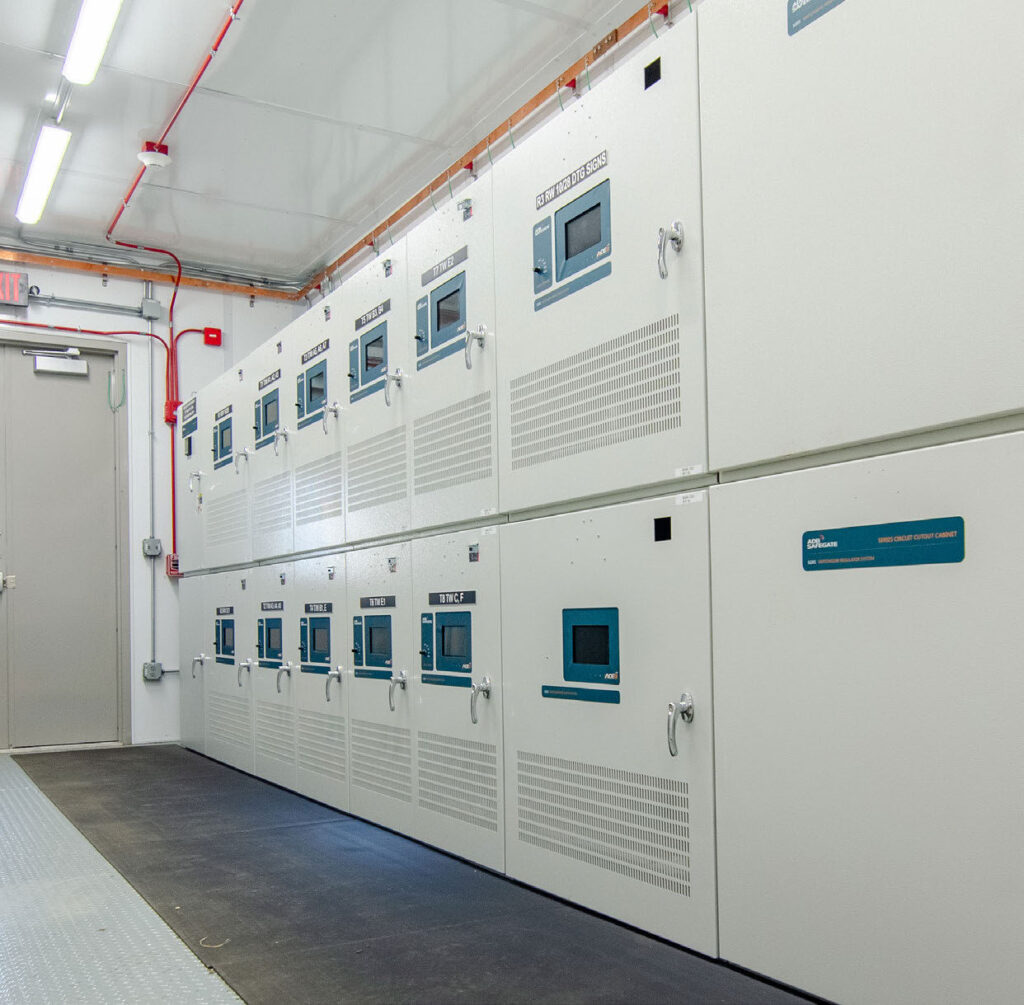
The new vault contains constant current regulators, emergency power connections and other key components for airfield lighting.
FAA personnel originally suggested leaving old lines underground as a cost-saving measure, but the project team felt it was important to create a clean slate to avoid confusion during future projects. Ultimately, FAA agreed.
Jeff Green, owner of General Precision Approach, says the most challenging aspect of the ongoing work at MGM is working in five-hour overnight shifts to keep the airfield’s sole commercial runway available for traffic during the day. (The 4,011-foot secondary runway is only long enough for general aviation aircraft.)
Phase 2 will also include the installation of a backup generator to power the entire airfield in case of an electrical outage.
Looking Forward to the End
The decision to install a prefabricated electrical vault was made by the Airport Authority and Jenkins’ predecessor, Wade Davis. At that time, Jenkins was police chief for the airport; but he was named interim executive director in May 2025 and “interim” was removed from his title one year later.
 When the time comes, Jenkins may be happiest of all to decommission the airfield’s current electrical vault, which is located “deep in the bowels” of the airport terminal and shares space with HVAC and other mechanical equipment. The vault’s cramped quarters and awkward layout make it a nightmare to repair or replace equipment, he explains.
Thomason notes that the vault includes room to expand electrical equipment. “We took care to make sure the building suits them for 50-plus years,” he remarks. “However, if expansion was needed after this, another module could be added to the structure as needed.”
Despite challenging timetables, both general contractors credit detailed planning by MGM leadership and Goodwyn Mills Cawood for helping them stay on schedule.
“It’s neat to be able to say this is the first one of its kind in the U.S. and to do something you’ve never done before,” Hutcheson remarks. “It takes a big effort from the owner to the design team to the contractors and subcontractors. If you didn’t have the right people, it could have been disastrous.”
Although prefabricated airfield vaults are not a well-known option in the U.S., Thomason hopes the success at MGM will encourage other airports to consider them.
Why Prefab?Although Montgomery Regional Airport (MGM) is the first U.S. airport to install a prefabricated airfield lighting vault, ADB SAFEGATE has previously provided them to airports in Canada and the Caribbean.
Weigel also emphasizes that prefabricated airfield lighting field electrical centers (ALFECs in the company’s parlance) provide key advantages no matter what the location:
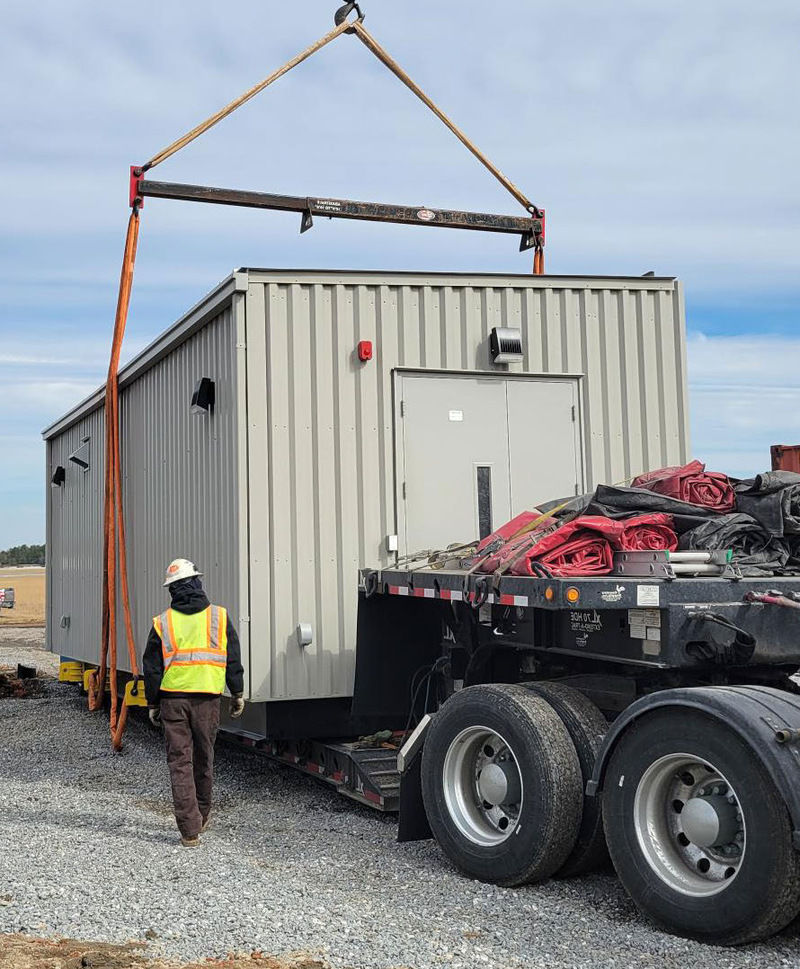 The vault arrived in two separate sections that were joined onsite. |
 Bill Weigel, the company’s southeast regional sales director, notes that prefabricated units are especially practical in remote locations with limited infrastructure, or in climates where the weather makes onsite construction difficult.