Raising money for major construction projects is typically a major challenge, but officials at Lafayette Regional (LFT) recently got the job done in short order with a short-term sales tax earmarked to help fund a new terminal.
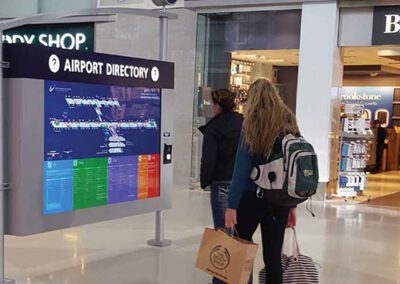
As airports become increasingly complex environments to navigate, guests need more help from wayfinding aids. Detroit Metropolitan Airport (DTW) is doing its part to relieve travelers' stress by installing digital LG directories throughout its two terminals.
Denver International Airport (DEN) has a new tool at its disposal for managing winter operations: in-pavement sensors that help predict when ice will form on runway and other airfield surfaces. The system includes five clusters of sensors embedded in Runway 17L-35R, one of DEN's four north/south runways, and three more clusters in adjacent high-speed taxiways. The in-pavement sensors were installed as part of a $46.5 million runway resurfacing project.
In June 2015, Seattle-Tacoma International Airport (SEA) completed a $23 million cargo expansion project designed to support the growing cargo demand the airport is experiencing and hopes to increase.
With huge windows and plenty of open space, the mezzanine in Terminal 1 provides the best airfield views at Minneapolis-St. Paul International (MSP). And until recently, 5,000 square feet of the prime airport real estate was used for storage. That's right, storage. Late last year, however, MSP began leveraging its second-story asset to create a new 'luxury amenity.' It now leases the mezzanine space to MAG USA for an upscale common-use passenger lounge. MAG USA is the U.S. subsidiary of U.K.-based Manchester Airport Group, which owns and operates four British airports, including Manchester Airport and London Stansted Airport.
Passengers at Indianapolis International (IND) will soon have a new and greener option for getting to and from the airport: an all-electric car-sharing program. BlueIndy, which launched local service in September, is slated to open a 20-car station in the airport's parking garage later this month. The new facility will allow arriving passengers to pick up cars at the airport and drop them off at stations near their destinations. Departing passengers will be able to pick up vehicles at stations throughout the Indianapolis metro area and return them to the new station at IND.
Terminal renovation projects often provide shiny new flooring, fresh paint and updated fixtures. But they can also be an excellent opportunity to spruce up dated marketing strategies. Gerald R. Ford International and Louisville International are both seizing the chance to renovate their brand identities while remodeling their facilities.
Between international turmoil, nationwide security challenges and the headlines that invariably follow, Philadelphia International Airport (PHL) is implementing an autonomous security master plan. As security manager at PHL, Renee Tufts is accustomed to playing in the big leagues. If a security incident occurs at a small, rural airport, news may trickle around the nation or industry; but if a similar issue occurs at a large airport, the floodgates swing wide open, Tufts explains.
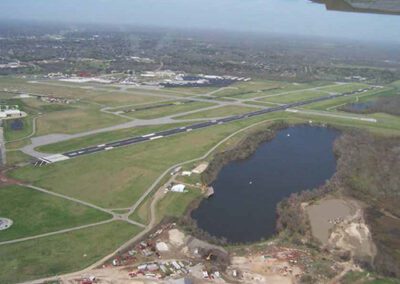
Getting a new facility approved, funded and built is typically a daunting task. But every now and then, things just seem to fall into place. That was the case for Mark Day, director of engineering and maintenance at Blue Grass Airport (LEX).
Kodiak Benny Benson State Airport (ADQ) faced a quandary when devising plans to meet the federal mandate for runway safety areas: There simply wasn't enough land at the island-bound Alaskan facility to add them. So planners got creative and built into the ocean. Contractors moved an estimated 1.1 million tons of rock to fill a portion of the Gulf of Alaska in order to create enough surface area for an engineered material arresting system (EMAS) on one runway and to lengthen another runway to allow for an EMAS bed on its other end.
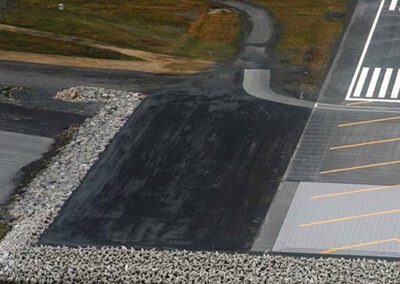
The Metropolitan Nashville Airport Authority gave contractors 60 days to rebuild the runway and terminal at John C. Tune Airport (JWN), and collectively, they rose to the challenge. In order to provide numerous crews with around-the-clock access to multiple worksites, JWN officials closed the airport from June 1 to July 30, 2015.
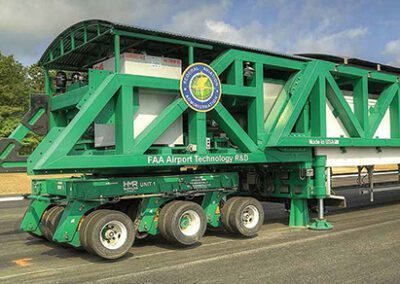
Research that may lead to more widespread use of 'green' runway pavement materials is underway at the FAA National Airport Pavement & Materials Research Center, in Egg Harbor Township, NJ. Engineers at the new facility use a custom-designed heavy vehicle simulator to test asphalt and other pavement materials at high tire pressures and temperatures.
Few news reports grab my attention more than regulatory action within the industry. When I heard about airports being fined for activities related to winter operations, my first inclination was to find out what happened so my airport could avoid the same consequences. Then I began to worry whether our industry is somehow failing in this area.
As of December 9, 2015, travelers flying out of Tijuana's General Abelardo L. Rodriguez International Airport (TIJ) have a faster and easier way to access the Mexican airport from the U.S. side of the border. Instead of waiting in long lines of vehicles at the San Ysidro or Otay Mesa border crossings, airline passengers can now use the new Cross Border Xpress (CBX) terminal, which spans the U.S.-Mexico border.