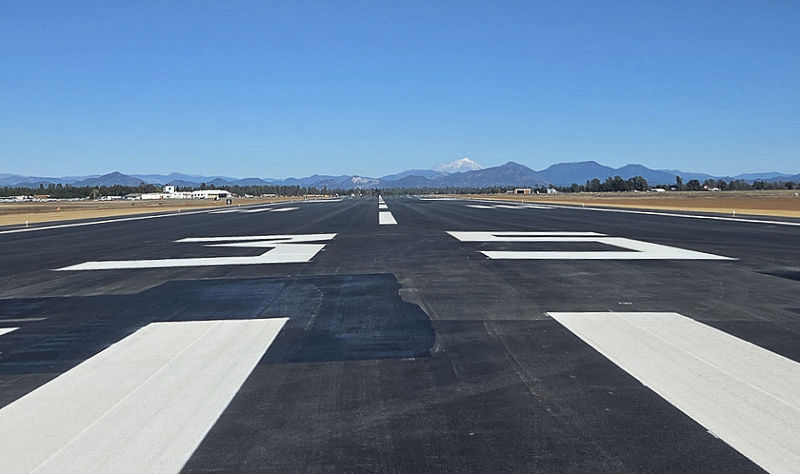
Much like the tortoise proved in Aesop’s fable, slow and steady can also win the race for federal funding. No one knows that better than Redding Regional Airport (RDD) in Northern California. But the city-owned airport also showed hare-like speed once it secured a much-needed Airport Improvement Program grant.
For decades, RDD’s primary runway was on the decline, eventually warping and undulating due to age and weathering. But despite operating with pavement first constructed in 1991 and last restored in 2001, the airport was unable to obtain FAA funding for a rehabilitation project.
In recent years, Runway 16-34 needed a major rehabilitation to keep the runway in safe operating condition. Without major improvements, pavement deterioration could have grounded crucial airline connections to larger airports in the region.
| facts&figures
Project: Runway Rehabilitation Location: Redding Regional Airport, in CA Scope: Mill & overlay, crack repair, grade correction on 7,003-ft. asphalt runway Projected Cost: About $30 million Funding: $28.4 million Airport Improvement Program grant; passenger facility charges; $1.5 million loan taken by city for parking lot enhancements Key Benefits: Operational continuity for commercial & general aviation customers; fixing years of pavement deterioration Project Timeline: Design 2022-Jan. 2024; preconstruction Aug. 2025; runway closure Sept. 23-Oct. 20, 2025; runway reopened in late Oct. 2025; off-peak nightly closures Nov.-Dec. 2025 for remaining work Lead Consultant: Mead & Hunt Construction: Redding Airport Constructors, joint venture of DeSilva Gates & J.F. Shea Prime Electrical Contractor (Runway Lights & Signage): Royal Electric Co. Soil Stabilization & Backfill: Griffin Soil Site Prep, Grading & Erosion Control: M&S Environmental Landscapes Airfield Markings: Centerline Striping Co. Inc. Associated Projects: Repaving rental car, public & employee parking lots |
But persistence paid off—with the assistance of California’s congressional office and local officials who coordinated with the FAA to secure an Airport Improvement Program grant of up to $28.4 million in time to rescue the rapidly deteriorating airfield infrastructure. Today, RDD has a freshly regraded and resurfaced runway that serves a mix of scheduled commercial service and general aviation traffic.
“We may have been able to last another year or two [without major rehabilitation work],” says Airport Director Andrew Solsvig, adding that one bad winter could have cut the timeline even shorter. “If we were to get any significant damage where [the pavement] wasn’t really fixable, that would have shut us down for a longer period of time. That’s the risk you take.”
Ultimately, it took a project team that stayed together through funding delays and paving crews that moved quickly and efficiently during a monthlong runway closure to pull the project off. With crucial cooperation from airline partners and airport users, RDD shut down its primary runway from Sept. 23 to Oct. 20 last year so contractors could work around-the-clock to revive the aging pavement with a fresh asphalt overlay.
“It was a really good collective effort with everyone inside and outside of the airport world,” says Assistant Airports Manager Ken Griggs, whose responsibilities includes RDD and Benton Field (O85). “It was a very big, needed project. Like any infrastructure, there is an expiration date.”
With commercial airline traffic grounded during the runway project, the city of Redding also took the opportunity to repave RDD’s rental car, public and employee parking lots. It cost $1.4 million for resurfacing, removal of curb islands and installation of initial charging stations for electric vehicles—expenses not in the initial project that were covered with a loan.
Early Challenges
The airport has two commercial carriers that provide direct flights to four key markets—Alaska Airlines with service to Seattle-Tacoma International (SEA), and United Airlines to San Francisco International (SFO), Los Angeles International (LAX) and Denver International (DEN). In 2024, enplanements totaled about 88,700, up 1.2% from the previous year; and 2025 enplanements topped 89,000 despite the month off for runway repairs.
If further pavement degradation had forced RDD to close to commercial traffic, there would have been significant inconvenience to the region.
Fortunately, the airport prevented that scenario—but not without challenges. The initial plan was to close the runway for full rehabilitation in 2024, but an expected FAA grant fell through, postponing the schedule for about one year.
Airport officials and lead consultant Mead & Hunt worked to keep their planning and construction partners on board and update travelers about the new timeline for runway work. They also notified airline partners well in advance to allow them time to suspend ticket sales.
“Let’s assume we’re going to start in mid-to-late September. They want to know in June for their scheduling purposes at the very latest,” says Solsvig.
Not only did all the project team members stay engaged, they also held their bids for a year—even Redding Airport Constructors, a joint venture of DeSilva Gates and J.F. Shea, both of California.
As summer approached, the team remained focused on moving the project forward while awaiting a decision from the FAA on the status of a grant. “We get to the end of spring and we still don’t have an answer,” Solsvig recalls.
That’s when he called the now-late U.S. Congressman Doug LaMalfa and other local politicians. “They worked [the issue] from Washington, D.C., because we needed a large chunk of discretionary money as part of this project. Luckily enough, within a few weeks, we were able to get that grant in place and give the OK to our construction team.”
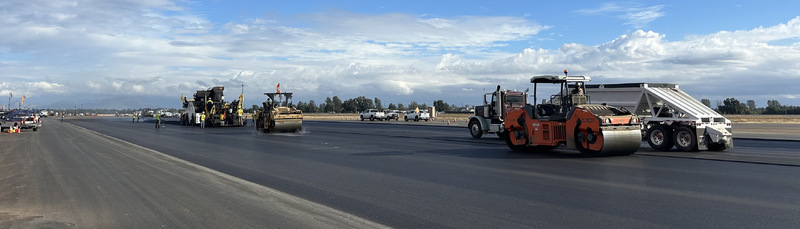
The entire 7,003-foot runway was milled and overlayed with fresh asphalt.
Planning and Communication
Advanced planning was important on several fronts. First, though airlines agreed to suspend operations for a month while crews rehabilitated the runway, they needed time to communicate those changes to passengers.
The airport also worked to minimize impacts on cargo operators, general aviation customers, CAL FIRE and the U.S. Forest Service, which has a big tanker base on the airfield. They were all able to continue flying in and out of RDD for all but six days during the project by using RDD’s 5,067-foot crosswind runway.
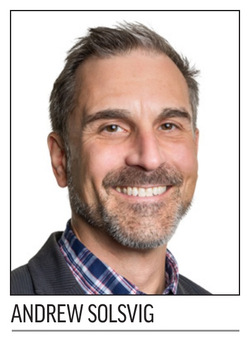 “Scheduling the time of year was important in planning,” Solsvig relates. “Finding a time when it’s outside of fire season, knowing the importance of that, and when it was a seasonal adjustment for commercial traffic, that’s why October was chosen.”
However, the original October start date was moved into late-September due to concerns over rain. And once again, the airport had to make sure all of its partners were still on board.
Jeffrey Leonard, business unit leader of aviation services at Mead & Hunt, notes that communication with stakeholders started early and continued throughout the project. Leaders from all companies involved met daily and weekly to update each other on progress and challenges before and during construction.
“I think that’s what set us up early for success,” Leonard reflects. “At the beginning of the project we had a huge meeting, once we knew this project was going to get funded, to just talk about partnering, communication and transparency. That started extremely early.”
Mead & Hunt also authorized leaders of each particular unit to make on-site, immediate decisions to keep the project moving with formal paperwork to follow.
Throughout the process, there were expected differences of opinion, but they were solved during regularly scheduled meetings. In fact, Leonard reports that once work was underway, the team’s biggest challenge was deciding whether to suspend work for a day due to unexpected weather.
“Shockingly, we did not get caught shutting down mid-shift for rain even once,” he adds.
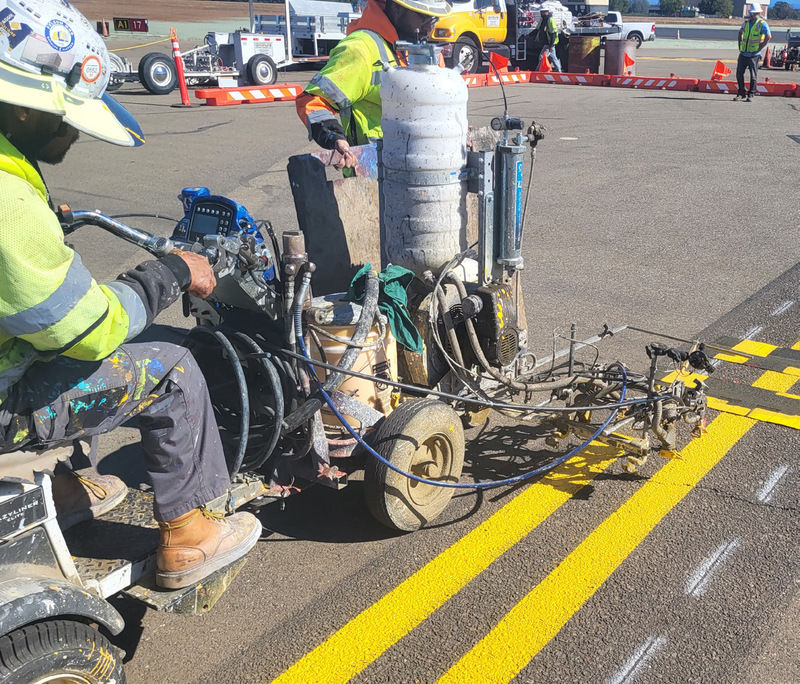
During the runway project, the city also renovated several airport parking lots.
During the project, crews milled and overlayed the entire 7,003-foot-long,150-foot-wide asphalt runway. Cracks were repaired, grading variations were corrected and new lighting was installed. Taxiway connectors and runway intersections received similar improvements. Work was substantially complete on time and under budget, with an expected lifespan of 20 years.
Month Off Paid Off
The project team’s collaborative approach and the willingness of RDD’s airline partners to temporarily suspend flights allowed for a full-on 24-hour construction schedule that cut the overall project time to just under a month. Doing the project piecemeal, Griggs and Leonard explain, would have taken three or four months, and could have tripled the cost.
 “It definitely saved a lot on the construction cost as well as the overall timeline that we would have been closed,” Leonard relates. “Because obviously, if you have to open and close, you have to stop a half a shift to basically button everything up for reopening. So, it allowed us a more streamlined, more cost-effective project.”
The approach also positively impacted the final results. Paving during the night and stopping each morning to open the runway for traffic would have created connection points where pavement might fail more quickly over time, explains Griggs. By using a continuous pavement process, RDD should not need to refurbish the surface for another 20 years, he adds.
“We have a clean product,” Griggs remarks. “It buys us a lot more time to be self-sustaining without having to do any patchwork or repairs.”
When the primary runway reopened in late October 2025, it did so as Runway 17-35 to reflect slight magnetic shifts that had occurred slowly over the years. Similarly, Crosswind Runway 12-30 was redesignated Runway 13-31. Naturally, the new compass headings required the airport to update pavement numbers, airfield signage, etc. Final striping and a few other minor closing pieces of the project remained in process this spring.
Another pending project for the airport is runway safety area improvements. FAA initially wanted to add shoulders and safety areas on both sides of the primary runway during the resurfacing project, but that work was deferred because it would have added significant cost.