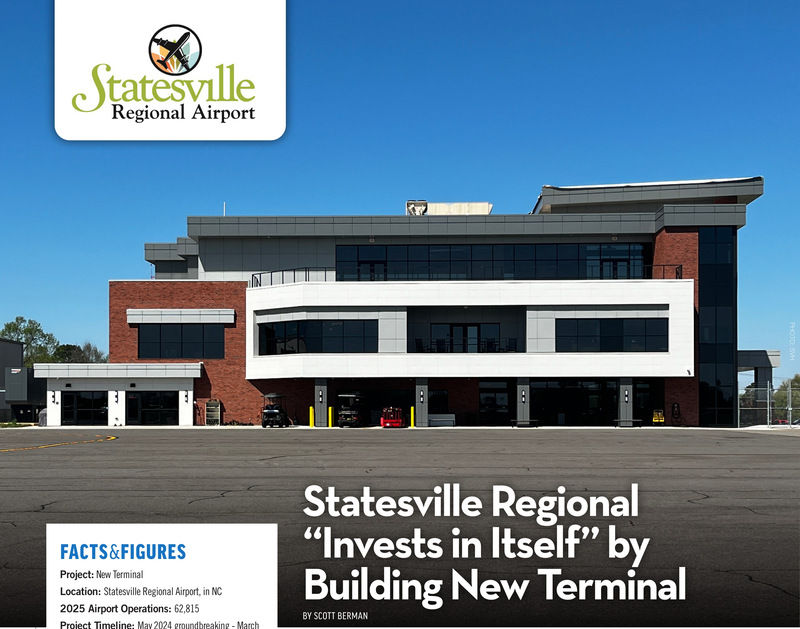
When local officials began eyeing ways to improve Statesville Regional Airport (SVH) in North Carolina, all eyes were on its dilapidated terminal building. Clearly, something had to be done.
The 3,600-square-foot, single-level building from 1985 was “very small and very old,” says Airport Manager John Ferguson. “It was leaky and had mold. It just didn’t portray our community very well.”
The remedy was revealed this spring: a new $12.5 million terminal with three stories and more than 26,000 square feet of space. City Manager Ron Smith describes it as a building anyone would be proud of. “It’s a wonderful facility,” he remarks.
| facts&figures
Project: New Terminal Location: Statesville Regional Airport, in NC 2025 Airport Operations: 62,815 Project Timeline: May 2024 groundbreaking – March 2026 grand opening Facility Size: 26,082 sq. ft. Cost: $12.5 million Funding: $22.2 million from state ($6.7 million in 2023, $15.5 million in 2024) Design: Lindsey Architects Prime Contractor: Samet Corp. Civil Engineering: Parrish & Partners Demolition of Old Terminal: D.H. Griffin Wrecking Foundation & Ground Improvement: Keller North America Building Envelope Consultant: WBD & Associates Building Envelope Contractor: Martin Roofing Services Flooring, Ceilings, Cladding, etc.: Bonitz Wall Systems: Precision Walls Roof Systems: WXTite LLC Vertical Transportation: Schindler Elevator Plumbing: Gentry & Son Plumbing Exterior Brick Manufacturer: Statesville Brick Seating: Interior Elements |
The city of Statesville, which owns and operates the airport, had already purchased the fixed-base operator on the field in early 2019 for $5.4 million, and then proceeded to map out a plan for improving the terminal and other parts of the general aviation airport.
It did so because SVH is an important asset to the community and region, Smith explains. “The airport is a tax revenue generator,” he elaborates. “It provides jobs for the community, and we want to continue to see it grow.”
Traffic at the airport is, indeed, growing. Aircraft operations increased 33% from 47,015 in 2023 to 62,815 last year. Ferguson attributes much of the growth to the region’s increasing population, primarily due to residents moving north from Charlotte and Mooresville, NC.
Charter activity for several NASCAR teams is another factor. Victory Air bases nine jets at SVH, and Champion Air bases three. The airport’s connection with NASCAR mirrors the sport’s large presence throughout the state, including several racetracks, the NASCAR Hall of Fame and headquarters facilities for most of the teams.
Given these existing relationships, plus encouraging prospects for continued growth and development, city leaders were inspired to take action about SVH’s badly outmoded facilities.
The Process
In summer 2021, a committee of airport stakeholders visited four other airports throughout the region for a close look at their facilities. The team included Ferguson, SVH Office Manager Carissa Barnette, two representatives from the Iredell County Economic Development Corporation and a member of the Statesville Chamber of Commerce. In North Carolina, they toured Concord-Padgett Regional Airport, Charlotte-Monroe Executive Airport and Stanly County Airport. In South Carolina, they visited Rock Hill/York County Airport. All four are general aviation facilities; Concord-Padgett Regional also has commercial service.
Committee members asked leaders at each airport what they like about their terminal and what they would suggest to SVH. The advice was unanimous: Build it bigger than needed now and add more storage space.
Funding, of course, was crucial. Ferguson credits the Statesville City Council for its support and related outreach to elected state officials. State Rep. Jeffrey McNeely and State Sen. Vicky Sawyer, who represent the region in the North Carolina General Assembly, saw the need and potential at SVH and spearheaded efforts to add two separate line items to state transportation bills that provided $22.2 million for the terminal project ($6.7 million in 2023 and another $15.5 million the following year). Construction of the terminal building came in at $12.5 million, with civil engineering and architectural fees costing an additional $1.3 million. Another $6.5 million of the state funding will be used for a project to prepare an airfield site for hangars and other developments.
With funding secured, the city selected Samet Corporation as the primary general contractor. It also chose to use the construction-manager-at-risk (CMAR) project delivery method.
 Samet Director of Field Operations Loyd Johnson says the CMAR method worked well for the project because of the reduced risk and budget predictability it provided the city and airport. The contractor is also using this method for a terminal and concourse modernization project underway at Piedmont Triangle International Airport in Greensboro, NC.
Johnson explains that CMAR often trades a slightly higher fee upfront for significantly reduced risk, better budget predictability and a collaborative team aligned toward the same outcome. “This is especially valuable on complex or first-time project types like airport terminals,” he notes.
Crews broke ground in May 2024, with demolition of the old terminal building taking priority because the new structure was built on the same site. The upgraded three-story building was officially open for business in March 2026.
The Design
Airport leaders had a clear vision about what they wanted, and collaborated closely with Lindsey Architecture to translate their ideas into construction drawings. The vision was for a sleek, modern terminal that looked like it belonged in the region. “We wanted to reflect Statesville,” says Ferguson. It was also important for the new building to be welcoming and attractive, he adds.
 Project Architect Amanda Lamb notes that the majority of the terminal exterior is covered with locally manufactured brick in a deep red color that is prevalent in the city’s historic downtown. “Early in the design process, we spent some time in downtown Statesville to look at building materials and characteristics so we could pay homage to Statesville’s heritage,” says Lamb.
That historic reference is balanced by modern materials including brick veneer, fiber cement panels and a metal panel rainscreen. Low-e glazing was added for climate control inside the building since there are a lot of glass windows. The third-floor balcony has lighting along the railing to help illuminate it at night.
Another key design objective was to provide comfort and state-of-the-art amenities to passengers, pilots, employees and local citizens. “We used warm tones inside the lobby, which helps relax passengers,” says Lamb, adding that the views afforded by ample windows also have a soothing effect.
For additional comfort, architects specified a variety of seating options, including styles with soft yet durable materials. An island with built-in outlets provides a convenient place for guests to charge laptops and other devices.
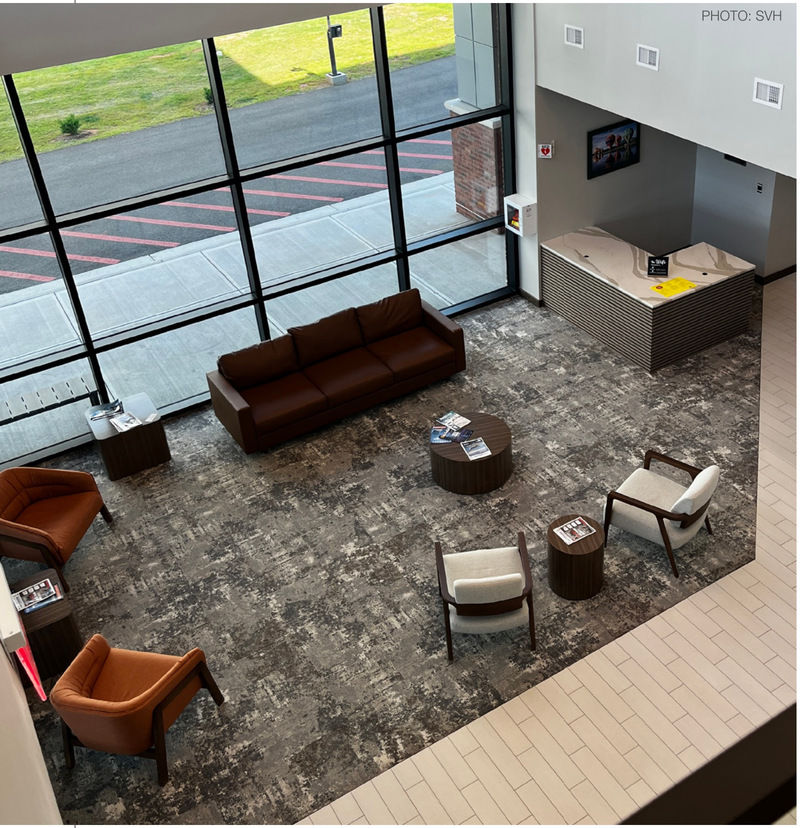
Designers selected warm tones for the lobby to help passengers relax.
Space on the third floor is earmarked for a restaurant, and airport staff are working to find the right tenant to operate it. A 657-square-foot boardroom on the second floor will be made available for outside groups to rent.
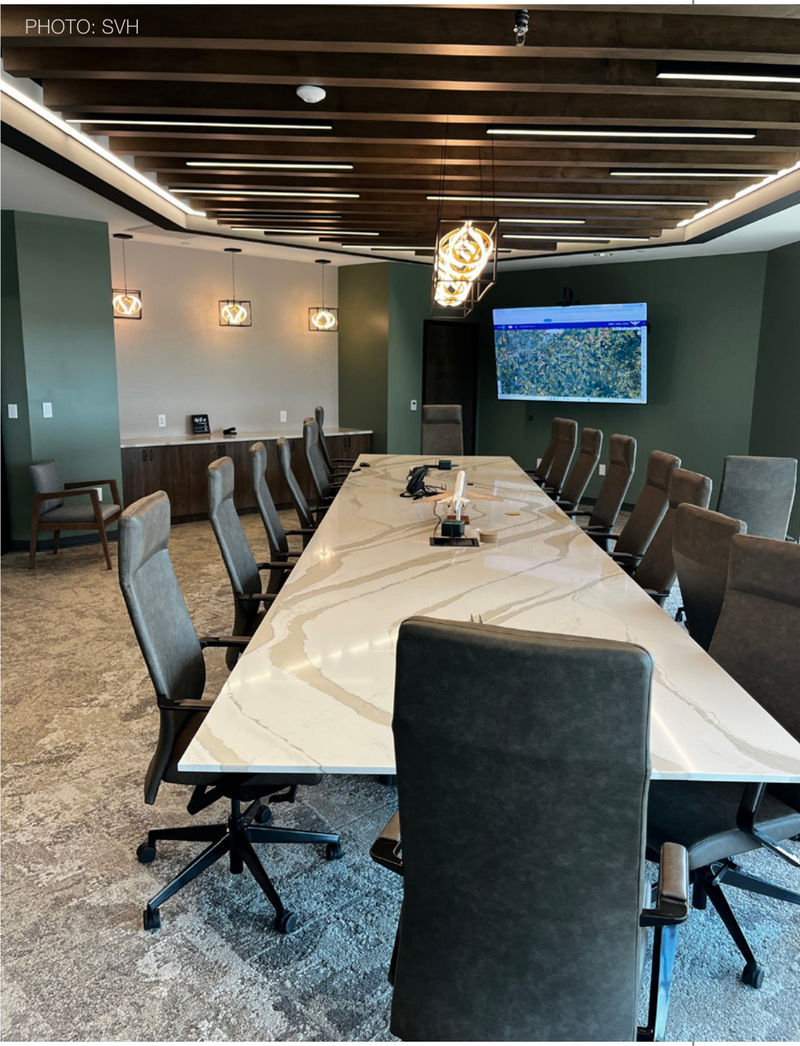
Pilot amenities include a work station, private lounge, two “snooze rooms,” and a shower. “Our team spent time talking to local pilots to find out what they are looking for in airports,” Lamb relates. Project designers located the pilot facilities on the second floor to help reduce noise and distractions and allow them to rest in between flights.
Other Improvements
Change is also occurring airside, including the recent completion of a $9.8 million southside taxiway project funded by the North Carolina Department of Transportation Aviation Division. This March, SVH finished a runway safety zone improvement project funded by a $9.3 million FAA grant. Crews cleared away obstructions such as an old rock dam that was a remnant of an old runway project.
A $6.5 million project to prepare six pad-ready sites for hangars, aircraft parking and other uses is currently underway, with the city calling for build-out bids this past June. That development is being partially funded by unused portions of the $15.5 million state grant for the terminal project. Other initiatives in the works include an apron expansion and airfield lighting improvements.
Looking further ahead, the airport is exploring funding options to lengthen its sole asphalt runway from 7,000 feet to 7,700—a significant change that would enable more planes to take off fully loaded and fully fueled, thus eliminating the need for intermediate stops elsewhere.
Finally, Smith and Ferguson are carefully monitoring preliminary plans for Elizabeth City State University to house operations for its aviation school in a hangar that would be constructed at SVH.
 Continued growth in aircraft operations and the likely prospect of an on-field aviation school could prompt even more airfield projects. “We’ve got to start thinking about a control tower and other improvements that are necessary when you have that activity,” says Smith.
A site has been designated for a future tower, but specifications and a timetable have yet to been seen. Officials may be focusing on the tower project in about a year, Smith notes.
For him, it all boils down to one guiding principle: “We’re investing in ourselves.” The goal, he says, is nothing less than building the best general aviation airport in North Carolina.
Food for Thought
Considering the many challenges airport decisionmakers can face during infrastructure projects, stakeholders at SVH want to help by suggesting a few things to bear in mind.
Ferguson emphasizes the value of building diverse coalitions to support airport improvements. “Bring in your elected officials and get their buy-in,” he says. “Everybody has to buy in. It makes it so much easier. And get your state aviation officials to buy in also.”
On another tack, Johnson advises choosing the project partners and delivery method carefully. He also recommends asking plenty of questions: What are the funding opportunities? What is the comfort and knowledge about construction of those managing the project? What are the operational constraints surrounding disruption during construction? What is the construction timeline, and are there opportunities for schedule flexibility?
Lamb emphatically echoes what she heard when visiting other airports before SVH’s terminal project: “Always provide room for growth!”
“More space means more money,” she acknowledges. “But everyone involved said they would have spent the money, and that it’s cheaper to add space when you are already building than paying for an expansion down the road.”
While many airport managers who have built or refurbished a terminal say they never want to do it again, Ferguson doesn’t seem to bear the same scars. “This one went so smoothly,” he says, noting the need for only two change orders during the $12.5 million construction project.
Finally, Smith sees it this way: If all the growth occurring at SVH is a problem, it’s a great problem to have.