
Fueling and deicing operations have a lot of moving (and stationary) parts that need to be located, inspected, maintained, replaced and documented. For decades, much of that information was recorded on paper or stored in spreadsheets and databases scattered throughout several locations. These days, asset management software platforms digitize and centralize “paperwork,” manage work orders and enhance operational efficiency.
Earlier this year, more than a dozen Canadian consortia responsible for fueling and/or deicing operations throughout the country began using a cloud-based platform to centralize asset records, inspections and maintenance activities, compliance documentation, engineering information and planning data. Authorized users can access role-appropriate reports, dashboard data and other information across participating facilities in their portfolio 24/7 via connected web or mobile devices.
The various consortia purchase SAIM™—short for Smart Asset Integrity Management—as a monthly subscription.
| facts&figures
Project: Digital Asset Management Platform for Fueling & Deicing Operations Locations: 12 airports throughout Canada Tech Platform: SAIM™ – Smart Asset Integrity Management Developed by: SAIM LLC, a subsidiary of Argus Companies Users: 15 Canadian fueling consortia, 3 deicing consortia & partners they authorize Deployment: Jan.- summer 2026 First Location: Vancouver Int’l Airport Cost: Monthly subscription based on user’s selected modules Airline Consortia Manager: FSM Management Group Key Benefits: 24/7 access to track fueling & glycol operations assets, inspection/maintenance schedules, design/engineering, capital investment decisions, regulatory compliance; greater visibility, accountability & audit readiness across multiple locations; trending data to support repairs & preventive maintenance; asset history & cost information for planning & budget decisions; alerts that improve response time & facility records; interactive digital twins, LiDAR imagery & as-builts for troubleshooting & improvement projects; reduction in data entry errors; improved retention of institutional knowledge |
Frank Femia, director of Fuel and Deicing Services and Renewable Fuels with Air Canada, laughs recalling the days of storing data in boxes and boxes of paper. “I am an auditor and inspector as well, and the amount of paperwork we used to generate, it’s incredible.” He acknowledges that some people still prefer hard copies, but expects physical storage needs to decline as acceptance of new technologies grows.
The digital transition for Canadian consortia traces back more than a decade ago, when their U.S. counterparts became concerned about experienced personnel retiring and taking years of site-specific knowledge about systems and assets with them. Records were spread throughout stacks of papers, shelves of binders and spreadsheets buried in various folders for the next generation of personnel to find and decipher, which sometimes proved untenable.
That prompted Argus Consulting to find a better way for its clients. After identifying gaps in existing off-the-shelf asset management tools, Argus began developing a platform tailored to the needs of complex, regulated aviation infrastructure. The result was SAIM, a Software as a Service platform that connects asset information, maintenance and inspection workflows, documents, parts inventory, digital models and real-time system data signals. Development began in 2017, followed by pilot programs in 2019 at Oakland International Airport in California and McCarran International Airport (now known as Harry Reid International) in Las Vegas. (See May 2021 edition of Airport Improvement for more details.)
Today, Canadian fuel consortia are using an evolved version of SAIM to help manage their fueling and glycol assets and operations.
Mark Bourdeau, a fuels specialist at SAIM with 45 years of fuels industry experience (including service as an airline fueling consortium chair), recalls that paper-and-pencil systems, Excel and Access all served a purpose, but also fragmented information across facilities, airlines and operating locations. Valuable data was isolated and much of the employee expertise behind it has been lost. As Bourdeau explains it, SAIM consolidates that history into a “single pane of glass,” providing timely, meaningful data to help users make informed decisions.
SAIM President Tina Lux-Boim explains that during development, U.S. consortia wanted the ability to compare the performance of various fueling facilities and have better visibility of where investments were most needed. “They wanted benchmarks,” she says. “They wanted to see what was happening and what might be at risk across their network, without having to reach out to each location or log into multiple platforms with multiple usernames and passwords.”
Since 2022, SAIM has been deployed at nearly 60 airports across the U.S. and Canada. It is used by airlines, consortia, third-party operators, airports and their engineering teams. Although the digital platform originated in fuels, Lux-Boim emphasizes its capabilities can support other complex airport systems. “Whether you are managing airfield infrastructure, mechanical and electrical systems, terminals, baggage systems or fueling facilities, SAIM can help simplify how you track the assets and the many operational and compliance tasks, data and records associated with them,” she says.
Canadian airlines became interested in the asset management platform after seeing its success with U.S. airlines. “We kept a very close eye,” says Femia. “In essence, we let the U.S. market do most of the troubleshooting.”
The fueling and deicing locations where SAIM is being used in Canada are separate legal entities managed collectively through an executive committee, allowing selected solutions to benefit the broader network. “You leverage economies of scale, you leverage continuity—these are the benefits we bring,” Femia explains, adding that the new system has significantly improved the efficiency of tracking fueling and glycol assets.
The SAIM contract was awarded in November 2025, with deployment beginning at Vancouver International Airport (YVR) in January 2026. Rollout to the remaining 12 airports was completed this summer.
Top Tracks
Bourdeau explains the type of information he pays closest attention to: “For me, it is the forward-looking data on regulatory items and risk analysis. Fuel is still considered one of those single points of failure, and it literally is.”
He says the consequences of asset failures can be more significant these days due to higher demand on operations. And even while there is more efficiency in how assets are used, failures can still occur; therefore, operators must consider how to reduce risk, respond quickly, and recover.
Femia identifies supply disruption as one of the greatest fuel-related risks in aviation. With billions of dollars of assets across the country, airlines can be forced into reaction mode during a disruption like a pump outage—either tankering additional fuel to affected airports or, in extreme scenarios, canceling flights.
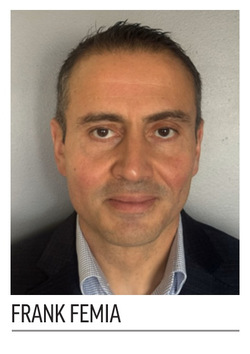 “Where I look to gain the most benefit out of SAIM is in the ability to, not so much predict, but be on top of asset management,” says Femia. He also relies on the system to support preventative maintenance.
“My view has always been the more you stay on top of things, the fewer surprises you have,” he adds. “Inspections, work orders, corrective actions, deficiencies, compliance tasks—is the work being done like it’s supposed to be done? Are adequate replacement parts available in inventory?”
Eventually, Femia hopes the new digitized system will help reduce maintenance costs by providing better visibility of asset age, condition, maintenance history and replacement needs. “Will the benefits show up two or three years down the line? I want to find out,” he says.
How Does It Work?
SAIM is a cloud-based digital twin platform that connects 3D models of facility infrastructure to asset data, including real-time equipment signals, automated maintenance and inspection tasks, digitized work orders, training and manuals, compliance forms, parts and inventory management, fleet tracking, documents, and related reporting and dashboards.
In the field, authorized personnel can use handheld mobile devices to read Near Field Communication (NFC) tags or other asset identifiers to open the correct digital records; complete assigned tasks; capture tagged photos, videos, or voice notes for inspections; submit work orders; and synchronize updates for managers and other approved stakeholders.
 Lux-Boim points out that the system primarily houses maintenance and compliance data—not information that could compromise personnel or corporate data, or sensitive details about the airport or fuel farm. “The system is hosted in Microsoft Azure and uses security architecture designed for operational data,” she adds. Access is permission-based and can be configured according to each client’s facilities, users, roles and responsibilities.
SAIM is subscription based, modular and can be scaled through three connected capability areas:
- Digital Twin/As-builts, including measurable visual facility documentation, interactive models and as-built information that can support engineering, planning and communication with remote stakeholders.
- Maintenance and Inspection for automated and custom task assignment and tracking of regulatory and operational inspections and work. This includes recurring and one-time assignments, work orders, cost history, equipment specs, compliance records, inventory tracking and related documentation.
- Real-Time Signals Monitoring, which connects with Supervisory Control and Data Acquisition (SCADA) and other systems to bring equipment alerts and performance data into centralized dashboards and supports trending.
Clients subscribe based on the capabilities and deployment scope they need/desire, and pay associated monthly fees. The Canadian consortia opted for a multi-year agreement. “We wanted consistency in the platform,” explains Femia. “It’s not something to deploy for a year. We are in it for the long run.”
SAIM has undergone NIST 800 assessment (a government requirement for cybersecurity) and received a 95% compliance rating. Currently, the company is working on SOC2 and ISO27001 certifications, which are international cybersecurity ratings.
Tag Team
Many physical assets, such as pumps and flow meters, are linked to their digital records in SAIM via small NFC tags. Each tag is assigned to a specific asset, allowing operators to tap with the SAIM Inspect app and immediately access the asset’s assigned tasks and other associated information. The tags, often secured with steel wiring or epoxy, are designed to withstand the temperature extremes common at airport facilities and can be quickly replaced in the field without coding or programming.
Mobile devices used at fueling facilities must follow each operator’s site safety requirements and hazardous-location procedures. SAIM offers “intrinsically safe” Android phones and tablets for field use that are recommended, but not required. The SAIM Inspect app is available for authorized users with an active subscription. iPhone support is planned for 2027, pending certification for safe use around fuel-handling equipment.
Lux-Boim explains that using NFC tags puts the onus on the operator to inspect assets in person, ensuring more accurate assessments and reporting. When a worker taps a tag with a handheld device, the assigned tasks are displayed. Completed work is time-stamped, inspections can be signed digitally, and records are synchronized to the web, supporting more consistent and organized documentation and visibility for both field teams and managers.
For Femia and other users, the system provides accountability. “We hire a third party to do the work, and having the ability to physically track if the work is being done is key,” he says. “It gives us the assurance that the required events are being completed.”
The variety of tagged items ranges widely—from fuel storage tanks, valves and meters, to hydrant system components, support vehicles and other equipment. “As long as you can measure the activity associated with that asset, you can tag it and continue to monitor it,” Femia explains. “I think we have tagged more than 4,000 unique assets so far.”
 While each consortium chooses which items to tag, the underlying need and utility are consistent. “Effective maintenance and capital planning start with knowing what assets you have, where they are, and what condition they are in,” explains Bourdeau. “Without an accurate asset inventory and history, it is difficult to plan maintenance, anticipate replacement needs, or make meaningful financial decisions.”
As fueling and deicing facilities continue to grow in size, it would be difficult to maintain an accurate accounting of all assets and their locations without NFC tags, he adds.
Who Can Log in?
Each fueling or deicing consortium dictates who has access to its SAIM platform. User permissions can be configured by role, facility and function, allowing the consortium to determine which parts of the system, records and data each user can view or manage.
Service providers such as Menzies, Swissport, PLH Dublin and Inland were natural choices because they manage day-to-day operations and work on assets. Inspections data, maintenance activities, asset inventory, reporting, signals and alerts are all highly pertinent to them. Airline representatives, consortium members, airport personnel and other stakeholders can be given access to specific dashboards, facilities information, records and/or reports relevant to their responsibilities.
Clients can also provide limited or project-specified access to engineers, equipment vendors, contractors or construction managers who are supporting operational or capital improvements. Depending on their role, those teams may use digital twin information, equipment records or real-time signals to verify as-built conditions, coordinate design and construction activities, or help troubleshoot facility issues remotely.
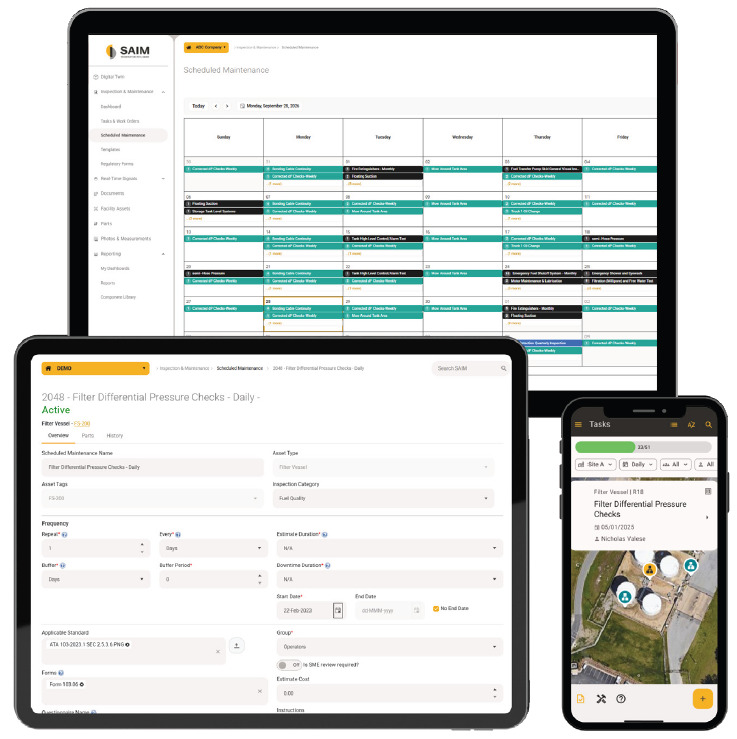
The SAIM platform connects planning in the office with work performed in the field.
Authorized airline users like Femia can monitor performance across several facilities from a single dashboard without traveling to each site or logging into multiple systems. He says the platform’s greatest advantage is replacing paperwork and on-site inspections with quick access to consolidated data. “We are not there yet, but part of the objective for this year is to use the dashboards as part of our quarterly business reviews with the operators,” says Femia.
Airside and Seaside
Marine facilities can also fall under consortia purview. “In Vancouver, we have the ability to receive fuel via ship at a marine terminal and move it through a dedicated pipeline to the airport fuel facilities,” says Femia.
Airlines form the consortium ownership structure, but the system can accommodate other approved fuel suppliers. Femia describes it as an “open system,” allowing companies like Shell or Exxon to supply ships at the marine terminal. “We need that facility to be able to accept ships at the dock and we’re building a brand new one like it in Montreal,” he says.
The project Femia refers to is a $350 million jet fuel transshipment facility and marine terminal under construction in Montreal-Est, Quebec. It is being developed and managed by FSM Group’s Montreal International Fuel Facilities Corporation and is expected to be completed and fully operational in early 2027.
Femia says integrating technology with supply-chain information will be key for future fuel operations, “Having fuel and asset data from all of our operations at our fingertips is another area where I see SAIM bringing value,” he says.
Glycol, Too
SAIM’s asset management capabilities extend beyond fueling infrastructure to other complex systems, facilities and mobile equipment. Canadian consortia, for instance, are applying the platform across both fueling and deicing operations—managing stationary assets within storage and distribution systems, while also supporting the maintenance and field operation of into-plane fueling equipment, hydrant carts, refuelers, glycol-recovery vehicles and other fleet assets.
Three glycol consortia in Canada currently use the platform.
As Femia points out, there is significant crossover between fueling and deicing operations. At the most basic level, they both deliver, store and dispense chemical fluids that are crucial to keep airlines flying. And both involve complex systems, equipment and vehicles that must be inspected, maintained and documented. “The same principles apply for tracking output on all the storage, valves, pumps—all those assets,” says Femia. “That’s what we want to manage.”
That said, the products and operating requirements are likely to differ from one facility to another. Some fuel systems handle a common aviation fuel specification supplied by multiple providers, while deicing operations use different types and formulations of glycol that must be stored separately. SAIM allows consortia to configure their particular asset records, inspections, maintenance activities and compliance documentation around location-specific equipment, products and requirements.
Closed Loop Compliance
Environmental regulations in Canada require deicing fluids and associated runoff to be recovered. After aircraft are deiced on the apron or in centralized areas, glycol recovery systems collect effluent for processing, and the byproduct is recycled back into glycol for reuse. “It’s a closed loop,” explains Femia. “We recover it, we treat it, and we make glycol again to supply the airport.”
Tracking the assets, outputs and activities associated with glycol is essential for environmental compliance, maintenance monitoring and cost control. For Femia, preventative maintenance is one of the top priorities the platform supports—from the sweepers that collect spent glycol and the underground tanks that store it, to the distillation systems and other components later in the loop.
While regulatory compliance is crucial everywhere, reporting requirements can vary significantly by country and local government authority. Bourdeau notes that documenting applicable requirements and retaining associated records in the system helps clients maintain a clearer compliance history.
Challenges and Benefits
User adoption has been the main challenge since Canadian fuel and glycol consortia began implementing the SAIM platform earlier this year. Using a digital platform requires a more structured and consistent approach than many of the paper-based and other processes they previously used. “We have individuals who have worked in these facilities for the last 25 years. This is a change management process that has to take place,” says Fernia, “Other than that, the workflows and the training are pretty intuitive and we haven’t had any major issues.”
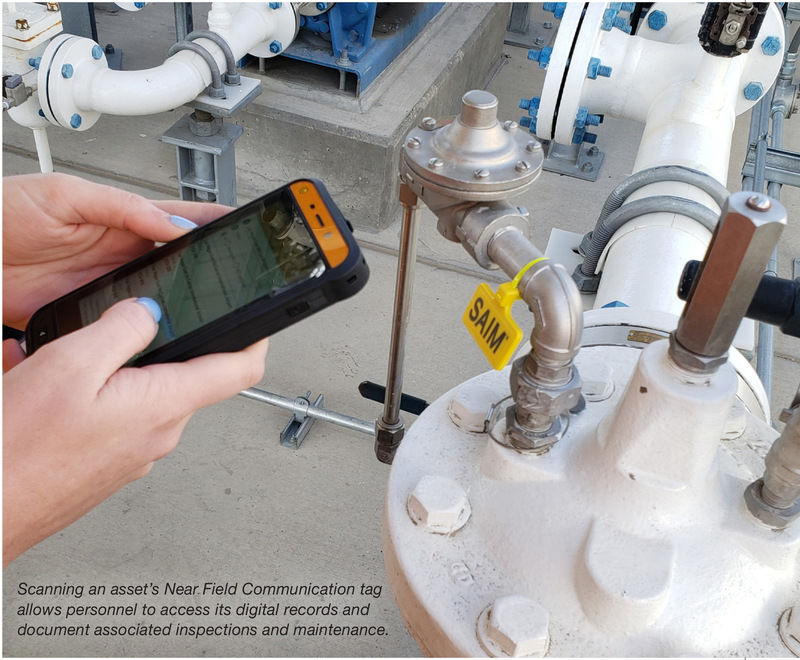
Scanning an asset’s Near Field Communication tag allows personnel to access its digital records and document associated inspections and maintenance.
As field users become more familiar with the platform, Femia continues to find additional benefits, one of which is sharing knowledge across locations. “SAIM’s strength is its close-knit community, supported by an annual event [the SAIM Connect Conference] where airports, airlines and operating teams share insights and experiences that can be applied to others,” he says, adding that these exchanges also drive future improvements and developments for the platform.
Inside Perspectives
Although more software providers are continually entering the market, Lux-Boim says SAIM’s distinction is that it was built by, for and with the aviation industry—and brings maintenance, monitoring and digital facility information together in one connected application.
“It is true asset integrity management with a 360-degree view of your assets,” she emphasizes. “SAIM grew out of Argus Consulting’s more than 30 years of experience designing and supporting aviation fuel infrastructure. That foundation gives the platform a practical understanding of airport and airline operations and the complex systems they rely on, while allowing each stakeholder to work from the same source of information and see the facilities, assets, tasks and data most relevant to their role.”
The platform also has to be practical for the people managing those facilities every day, Bourdeau adds.
“We have spent a lot of time making sure the tools are easy to use, adaptable to each facility and meaningful to everyone from general and operations managers to the frontline employees performing the work,” he says. “The data should help the person in the field identify an issue, prepare for an audit and keep the facility operating safely and reliably so flights stay fueled and on schedule.”
Addressing the topic from a user’s perspective, Femia notes that it is critical for operators to have more and accessible data in the current digital age. And he suspects the COVID-19 pandemic reinforced the importance of being able to access operational information remotely. “So, building that database, having those dashboards, tracking information and using that information for decision-making—I think that is key,” he says. “You wouldn’t get that from a box of papers.”