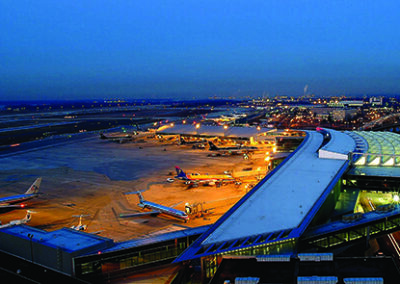
When Louis Armstrong New Orleans International Airport (MSY) officially opened the doors of its new terminal in November 2019, the facility gleamed. The concourses and updated finishes literally transformed the way nearly 25,000 passengers traveled through the airport each day. But shortly after the grand opening, cleaning challenges emerged that threatened the image and reputation of the city's flagship airport.
As the general public continues to shy away from commercial air travel during the ongoing COVID-19 pandemic, airports are finding new ways to keep their important infrastructure improvements on track. Teams supporting projects in Pittsburgh and Puerto Rico, for instance, learned how to keep projects moving during shutdowns in March. Leveraging remote technologies that allowed personnel to work from home proved pivotal in both cases.
As the world's busiest airport, Hartsfield-Jackson Atlanta International (ATL) spans more than 7 million square feet of property. Naturally, it takes a lot of supplies and materials to keep the facilities that large running smoothly. Everything from carpeting and trash cans to paper towels and window cleaner is purchased and used in high volume.
Minneapolis-St. Paul International Airport (MSP) recently completed a roughly $3.5 million project designed to prevent the glycol used to deice planes from potentially seeping into groundwater. By sealing select sections of concrete storm sewers with leak-proof liners, the airport avoided the higher cost and disruption associated with excavating and replacing pipes.
Savvy airport officials know that it makes sense to help senior-level executives improve their leadership skills and broaden their perspectives. Such training helps the executives and airports. Cincinnati/Northern Kentucky International Airport (CVG) put a global spin on its development program by sending one executive to experience life at a European airport and another to observe operations at an Asian airport.
By their very nature, airports require nimble communication teams. One day, it's a routine personnel announcement or upbeat ribbon-cutting ceremony; but the next can bring an all-out media frenzy about COVID-19. The topics airports must address run the gamut, and so do their communication strategies.
When customers roll up to a ticketing counter in a wheelchair or navigate through the concourse tapping a white cane on the floor, airport employees know that they might want extra assistance. It's far more difficult, however, to identify customers with conditions that are less apparent such as learning difficulties, mental health issues or hearing impairments.
Washington, D.C. is experiencing an especially mild winter this year. In fact, it is on track to be the fifth warmest on record for the past 150 years. (Fingers crossed, it doesn't prove to be a jinx.)
Frequent flyers take great pride in their ability to overcome travel hurdles. They have finely honed strategies for moving efficiently through security, managing tight connections and scrambling to book other flights when theirs are delayed or canceled. It's almost a science.
Successful airports tend to operate at peak efficiency when they partner well with the state agency that supports them. This is especially true in Colorado, where the Colorado Department of Transportation (CDOT) Division of Aeronautics offers several programs to help member airports prosper.
When Philadelphia International (PHL) wanted to upgrade its asset management system to a more robust tool, the project team talked with personnel at other airports about their experiences. As the Pennsylvania airport continues to deploy its upgrade, PHL Enterprise Asset Manager Milton Robinson is sharing his department's experience to help other airports reap similar benefits.
Small airports in the northern U.S. share one common trait with huge airports such as Chicago O'Hare and Kennedy International in New York: They have to keep their runways and taxiways clear of snow during winter. Most, however, don't have multimillion-dollar budgets for accomplishing this.