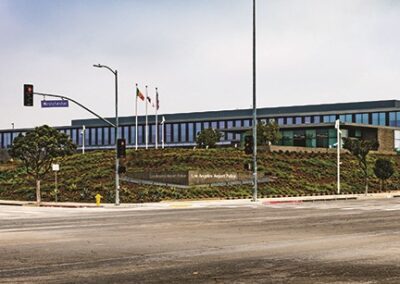
The Los Angeles Airport Police Division (LAXPD) now has a home befitting of its status as the largest airport law enforcement agency in the United States. The 1,100-member department moved into a new $216 million facility on the north side of Los Angeles International Airport (LAX) in fall 2021.
In July, San Diego International Airport (SAN) commemorated the opening of its brand new Airline Support Building. The $49 million project is part of a larger program to enhance overall behind-the-scenes facilities. The purpose-built facility was designed to provide a more efficient approach to cargo operations and consolidate support functions into a single centralized location.
As the last major step of a plan to control its own destiny, Southwest Florida International Airport (RSW) in Fort Myers will soon give FAA the keys to its new $81 million airport traffic control tower. As such, the Lee County Port Authority is the first airport owner/operator to build and equip an FAA control tower without any federal funds.
Construction of the tower is expected to be substantially complete by November, and the FAA is slated to begin installing equipment by January 2022. If all goes according to plan, RSW's new tower will start operating before the end of 2022 with freshly trained staff.
Big changes are underway at Tweed-New Haven Regional Airport (HVN), and even bigger changes are in the works. Current projects include $5.2 million of improvements, most notably the addition of modular buildings to provide space for a 300-seat holdroom and a new ticketing area.
Austin-Bergstrom International (AUS) had expanded its terminal and amenities to accommodate an unprecedented boom in passenger traffic over the past decade. Now, the central Texas airport has also improved its behind-the-scenes operations with a new consolidated maintenance complex.
Early this year, Cincinnati/Northern Kentucky International Airport (CVG) struck a noteworthy deal to manage and operate Miami University Airport (OXD), a quiet general aviation airfield located about an hour north of CVG in Oxford, OH. Per the five-year agreement, CVG will lease OXD for $84,000 per year and take over revenue streams such as aircraft fueling, aircraft parking and hangar rental.
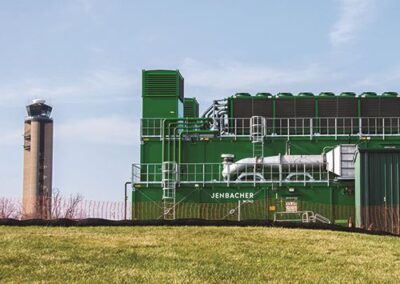
Pittsburgh International Airport (PIT) made history in June when it flipped the switch on its own natural gas and solar energy powered microgrid. In an era when energy resiliency and independence have become a Holy Grail of sorts, PIT is the first airport in the world to be completely powered by its own microgrid. And, it did so at no cost to the airport or local taxpayers.
For years, personnel at Murfreesboro Municipal Airport (MBT) manually tracked aircraft to estimate daily traffic at the central Tennessee airfield. Based on crude visual tallies, MBT officials began this year thinking the general aviation facility logged about 225 operations per day.
The team that maintains the airfield and operates snow removal equipment at Redmond Municipal Airport (RDM) worked out of a 7,000-square-foot building with modest heavy equipment storage bays. Equipment was stored in several different places across the airfield, some outside. That led leaders at the Oregon airport to invest in a larger facility.
Widespread uncertainty was understandable given the unprecedented circumstances presented by the global pandemic. But passenger forecasts impact nearly every area of operations, from parking lot closures and law enforcement schedules to concession hours and capital improvement projects. So Kenneth Strickland pressed on for clearer answers.
Salt Lake City International Airport (SLC) is changing the way people and goods travel through its facilities. A multiphase effort to address its changing operational needs began with an airport redevelopment program that focused on passenger flow, and a $5.6 million Central Receiving and Distribution Center (CRDC) that opened last August.
Until recently, the common-use gates at Eisenhower National Airport (ICT) were a bit like Wichita's version of the Wild West. The system worked fine when gates were, in fact, open. But when two different airlines wanted to use the same gate, there was no clear way of deciding which had priority.