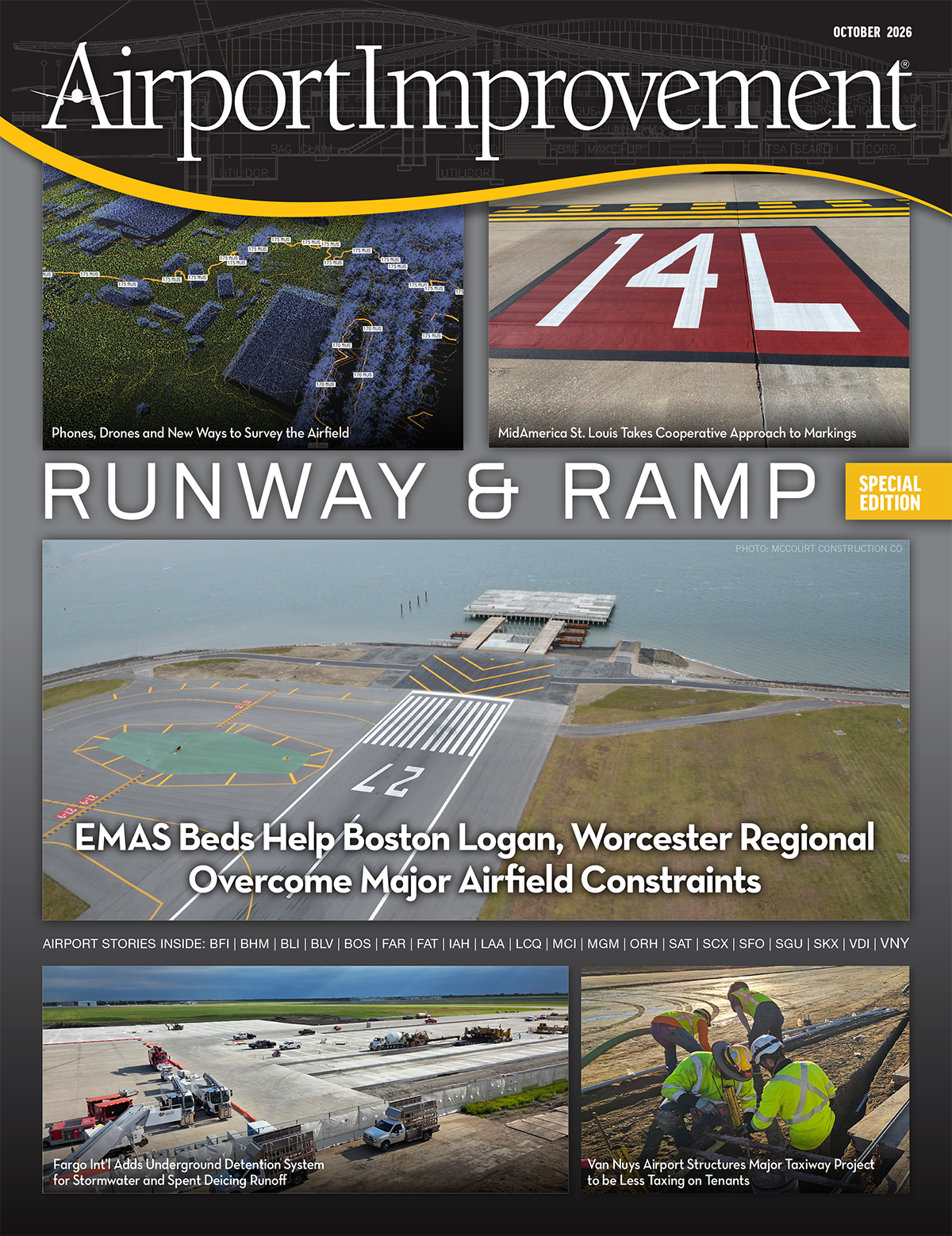
Engineered material arresting systems (EMAS) are a lot like pepper spray and fire extinguishers. You fervently want them to remain untouched, but having one at the ready is simply the smart choice in certain places.
 Over the last two years, Massachusetts Port Authority (Massport) has invested more than $123 million in EMAS beds at two of the airports it owns and manages—Boston Logan International (BOS) and Worcester Regional (ORH). The swaths of crushable material provide pilots a way to decelerate aircraft if they overshoot select runways.
“I hope we never have to use them,” says Sarah Dennechuck, deputy director of Airport Projects for Massport.
That sentiment was underscored last fall, shortly after EMAS beds were replaced at ORH and another replacement project was barely underway at BOS.
Not 24 hours into construction at BOS, Dennechuck and other Massport officials received news that EMAS beds had safely stopped business jets in runway excursions at Chicago Executive Airport in Wheeling, IL, and Boca Raton Airport in Florida on the very same day (Sept. 3, 2025). Three weeks later, a similar incident occurred with a United Express aircraft at Roanoke-Blacksburg Regional Airport in Virginia. All three of the runway excursions occurred after landings, and none involved reports of serious injuries.
| facts&figures
Project: Installing Engineered Mmaterial Arresting System (EMAS) Beds Location: Boston Logan Int’l Airport Project Scope: Installing EMAS bed at 27 end of Runway 9-27, atop 650-ft.-long deck over Boston Harbor Cost: $110 million Funding: 75% FAA Bipartisan Infrastructure Law Airport Infrastructure Grant & Airport Improvement Program grants; 25% airport capital funds Construction: Began Sept. 2025, expected to end Nov. 2026 Associated Runway Closures: Sept.-Dec. 2025; Aug. 31-Nov. 2026 EMAS Manufacturer & Supplier: Runway Safe Environmental Consultant & Owner’s Rep: WSP General Contractor: McCourt Construction Co. Civil Contractors: J.F. White; Jacobs Environmental & Noise Subconsultant: HMMH Airfield Engineering & Construction Management Subconsultant: Orion Engineers & Associates Key Benefit: Added safety in cases of runway excursions Location: Worcester Regional Airport, in MA 2025 Aircraft Operations: 30,310 Commercial Airlines: 3 Project Scope: Replace EMAS beds at either end of Runway 11-29 Costs: $5.1 million in 2024; $8.18 million in 2025 Funding: 90% by FAA Bipartisan Infrastructure Law Airport Infrastructure Grant & Airport Improvement Program grants Construction: Sept. 2024–Sept. 2025 EMAS Manufacturer & Supplier: Runway Safe General Contractors: The Dow Company (2024); J.H. Lynch & Sons (2025) Airfield Engineering & Construction Management Subconsultants: HNTB Corporation (2024); Atkins Realis (2025) Key Benefit: Added safety in cases of runway excursions |
Timely reminders aside, Massport has an established history of using EMAS when water or natural terrain doesn’t allow for the extra safety area that FAA requires beyond runway ends. In fact, it was among the early adopters, installing BOS’ first EMAS in 2005, and ORH’s in 2009.
But Massport is not alone. FAA data indicates that 14% of commercial U.S. airports have EMAS. Collectively, the 122 beds at these 70 airports have stopped about 26 runway excursion incidents without injuries since 1996, when the first commercial EMAS was installed.
The beds at BOS and ORH are EMASMAX® from Runway Safe, the only FAA-approved manufacturer of such products. The system is comprised of cellular cement blocks that crush when an aircraft rolls over them, safely decelerating the aircraft in a predictable manner. Blocks are secured together to form a bed that is sized to each site and the mix of aircraft using that particular runway. Trip Thomas, commercial director for Runway Safe, says the material has a performance lifespan of 20 years with proper maintenance.
Bed on a Deck
With six runways, more than 407,000 annual operations and an airfield surrounded by the waters of Boston Harbor on three sides, BOS could very well be the poster child for EMAS. Runways 15R and 4L each received a bed in 2005 and 2006, respectively; and both were later replaced with newer versions.
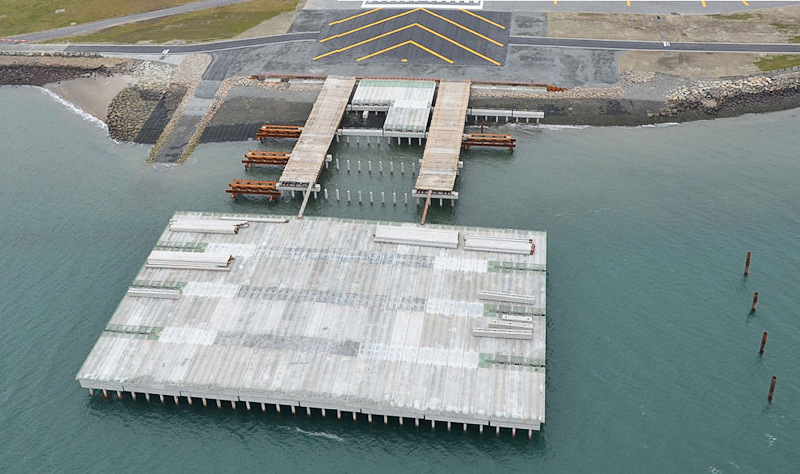
The current $110 million project, scheduled to be finished before the upcoming Thanksgiving travel surge, is adding a 4,000-block EMAS bed at the 27 end of Runway 9-27. First, however, crews had to build a 650-foot-long deck/pier to accommodate the new safety feature.
Engineering firm WSP provided a diverse slate of services for the design/build project, including environmental compliance, stakeholder coordination and creating the final environmental impact report. It also served as the owner’s representative, managing the construction schedule, budgeting process and quality control for Massport.
Amanda DeCesare, senior vice president and national aviation design director for WSP, emphasizes that work in the harbor had to meet comprehensive environmental rules while at the same time, work on land had to be planned and implemented to minimize operational disruptions at the complex, space-constrained airport with 45 commercial carriers.
“From a construction standpoint, the project presented an equally challenging balancing act,” says DeCesare.
The imposing 650-foot-long deck/pier points east, with 450 feet of it extending over a section of Boston Harbor called Winthrop Inlet. The easternmost edge of the deck is about 1,500 feet from Coughlin Park, a near point on the opposite side of the inlet. The section built on land, where the new EMAS bed abuts the runway, is 350 feet wide, but the portion over water narrows to 306 feet. The design provides ample safety for aircraft but reduced the number of piles needed to support the structure and decreased the environmental impacts of installing them, explains DeCesare.
Crews drove 308 precast concrete piles down into bedrock, with 34 placed at precise angles to brace the structure. Concrete panels laid on top of cap beams form the floor of the deck. The concrete piles, which average about 120 feet long, were transported to the worksite via barge to streamline delivery and keep heavy vehicles off area roads.
The deck is “pretty unique,” Dennechuck says. “People may equate it with a bridge deck, but it’s meant to support aircraft, so that’s the difference.”
Construction required two 75-day runway closures. The first spanned September to December 2025. The second began Aug. 31, 2026, and is expected to last until November 2026. Some flights were rerouted during the closures. In the interim, BOS has used runway length and landing distance declarations to govern aircraft operations and meet FAA safety requirements.
Fully 75% of the $110 million project is being funded by an FAA Bipartisan Infrastructure Law Airport Infrastructure Grant and Airport Improvement Program grants. Airport capital funds are covering the remaining 25% of the cost.
A similar deck structure was created for Runway 33L in 2012, when Massport completed a $63 million project to replace that runway’s original EMAS. At 470 feet long and 300 feet wide, its deck is slightly longer and of uniform width.
Worcester Regional
While water is the constraining issue at BOS, steep slopes around the airfield are the challenge for ORH, its smaller commercial cousin about 50 miles to the west. Last year, ORH logged 30,310 aircraft operations on its two runways, one of which requires EMAS beds on both ends.
In 2024, Massport replaced the existing bed on the 29 (departure) end of Runway 11-29 for $5.1 million, and did the same on the opposite end last year for $8.18 million. Each project was funded at 90% by an FAA Bipartisan Infrastructure Law Airport Infrastructure Grant and Airport Improvement Program grants.
Although the original beds installed in 2009 hadn’t completely “aged out,” Massport opted to replace them while the runway was already going to be shut down for repaving, grooving and lighting upgrades—work that would have required crews to pry up the existing EMAS anyway.
The timing also allowed for reconfiguration to match ORH’s current airfield traffic. Thomas notes that EMAS beds are designed in part for the specific aircraft that use a particular runway, and fleet mixes change over time. Like many airports, ORH has accommodated larger aircraft during the past few years. In simplistic terms, bigger planes need bigger beds.
As Thomas explains, “The first choice of the FAA is to see a 70-knot system installed. However, in many cases the runway safety area is not long enough to accommodate a full 70-knot EMAS. Under these situations the runway safety area is ‘filled’ with EMAS (install the largest bed possible) to maximum performance (arresting ability). The minimum performance EMAS the FAA will accept is 40 knots”—that is, the ability to safely stop an aircraft rolling into it at that speed—to provide the equivalent protection of a 1,000-foot-long runway safety area. As the fleet mix changes on a runway, “there may be a loss of performance because the aircraft got bigger,” he adds.
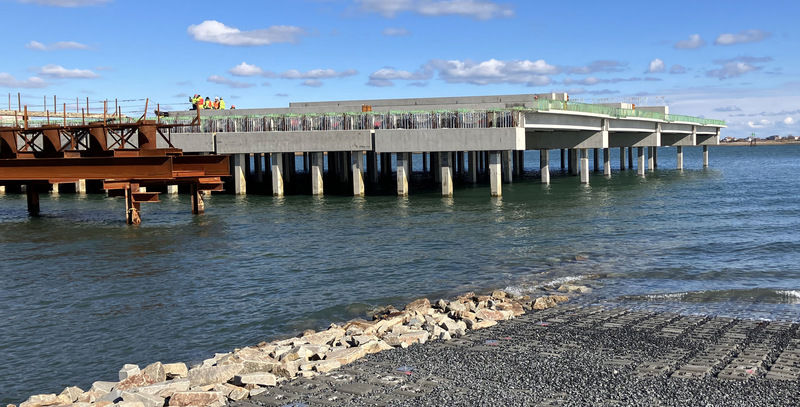
The new EMAS at Boston Logan sits atop a 650-foot-long pier.
Performance and longevity can also be affected by how an EMAS is maintained. Thomas recommends regular monitoring and testing as well as sealing seams and applying new paint when needed. Protecting the beds from mowers and snowplows is also important, he adds.
Más EMAS
Looking ahead, Massport is planning to install an EMAS bed at Laurence G. Hanscom Field, the general aviation airport in its network. Work at the end of Runway 5 is scheduled to begin by early next summer.
 Chris Conley, WSP project manager for the work at BOS, notes that Massport’s recent and future EMAS installations speak to the ways runway projects are changing. “One of the strongest trends we’re seeing is airports continuing to comply with FAA standards while also enhancing overall airfield resiliency,” says Conley. “Many airports, particularly legacy facilities, face physical constraints that make traditional runway safety area improvements difficult. As a result, owners are increasingly evaluating innovative solutions such as EMAS where extending the runway safety area isn’t practical.”
Thomas reports that Runway Safe regularly fields inquiries from officials at mid- to large-size general aviation airports that are handling more traffic, including business jets. Beyond enhancing safety, another prevalent interest is “maintaining or growing the performance of their runway, which allows them to get larger aircraft and more operations” as well as enabling larger fuel loads that, in turn, foster more destinations. “It’s about growing service inside of regulations and the space an airport has,” he summarizes.
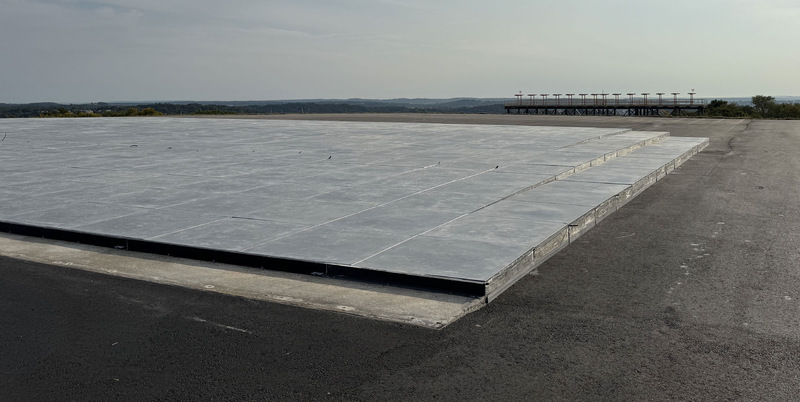
Worcester Regional replaced two EMAS beds from 2009 while Runway 11-29 was shut down for repaving and other work.
Addressing the issue of price, Thomas points out that both of the replacement EMAS beds at ORH, the BOS deck bed, and the bed scheduled for Hanscom Field together cost around $23 million—slightly less than 20% of the total cost for the runway projects.
 DeCesare, from WSP, encourages airport operators to fully understand the physical constraints of their airfield, including available land, surrounding development, property boundaries, terrain and environmental considerations. “Those factors often determine whether a standard runway safety area extension is feasible or whether EMAS is the more practical solution,” she explains.
“Whenever practical, airports should first evaluate whether the runway safety area can be extended to meet FAA standards,” DeCesare advises. “If site constraints make that impossible, EMAS provides a proven alternative that can deliver the required level of safety without significantly impacting airport operations. Early coordination with the FAA, airport stakeholders and environmental agencies is also critical to identifying the most cost-effective and constructible solution.”
Conley adds that runway projects “are becoming increasingly multidisciplinary, requiring engineers to integrate safety, resilience, environmental considerations and constructability into a single solution that supports both current operations and the airport’s long-term vision.”
For Dennechuck, EMAS projects boil down to operational safety. “To me, they are a way to keep passengers safe,” she says. “They save lives. They’re important.”