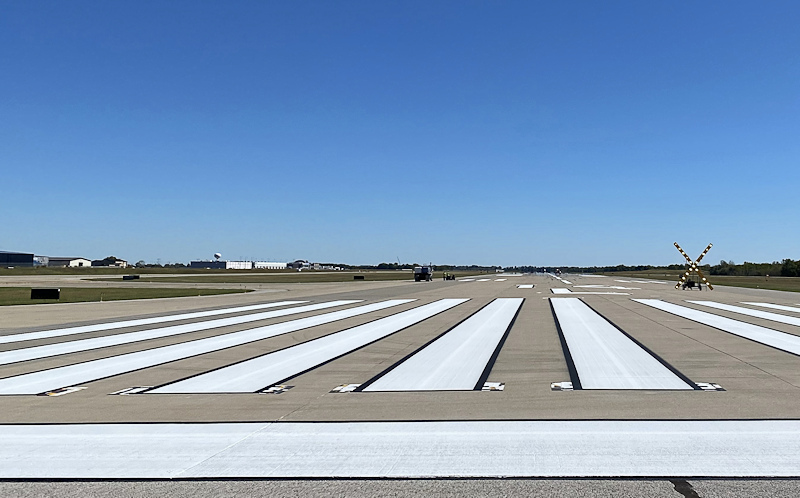
Between commercial traffic from Allegiant Air and military support missions from Scott Air Force Base, MidAmerica St. Louis Airport (BLV) logs about 18,000 aircraft operations per year. And it handles them all with a staff of 21 employees, including part-timers. That math, along with the nature of its traffic and an emphasis on safety, prompts BLV to outsource daily airfield inspections and markings maintenance to outside contractors.
This year, the budget for those line items is $250,000, including rubber removal, which accounts for a significant portion of the expenses.
Some practices are different at BLV because it is one of only 21 joint-use airports in the United States. The military owns its side of the airfield (including Runway14R-32L), St. Clair County owns the civilian side (including Runway 14L-32R), and the two are connected by a 7,000-foot taxiway. Snow removal duties are shared, with the military often using the longer 10,000-foot commercial runway when winter weather is a limiting factor.
| facts&figures
Project: Airfield Markings Assessment & Maintenance Location: MidAmerica St. Louis Airport, in Mascoutah, IL Airport Owners: St. Clair County, IL; U.S. Dept. of Defense Key Benefits: Joint-use airport saved time, money & staff hours by using cooperative purchasing contract for airfield marking assessment & maintenance; using separate contractors for assessment & maintenance validated previous strategy/work 2026 Markings Budget: $250,000 Scope of Assessment: Runway 14L-32R (10,000 ft. x 150 ft.) & 3 associated taxiways Assessment Timeline: 2 days in Oct. 2025 Maintenance & Remediation: About 10 days in Sept. 2026 Rubber Removal: 300,000 sq. ft. Surface Prep: 260,000 sq. ft. of cleaning; 8,000 sq. ft. of markings removal New Painted Markings: 42,000 sq. ft. (330 gals. of paint) Other Elements: Surface-painted holding position sign; preformed thermoplastic markings at Taxiway G Daily Inspections: Avports Assessment Contractor: Sightline Inc. Maintenance Services Contractor: Hi-Lite Airfield Services LLC Cooperative Purchasing Entity: Sourcewell Preformed Thermoplastic Markings: PPG/AirMark Maintenance Reporting Software: Veoci; ManagerPlus Annual Aircraft Operations: About 18,000 Tenants: Allegiant Air & 6 others |
“It is definitely a symbiotic relationship,” says Airport Director Darren James, a retired U.S. Air Force member who spent years at Scott. “And each entity is responsible for its own infrastructure.”
Fixed-base operator services for BLV’s limited general aviation activity are provided by Alliance Ground International, which also supports Allegiant Air. Civilian tenants include a produce company with a 56,000-square-foot cold storage warehouse on the cargo apron of Runway 14L-32R. Avports is both a tenant and the third-party contractor responsible for conducting daily airfield inspections and providing aircraft rescue and firefighting (ARFF) services.
“Our staff is very small, [but] I do have an Airport Operations Specialist,” says James. Still, he sometimes has to leverage employees in other positions for extra hands on the airfield. Fortunately, the entire team is qualified to assist because they have all “grown up in the operations world,” he explains.
Given this dynamic, it takes extra time to hire, onboard and train new employees; and James focuses on eliminating turnover. Staffing is extra challenging for Avports because its employees need both airfield inspection and ARFF credentials.
Although BLV maintenance employees periodically perform markings maintenance, rubber removal and some cleaning, the airport hires a third-party contractor for more robust maintenance about every other year. “We don’t have a water blasting truck, so we do what we can with the equipment we have,” says James, noting that crews use snow brooms for cleaning and light rubber removal. The airport also owns and operates striping machines.
In-House Oversight
BLV Director of Engineering and Planning Dan Trapp focuses on making sure markings comply with FAA standards regarding visibility, reflectivity, color, coverage, contamination, rubber buildup, peeling paint and surface wear. Trapp also monitors factors that contribute to wear and deterioration such as weather, snow removal equipment/chemicals and the frequent removal of rubber that aircraft tires leave behind when braking during landings.
The airport and Avports use the Veoci platform to document airfield inspections, assess operational impacts, generate reports and track Part 139 compliance; while maintenance personnel use ManagerPlus for generating and administering work orders. The challenge is that the two systems do not “talk” to each other, which requires reporting in two separate places. James and his team are currently seeking a better strategy to improve efficiency.
Time for Maintenance
Late this summer, Hi-Lite Airfield Services spent about 10 days cleaning and maintaining BLV’s airfield markings, with up to a dozen crewmembers on site from its water blasting, paint and thermoplastic divisions. Overall, the job was similar to work the company performed in October 2024. This time, however, another firm conducted the preliminary markings assessment to determine what work would be performed.
While Hi-Lite and other maintenance providers often conduct their own assessments, some airports prefer to hire a neutral third-party contractor to establish the subsequent work scope. Hi-Lite Vice President of Business Development and Marketing P.J. Mills recommended Sightline Inc. to perform the assessment at BLV this year, based on his extensive experience with the company.
“Our primary goals are to identify markings that require maintenance, and perhaps more importantly, markings that are in good shape,” explains Sightline President Mike Speidel, who has been in the airfield markings industry for more than 20 years. Airports that hire separate companies for assessment and maintenance often spend less time and money to maintain markings, he adds.
In October 2025, the Sightline team spent two days at BLV, evaluating the airfield and collecting data to help determine the scope of work for the following year.
“The assessment is basically a needs analysis,” Speidel explains. “We essentially helped prioritize the activities and were able to tell the airport what they didn’t have to paint.”
Sightline crews focused on movement areas—mainly runways and taxiways, which are the FAA’s primary inspection areas. The team conducted condition assessments to evaluate visibility, reflectivity, durability and compliance with FAA/UFGS/ICAO standards. That data helped determine which markings were high priorities for cleaning or replacement, and which could be deferred until the next cycle. Speidel notes that he writes prescriptive maintenance plans as if it were for his own airport.
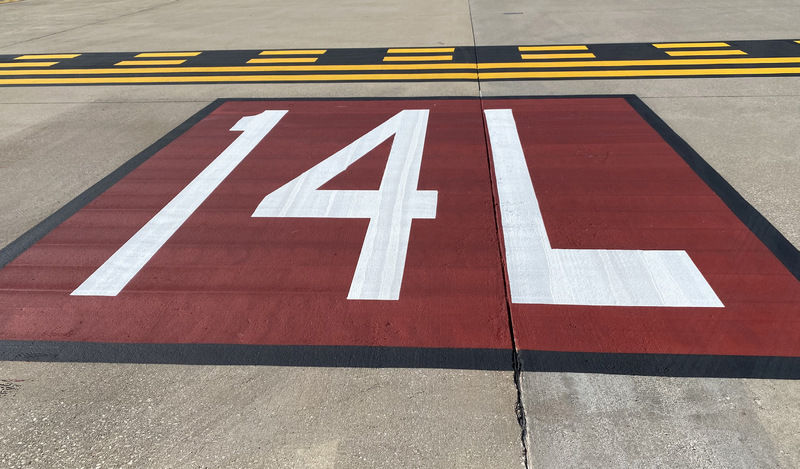
Hi-Lite’s marking services include surface painted holding position signs.
The Results
The follow-up report BLV received contained good news—one of the best ratings Sightline has ever recorded. “We try to do a good job, but we didn’t realize our markings were that great,” Trapp says.
 The assessment highlighted a few issues, but deemed the large majority of markings to be in very good condition—”relatively excellent among all of the markings that we look at,” says Speidel. Trapp interprets the results to mean Hi-Lite’s former services and BLV’s ongoing maintenance held up well.
For most markings, Sightline recommended cleaning rather than more significant maintenance. “Instead of spending the time and money to repaint everything, BLV can redirect their resources to more critical needs,” Speidel explains.
“We recommended some removal in one problem spot on taxiway L with adhesion issues—about 10,000 square feet of removal and cleaning and replacing,” he details. Overall, Sightline’s plan included $12,000 of removal over the next couple of years, about $130,000 of cleaning, and $40,000 to $50,000 in painting over the next two years.

“If you were to take that cleaning number [$130,000] and turn it into repainting, that would be about $500,000,” Speidel advises.
 Hi-Lite Business Development Manager Kenny Gregson notes that BLV chose to do exactly what Sightline recommended. “This is a two-year phased project with three areas of priority,” he relates. The top two priority portions, completed this year, mainly included cleaning and rubber removal on Runway 14L-32R and taxiways G, K and L. The specific breakdown of work was rubber removal on 300,000 sq. ft.; cleaning/surface prep on 260,000 sq. ft.; marking removal on just 8,000 sq. ft.; painting 42,000 sq. ft.; and adding a surface-painted holding position sign and preformed thermoplastic markings at Taxiway G.
Pre-Solicited Contracts
Trapp notes that working through a cooperative purchasing organization made BLV’s recent markings project possible because it streamlined the traditional three-bid process and saved time and money by combining the initial assessment and subsequent maintenance work into one contract.
Sourcewell, a government agency, provides access to competitively solicited contracts, but the purchasing decisions and transactions occur directly between the participating airports and suppliers. For BLV, this helped simplify procurement while maintaining transparency and compliance with local solicitations requirements. (For more information about Sourcewell, see the Nov/Dec 2023 issue of Airport Improvement magazine.)
 “We are seeing sustained growth in airport engagement, with more airports proactively reaching out to Sourcewell as they seek solutions for evolving operational and infrastructure needs,” says Director of Cooperative Contracts – Construction Equipment, Roads and Airports Kelly McAllister. While runway work and airside equipment remain top purchases, he reports that more airports are exploring contracts for construction equipment, HVAC and other facility systems, information technology systems, flooring, vehicles, office equipment and other categories. For Sourcewell, this broader interest reflects the wide range of functions required to operate a modern airport. Cooperative purchasing can help airports find/purchase/implement solutions more efficiently by jumpstarting the procurement process with access to competitively solicited contracts, McAllister summarizes.
He encourages airports to check sourcewell-mn.gov/lookup to see if they are already registered with Sourcewell. Those that are can explore available contracts. Those that aren’t can find information about the process.
 This year was the third time BLV has used Sourcewell to hire Hi-Lite for markings maintenance. Mills describes the alternative contracting vehicle as instrumental in the partnership between the airport and Hi-Lite, and now Sightline. “They were able to combine it all and build out a really custom scope of work to get their assessment and work done within the budget over the course of two years,” he says.
Gregson says Hi-Lite’s contract through Sourcewell allows airports better pricing because three or four jobs can be done in one trip versus putting individual components out for separate bids.
Working the Plan
The cooperative purchasing process did more than provide a roadmap for current and future projects; it also cemented vendor relationships. “Having that assessment that gave us such high marks was definitely reassuring and definitely assured us to stay with that contractor,” says Trapp.
Speidel commends BLV for its “assessment first” strategy to determine specifically which markings needed maintenance. Repainting indiscriminately can eventually take them outside tolerance criteria, he notes.
As a Sourcewell awarded supplier, Hi-Lite works to be considered a project partner rather than a contractor. “We want to save airports time and money”, says Mills. “We want to keep you compliant.”
 From the airport’s perspective, James and Trapp say their experience with cooperative purchasing for airfield markings work has been positive. The Sightline assessment reinforced confidence in the quality of Hi-Lite’s work, and Sourcewell’s alignment with BLV’s procurement requirements makes it easier to continue partnering with them for future projects.
“When you find a good team, as long as they continue to perform at the same level, you’re going to leverage that as long as you can,” says James.
Mills encourages other airports to follow BLV’s lead and not to wait until just before their annual Part 139 inspection to review airfield markings because there might not be time for needed maintenance.
“Proactive maintenance is always cheaper in the long run than reactive maintenance,” he emphasizes.
Positive Culture ShiftAirfield maintenance staffers at MidAmerica St. Louis Airport (BLV) receive a combination of annual Part 139 training and on-the-job instruction, including how to use the airport’s equipment for cleaning airfield markings. Airport Director Darren James emphasizes ongoing training and development to ensure employee practices support continued compliance with FAA requirements.
Sightline Inc. President Mike Speidel agrees that many airports have improved staff training over the past 15 years, partly due to improved FAA guidance. More airports are also using performance data to develop proactive maintenance plans rather than repainting everything prior to FAA inspections, he adds. Speidel cites the Airfield Marking Handbook as a key factor for the changing culture. The free industry resource was originally published in 2008 by the Innovative Pavement Research Foundation, under a cooperative research agreement with the FAA. Sightline led the research and served as the primary author. “I think 20 or 30 years ago, management felt anyone could go out and throw down some paint,” says Speidel. “But airfield marking requires specialized knowledge to do it the right way the first time.” Airfield Marking Professional training stresses that proper cleaning and surface preparation are essential for adhesion, longevity and durability. “If you go too fast or you don’t prepare the surface, [the marking] is not going to last,” he advises. Of course, regulatory compliance is also an issue. According to Speidel, airfield markings remain among the most frequently cited Part 139 discrepancies. |
 Some other airports, however, operate with a “just do it the way we’ve always done it” mindset, repeating the same practices year after year. Fortunately, leaders from Hi-Lite Airfield Services see this changing; and they credit improved training about the installation and maintenance of high-quality markings, including Sightline’s Airfield Marking Professional certification program and symposiums.